
Income funds are a popular choice – how are they changing?
Sunday, May 3, 2026
Eve Maddock-Jones
Funds and Investment Trust Writer
Related news
Income funds are consistently popular among DIY-retail investors, and even the disruption markets saw during the first three months of the year failed to dampen investor appetite for some of the biggest income funds.
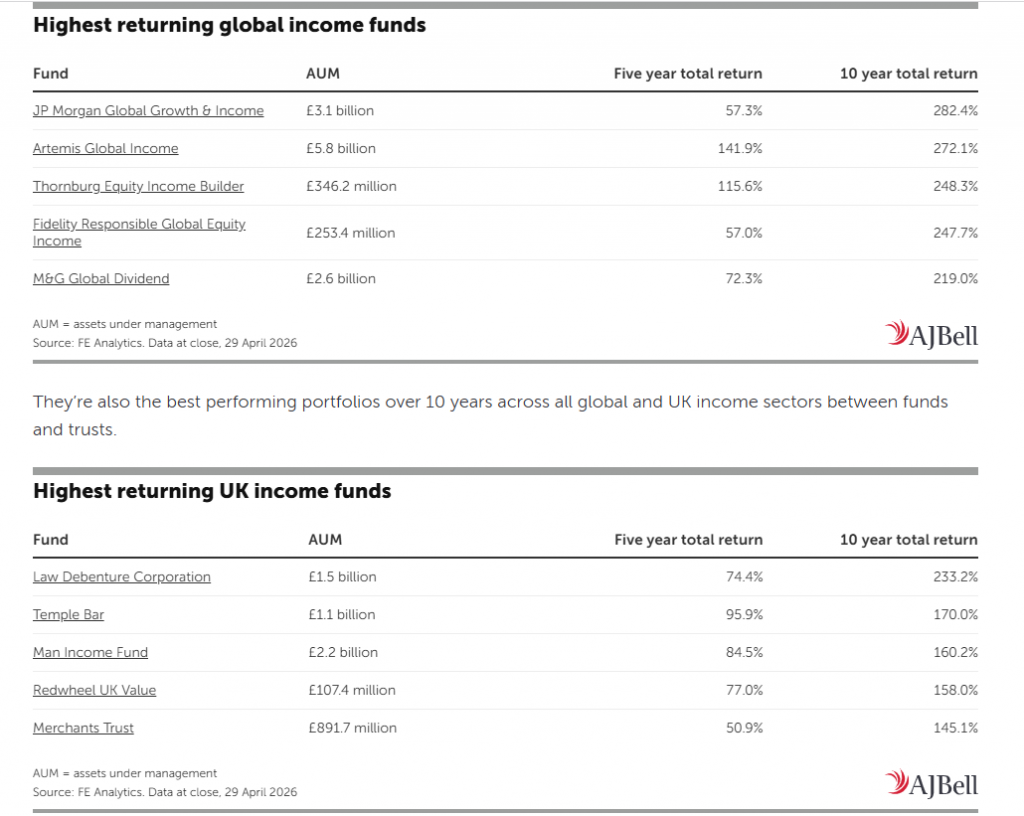
Among AJ Bell customers since the start of the year, the JPMorgan Global Growth & Income trust and Artemis Global Income funds were among the 25 most popular investments.
What is an income fund?
As their name suggests, this type of fund used to generate income for investors, which makes them popular for people like retirees looking to cover regular expenses in the absence of a monthly pay pack. Investors might also use them to cover regular bills or help with school fees.
The UK is a hub within the income space because of its large number of dividend-paying companies. A dividend is what creates the ‘income’ payout for investors. It’s derived from companies opting to pay out some of their profits to shareholders rather than reinvest the cash for growth.
Big US firms such as Apple, Nvidia or Meta do offer dividends but, they tend to be much smaller, ranging from 0.02% to 0.4% yield – this being the financial measure showing how much a company pays out in dividends each year relative to its share price. These firms prioritise reinvesting their profits for growth to create higher stock market returns.
Income funds having to think smarter about how they pay a consistent dividend
While income funds have been a consistently popular buy for retail investors, the sector as has seen a significant change under the bonnet in the past six years.
Prior to 2020, the major dividend paying stocks were well established, allowing the funds buying them to offer fairly consistent income payments to investors.
But when the pandemic and global shut down hit, many firms halted dividend payments for the first time in decades to keep more cash on hand for whatever unknown challenges appeared.
The European Central Bank directly asked banks to cease paying out dividends or buying back shares for around seven months to maintain lending capacity.
The pandemic caused $220 billion of global dividends cuts in 2020, a 12.2% decline with the severe cuts coming from key markets such as the UK and Europe, research by Janus Henderson found.
New research by Peel Hunt found that since the troughs of the Covid-19 pandemic, UK equity dividend payouts have improved significantly “however, the ways in which companies return capital to shareholders have shifted”, as firms prioritise share buybacks to try and bolster their valuations.
The proportion of large UK companies that have bought back at least 1% of their shares over a 12-month period has increased from c.6% in mid-2020 to c.55% at end-2025, outpacing the US, Japan, and Europe. It appears that UK buybacks have peaked, and companies are more focused on growth opportunities and/or balance sheet strength,” Peel Hunt said.
This shift away from dividends for companies has meant that many fund managers will need to broaden the sectors they invest in to keep up their income payments to investors, often looking away from the UK.
Both the JGGI and global Artemis fund mentioned above use their ability to invest in any market to full effect and actually have very little in the UK, between 2-5% of their portfolios.
These are two of the biggest portfolios of this ilk on the market, at £3.1 billion and nearly £6 billion, respectively.
They’re also the best performing portfolios over 10 years across all global and UK income sectors between funds and trusts.
For those that are looking to stick solely to the UK, Law Debenture tops the 10-year performance data, followed by Temple Bar and Man Income.
Temple Bar recently made a flurry of new additions to their portfolio that boast strong dividends, including B&M European Value Retail, Land Securities and Kraft Heinz.
Kraft Heinz welcomed its new CEO at the start of the year and “reset the strategy” while still offering a yield close to 7%.
But still, among other long-term holdings, dividends were challenged, reflecting Peel Hunt’s broader point that income seekers were having to take a broad view to find opportunities.

You do not need to take high risks with your hard earned.
For those that are looking to stick solely to the UK, Law Debenture tops the 10-year performance data


Become a member of the club, when markets are rising you can take out your profits from your Snowball and re-invest into some higher yielding shares.

When markets are falling or going sideways, re-invest those dividends into your Snowball, where you will get more shares for your money at a higher yield.
Along with fellow members of the club you will be pleased that prices are falling where 90% of non club members will get more worried as each day passes.

Leave a Reply