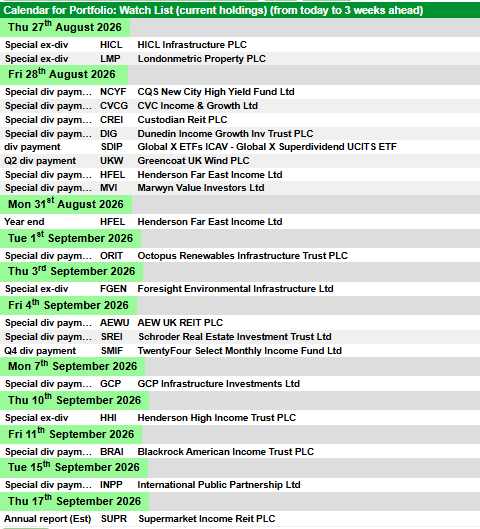

Investment Trust Dividends

Story by Alan Oscroft
What are the traits needed to maximise our chances of building a long-term passive income? I’ve been checking on Stocks and Shares ISA millionaires at the UK’s biggest investing platforms.
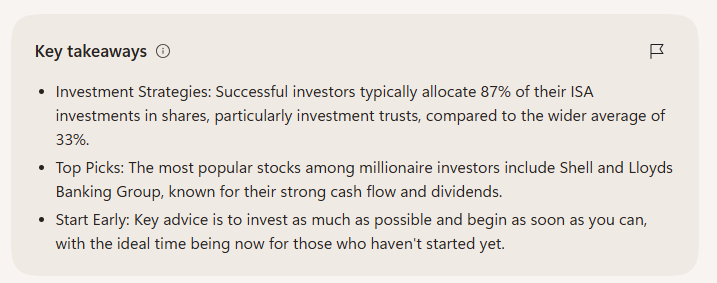
At AJ Bell (LSE: AJB), millionaire ISA holders have 87% of their investments in shares, on average, including investment trusts. The average across other ISA accounts is just 33%.
Barclays conducts annual surveys — and has found the UK stock market easily beating cash savings and bonds for well over a century. And these ISA millionaires are the evidence of the success it can bring.
What about investment trusts? They’re companies that spread investors’ cash over a range of stocks and provide much-needed diversification. Some investment companies handle client funds while having owners’ profits to prioritise. But we buy shares directly in an investment trust — so were the owners.
Other ISA providers, like Hargreaves Lansdown, also find their ISA millionaires put more into investment trusts and individual shares than the wider UK average.
But which actual shares do the UK’s most successful investors go for? Remember, they’ve achieved millionaire status by investing a maximum of £20,000 a year — and less in earlier years. So are they great at spotting the next big winner?
It doesn’t look like it. AJ Bell’s two most popular picks among millionaires this year are Shell and Lloyds Banking Group. And it was the same two last year.
They’re mature companies with track records of strong cash flow and progressive dividends. Dividends aren’t guaranteed, and sometimes they can be cut. But over the long run they can make quite a difference, especially if we buy more shares with them to compound our returns.

Aviva, GSK and BP make up the rest of the top five for the two years — though in different orders. And it strikes me that these all have good defensive moats, in businesses where newcomers would face a very tough task trying to muscle in.
The other key millionaire investor secrets might seem obvious. Invest as much as we can, and get started as soon as we can.
Only individuals can work out what they can afford. But for those who haven’t started yet… the ideal time is surely now.
The post Learn the habits of the UK’s most successful passive income investors appeared first on The Motley Fool UK.

You want to include America in your Snowball.
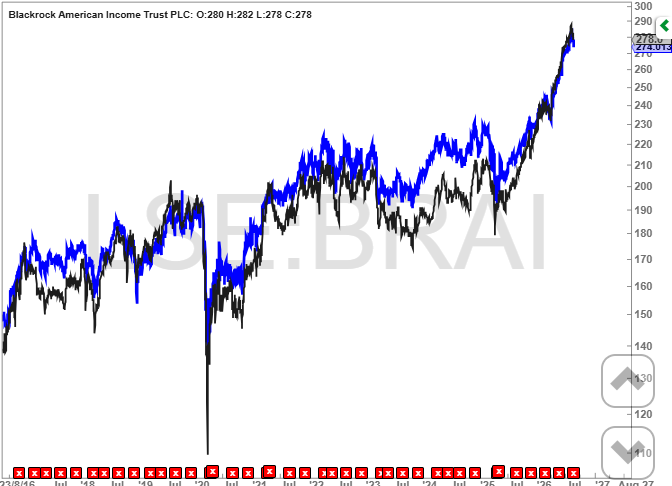
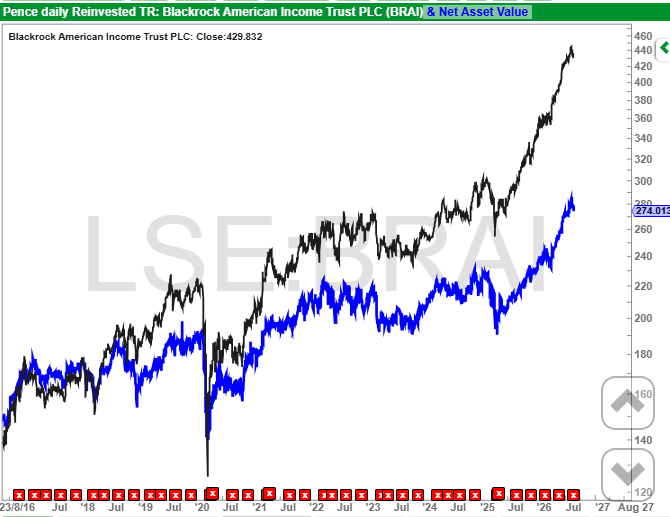
There has been years of under performance but you note the recent performance.

You decided not to risk anymore seed capital but simply re-invest the earned dividends back into the Trust. Anyone who bought near to the covid low around 120p and re-invested the dividends has done extremely well, for sitting.
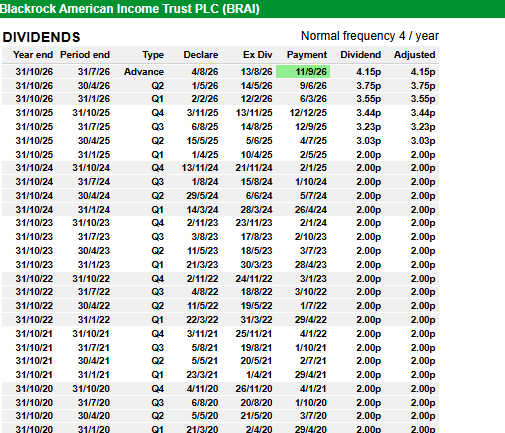
ANNOUNCEMENT OF QUARTERLY INTERIM DIVIDEND
3 August 2026
The Board of BlackRock American Income Trust plc is pleased to announce the third quarterly interim dividend in respect of the financial year ended 31 October 2026 of 4.15 pence per ordinary share. The dividend is payable on 11 September 2026 > to holders of ordinary shares on the register at the close of business on 14 August 2026 (ex-dividend date is 13 August 2026). The quarterly dividend has been calculated based on 1.5% of the Company’s NAV at close of business on 31 July 2026 (being the last business day of the calendar quarter) which was 276.96 pence per ordinary share.

BRAI now pays a yield of 6% of NAV, from income and capital. If/when the NAV falls the dividend will follow but in the long term it should be a gently rising yield.
Saturday, August 22, 2026
Funds and Investment Trust Writer

The US stock market has more exchange-traded funds (ETFs) covering it than any other and among AJ Bell DIY investors, two of the most popular options are the Vanguard S&P 500 vs Invesco EQQQ NASDAQ-100.
The Vanguard fund is the most widely held ETF among AJ Bell investors, period, meanwhile the Invesco fund is the seventh most popular.
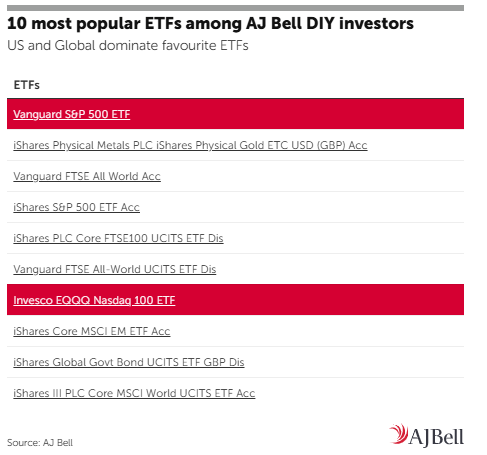
AJ Bell previously looked into the differences between the most popular ETF and tracker funds covering US equities, which included both these names, but comparing two of the most in-demand names head-to-head is a useful exercise.
The first ETF was launched back in 1990 in Canada covering 35 stocks on the Toronto Exchange. The first US ETF debuted three years later, covering the S&P 500. Today, there are more ETFs listed in the US than there are individual stocks, so ravenous have investors been for these types of product and, increasingly, that has extended to the UK too.
Calastone has been tracking the fund flows of UK investor’s capital since 2018 and one of the most persistent themes is that while money is often being moved out of markets and sectors such as the UK or fixed income, investors continue to move into the US, and they are doing so via passives more and more.
Looking at the most widely held ETF table above, you’ll notice that there’re some other US-focused ETFs ahead of the Invesco name, specifically the iShares S&P 500 ETF. The reason we’re not using this in the comparison is that it tracks the same underlying benchmark as the Vanguard fund: the S&P 500. Though there will be differences between the two, they are likely to be modest.
The Invesco fund instead tracks the Nasdaq 100 and this is the key difference when picking one or the other because it has a big impact on your total returns, and how well diversified your portfolio ends up being.
The S&P 500, and therefore the Vanguard fund, is the more diverse of the two as it covers the 500 largest US-listed stocks.
Because this index covers such a large swathe of the equity market it’s used as the main benchmark for the US stock market.
The Nasdaq is the main listing venue for tech companies in the US and the Nasdaq 100 contains the largest companies on that market.
While both feature the likes of Apple, Nvidia and Alphabet, the Nasdaq excludes sectors like financials, so Warren Buffett’s Berkshire Hathaway and JPMorgan Chase, which feature in the S&P 500’s top 10, are nowhere to be seen in the Nasdaq 100.
These differences inevitably have a sizeable impact on the indices’ returns, and the funds that track them. This has been largely to the benefit of the Nasdaq over the last decade or so as US tech stocks have dominated markets during that time. But in recent months, when the AI-spending story has become a source of market concern, the S&P 500 has fared better.
Over 10 years, the Nasdaq 100 has a total return nearly double that of the S&P 500.
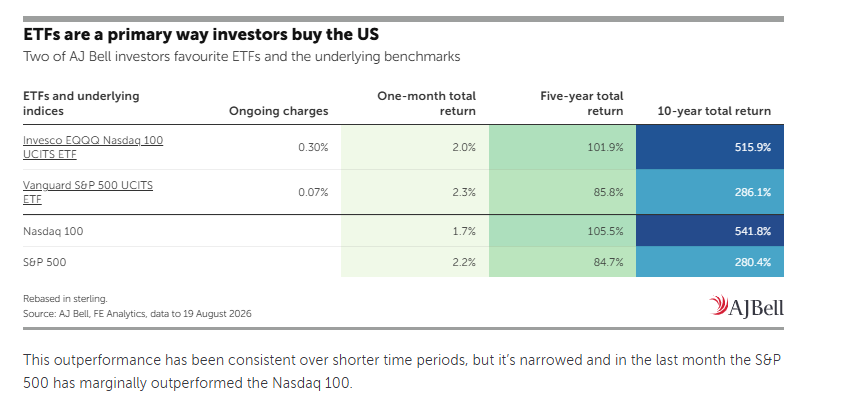
This outperformance has been consistent over shorter time periods, but it’s narrowed and in the last month the S&P 500 has marginally outperformed the Nasdaq 100.
Changes to how companies join these indices could also impact which ETF is right for you.
Earlier this year, Elon Musk’s SpaceX made the biggest public market debut ever with a $1.78 trillion valuation.
There are specific rules about how and when a company is included in an index once it’s gone public, which matters a lot for ETFs and tracker funds since they’re designed to replicate whichever market they’re tracking, making them ‘forced buyers’.
Historically, a stock had to wait months before it was included in the Nasdaq 100 but in the run-up to the SpaceX IPO an accelerated entry system was introduced which allowed SpaceX to join after just 15 days.
The rules for inclusion in the S&P didn’t change meaning at least a 12-month wait from the date of its IPO before SpaceX could be eligible.
This sets a precedent for any future IPOs, and 2026 could be due a few more record breakers as both Claude creator Anthropic and ChatGPT’s parent company OpenAI are expected to go public later this year.
It’s not guaranteed and there may be more rule changes to come, but, if things stayed as they are, investors in the Vanguard fund and other S&P 500 trackers would not have exposure to these AI titans while Nasdaq-focused products would.
The difference in cost between these ETFs is material, with the Vanguard fund having ongoing charges of 0.07% compared with 0.3% for the Invesco product.
While the Nasdaq 100 is a commonly tracked benchmark, it’s more specialised than the broad-based S&P 500. ETFs tracking more specific benchmarks tend to command a slightly higher ongoing charge than ones tracking a more broad-based index, and Invesco’s cost is in line with its peers.
The Vanguard fund also faces more competition as the S&P 500 is the most heavily tracked equity market in the world, and with little to no performance variance, fees are the main way providers can try and capture investors’ interest.


Brett Owens, Chief Investment Strategist
Updated: August 21, 2026
We contrarians rarely play in the tech sector. It’s just not built for us.
Technology stocks are often overhyped, overcovered and valuation-rich. Wall Street already loves them, which means there’s no room for upgrade-triggered pops and few inefficiencies for us to exploit.
They’re also historically dividend-poor.
And Right Now, Tech Stocks Are Dividend-Destitute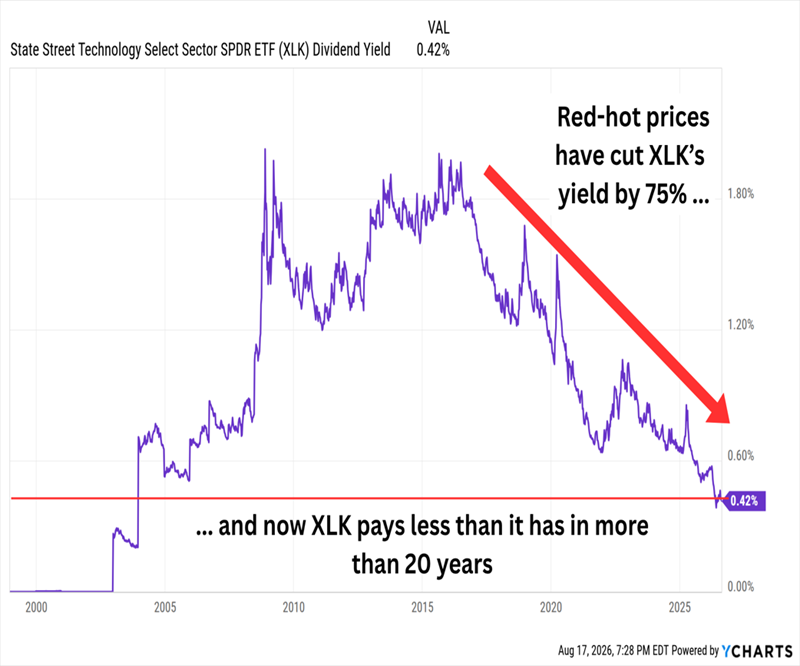
But despite ludicrous prices in the likes of Palantir Technologies (PLTR) and Crowdstrike Holdings (CRWD), the sector as a whole is starting to look more reasonable. Tech stocks’ forward P/E has quickly winnowed to near pre-COVID levels and isn’t much more expensive than the broader market.
And while the S&P 500’s tech companies might as well be paying IOUs, a few of the sector’s less traveled names look downright generous.
Of course, there is usually a reason why tech dividends are large. Often it is because investors are not giving their businesses a lot of credit going forward. Let’s see what is under the hood of these businesses.
Take, for instance, the following six tech plays, which are shelling out staggeringly high yields of between 4.4% and 8.1% that put the rest of the sector to shame.
Several Asian tech stocks have become everyday names here in the U.S. Semiconductor companies such as South Korea’s Samsung and SK Hynix (SKHY), as well as Taiwan Semiconductor (TSM), are tightly tied to artificial intelligence and thus a top priority for the financial media.
That same AI trade has swept traditional IT services companies like India’s Infosys (INFY, 4.4% dividend yield) and Wipro (WIT, 4.6% dividend yield) into the dustpan. While other businesses have traditionally called upon these and similar companies for coders, testers and other human specialists, they’re increasingly trying to determine whether AI can do the job instead.
Infosys and Wipro both acknowledge the solution is adapting to AI in one way or another. The former says it will hire 6,000 “forward deployed engineers,” or FDEs (a term popularized by Palantir), over the next few years. These engineers work on-site to build infrastructure and customize solutions for clients’ AI needs. The latter is teaming up with Databricks to develop AI-first products to serve the needs of wealth management, telecom, energy and other industries.
Both companies have lost nearly a third of their value in 2026. INFY traded at 22 times 2027 earnings at the start of this year; it currently trades at 14. WIT has thinned out from a 19 forward P/E to just 13.
Infosys and Wipro also both pay semiannual dividends, and like many international programs, those dividends usually fluctuate. Still, they both pay yields near 4.5% that are many times better than the sector average.
They reflect very different stories, however. Infosys’s yield is just a product of its recent losses. Wipro’s yield had been plumping up, too—until recently.
But a Sharp Interim Dividend Cut Knocked Off Several Points of Yield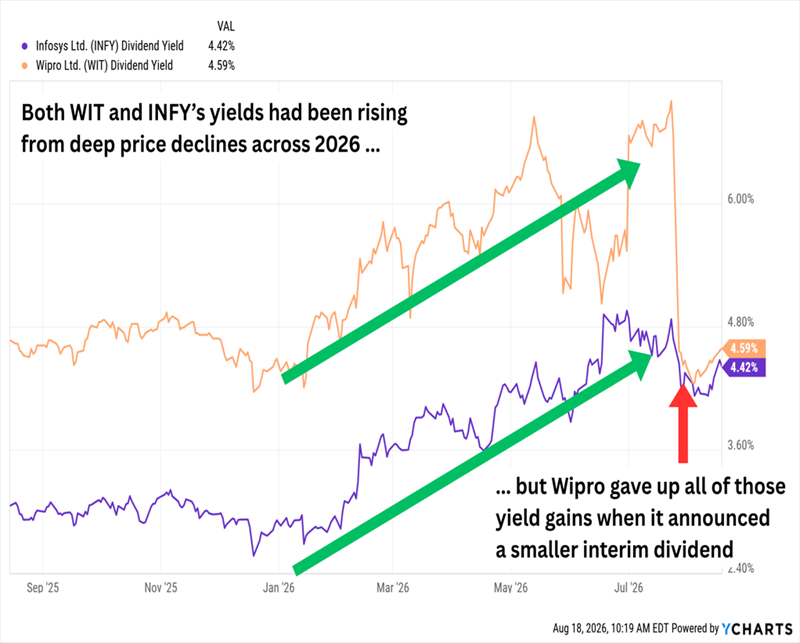
Investors who would prefer a more reliable, regular dividend can look north to Waterloo, Canada’s OpenText (OTEX, 4.6% dividend yield). OpenText is an information management software company whose solutions span business networks, content services, cybersecurity, IT management and more. Like Wipro and Infosys, OpenText is viewed as an “AI loser” and is trying to shed that label by leaning into AI.
Earlier this year, the company divested noncore businesses Vertica and eDOCS. It brought on International Business Machines (IBM) veteran Ayman Antoun in April, and he has since pledged to ramp up the company’s investments in research & development and sales reps.
OTEX lost roughly a quarter of its value near the start of the year, and none of the above developments have gotten the stock out of its funk. So right now, we can own this potential turnaround story for less than 6 times adjusted earnings and collect an extremely well-covered 4%-plus that is paid quarterly and has been growing annually for more than a decade.
OpenText Has Opened Up Its Wallet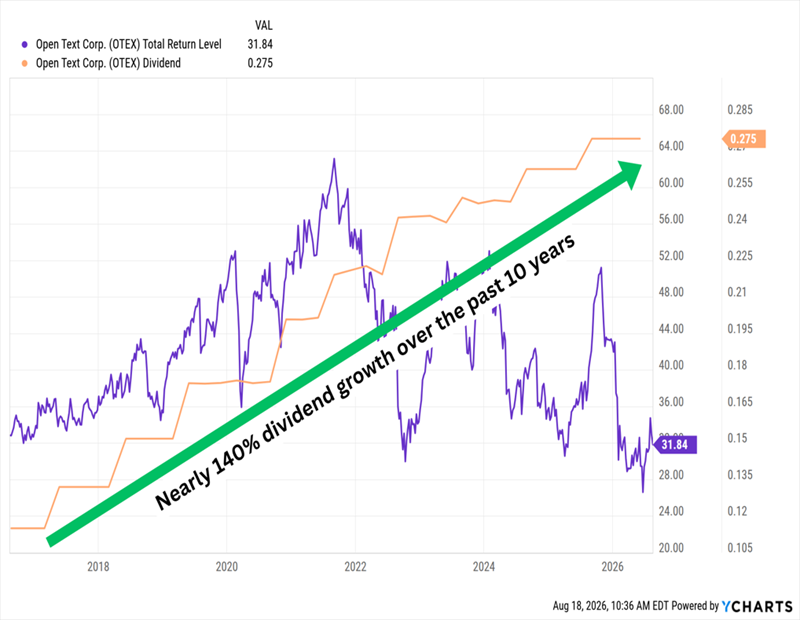
While we can capture decent yields from individual tech plays, funds are where we’ll find the sector’s standout income opportunities.
Take the FT Vest Technology Dividend Target Income ETF (TDVI, 5.6% dividend yield), for instance.
This exchange-traded fund owns a basket of Nasdaq Technology Dividend Index companies like Microsoft (MSFT) and Broadcom (AVGO), but it also sells call options—contracts that give the buyer the right to purchase a stock from the seller for a certain price within a certain period of time—on the S&P 500 and Nasdaq-100.
The premiums it collects from selling “covered calls” allow TDVI to take a portfolio that would normally pay us 1%-2% and instead pay out north of 5%!
Covered-call funds typically reduce volatility, but at the cost of lower overall returns. That’s because if the stock rises to (or above) the option’s strike price, the shares will likely be “called away,” and we won’t enjoy any additional upside from the stock.
But FT Vest’s performance gap against the index it’s built around—represented by the First Trust NASDAQ Technology Dividend Index Fund (TDIV)—is modest compared to other covered-call ETFs.
TDVI Competes Despite Having an Arm Tied Behind Its Back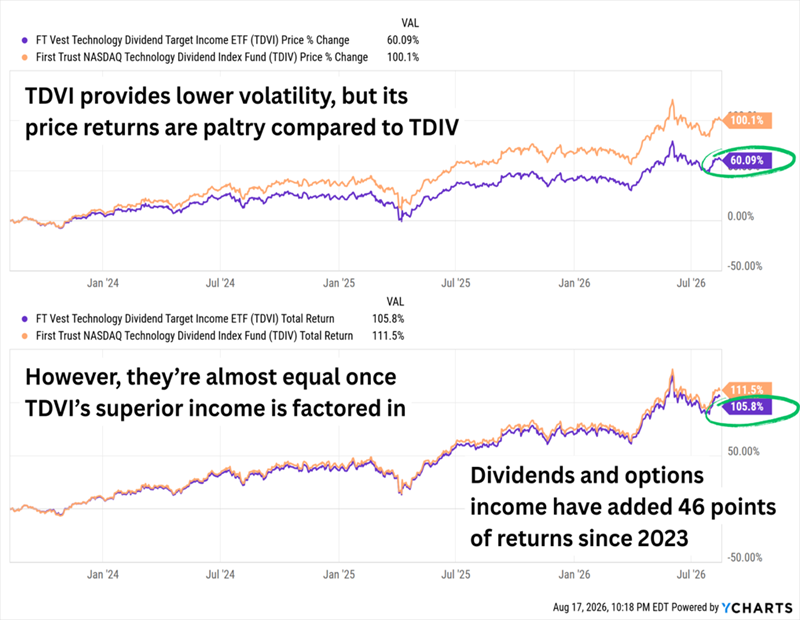
“Hey. Can’t we get 50%-60% yields from ETFs now?” Technically yes, but as I’ve written before, those are gimmicky, poorly run funds that don’t create shareholder wealth—they destroy it.
Back here on Planet Earth, we can get bigger (but still realistic) tech-sector yields from closed-end funds (CEFs). They trade options, too. But they can also use debt leverage to invest more than 100% of their assets in their portfolios, invest in private equity and use other tricks to gin up their performance and income.
Better still? While ETFs are built in a way that keeps their prices tightly locked to their net asset value (NAV), CEFs are much less efficient, so we can often buy these funds’ holdings for less than they’re actually worth.
The BlackRock Science and Technology Term Trust (BSTZ, 6.2% distribution rate) is a mostly tech-sector fund (80% of assets) with some global exposure. Comanagers Tony Kim and Reid Menge own companies “selected for their rapid and sustainable growth potential from the development, advancement and use of science and/or technology.”
Not exactly dividend-paying types. Instead, this monthly distribution is almost entirely made up of capital gains and return of capital (RoC). It’s a somewhat managed payout, though it does shift a little higher or a little lower from one year to the next.
We Occasionally Get Special Dividends, Too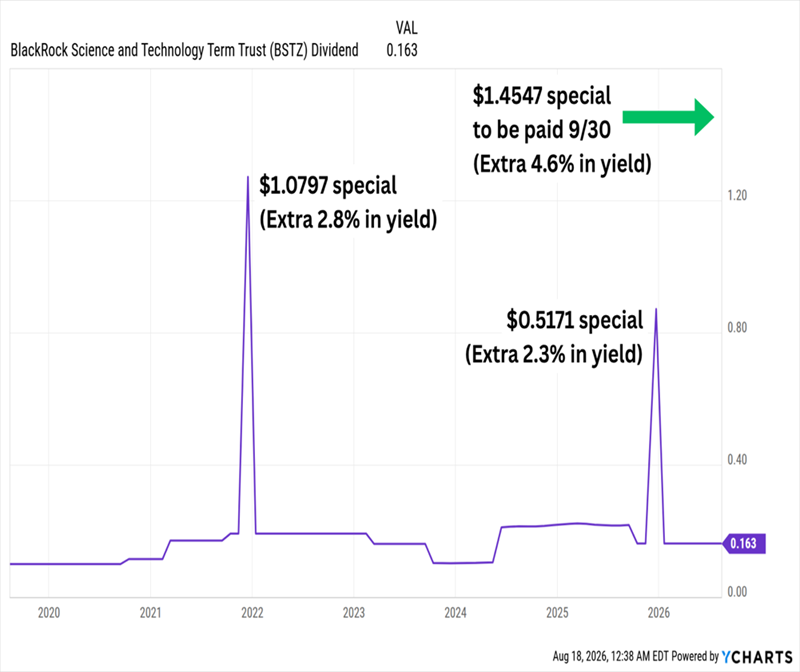
That most recent special would’ve kicked up the fund’s total yield to north of 10%.
But it’s not just the dividend that makes BSTZ stand out—it’s also the holdings.
BlackRock owns not just standard tech-sector fare like Nvidia (NVDA) and Micron (MU), but significant chunks of private firms including Databricks, quantum computing company PsiQuantum and Claude maker Anthropic (which might be a publicly traded firm in a couple months).
BSTZ’s ability to tap into the private markets hasn’t always worked out for it—in fact, it has returned only half as much as the broader tech sector since the fund launched in 2019. Things have picked up over the past couple years, though, resulting not just in outperformance, but a couple of booster shots to the already-generous distribution.
We can also buy BSTZ’s holdings for about 7% less than they’re worth. That’s nice, though that’s actually more expensive than its long-term discount to NAV of nearly 12%.
Just know that this CEF is a “term trust” that is expected to dissolve June 26, 2031, though the board can extend its life by up to 18 months.
I’ve talked about several tech plays that get us some sort of exposure to artificial intelligence, but the Virtus AI & Tech Opportunities Fund (AIO, 8.1% distribution rate) is a direct, focused play on the technology sector’s most pressing trend.
It’s a distribution monster. It pays us more than 8% on its regular payout alone. It pays us monthly. It pays us specials, too—the most recent extra distribution sends its yield into the double digits.
And AIO Has Given Us a Few Raises to Boot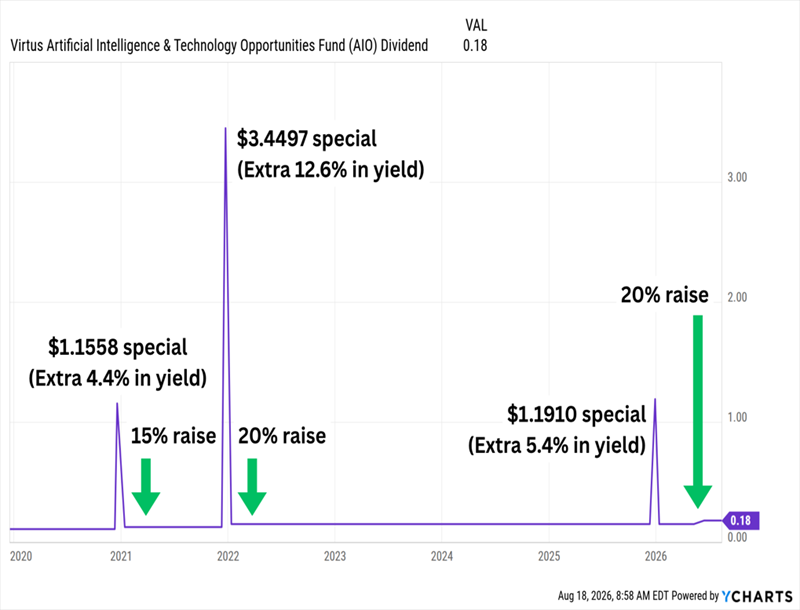
It’s also a much better deal than BSTZ right now, trading at a nearly 9% discount to NAV versus a long-term average of about 7%.
Unlike BSTZ, which largely just allocates its performance as distributions, AIO is actually constructed with income in mind. Yes, it holds traditional AI plays like Nvidia and Taiwan Semiconductor. But only about half its portfolio is made up of common stocks—the rest is a blend of convertible securities and high-yield bonds. So its distributions are made up of just about everything: dividend and interest income, capital gains, and RoC. The four-person management team also uses a modest amount of debt leverage, currently in the low teens, to juice its payout and returns.

Tech could be an option for long term investing but better to earn a dividend in case you are buying into a rally that is just ending.
Supermarket Income REIT (SUPR) is the only LSE-listed company dedicated to investing in grocery properties, which are an essential part of national food infrastructure. The company focuses on grocery stores, which are predominantly omnichannel, fulfilling online and in-person sales, and are let to leading supermarket operators in the UK and Europe. Its objective is to provide shareholders with an attractive level of income, alongside the potential for capital growth over the longer term.
We highlight the five key points in SUPR’s investment case.
1. Robust and visible income growth.
SUPR provides property that supports the essential distribution of groceries, predominantly let to leading operators like Tesco and Sainsbury’s in the UK and Carrefour in France. The grocery sector is large and consistently growing and, being largely non-discretionary, it has proven resilient through a range of economic conditions. Online grocery shopping is the fastest-growing channel and most of this is fulfilled through the sort of large-format omnichannel stores that SUPR targets. SUPR does not benefit directly from operator sales growth, but indirectly it supports sustainable rent growth and underpins capital values. Strong income visibility is provided by a long average lease length of c 12 years, upward-only, mostly inflation-linked leases, full occupancy for grocery stores and consistent 100% rent collection.
2. A low-cost and scalable platform.
Through a combination of increased scale and internalisation of its previously outsourced management, SUPR has built a lean, shareholder-aligned operating structure, with one of the lowest cost ratios in the UK real estate investment trust sector. Management internalisation was not simply a cost-cutting exercise; it also gave the management team greater flexibility to execute strategy and has coincided with changes to the group’s listing arrangements intended to broaden its appeal to a wider pool of investors. Together, these measures mean a greater share of future income growth should flow through to shareholders rather than being absorbed by overheads or structural constraints.
3. Specialist, active management.
SUPR is not simply a passive investor in grocery property; it combines specialist grocery-property knowledge with institutional real estate and capital-markets expertise. It assesses store trading, rent affordability, local competition, omnichannel relevance and alternative-use potential to identify strategically important assets rather than relying only on tenant covenant or lease length. After acquisition, SUPR creates value through rent reviews, lease extensions, reletting and tenant improvements, with the aim of increasing income, extending leases, strengthening asset quality and optimising shareholder returns.
4. Strong growth opportunities.
SUPR sees strong opportunities to leverage its cost-efficient platform and deep grocery real estate knowledge and has an ambition to increase the portfolio size from more than £2.2bn currently to c £4bn over time. Recent growth has been funded by a successful £100m equity offering and the creation of a joint venture with Blue Owl Capital, a global asset manager, providing access to third-party capital and validating the group’s investment approach. The joint venture also provides an additional, recurring source of management fee income.
5. Dividend growth set to accelerate.
Backed by consistent growth in rental income, SUPR has increased its dividend every year since it listed in 2017. However, growth has been modest, primarily held back by the rising cost of debt. The drag from finance costs has now receded and management has signalled its intention to accelerate dividend growth from next year as recent investment activity and lower administrative costs feed through to earnings. Combined with the group’s inflation-linked income base, this points to a dividend that should continue to grow on a durable, well-supported footing.
Published 21 August 2026
Edison
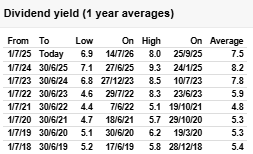
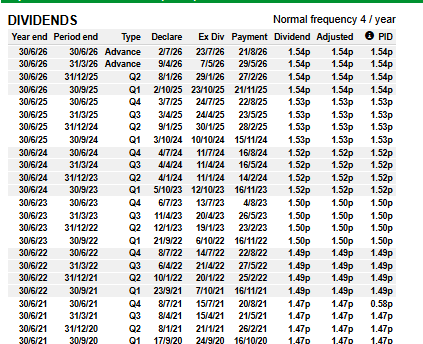
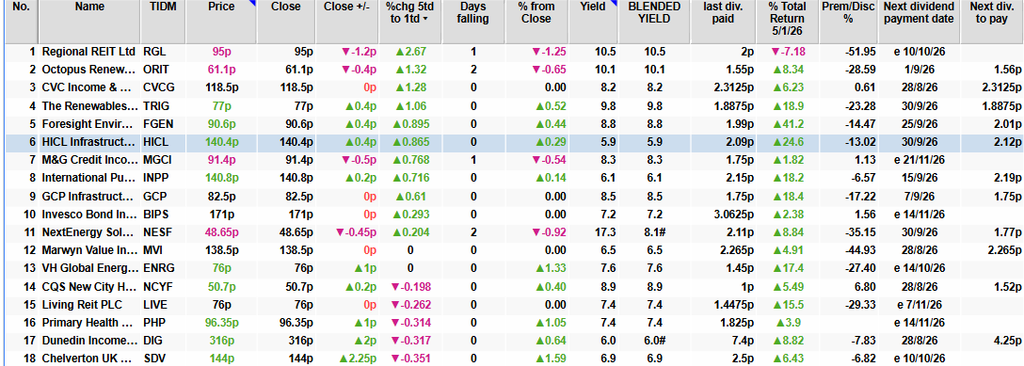
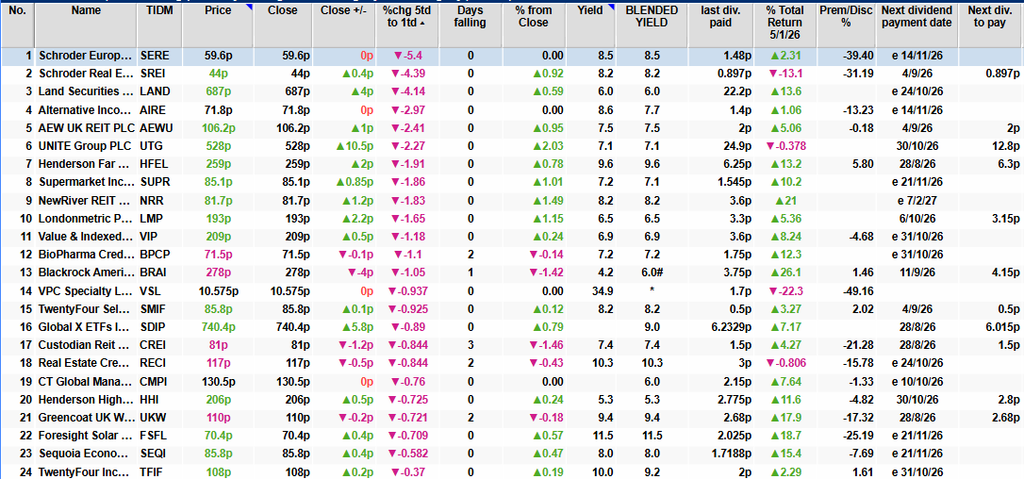

Income at the 8 month stage, will be £9,601
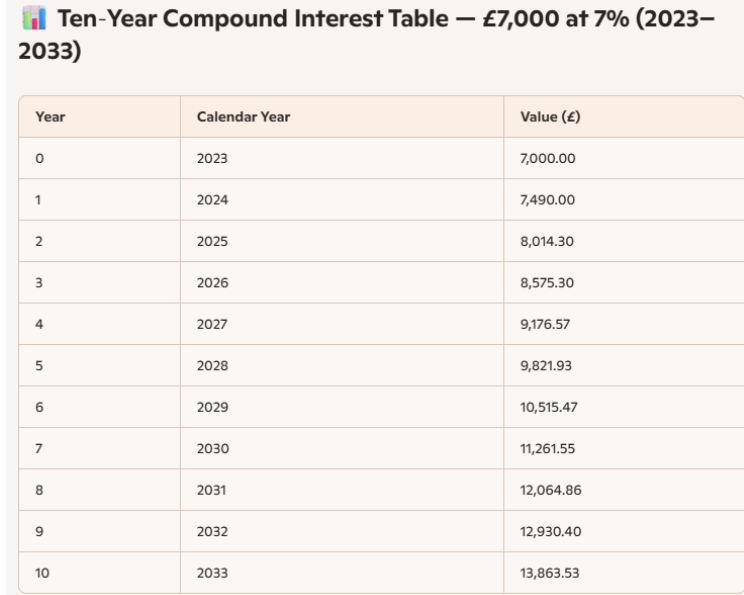
Income for 2026, should meet the 2031 target. With the recent changes to the SNOWBALL, next years target will be £11,261.00.

Its business model means secure income, yet it offers an 8 per cent yield and a bargain share price 
Published on August 20, 2026
by Hugh Moorhead
One megatrend for investors to grapple with at the moment is the UK’s ageing population and the rickety healthcare system that tends to it.
The Labour government needs help turning around the NHS, not least from its largest landlord, Primary Health Properties (PHP).
PHP last year fought off a rival bid from private equity giant KKR (US:KKR) to acquire smaller peer Assura for £1.8bn. That deal has helped to create a £6bn portfolio of British and Irish healthcare properties that can provide shareholders with a secure, growing dividend. We think the market underappreciates this story.
Current yield 7.4%
© 2026 Passive Income Live
Theme by Anders Noren — Up ↑