Passive Income Live

Investment Trust Dividends

Page 386 of 465

Investment Trust Results

The Results Round-Up – The Week’s Investment Trust Results

Which fund has generated five and ten-year NAV total returns of +18.8% and +85.4% respectively, both of which are double those of its benchmark? And which fund’s average holding period for its top-10 stocks is 10 years? Find out in this week’s round-up.

The Results Round-Up – The Week’s Investment Trust Results


By
Frank Buhagiar

Vietnam Enterprise Investments’ (VEIL) three-year track record of outperformance
VEIL’s NAV per share growth couldn’t quite match that of the index over the full year – in sterling terms NAV per share increased +4.1% compared to the VN Index’s +5.3%. Tables turned over a 3-year period though with VEIL outperforming the index by +2.6%. The biggest detractors to relative performance over the year just gone were retail, real estate and construction sectors.

The Portfolio Manager’s full-year Report lists a number of reasons why investors can look forward to the year ahead: inflation at manageable levels of around 3.3%; interest rates on their way down; and a government focused on economic growth. What’s more the Portfolio Manager has pencilled in mid-teens earnings growth for 2024 which equates to a price to forward earnings ratio of 9.6x. All of which points to a very attractive growth and value profile – and hopefully a positive year ahead.

Numis: “We remain positive on the outlook for Vietnam, which we believe is a beneficiary of diversification away from China.”

Schroder Income Growth’s (SCF) 28 consecutive years of dividend growth
SCF posted an NAV per share total return of +1.9% for the half year, a little off the FTSE All Share’s +3.9%. The Half-year Report puts the underperformance down to stock selection, particularly within the consumer discretionary, industrials and basic materials sectors. The good news is that the second half has got off to a decent start – NAV Total Return stands at +7.6% for the period 29 February 2024 to 24 April 2024, comfortably ahead of the All Share’s +5.9%.

Chairman, Ewen Cameron Watt, points out that since the current investment management team were appointed in July 2011, the fund has outperformed the FTSE All-Share Index by 0.8% per annum on a cumulative basis. And the dividend has continued to grow too – the payout has now been increased for 28 years in a row. That long-term track record is key as, according to Watt, over the long-term returns are less likely to be derailed by any unexpected nasties.

Winterflood: “Share price TR -0.3% as discount widened from 8.9% to 11.1%; 38k shares repurchased over HY, representing first buyback since 2008.”

Gresham House Energy Storage’s (GRID) good timing
GRID had a tough year. EBITDA down 47% year-over-year to £25.8m due to a weakening revenue environment for the battery sector; NAV per share off 17% year-over-year to 129.07p thanks in part to those lower revenue forecasts; and then there was the decision to scrap the 2024 dividend.

Wasn’t all bad though. During the year, operational capacity increased by a quarter to 690MW/788MWh. And since year end, capacity has grown to 740MW, putting the fund on course to hit its 1GW operational capacity target in 2024. Good timing it seems as, according to the Full-year Report, the challenging trading environment has eased in recent weeks as market fundamentals have improved.

Liberum: “We note that GRID is continuing to progress a disposal of a subset of the portfolio and it is hopeful that something may be announced in this regard in the coming month or two. This could act as a helpful proof point in terms of valuation and we note that there is sufficient funding for the planned roll-out without any disposals.”

Ecofin US Renewables Infrastructure’s (RNEW) final Finals?
RNEW’s Finals included an update on the ongoing strategic review, perhaps of more interest to shareholders than the latest full-year numbers. The review is ongoing – already knew that. And it’s taking longer than expected – knew that too. The interesting bit is that the review, which involved looking for potential buyers for the fund’s assets, has, according to Chairman, Patrick O’D Bourke, resulted in “specific discussions and negotiations taking place”. And these negotiations are expected to conclude soon. So, watch this space. As for the full-year numbers, NAV per share fell 9.7%.

Numis: homes in on “comments that potential buyers would take account of RNEW’s discount to NAV, when arriving at their valuation of the portfolio as a whole.”

abrdn Property Income’s (API) full house
API might have reported a -3% NAV total return for the year, but the real estate investment portfolio still managed a +0.7% return, comfortably ahead of the MSCI Quarterly Property Index’s -1.5%. This means API’s portfolio has beaten the Index over 1, 3, 5 and 10-year timeframes – a full house! Despite the outperformance, an Extraordinary General Meeting (EGM) is to be held in May at which shareholders will be asked to approve plans to wind-down the company. Why? As explained in Chairman, James Clifton-Brown’s full-year statement, this is down to concerns over the size of the fund, liquidity in the shares, the discount at which the share price trades to net assets and the lack of dividend cover.

Numis: “The manager comments that if the managed wind down is approved by shareholders, a sales process ‘is expected to take approximately 24 months within a range of 18-30 months from the date of implementation, although this is very dependent on a reasonable market existing for all the Company’s properties.’”

Digital 9 Infrastructure’s (DGI9) long good-bye
DGI9’s latest set of full-year numbers, which included a 28% decline in NAV to £686.3 million, are probably not as important as they may have been a few months ago. That’s because post-period end, 99.9% of shareholders who attended the General Meeting in March voted to adopt a new Investment Objective and Policy – an orderly managed wind-down. In line with this, sale preparations for the fund’s remaining five wholly-owned assets are being progressed. But DGI9 is unlikely to be disappearing anytime soon. According to Chair, Charlotte Valeur, selling the remaining portfolio and winding down the company is expected to take a number of years.

JPMorgan: “DGI9 has a concentrated portfolio and there are significant risks in executing its managed wind down. But on balance we continue to think there is now likely to be materially more upside than downside. We remain Overweight.”

Jefferies: “A reduction in the audited NAV further erodes confidence in the portfolio valuations and so is likely to limit confidence in the wind-down process for the time being. More positively, the balance sheet position will be much more simplified following the impending RCF repayment, albeit with further progress contingent on executing the Aqua Comms sale.”

Pacific Assets (PAC), top of the class
PAC may well have reported a -1.3% NAV total return for the year, but this was still the best among its four peers and an exchange-traded fund. It was also considerably better than the -10.5% fall in the MSCI AC Asia ex Japan Index. In terms of performance drivers, Chair Andrew Impey cited the fund’s Indian exposure as being particularly helpful – seven of the portfolio’s top-10 positive contributors during the year were Indian companies.

As for the outlook, Impey said it’s nigh on impossible to predict what’s around the corner for the Asia Pacific region in the short term, but long-term growth drivers such as a growing middle class, investment in infrastructure and technological change remain in place. Helpfully, the fund’s Portfolio Manager invests for the long term. According to the Portfolio Manager’s Report, the average holding period for the top-10 stocks is 10 years.

Winterflood: “India exposure level is determined by bottom-up stock selection, not a ‘macro overlay’, thematic view or political assessment. 75% of top 100 India stocks considered uninvestable for quality or sustainability reasons. China & Hong Kong exposure (12% of NAV) detracted. Approximately 20 Chinese companies considered investable. Indiscriminate sell-off has generated opportunities for stock-picking, and the managers expect China weighting to increase.”

Invesco Perpetual UK Smaller Companies (IPU) to be continued?
IPU posted full-year NAV and share price total returns of –4.1% and –1.8% respectively – a respectable outcome considering the benchmark returned –3.3%. The long-term performance is more than respectable with the fund outperforming the Deutsche Numis Smaller Companies + AIM – Investment Companies Index over five and 10 years – the five-year cumulative NAV total return stands at +18.8%, double the benchmark’s +9.8%; similarly, over 10 years, the NAV total return is +85.4%, more than double the benchmark’s +40.4%. With numbers like these it’s no wonder Chair, Bridget Guerin, and the Board are hoping shareholders vote for the fund’s continuation at the June 2024 AGM “to allow the Company the opportunity to continue to grow over a longer market cycle”.

JPMorgan: “if shareholders do want a return of capital they have the opportunity to vote collectively against continuation, though we would expect the company to continue. Overall, we see no reason to change our Neutral recommendation.”

DOCEO tips

The Tip Sheet

The Times thinks Schiehallion offers something different for sophisticated investors, while This is Money runs the rule over JPMorgan American.

The Tip Sheet

By Frank Buhagiar

Tempus – Schiehallion offers something different, if you dare…
To summarise the investment case presented in the above tip from The Times’ Tempus Column, it’s helpful to flip the article on its head and start at the end: “Advice Buy. Why? High risk and only for sophisticated investors, but provides meaningful diversification from traditional investments.” High risk? As Schiehallion (MNTN) itself says, it’s one for professional and sophisticated retail investors. Why? Because MNTN looks to invest in late-stage private companies that have a good chance of going public.

Trouble is, that private company focus can come with a high degree of volatility. Just look at the fund’s performance over the past two years. During this period, MNTN shares fell almost 70% from their peak before rebounding 39% in dollar terms in March alone. Not for those with a nervous disposition then, but as Tempus writes: “There is much to like in its underlying portfolio.”

The portfolio companies are growing – the latest full-year results highlighted how the top 20 companies posted overall revenue growth of 40% and 40%+ gross margins. The top-five holdings (SpaceX, Wise, Affirm, ByteDance and Bending Spoons) are all cash generative – three are profitable. And the average cash runway (how much time a loss-making company has before it runs out of cash) is over five years – 90% of the portfolio has over 12 months’ cash runway.

As for the “meaningful diversification” the fund provides, it’s worth going back to the opening lines of Tempus’ tip: “Companies are staying private for longer. In 1980, the median age of a business at flotation was six years. Today it is ten. By the time these businesses hit the public markets, investors have missed out on some of their best growth spurts.” There you have it, MNTN allows sophisticated investors to participate in pre-IPO growth spurts.

This is Money: JPMORGAN AMERICAN: Thinking big… £1.8bn trust built around America’s mega stocks
JPMorgan American’s (JAM) turn to get the once over from This is Money’s Jeff Prestridge. Understandable after the fund clocked up a +36% return over the past year. While much of the strong performance is down to JAM’s exposure to 40 mega-cap growth stocks and the buzz surrounding AI, the fund is no one-trick pony. For as well as holding its fair share of growth names such as tech giants Microsoft and Nvidia, JAM also invests in stocks that represent outstanding long-term value for money – names here include oil and gas company EOG Resources and healthcare giant Johnson & Johnson.

Growth and value stocks held side by side – JAM is style-agnostic. The article goes on to quote Felise Agranoff, one of four managers, who describes JAM as “a blend of our very best investment ideas. We’re not wedded to any one investment style which means we can find opportunities right across the market.’” Speaking of the fund managers, one of the team Jonathan Simon is due to retire next year but, according to the article, “the impact on shareholders will be minimal.” Not because Simon won’t be missed but, as Agranoff says, “We have a deep investment bench here”.

Dividend Heroes

If u had invested 10k from the chart in MRCH and re-invested the dividends u would now have 20k.
U could decide to sell the whole position, u may be premature, it’s all conjuncture because I doubt if many bought from the chart.
U could re-invest in NESF and SMIF and earn a dividend yield of 10%
10k x 10% 1k x 2 = 2k
Initial sum invested 10k a yield of 20%. If u do nothing u could receive the initial sum back in another 5 years and your Snowball is really starting to grow. If u re-invest u would have 30k invested in the market and who really cares or knows what it will be worth in 5 years time. U just need to be ready when Mr. Market gives u the chance, u will be concerned that the price will keep falling after u buy but if u are content with the yield it shouldn’t matter.
But as always best to DYOR.
Stick to your plan, until it sticks to u.

SMIF

TWENTYFOUR SELECT MONTHLY INCOME FUND LIMITED

Annual Report and Audited Financial Statements

For the year ended 30 September 2023

The Directors of TwentyFour Select Monthly Income Fund Limited (the “Company”) announce the results for the year ended 30 September 2023.

FINANCIAL AND OPERATIONAL HIGHLIGHTS

  • NAV per share of 75.44 pence (FYE 30/09/22: 69.99 pence)
  • Total Net Assets of £181.69 million (FYE 30/09/22: £151.33 million)
  • Dividends declared for the year of 7.37 pence per share (FYE 30/09/22: 6.39 pence per share)
  • Total Return of 17.54% (FYE 30/09/22: -18.94%)

Eoin Walsh, Partner & Portfolio Manager at TwentyFour Asset Management, said: “The rising rate environment resulting from global inflation has enabled us to position the TwentyFour Select Monthly Income Fund Limited positively over the period. The strong NAV performance coupled with a focus on the credit quality of the portfolio positions has left the Company well placed for the next stage of the cycle.”

Ashley Paxton, Chairman of TwentyFour Select Monthly Income Fund, said: “We are very pleased to present the audited financial statements for the Company, which demonstrate how the TwentyFour Select Monthly Income Fund Limited has delivered a Total Return of 17.54%, including dividends declared of 7.37 pence per share. We are also pleased to reflect on the share activity for the period, having traded at or around NAV (within a c4.5% tolerance above and below NAV) throughout the year to 30 September 2023, at a time where the majority of the investment company market saw significant discounts.”

SUMMARY INFORMATION

The Company

TwentyFour Select Monthly Income Fund Limited (the “Company”) was incorporated with limited liability in Guernsey, as a closed-ended investment company on 12 February 2014. The Company’s Shares were listed with a Premium Listing on the Official List of the UK Listing Authority and admitted to trading on the Main Market of the London Stock Exchange (“LSE”) on 10 March 2014.

Investment Objective and Investment Policy

The Company’s investment objective is to generate attractive risk adjusted returns, principally through income distributions.

The Company’s investment policy is to invest in a diversified portfolio of credit securities.

The portfolio can be comprised of any category of credit security, including, without prejudice to the generality of the foregoing, bank capital, corporate bonds, high yield bonds, leveraged loans, payment-in-kind notes and asset-backed securities and can include securities of a less liquid nature. The portfolio is dynamically managed by TwentyFour Asset Management LLP (“TwentyFour” or the “Portfolio Manager”) and, in particular, is not subject to any geographical restrictions.

The Company maintains a portfolio diversified by issuer and comprises at least 50 credit securities. No more than 5% of the portfolio value will be invested in any single credit security or issuer of credit securities, tested at the time of making or adding to an investment in the relevant credit security. The Company may hold up to 10% in cash but works on the basis of an operational limit of 5% and any uninvested cash, surplus capital or assets may be invested on a temporary basis in:

  • cash or cash equivalents, money market instruments, bonds, commercial paper or other debt obligations with banks or other counterparties having a “single A” or higher credit rating as determined by any internationally recognised rating agency which may or may not be registered in the EU; and
  • any “government and public securities” as defined for the purposes of the Financial Conduct Authority (the “FCA”) Rules.

Efficient portfolio management techniques are employed by the Company, and may include currency and interest rate hedging and the use of other derivatives to manage key risks such as interest rate sensitivity and to mitigate market volatility. The Company’s currency hedging policy will only be used for efficient portfolio management.

The Company does not employ gearing or derivatives for investment purposes. The Company may use borrowing for short-term liquidity purposes, which could be achieved through arranging a loan facility or other types of collateralised borrowing instruments including repurchase transactions and stock lending. The Articles restrict the borrowings of the Company to 10% of the Company’s Net Asset Value (“NAV”) at the time of drawdown. No arrangements for borrowing are currently in place.

At launch, the Company had a target net total return on the original issue price of between 8% and 10% per annum. This comprised a target dividend payment of 6p per share per annum and a target capital return of 2p-4p, both based on the original issue amount of 100p. Whilst there is no guarantee that this can or will be achieved, the 6p per share Dividend Target has consistently been met.

In accordance with the Listing Rules, the Company can only make a material change to its investment policy with the approval of its Shareholders by Ordinary Resolution.

CHAIRMAN’S STATEMENT

For the year ended 30 September 2023

As Chairman to the TwentyFour Select Monthly Income Fund Limited, I am delighted to present my first report on the Company’s progress for the year ended 30 September 2023.

Market Overview

Central bank activity, higher inflation data, continuing low employment rates and the upward pressure on wages have been the biggest driver for much of the year as central banks implemented more rate hikes and market participants watched closely for signs that inflation was moving back towards target. Towards the end of the year to 30 September 2023, central banks seemed to be approaching or were already at terminal rates for the cycle, allowing existing rate increases to feed through and to continue to bring inflation closer to target. Labour markets and other economic data remained resilient, leading to some market participants to call for a soft-landing. However, in our view, with central banks maintaining their “higher for longer” messaging, there is an increased likelihood of more cracks appearing in the global economic picture.

Towards the end of the year, volatility in the rates market was driven by strong economic data and concerns over budget deficits together with increased supply and term premiums. This volatility led to a modest softening in credit spreads towards the end of the period.

Generally, earnings remained resilient, particularly in the European banking sector where banks maintained strong capital levels and low non-performing loans (“NPLs”) and called and issued Additional Tier-one bonds (“AT1s”) as expected, post the collapse of Credit Suisse.

With the bouts of volatility over the period, there is a lot of value in the portfolio, with many of the Portfolio Manager’s favourite names and bonds trading at very attractive levels.

The Portfolio Manager also sought to increase the credit quality of the portfolio by continuing to conduct relative value switches, which served to improve the yield and extend duration to lock in the available attractive yield levels.

Outlook

The Portfolio Manager’s base case is for a “soft-ish” landing whereby it expects a short and shallow recession and for the unemployment rate and default rates to increase moderately. We expect to see a deterioration of economic fundamentals as the lag effects of the many interest rate increases feed through economies, leading to a mild recession as the economy is supported by strong consumers, corporates and banking sector. This should give central banks the ability to cut interest rates later in 2024.

The Board believes there is a lot of value in the portfolio and the very attractive yields offer good protection against future volatility and the Portfolio Manager is actively adjusting the portfolio to find better opportunities for value, in order to optimise the Company’s performance.

££££££££££££

The dividend is fairly secure, they occasionally pay an increased dividend in April which was already declared before the Trust was bought for the portfolio.

Pays a monthly dividend, which can be re-invested but as always best to DYOR.

Keep calm and carry on ?

The chart showing why you should keep calm and carry on investing

There are plenty of logical reasons why investors might want to shift out of stocks but the data tells us not to.

By Jonathan Jones,

Editor, Trustnet

‘Time in the market is better than timing the market’ is an old adage used by financial experts and one that is typically thought to be the best way for new investors to think about how to put their money to work.

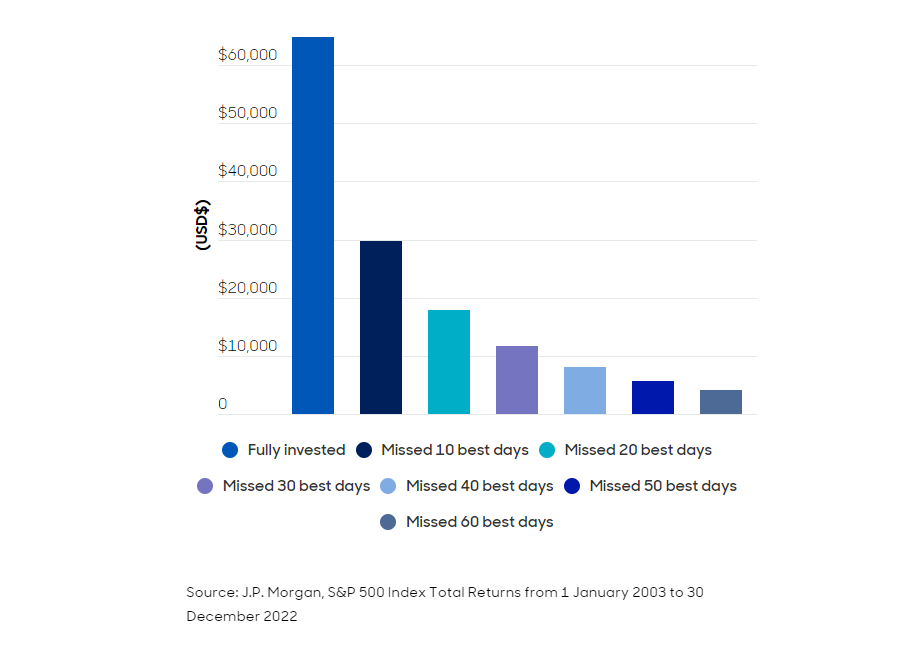
The idea of staying invested came up again this week in a blog post from abrdn, in which its Asia Pacific team highlighted the below chart.

It shows how much an investor would have made if they had put $10,000 in the S&P 500 back in 2003 and left it fully invested for 20 years.

By comparison, the chart also shows the returns that same investor would have experienced if he or she had missed the 10 best days in the market or fared even worse.

How much an investor would have made with $10,000 over 20yrs

This phenomenon of lowering returns when missing out the best days is particularly compounded for income investors, the research noted, as investors will miss out on dividends throughout any periods their money is not being put to work.

It sounds simple: stay invested throughout and reap the rewards. But there will undoubtedly be some that believe they can do even better – why not try to miss the worst days and still reap the rewards of the best?

The reason this is so difficult to do in practice, however, is because quite often these best days come shortly, or even immediately, after the worst days – making it incredibly hard to time.

Yet it would not come as a surprise if investors have in fact been making changes to their portfolios during the past couple of tumultuous years. Indeed, there are plenty of logical reasons why they might want to consider pulling their money out of stocks.

First, cash and bonds now offer compelling yields for the first time in more than a decade, giving investors the chance to move down the risk scale and still achieve steady returns.

This has been compounded by several big events including Covid-19, war in Europe and the Middle East and – new to 2024 – an array of elections in countries around the world including the UK, US and India. All of these have at times posed significant risks to markets.

Then there are the macroeconomic pressures. Inflation has dropped but the final push to central banks’ 2% target is proving difficult to achieve, leaving interest rates in limbo at present and causing more concern that rates may stay higher for longer – something markets are not favourable on.

Lastly, turning to markets themselves, it is easy to come up with arguments as to why now may be a good time to take profits from expensive US stocks such as Nvidia and the other ‘Magnificent Seven’ names that have dominated for the past 18 months, or the ‘Granolas’ in Europe, which have rocketed in recent years.

An investor looking at any or all of these factors could be forgiven for making changes to their portfolios and shifting exposures, taking profits or selling out entirely.

Despite plenty of reasons to move your money elsewhere, whether it be to take on less risk through bonds and cash options, or to move outside of expensive areas such as the US, the data always reminds us that the best course of action is to stay the course and remain invested.

« Older posts Newer posts »

© 2026 Passive Income Live

Theme by Anders Noren — Up ↑