Passive Income Live

Investment Trust Dividends

Page 389 of 465

Lifetime passive

The Motley Fool


I’d use these methods for targeting a lifetime of passive income.

Story by Charlie Keough


It’s no secret that inflation has wreaked havoc on markets in the past months. And with that, it’s no surprise that many investors are focusing on generating passive income.

Investing in companies with high dividend yields is a great way to put money to work as opposed to it stagnating.


However, it’s smart to have a strategy before targeting passive income. And there are plenty of considerations that must be taken into account to ensure a greater potential for success.

Let’s explore these further.

The strategy
The first consideration is my timeframe for investing. Often we see the promotion of investing is to ‘get rich quick’. But as a Fool, I much prefer to view my investments over a long-term horizon.

As billionaire investor Warren Buffett famously said: “If you don’t feel comfortable owning a stock for 10 years, you shouldn’t own it for 10 minutes”. And more often than not, the stock market has proven that investing with a long-term outlook is the best way to extract the benefits.
Granted, investors may find it difficult to remain persistent when they see the value of their investments falling. But by viewing them over a timeframe of five to 10 years minimum, short-term volatility is ironed out.


Secondly, I must also consider methods I can use to boost my profits. This predominantly exists in the form of reinvesting my dividends. By doing this, I can benefit from compounding which, over time, will allow my pot to continue to grow at a greater pace.

On top of this, I can also generate greater returns by consistently adding to the size of my investment.

£500 invested in a stock generating 7% growth a year (which, of course, I may not achieve) with a 6% yield would leave me sat with £24,000 after 30 years. However, if I topped this up with a monthly payment of £30, over the same period, my pot could be worth over £150,000.

Finally, I’d diversify my investments. By doing this, I’d reduce my reliance on one company or industry.

Putting this into practice
So if that’s the strategy, how do I implement it? Well, I think the FTSE 100 is a great place to start.

The index is home to a variety of quality companies with growth potential that also offer high dividend yields.

There are over 15 companies that offer yields of 6% or more, spread across industries such as investments, tobacco, housebuilding and insurance. This includes firms such as Rio Tinto (8%), British American Tobacco (9%) and Legal & General (8.5%). And its quality companies with long-term growth potential that I’d target.
More widely, I’d also look at companies that offer yields above the index’s average of 4%. Here, I like the look of HSBC and Lloyds.

Of course, there are risks. Firstly, I wouldn’t buy a stock solely due to its dividend yield. And greater research would have to be done to convince me it has the long-term growth potential I’m seeking.

Additionally, the risk with targeting dividend stocks is that payments can be reduced, or cut altogether, as seen on multiple occasions. I must be aware of this.

However, by employing this strategy to the correct companies, I’m confident I could build wealth.

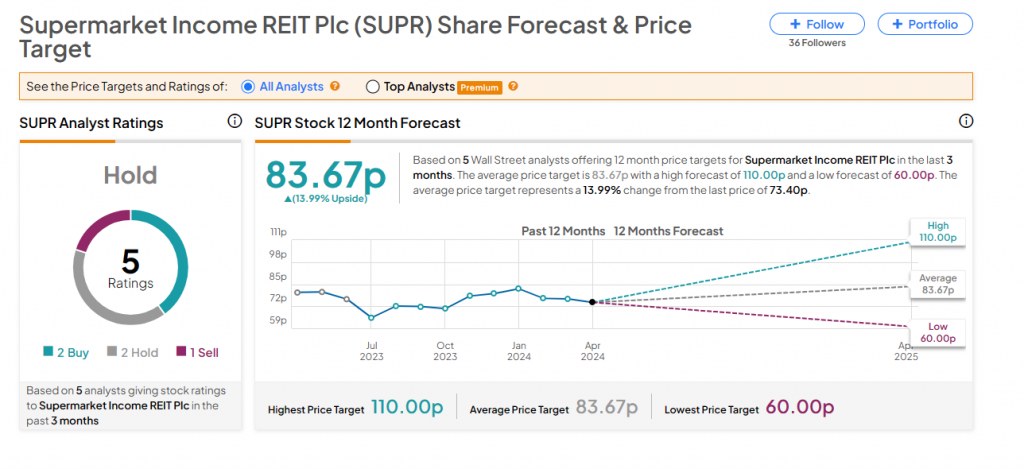
Chart of the day

BWRM will be leaving the watch list because as the price rises the yield falls and now only yields 5.8%. If u have pair traded it with another high yielder, u could book some profit and run the balance.

The worst thing that can happen ‘if u take profit’ is the price continues to rise and u have to take more profit. U could re-invest the profit into another high yielder to grow the Snowball.

Different strokes for different folks.

SUPR

There’s a ton of information on the net and it can get confusing when they all say something different.

The blog is only interested if the next dividend is going to be paid, better if it gently increases but that’s always the first thing I check when an update is issued.

KISS

SUPR

SUPERMARKET INCOME REIT PLC

(the “Company”)

ACQUISITION OF A CARREFOUR SUPERMARKET PORTFOLIO IN FRANCE

Supermarket Income REIT plc (LSE: SUPR), the real estate investment trust providing secure, inflation-linked, long income from grocery property, announces the acquisition of a portfolio of Carrefour supermarkets in France through a sale and leaseback transaction (“SLB”), for a total purchase price of €75.3 million (excluding acquisition costs), reflecting a net initial yield of 6.3%.

The SLB portfolio acquisition is in accordance with the Company’s investment policy and comprises 17 strong performing omnichannel supermarkets, which are geographically diversified, with a weighting towards northern France, and operated under the Carrefour Market brand. The stores have an average gross internal area of c.40,000 sq ft, with a long history of successful trading and form a key part of Carrefour’s “Drive” online grocery fulfilment network within their respective catchments.

The SLB portfolio has been acquired with a weighted average lease term of 12 years (with a tenant-only break option in year 10) with annual uncapped inflation-linked rent reviews. Carrefour is one of the largest grocers in the world, achieving total sales of €94 billion in FY23. Carrefour operates across 30 countries, is the second largest grocer in France with a 20% market share and has a Baa1 credit rating from Moody’s.

Financing Update

To fund the acquisition, the Company has drawn €81.7 million from its existing HSBC revolving credit facility having also increased the total size of the facility by £25 million. The cost of this new Euro denominated borrowing is 1.70% over EURIBOR, with the acquisition providing an attractive earnings spread over the long-term cost of the Euro denominated borrowings. The Company’s pro-forma net LTV following the acquisition is 37%.

Ben Green, Director of Atrato Capital Limited, the Investment Adviser to Supermarket Income REIT plc, said: 

“We are delighted to have completed this strategic sale and lease back transaction with Carrefour, one of the largest grocers in the world. The transaction represents the Company’s first investment in the €284 billion French grocery real estate market.

This accretive transaction is complementary to our existing portfolio, providing further tenant diversification and continues our strategy of investing in the future model of grocery.”

Details of the 17 stores acquired in this transaction can be found on the Company’s website: https://supermarketincomereit.com/our-portfolio/.

The Company was advised by Rothschilds & Co, Simmons & Simmons and Wargny Katz.

Chart of the day

This ship sailed at the end of last year plus the 4.61p dividend.

Current yield 3.11% should revert to 4% at the end of the year, maybe one for your watchlist if there is a Santa Rally this year.

Discount Watch

Discount Watch
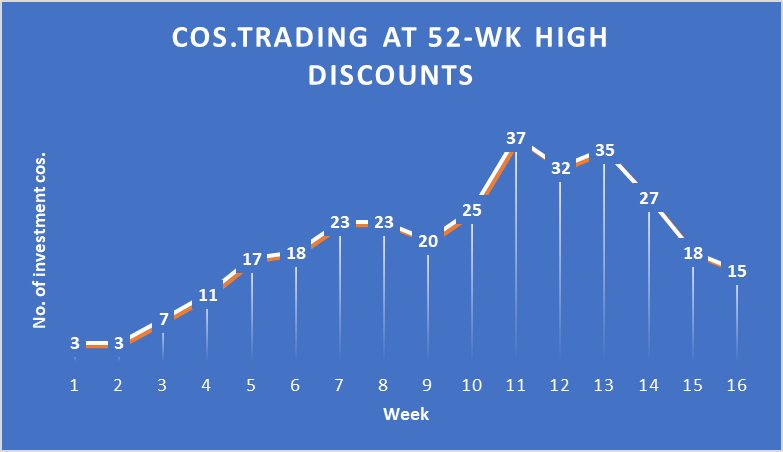
This week’s Discount Watch sees another drop in the number of investment companies trading at 52-week high discounts – down three to 15 from 18.

By
Frank Buhagiar

Doceo
22 Apr, 2024

Discount Watch

We estimate there to be 15 investment companies whose discounts hit 12-month highs over the course of the week ended Friday 19 April 2024 – three less than the previous week’s 18.discount watch pic 22.04.23

For a third consecutive week, the number of investment companies trading at 52-week high discounts has fallen. At 15, the year-high discounter tally is back to where it was nearer the end of Jan/early Feb, a period when markets were priming themselves for central banks to start cutting interest rates. Fast forward to the second half of April and interest rates around the world have barely budged. What’s more, the timing of when the rate cutting cycle is forecast to begin across developed markets has been pushed out deeper into the year – cue the steady increase in funds setting new discount highs to 35+. Until these past few weeks when the number of investment companies hitting year-high discounts has more than halved.

Question is, is the close correlation between elevated interest rates/bond yields and widening discounts in the investment company space breaking down or is it just taking a pause? Time will tell.

The top-five discounters

Fund Discount Sector
LMS Capital (LMS) -70.84% Private Equity
Gresham House Energy Storage (GRID) -70.78% Renewables
Schroder European Real Estate (SERE) -42.03% Property
Apax Global Alpha (APAX) -38.16% Private Equity
Downing Renewables & Infrastructure (DORE) -37.47% Renewables

The full list

Fund Discount Debt
NB Distressed Debt (NBDD) -24.52% Debt
NB Monthly Income (NBMI) -33.33% Debt
Develop North (DVNO) -1.46% Debt
Impax Environmental Markets (IEM) -11.68% Environmental
Dunedin Enterprise (DNE) -22.30% Private Equity
Apax Global Alpha (APAX) -38.16% Private Equity
LMS Capital (LMS) -70.84% Private Equity
Schroder European Real Estate (SERE) -42.03% Property
AEW UK REIT (AEWU) -18.09% Property
Foresight Solar (FSFL) -31.29% Renewables
Octopus Renewables Infrastructure (ORIT) -36.27% Renewables
Gresham House Energy Storage (GRID) -70.78% Renewables
Downing Renewables & Infra (DORE) -37.47% Renewables
Greencoat Renewables (GRP) -27.22% Renewables
BlackRock Throgmorton (THRG) -10.99% UK Smallers

Income Trust shares

Where did all the UK equity income funds go?

The number of UK equity income funds trading at 52-week high discounts has fallen from seven to zero in the space of a month. The Deep Dive takes a closer look to find out what’s behind the turnaround.

ByFrank Buhagiar•24 Apr, 2024•

Week ended Friday 22 March 2024, we counted 32 investment companies that were trading at year-high discounts to net assets. Of these, no fewer than seven belonged to the Association of Investment Companies’ (AIC) 20-strong UK equity income sector. Barely a month on and the number of UK equity income funds on the Doceo Discount Watch list stands at zero. Where have all the UK equity income funds gone?

Why were they there in the first place?

In UK Equity Income Trusts – was it something the Chancellor said?, a number of reasons behind the sector’s strong showing on the Discount Watch List were put forward – the Chancellor’s Spring Budget, underlying UK markets and the performance of the funds themselves. The conclusion? Not much in the Budget for UK equity income funds to concern themselves with apart from a possible small boost arising from the proposed British ISAs. Meanwhile at the time of the article, UK equity markets were only marginally down for the year. As for how the funds themselves have been performing, only two had reported results this year. So, no mass underperformance to report. And the two funds that have reported, have largely performed well. Something else at work, it seems.

According to Winterflood, that something else has been Gilt yields. Writing in its February monthly summary of the sector, the broker had this to say: “Investment Trust sector average discount at 29 February was 15.9% vs 14.2% at 31 January, 12.9% at the end of 2023 and 11.3% at the end of 2022. Discount moves remain closely correlated with Gilt yields, with the sector discount widening so far this year coinciding with a rise in yields. The vast majority of sub-sectors were de-rated last month, with still none trading at a premium at the end of February”.

As for the mechanics behind the correlation between Gilt yields and investment company discounts, when risk-free Gilts yields rise, the yields of other asset classes, particularly those competing for the investor’s pound, such as UK equity income funds, rise too in order to remain attractive. Assuming dividends remain constant, share prices need to fall for yields to rise. And assuming net assets remain constant, as share prices fall, discounts widen.

So rising Gilt yields most likely behind the discount pain seen in the UK equity income sector in Q1 2024. It therefore follows then, that falling Gilt yields could well be the trigger for a narrowing in discounts across the sector.

According to Winterflood’s monthly summary for March 2024 10-year Gilt yields did fall, by 19bps to 3.93% over March, 10-year Treasury yields decreased by 5bps to 4.20%, and 10-year Bund yields fell by 11bps to 2.30%.

Gilt yields fall, discounts of UK equity income funds narrow. The sector’s representation on the Discount Watch all but disappears. Or, so you’d think.

As at week ended Friday 29 March, there were still six UK equity income funds trading at 52-week high discounts.

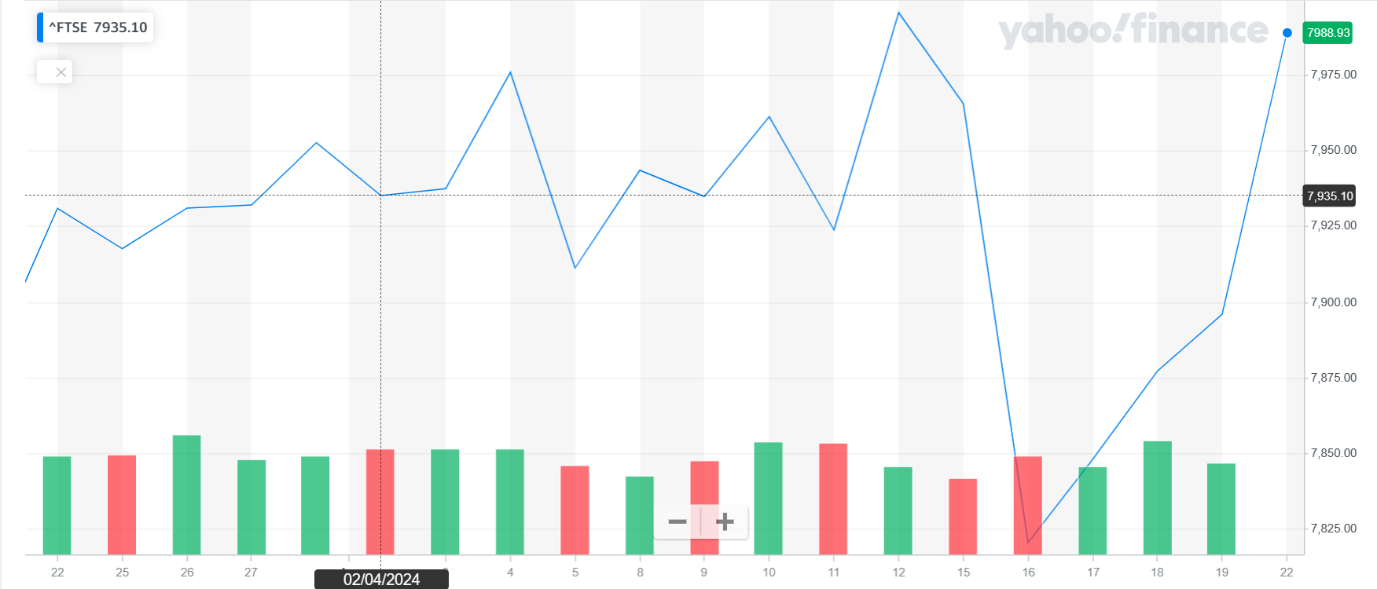
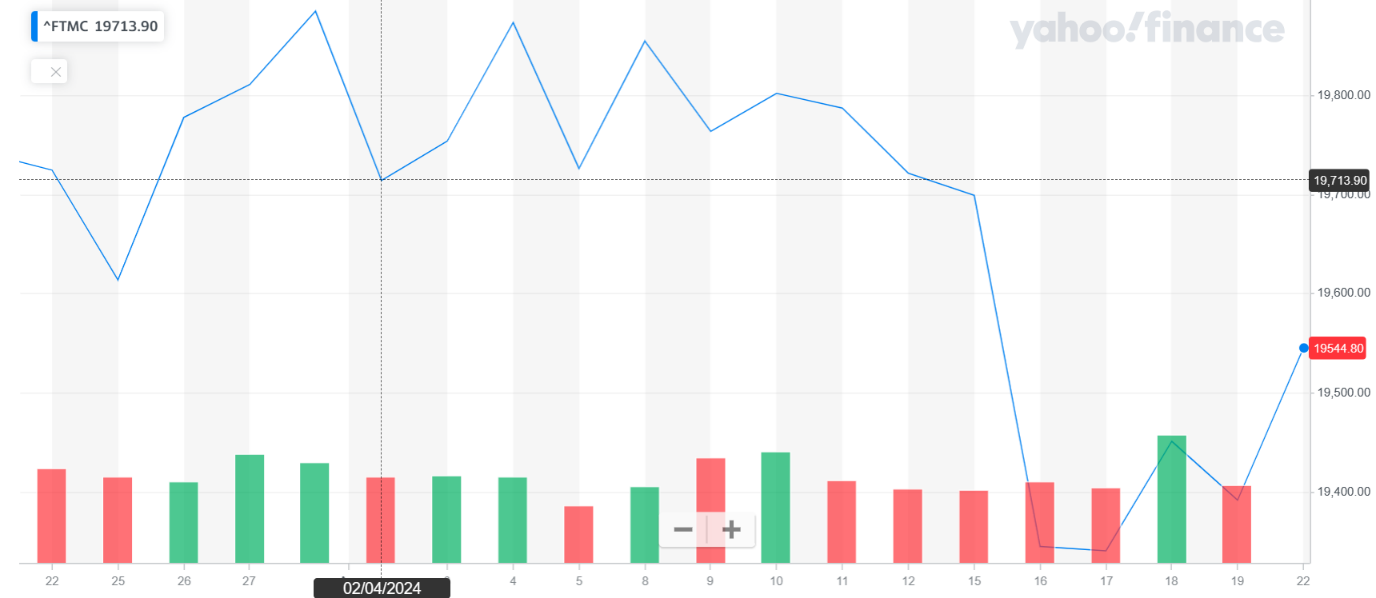
What’s more since 31 March 2024, UK Gilt yields have risen – as at Tuesday 16 April 10-year UK Gilts were yielding around 4.3%. And yet, the number of UK equity income funds continued to fall steadily. So, what’s going on? Buoyant markets perhaps? A look at the below graphs for the FTSE 100 and FTSE 250 for the month of April so far shows something of a mixed bag.

FTSE 100 firstdoceo insights 23.04.24 pic 1

Followed by the FTSE 250doceo insights 23.04.24 pic 2

The FTSE 100 marginally up. The FSTE 250 down.

So, what’s the cause?

April saw a flurry of results from UK equity income funds that have been on the Discount Watch in recent weeks:

• Dunedin Income Growth (DIG) – on 4 April, DIG unveiled an NAV total return of +6.7% for the year ended 31 January 2024. Not only did this beat the FTSE All-Share’s +1.9%, but also all the other trusts in the AIC UK Equity Income sector.

• Merchants (MRCH) – another to report on 4 April. The fund posted a -3.1% NAV total return for the year, a little off the FTSE All Share’s +1.9%. However, over the longer-term, MRCH’s track record still stacks up well having outperformed the benchmark and the sector average over three and five years. The fund also announced a 42nd consecutive annual dividend increase.

• Temple Bar (TMPL) – TMPL clocked up an impressive +12.3% NAV total return for the year ended 31 December 2023 comfortably ahead of the FTSE All Share’s +7.9%. The company reported on 3 April.

• JPMorgan Claverhouse (JCH) – on 21 March JCH announced a +7.3% NAV return for the full-year, almost matching the benchmark’s +7.9%.

• Murray Income (MUT) – on 06 March, MUT reported a +4.5% NAV per share total return (with debt at fair value) and a +6.2% share price total return for the six-month period ended 31 December 2023. That compares to the FTSE All Share’s +5.2% over the same timeframe.

• City of London (CTY) – on 16 February, CTY announced a +6.5% NAV total return for the six months to 31 December 2023. As with MUT above, a better outcome than the index’s +5.2% over the same period.

• Law Debenture (LWDB) – another to outperform. As reported on 27 February, the fund’s NAV with debt and the independent professional services business at fair value delivered a return of +9.4%, while the share price total return came in at +8.1% for 2023. The FTSE All share by contrast delivered a +7.9% total return.

Out of the above seven funds that have posted results, six outperformed over the relevant reporting periods. All in all, a decent set of results from the sector. What’s more, as a collective, UK equity income funds have delivered during a high interest rate environment. And while yields across the sector may not, at this particular moment in time at least, quite match those of other asset classes such as fixed interest or cash, the capital returns generated by the majority of funds appear to have gone some way to making up the difference.

In answer to the question, where have all the UK equity income funds gone? Onward and upwards it would seem.

« Older posts Newer posts »

© 2026 Passive Income Live

Theme by Anders Noren — Up ↑