
$10,000 doesn’t need perfect timing to become meaningful wealth — it mainly needs time and compounding.
Posted by Amy Legate-Wolfe
Published September 5, 8:15 pm EDT
You’re reading a Fool.ca free article.
- Most of the growth happens in the later years, when returns start earning returns at a larger base.
- WSP looks like a long-run compounder with record backlog and rising profitability, supported by global infrastructure demand.
- The key risks are valuation, acquisition execution, and how AI changes parts of engineering work.
A $10,000 investment doesn’t look like the beginning of a fortune. Give it 20 years, though, and it can become surprisingly ambitious.
At an illustrative 8% annual return, a single $10,000 investment left to compound for 20 years would grow to about $46,610. No additional contributions. No perfectly timed trades. Just time doing something investors frequently underestimate.
The Ontario Securities Commission’s investor education site describes compounding simply: returns are reinvested so they can begin earning returns of their own. The longer that process continues, the larger its contribution becomes. The early years are the least exciting part.
Decades of income
After 10 years at an illustrative 8%, $10,000 becomes roughly $21,589. That’s already respectable. Leave it invested another decade and the value more than doubles again.
* Returns as of July 30th, 2026
| TIME INVESTED | ILLUSTRATIVE VALUE AT 8% |
|---|---|
| Starting investment | $10,000 |
| 10 years | $21,589 |
| 15 years | $31,722 |
| 20 years | $46,610 |
An 8% return isn’t guaranteed. Stocks certainly won’t deliver it in a tidy straight line, either. Some years could produce enormous gains and others will make investors question every decision they’ve made since breakfast. The point is what happens when gains remain invested.
After 20 years, the original $10,000 generated roughly $36,610 of growth. The investor supplied less than one-quarter of the final portfolio value. Compounding did the rest. That’s why I’d rather own quality businesses for years than constantly hunt for the next short-term winner. Compound growth needs something productive to compound.
WSP
WSP Global (TSX: WSP) provides engineering, design, and consulting services across transportation, buildings, water, energy, and environmental projects around the world.
That puts WSP stock behind a huge amount of infrastructure investors rarely think about. Roads need designing. Power grids need expanding. Water systems need upgrading. Data centres, transportation projects, and new energy infrastructure all require engineers long before the ribbon-cutting photos appear.
The latest quarter suggests customers aren’t running out of projects. WSP stock finished its second quarter with a record $20.1 billion backlog, up 23.2% from a year earlier. Adjusted earnings before interest, taxes, depreciation, and amortization (EBITDA) increased 28.8% to $815 million, while organic net-revenue growth accelerated to 5%.
Looking ahead
Management also increased its 2026 financial outlook. For a long-term investor, that backlog may be the most interesting number. It represents work already waiting to be completed, giving WSP stock unusually good visibility into future revenue.
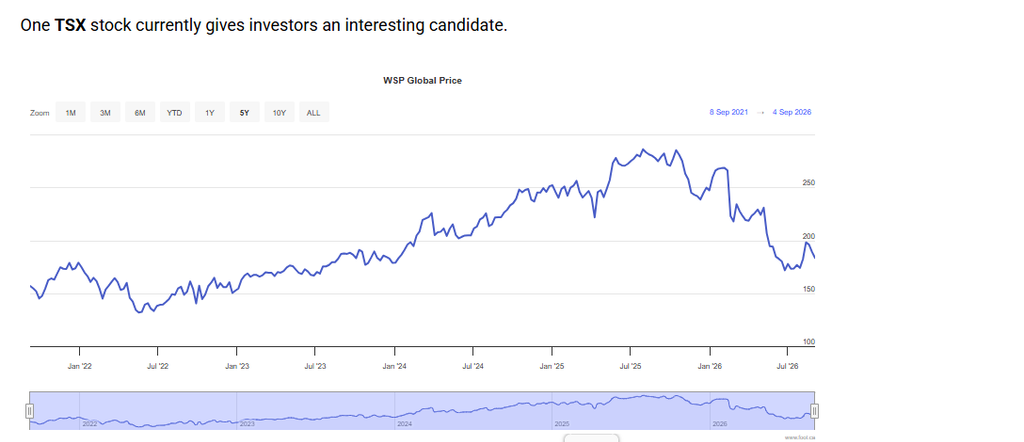
Meanwhile, WSP stock recently traded around $197. That remains roughly one-third below its 52-week high near $291. So, the stock isn’t exactly cheap at around 27 times trailing earnings. Even so, investors are paying considerably less than they were near the peak despite WSP producing record backlog and stronger profitability.
Part of the concern centred on whether artificial intelligence (AI) could eventually automate portions of engineering and design work. I wouldn’t dismiss that risk. WSP stock also grows heavily through acquisitions, and paying too much or integrating a major deal poorly could damage returns.
Its recent pursuit of Dutch engineering firm Arcadis shows both sides of that strategy. A successful acquisition could expand WSP stock substantially, but increasingly large deals also require increasingly careful capital allocation.
Bottom line
That’s why I wouldn’t buy WSP stock expecting another 8% every year like clockwork. I’d buy it because infrastructure spending, electricity demand, urban growth, and aging public assets can provide decades of work. Investors buying stocks in Canada don’t need every holding to double tomorrow.
Sometimes $10,000 simply needs a good business and enough time to become $46,610.

Leave a Reply