Investment Trust Dividends

Author: admin (Page 106 of 448)

Top 10 funds and trusts in ISAs

Company NamePlace change 
1Artemis Global Income I AccUp 1
2Royal London Short Term Money Mkt Y AccDown 1
3Seraphim Space Investment Trust Ord SSIT3.30%Unchanged
4Greencoat UK Wind UKW0.05%Up 5
5Vanguard LifeStrategy 80% Equity A AccDown 1
6Scottish Mortgage Ord SMT0.04%Down 1
7City of London Ord CTY0.18%Unchanged
8Artemis SmartGARP European Eq I Acc GBPNew
9Vanguard FTSE Global All Cp Idx £ AccUp 1
10HSBC FTSE All-World Index C AccDown 4

Royal London Short Term Money Mkt Y Acc has given up its place as the weekly ISA bestseller, ending a six-month spell at the top of the table.

The fund, which offers cash-like returns, has fallen to second place, displaced by the US-light Artemis Global Income I Acc, which returned roughly 45% in 2025.

The reshuffle partly reflects the sheer strength of returns from the Artemis fund, which takes the top spot for the first time. But there’s also a chance that the Royal London fund, and cash funds in general, could lose their shine as interest rates fall.

The Bank of England cut the rate to 3.75% in December and returns from cash funds (and cash accounts) have reduced in turn.

Investors could well now look to seemingly safe assets which pay out higher amounts, such as bonds, or even turn to riskier assets.

We’ve noted that Artemis is enjoying a moment in the sun, and another of its strong performers crops up in the list this week.

Artemis SmartGARP European Equity, which uses a proprietary screening tool to identify stock picks, returned roughly 56% last year and has a big allocation to financials, moves into the table in eighth place. The UK offering from the same franchise, Artemis SmartGARP UK Eq I Acc GBP, sits just outside the table in 15th place.

There’s the usual presence of global equity trackers (and one of Vanguard’s LifeStrategy funds) in the list, plus two very different investor favourites in the form of adventurous global growth fund Scottish Mortgage Ord  SMT

 and steady UK income play City of London Ord  CTY.

Elsewhere, it’s interesting to see two investment trusts with very different runs of performance in the top five.

With geopolitical strife back on the agenda, shares in Seraphim Space Investment Trust Ord  SSIT

many of whose holdings have been busy signing defence contracts, have returned almost 9% so far in 2026. That has pushed the shares on to a premium to net asset value (NAV), which at one point reached almost 18% last week but has since moderated to around the 9% mark.

Greencoat UK Wind  UKW

which has been in the wars amid a challenging few years for the renewable energy infrastructure sector, moves up to fourth place. It’s likely that investors still spy a bargain here, given that the shares trade on a roughly 31% discount and come with a dividend yield of more than 10%.

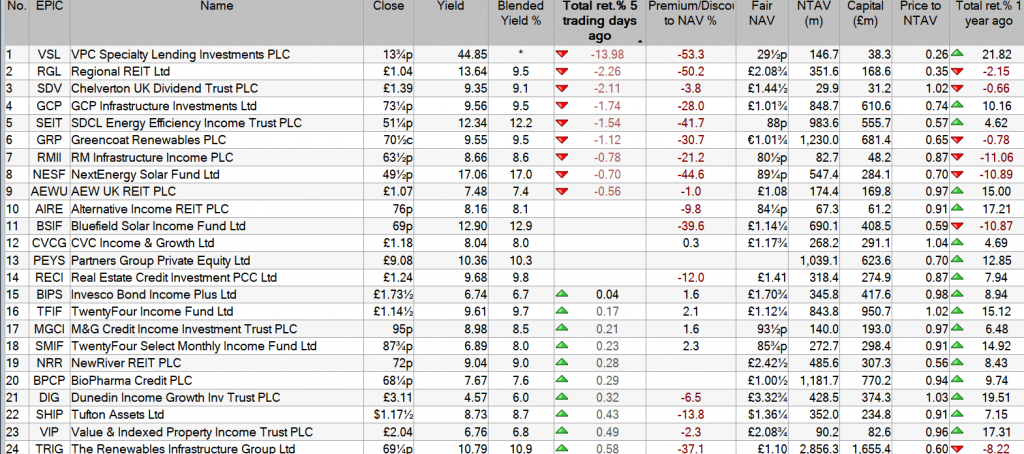
There are plenty of big yields now available in that sector, although this may suggest investors are sceptical about how sustainable they are. NextEnergy Solar Ord  NESF

shares now come with a yield just shy of 17%, for example.

Funds and trusts section written by Dave Baxter, senior fund content specialist at ii.

Today’s comment.

96 in com
96.comx
normanelsa76
Howdy! Would you mind if I share your blog with my zynga group ?
There’s a lot of folks that I think would really enjoy your content.
Please let me know. Thanks

Of course you can.

A general note about comments.

All comments are moderated and with the best will in the world no comments can be posted in a foreign language.

Although there is appeal for porn, otherwise there wouldn’t be so many sites, it’s not a suitable topic for this blog.

Ditto sex dolls.

Apologies if any comments slip thru the net.

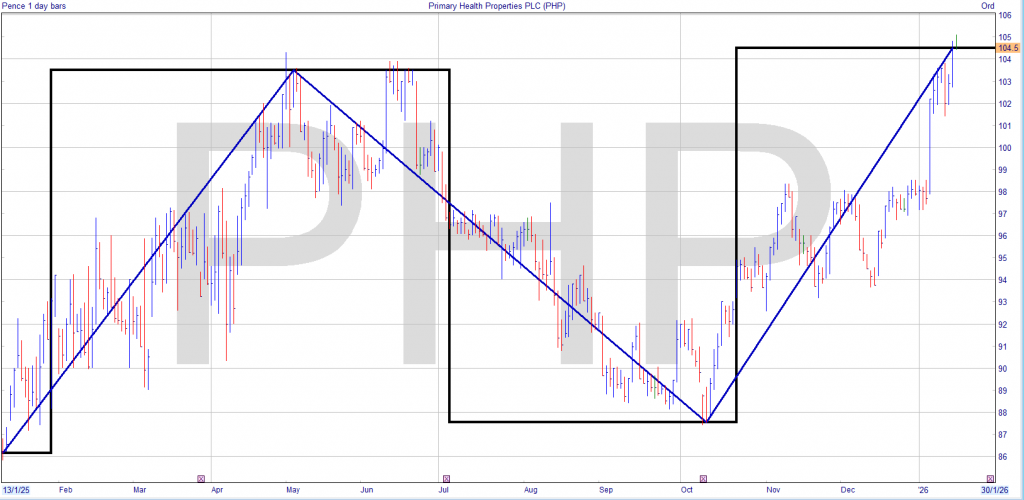
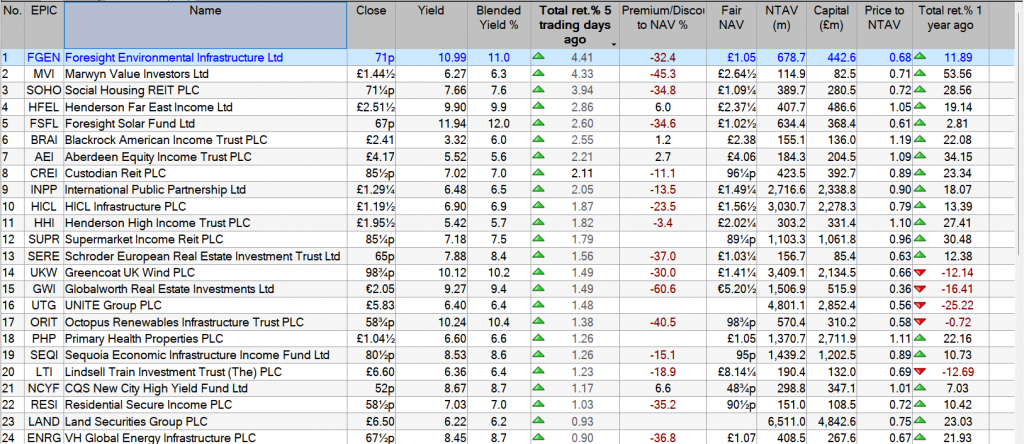
Case Study PHP

Copied from the Watch List Below.

The yield is a blend of the future fcast yield and the historical yield. Here because of the takeover of Assura the yield may change.

Notice of interim dividend

The Company announces the first quarterly interim dividend in 2026 of 1.825 pence per ordinary share, equivalent to 7.3 pence on an annualised basis, which represents an increase of 2.8% over the dividend per share distributed in 2025 of 7.1 pence and will mark the 30th year of consecutive dividend growth for PHP.  

The 1.825 pence dividend will be paid by way of a Property Income Distribution (“PID”) of 1.325 pence and an ordinary dividend of 0.500 pence on 13 March 2026 to shareholders on the register on 30 January 2026.

The Company intends to maintain its strategy of paying a progressive dividend, paid in equal quarterly instalments, that is covered by adjusted earnings in each financial year. Further dividend payments are planned to be made on a quarterly basis in May, August and November 2026 which are expected to comprise a mixture of both PID and normal dividend.

Share price £1.04 dividend 7.3p Yield 7%

You can only base your decisions on the statement from the company and take action if the future dividend changes.

There is no premium/discount to NAV as although the share is a REIT it’s an Investment Company, so you need to look at the Fair Value, which isn’t as reliable as a company’s NAV RNS.

NTAV is the capital minus any outstanding loans.

Trading Tip

Looking at the loans figure you can understand why REIT’s fall in value when interest rates rise and vice versa when they fall.

If you were lucky with your timing or new that REIT’s prices rise when interest rates fall, not all REIT’s so better to be lucky than clever, you would have made a TR return of 22%.

Which you may decide to take some or all of your profit and re-invest in another share, with a higher yield and discount to NAV.

Or maintain the holding and use the ‘secure’ dividend, no dividend is 100% secure

and re-invest the dividends in a higher yielder.

The Watch List will be reviewed at the end of the month and any shares that yield less than 5% will be deleted.

’26 Bull or Bear? Don’t Care. We’re Buying “Essential” Dividends.

Brett Owens, Chief Investment Strategist
Updated: January 14, 2026

Wall Street, please. Enough with the narratives.

CNBC and Bloomberg have become the ESPN and Fox Sports of the financial world. Stories are simplified, spun and spoon-fed to the audience.

We thoughtful contrarians can’t stomach this junk any longer!

These “experts” have vanilla investors sweating every headline. The always-impending recession. Job losses. Trade wars. Geopolitical battles. Domestic political dysfunction.

Sure, there’s a kernel of truth to every story. But investors who ride this roller coaster suffer heart palpitations and (worse!) retirement portfolio underperformance. They get scared stiff by the media coverage, sell stocks at the wrong time (near lows) and stay on the sidelines for too long.

Most investors are terrified of a recession because they own things people stop buying when times get tough. We own the things people literally cannot live without—like lunch.

Regardless of what awaits in 2026, people are going to eat. In my Hidden Yields, we played this “three meals a day” trend exactly one year ago and bought the company that processes the corn that goes into everything in the grocery store, Archer-Daniels Midland (ADM).

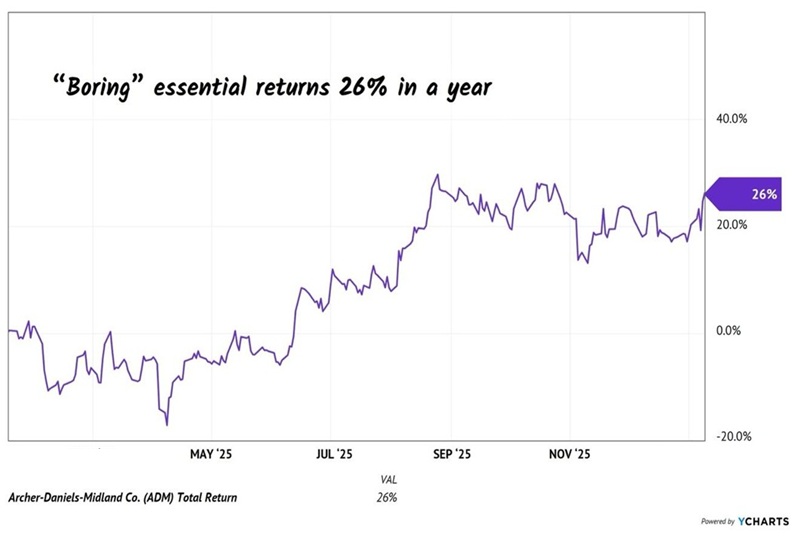
ADM is a “boring” company that prints cash in any economy. As the broader market chopped and churned over the past 12 months, this underappreciated food trade delivered 26% total returns to HY subscribers. No heart palpitations, just dividends (including one raise!) and price gains:

People Keep Eating, ADM Returns 26%

If you missed that run, I’ll share some good news—you have a second chance. ADM has pulled back in recent months, presenting us with a sweet opportunity to reload for 2026.

The stock topped out in late summer because Wall Street was concerned about low “crush margins,” industry jargon for the profit ADM makes from processing soybeans into meal and oil. Vanilla investors incorrectly saw this as a negative trend and sold the stock.

We careful contrarians know better. Agricultural markets move in predictable cycles. When corn prices are high, farmers plant more acres to chase the profit. That new supply floods the market, prices drop and farmers then plant less or switch crops (to cotton, for example).

Corn and soybean prices have come down in recent years, and the “dumb money” is fleeing the sector. This is exactly when we buy—at a cyclical low, with catalysts lining up to send related plays like ADM higher again.

Because recession or not, people keep eating. The global population is still climbing, adding millions of new mouths to feed every year. Developing nations are becoming wealthier and, with their money, people demand protein.

Raising chickens, pigs and cattle requires massive amounts of feed—mostly corn and soy meal. It takes about six pounds of feed to produce one pound of beef. This “multiplier effect” sets a floor on the corn and soybean fee inputs going forward and, guess what? They’re already about as low as they’re likely to go. It’s not a matter of if grain prices turn higher. It’s when.

Two previous worries for ADM are likely to turn into catalysts. First, policy. The EPA proposed a new Renewable Fuel Standard rule that includes higher biomass-based diesel targets. If approved, this will boost demand for corn and soybeans—and quickly improve those crush spreads. More profit for ADM.

Second, the business is getting leaner, cutting $500 to $700 million in annual costs over the next three to five years. While we wait, this “shareholder yield” monster is maximizing our future profit per share. Management’s aggressive share repurchases power a higher stock price. Over the last five years, ADM has reduced its share count by a fantastic 14%.

These “disappearances” are the quiet driver of total returns. They are the reason we earned 26% in a quiet year for crops. When ADM buys back its own stock, it reduces the number of shares outstanding. Every remaining share then owns a larger slice of the profit pie. This is how earnings per share (EPS) can increase, even if total earnings stay flat.

As we speak, ADM is using this “mini dip” in the stock price to buy back even more stock on the cheap. These smart shoppers know their stock is cheap and they are gobbling it up before crop prices rally.

Finally, there’s the dividend. ADM is a “Dividend King,” meaning it has raised its payout for more than 50 years in a row. Which means that through the inflation of the 1970s, the dot-com bubble, the Great Recession and COVID, ADM never missed a raise.

Last 20 Years of Dividend Kingpinning

I imagine it’ll do just fine through ’26, too—bull or bear!

ADM checks all the boxes we look for in Hidden Yields. Its products are essential. It’s boring. It’s bulletproof. It has plenty of upside and it generously pays us a 3.5% yield while we wait. And by the way, ADM is due to hike its dividend in the weeks ahead, making this is our last chance to “front run” the raise. Let’s not dilly-dally!

And ADM isn’t alone. I have identified five more “essential” stocks that are trading at similar valuations to where ADM was last January. These are recession-resistant dividend growers that are positioned to return 15% (or more) in the year ahead, regardless of what the economy does.

These are not the stocks you’ll see discussed on CNBC. They are too boring for TV! But they are exactly the kind of stocks that build real retirement wealth.

« Older posts Newer posts »

© 2026 Passive Income Live

Theme by Anders NorenUp ↑