Investment Trust Dividends
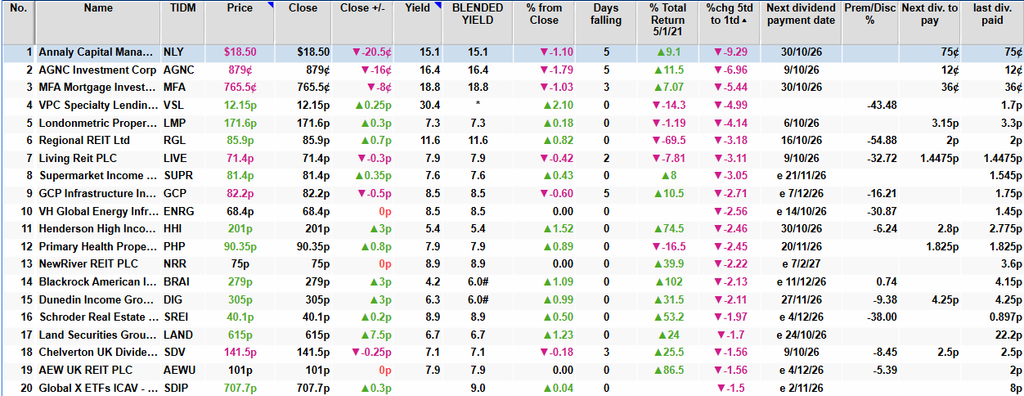
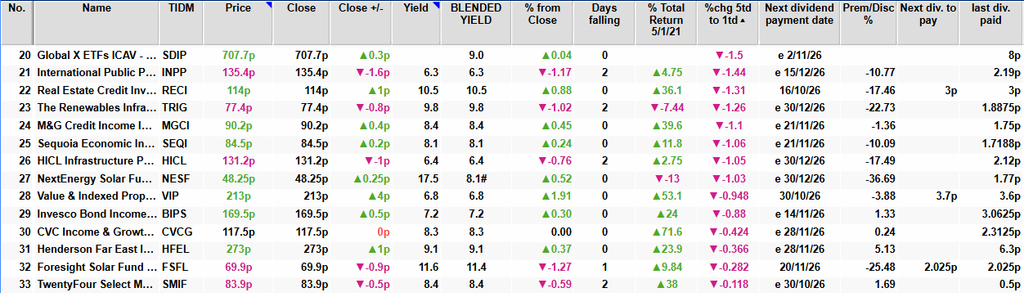
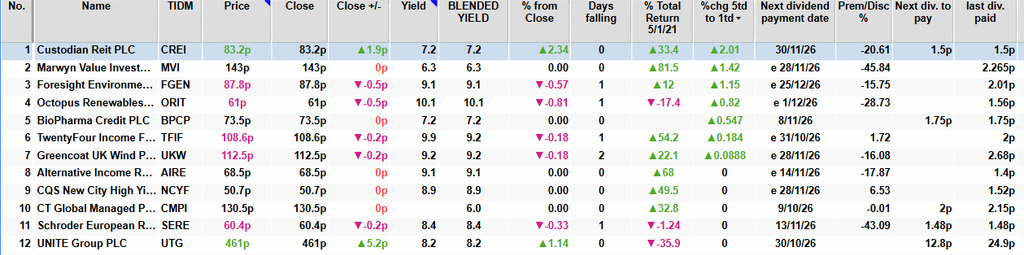
As prices fall, yields rise.
 by Michael Foster, Investment Strategist Let’s go ahead and break down a recent “win” at my CEF Insider service: an unloved fund that handed us a 48% total return in 10 months! Why? Because this call went our way for plenty of reasons – and we can take those reasons and “convert” them to strategies that can give us the kind of portfolio we all want: one that delivers healthy dividend income and strong price upside. The fund in question: the Columbia Seligman Premium Technology Growth Fund (STK), which returned that 48% from our buy call in the November 2025 CEF Insider to our sell in the recently released September issue. Let’s get into it. Step 1: Start With This “CEF-Only” Value Indicator The first thing that made STK jump out to us was the environment in late 2025. AI-bubble fears were rampant. STK is a tech fund, and wow, did those fears register with it. Before I get into how, a quick aside: as we’ve talked about here before, CEFs have a unique measure that tells us when they’re cheap or pricey: the discount to net asset value (NAV). It exists because a CEF generally can’t issue new shares to new investors, so these funds’ share counts stay more or less the same for their entire lives. This means a CEF’s market price can vary from its per-share net asset value (NAV, or the value of its underlying portfolio). This is exactly what happened as 2025 rolled on. As you can see below, STK’s total-return NAV (in purple) began to outpace its total return based on its price on the open market (orange). That was the “tell”: Investors were souring on STK, even as its portfolio performed relatively well. STK’s Portfolio Gains, Investors Start to Wonder … 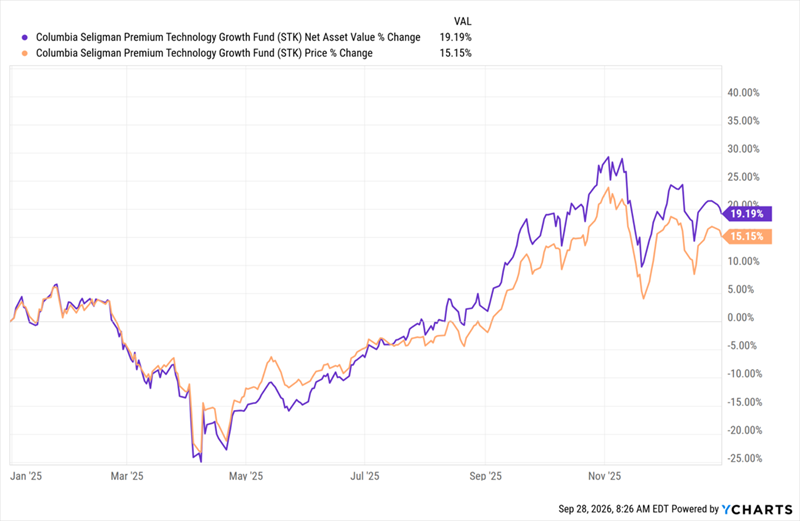 As that happened, STK’s discount broke south, to around 5.5%. This from a fund that was trading at a 5.5% premium to NAV as recently as May 2025: … And Its Widening Discount Grabs Our Attention 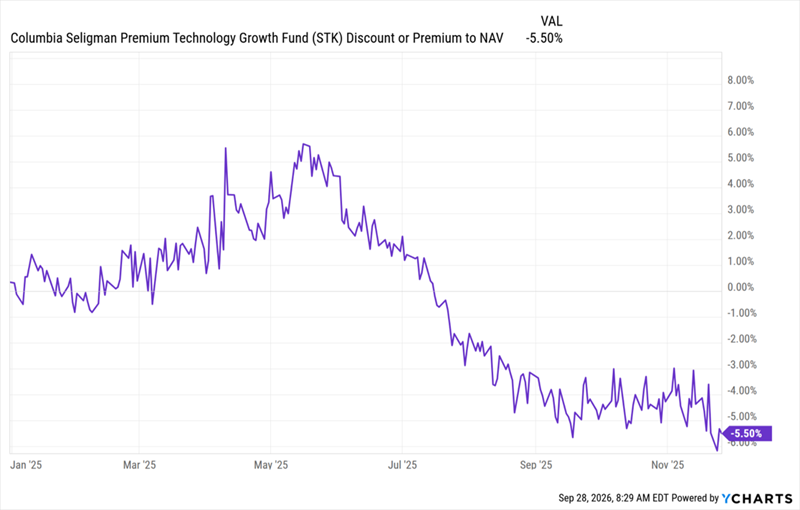 That’s the first sign that last November was a good time to buy. But as with stocks, a sudden widening discount can be a sign of trouble with CEFs. So we need to take a closer look. Step 2: “Check In” With Management When it comes to management, we have an advantage here at CEF Insider. Since this corner of the market is small (there are only about 400 or so CEFs, divided among a small number of management companies), I’ve talked to many fund-management teams over the years. That includes the team at STK, which has been in place for a long time, so we can safely say this discount did not have anything to do with any major change at the fund’s headquarters. Six portfolio managers work together to run STK. Paul Wick has been there the longest (since 2009). And even the two most recent additions, Vimal Patel and Shekhar Pramanick, have been managers at Columbia Seligman for eight years (since 2018). The takeaway? If you see a discount, pull up the fund’s documents and make sure it’s not because of a recent management shakeup. Or better yet, let me do it for you at CEF Insider! Step 3: Study the “Tale of the Tape” The best measure of management’s talent? The fund’s long-term performance, of course. But we have to make sure we’re looking at the right number here. This comes back to our earlier comparison of NAV versus market-price returns. When evaluating management, NAV matters more, as it’s more influenced by portfolio management and less by investors’ moods. There was no problem there with STK (in purple below) which had easily outrun the NASDAQ in the decade before our buy: STK’s Portfolio Shoots Past the NASDAQ 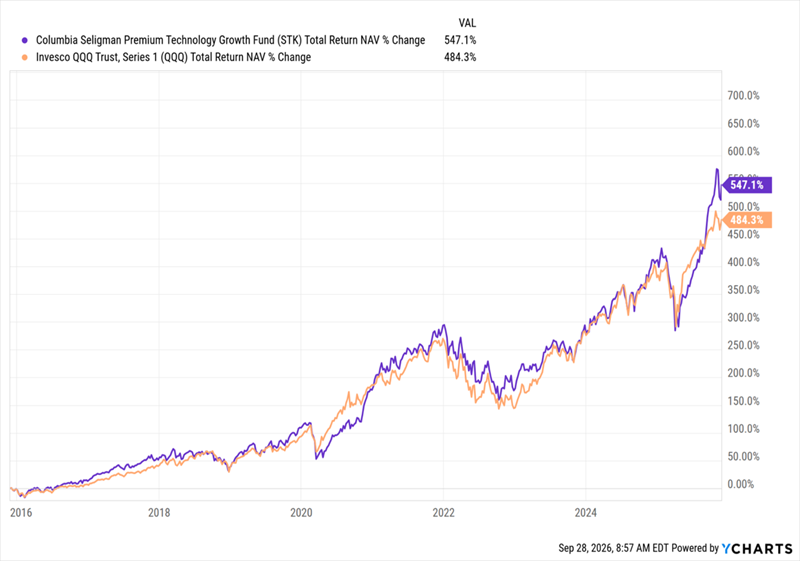 STK pulled this off by selling call options on the NASDAQ (or an ETF equivalent). That’s a relatively low-risk way to generate extra income. Beyond that, STK focuses on tech stocks, from more aggressive plays – such as fuel-cell maker Bloom Energy (BE) – to the more familiar: NVIDIA (NVDA), Alphabet (GOOGL), Apple (AAPL) and Microsoft (MSFT). So up to this point we’ve got a widening discount, a stable management team and a history of beating its benchmark. We also have a pragmatic growth-with-income focus that was overlooked as investors fretted about an AI bubble. Now let’s talk dividends. Step 4: Know Your “True” Dividend Payouts (Free Stock Screeners Are No Help) STK can fool investors who use free screeners like Yahoo! Finance and Google Finance into thinking the fund’s yield is low. That’s because these tools don’t count special dividends, which can make a huge difference with CEFs. That’s certainly the case with STK, which leans heavily on one-time payouts (the spikes below): A Steady Payout – With a Raft of Special Dividends 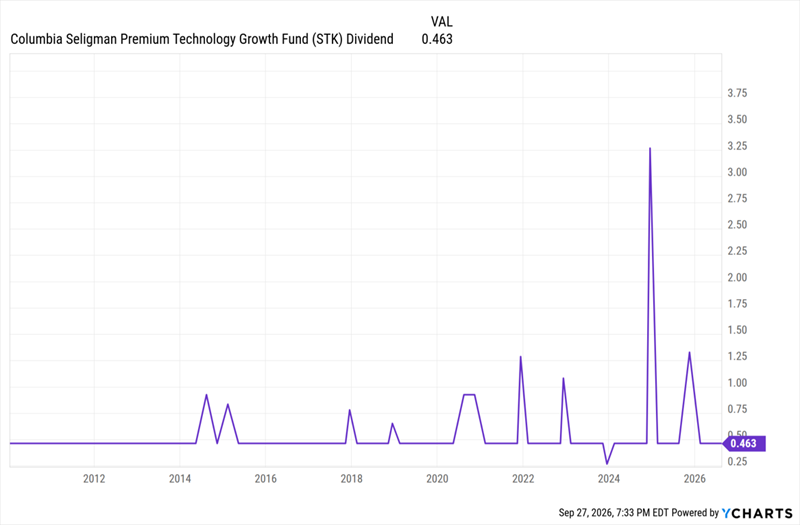 At the time of our buy, for example, you’d think the fund yielded just 5%, going by its “regular” payout. But include special payouts declared for 2025 and you get a far larger number: 8.2%. That’s way more realistic, and something most investors miss. (But something we at CEF Insider meticulously track, thanks to our advanced research tools.) The question then becomes, did STK have the performance to keep those payouts coming? The answer is yes. We can easily check this by looking at the fund’s long-term total-return NAV. STK’s Portfolio Backstops Its Payout (Two Times Over) 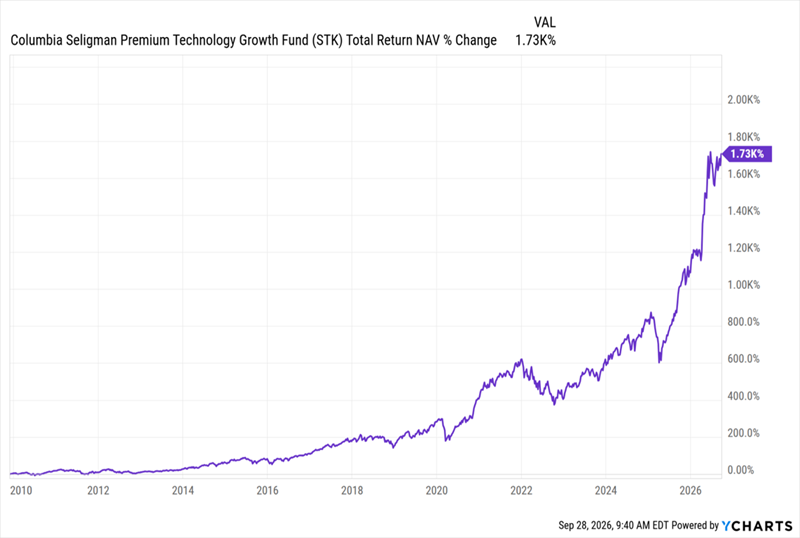 With an 18.1% annualized total NAV return since inception, STK was more than doubling the 8.2% yield on its market price when we bought, so we knew it could keep its payouts high. Here’s the scorecard to date:Unusual discount? Check.Stable management team? Check.Strong long-term performance? Check.High dividend payout? Check.The portfolio performance to back up that payout? Check.A clean sweep! And our call rewarded us with that 48% total return in just 10 months. Which leads us to our next question: How do you know when to sell and take that return off the table? Step 5: Look to NAV, Discounts and Dividends to “Time” Your Sells Traditionally with CEFs, we use the discount to NAV as our guide: When it widens to an unusual level, we look to buy. Then when the discount narrows, we sell and pocket the profits. That works, for the most part, but like most rules, there are exceptions – and STK is a fascinating one. Let’s start with the discount, which actually widened from around 5.5% just before our buy call to around 7% now, a few days after our sell. Meantime, its total return climbed 48% by market price during our holding period, while its total-return NAV gained 55%: STK’s NAV Outran Its Market Price While We Held 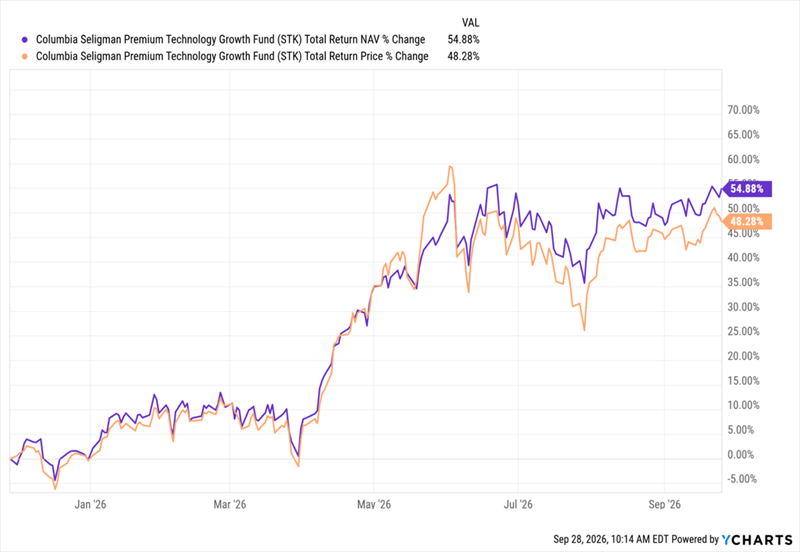 That might signal that our buying opportunity was still on the table, especially as nothing else had materially changed with the fund. Well, almost nothing else. When we sold, STK’s yield (including special dividends) had shrunk to 5.1% (and even lower without them). That was mainly driven by the fund’s strong price gains. This is where yield can play a key role as a value measurement. CEFs, of course, are mainly income investments, and a low yield (even one generated by price gains!) can cause buyers to take a pass on an otherwise-strong fund. That, in turn, would take some investors out of the market for STK, and make it harder for the fund to close that 7% discount. In other words, we want strong performance, a wide discount and a high yield to work together to attract more investors to a CEF. If one of those is missing, it’s time to sell. |
30 September 2026
Options span bonds, alternative assets, income and more.
By Emmy Hawker
Interest rates across many developed markets are on the rise as central banks battle to bring inflation under control – with the Federal Reserve and European Central Bank both hiking and the Bank of England expected to follow suit in the coming months.
For investors, the question is how to position their portfolios for a world in which interest rates will remain sticky for the foreseeable.
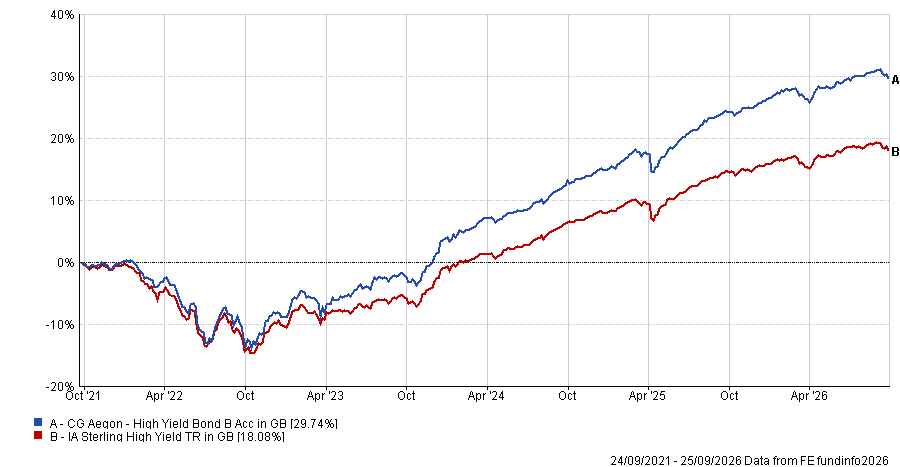
Those seeking to capture the income benefits of higher rates while limiting sensitivity to further rate moves might wish to consider high yield bonds, which Paul Angell, head of investment research at AJ Bell, described as a compelling middle ground. In this sphere, his selection was the £1.7bn Aegon High Yield Bond fund.
“High yield bonds are typically issued with shorter maturities than their investment grade counterparts, making them less sensitive to interest rate movements and better positioned to adapt to a higher-for-longer rate environment,” Angell said.
Aegon High Yield Bond has been co-managed by Mark Benbow and Thomas Hanson since 2018 and 2019 respectively, meaning they have been at the helm through the pandemic and the subsequent interest rate hiking cycle.
Over one, three and five years to the end of August 2026, the fund has logged top-quartile returns against its peers in the IA Sterling High Yield sector.
Trustnet recently highlighted the popular fund as one of the most consistent in the IA Sterling High Yield sector over the past 10 years, beating the sector average in eight years.
Performance of the fund vs sector over 5yrs
Source: FE Analytics
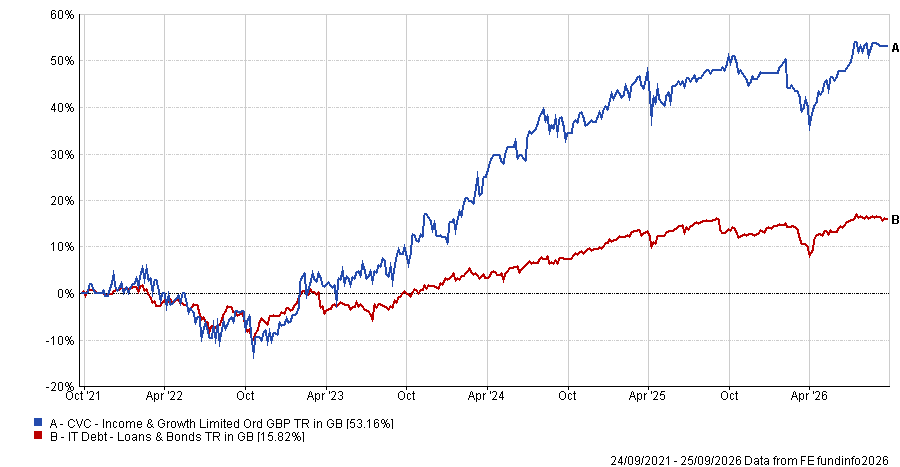
Along a similar vein, Emma Bird, head of investment trusts research at Winterflood, suggested CVC Income & Growth.
Managed by Pieter Staelens, the investment trust provides investors with access to a diversified portfolio of sub-investment grade debt instruments – primarily of European large-cap issuers, including loans, high yield bonds and structured debt.
The portfolio is typically split between performing credit, consisting of core income investments, and credit opportunities, which includes higher yielding debt with greater potential for capital growth.
“As at 31 July, 77% of the portfolio was invested in floating rate assets, meaning the fund should benefit from a rising or higher-for-longer interest-rate environment, in the form of rising/higher income generation,” Bird said.
The trust is currently trading at a narrow premium to net asset value (NAV) at 1.22%, while its sterling shares offer a yield of 8.2%.
Performance of the trust vs sector over 5yrs
Source: FE Analytics
However, while higher bond yields can offer more attractive income, Dzmitry Lipski, head of funds research at interactive investor, argued that persistent inflation and uncertainty over the path of rates call for bond funds offering flexibility and diversification.
Lipski said: “Unlike traditional bond funds aligned more closely to a particular market or benchmark, strategic bond managers can adjust duration, credit exposure and sector allocation as macro conditions change.”
This means strategic bond managers can favour shorter-duration bonds when interest-rate risk is elevated, capture attractive yields in corporate credit or increase exposure to longer-duration government bonds if growth weakens and interest rates begin to fall.
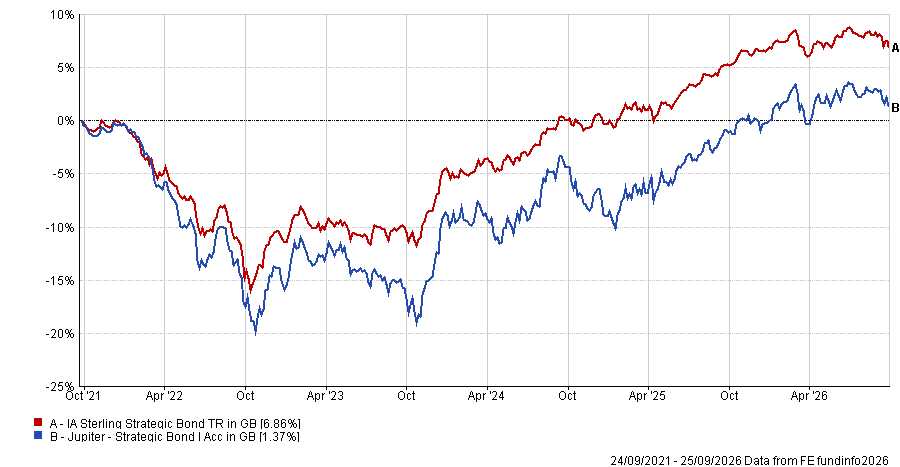
As such, Lipski suggested the £1.2bn Jupiter Strategic Bond fund, which is co-managed by Ariel Bezalel and Harry Richards.
Given the fund’s ability to alter its interest-rate sensitivity, Lipski said “it could be a flexible core bond allocation for investors comfortable with active manager risk”.
“It can capture income from higher bond yields while giving the managers scope to reposition if the economic or interest-rate environment changes,” he added.
Performance of the fund vs sector over 5yrs
Source: FE Analytics
Beyond fixed income, Lipski also pointed to global equity income strategies. The emphasis on dividend sustainability and pricing power can provide investors with a degree of protection against the corrosive effects of persistent inflation.
“Higher interest rates increase the cost of capital and can place a greater emphasis on companies with strong cashflows, resilient balance sheets, pricing power and sustainable dividends,” he said.
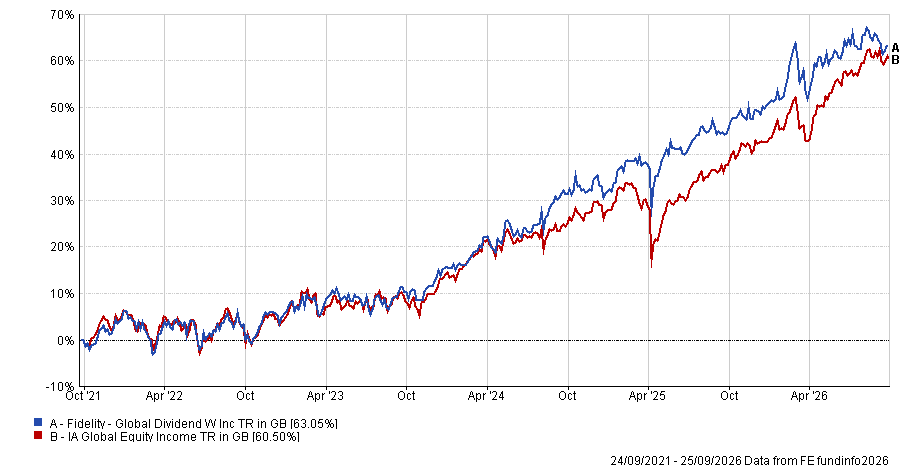
He suggested Fidelity Global Dividend, which was launched in 2012 and is managed by FE fundinfo Alpha Manager Daniel Roberts alongside Tristan Purcell.
“Within portfolios, it could be a core global equity holding with a defensive income discipline, offering participation in long-term equity growth alongside the potential for more resilient income and lower volatility than the broader global equity market,” Lipski added.
The fund returned 61.6% over the five years to the end of August 2026, beating the IA Global Equity Income sector average return of 59.4%.
Performance of the fund vs sector over 5yrs
Source: FE Analytics
Looking beyond traditional asset classes, infrastructure and other alternative assets can also provide inflation protection and diversification in a higher-for-longer environment.
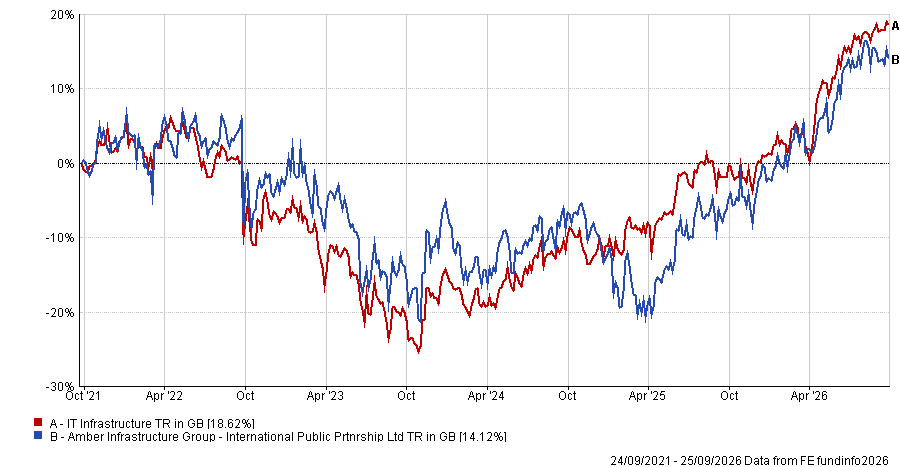
Matt Ennion, head of investment fund research at Quilter Cheviot, highlighted the £2.5bn International Public Partnerships trust. It aims to provide investors with long-term, inflation-linked returns by growing its dividend while also targeting capital appreciation.
Alongside government-backed and regulated assets, where revenues are often contractually linked to inflation, Ennion noted that even within the trust’s corporate investments, “many underlying assets benefit from inflation-linked revenue streams, providing additional resilience”.
Most of the portfolio (72%) is invested in the UK, followed by Belgium, Australia and Germany. It has just 2% invested in the US.
It is in the second quartile for returns in the IT Infrastructure sector over the five years to August 2026 and is in the first quartile over 10 years, up 53.2% over the decade.
The trust is trading at an 8.9% discount to NAV, meaning it “offers investors the opportunity to access a portfolio of high-quality infrastructure assets at an attractive valuation, making it a compelling option in an inflationary backdrop”.
Performance of the trust vs sector over 5yrs
Source: FE Analytics
Should rates stay higher for the foreseeable, then investors may also want to consider funds investing more specifically in companies that benefit operationally from higher rates, such as banks or insurers.
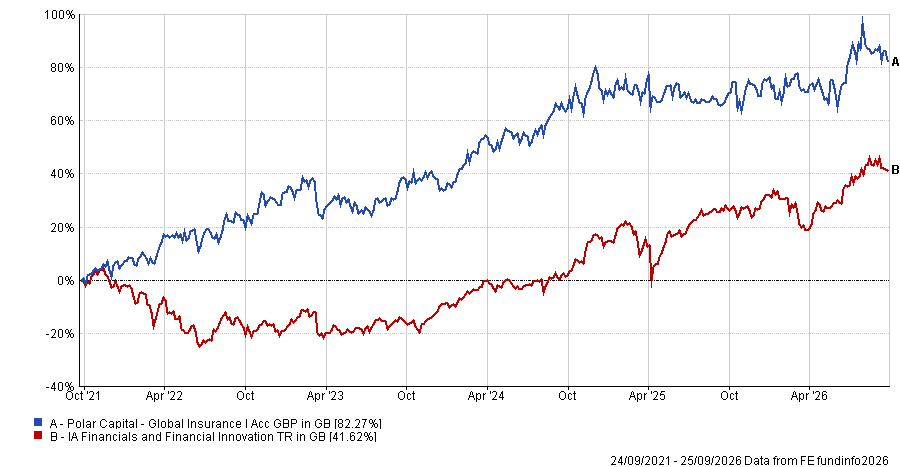
For funds in this category, Angell pointed to Polar Capital Global Insurance, which has £2.3bn in assets under management invested in companies operating within the international insurance sector.
He said: “Higher interest rates are not universally bad news. In fact, they can be highly supportive for insurance companies, which earn investment income on large pools of premiums before claims are paid.”
Rather than relying on traditional economic growth drivers, insurers’ earnings are largely linked to underwriting profitability and investment income.
“Polar Capital Global Insurance is managed by a specialist team with deep industry expertise,” Angell noted. “Within a portfolio, the fund acts as a diversifying global equity holding that can benefit from elevated interest rates whilst offering exposure to a defensive and often overlooked part of the market.”
Performance of the fund vs sector over 5yrs
Source: FE Analytics

Primary Health Properties PLC

Q3 Update on rental growth and joint ventures
Primary Health Properties PLC, a leading investor in critical healthcare infrastructure in the UK and Ireland, today publishes an update for the period to 30 September 2026 demonstrating continued rental growth, positive momentum in asset management and risk-controlled development and progress on our joint venture transactions.
Mark Davies, CEO of PHP, commented:
“PHP’s portfolio of critical healthcare infrastructure assets is defined by the security and longevity of rental income from GPs, the NHS, the HSE in Ireland and proven private healthcare operators, giving our sector attractive investment characteristics. We continue to deliver rental growth slightly ahead of our guidance and are encouraged by recent investment transactions in our sector at supportive valuations.
“We remain focused on completing the previously announced deleveraging plan and we are pleased to report that key transactions with our joint venture partners remain on track.”
Rental growth remains ahead of guidance
The Company continues to see an improving rental growth outlook, especially from rent reviews, with an extra £5.8 million of income generated in the first 9 months of the year from 480 completed reviews. This represents a total increase of 6.1% over the previous rent of £96 million, equivalent to 3.1% (target: >3%) on an annualised basis. All parts of the enlarged portfolio are performing very well with Primary Care UK +2.8%, Private Hospitals +3.7% and Ireland +3.7%.
Active asset management and development
The Government remains committed to the NHS 10-year plan and the creation of new Neighbourhood Health Centres, aiming to increase both the capacity for, and range of, healthcare services in a primary care setting and to relieve the pressure on NHS hospitals. PHP offers both the asset management and development capability to deliver this essential improvement in critical healthcare infrastructure over the coming years for the benefit of patients, health occupiers and investors.
We have recently completed significant asset management projects at our assets in Wakefield and Yeovil, both of which increase clinical space to enhance healthcare services and set a positive rental tone in the locality, and we continue to target further value generating asset management projects. This includes opportunities in private hospitals, such as the £6.5 million extension to Tees Valley Hospital in Middlesborough that has moved on site in the quarter.
PHP is currently on site with five new build development projects across the UK and Ireland, which all remain on track for completion on time and on budget. Our enhanced development capability means we have a growing pipeline of risk-controlled development opportunities across the UK, including a number of schemes meeting the criteria of Neighbourhood Health Centres and a strategic partnership with East of England Ambulance Service Trust for the delivery of new ambulance hubs, that are expected to be funded through the existing primary care joint venture.
Joint venture transactions remain on track
PHP has made further progress on its joint ventures since the Interim Results in late July. The transactions remain on track with financial terms agreed and due diligence complete. A further update will follow shortly.
Proceeds from the sale of assets into joint ventures will be used to pay down debt. The Company remains focused on bringing the key debt metrics of Net Debt to EBITDA below 9.5 times and LTV below 50%.
The Company is pleased to have completed the integration of Assura during the period and expects to deliver its financial synergies ahead of plan.
PHP’s portfolio of modern healthcare buildings, which act as essential infrastructure for the delivery of healthcare services in the UK and Ireland, offer secure and growing rental income in a market benefitting from long-term structural demand. With a strong track record of cost control, with one of the lowest EPRA cost ratios in the sector and a disciplined approach to liability management, PHP is proud to be in its 30th consecutive year of delivering dividend growth for investors and remains committed to a progressive covered dividend policy.
I’ve bought 141 shares in AGNC, xd today for 1k, currently yielding 15%.
As this is high risk, the SNOWBALL will pair trade the position with another ‘share’ with a blended yield of 10%.

Fiona Craig
LSE:SUPR
29 September 2026
Supermarket Income REIT (LSE:SUPR) is entering its next phase of growth with a portfolio now established at over £2 billion, a strong financial performance and ambitions to more than double the scale of the business over the coming years.
The company delivered a 7.5% total accounting return for the year, while continued acquisition activity has helped expand earnings and strengthen the platform for future dividend growth.
Speaking to ADVFN’s Watch List, Rob Abraham, CEO of Supermarket Income REIT, highlighted the role of acquisitions and the company’s growing scale in driving performance.
Acquisitions driving earnings growth
According to Abraham, the company’s strong performance has been underpinned by an active approach to acquisitions and the development of a more efficient investment platform.
A key step has been the establishment of a joint venture with Blue Owl Capital, which has now been scaled to £855 million.
The structure has enabled Supermarket Income REIT to recycle capital and reinvest proceeds into further earnings-enhancing acquisitions, creating additional capacity for growth.
The objective is not simply to expand the property portfolio, but to build the earnings base needed to support sustainable dividend growth.
Supermarket Income REIT has also set a target of at least 2% annual dividend growth from FY2027, with the growing scale of the platform helping to support that ambition.
Abraham also pointed to the benefits of scale, with the company continuing to build an efficient operating platform and improve its cost ratio as the portfolio grows.
A £4bn opportunity
With the portfolio now over £2 billion, Supermarket Income REIT has set its sights considerably higher, targeting £4 billion and beyond.
The opportunity extends across the wider grocery property market, where the company believes its sector specialism gives it the ability to identify and underwrite opportunities across a broad range of assets.
That includes traditional large-format supermarkets, which remain an important part of the strategy, alongside smaller-format and convenience stores.
The company is also looking further along the grocery supply chain, including grocery logistics properties and distribution warehouses that support store networks.
There is also potential to expand the strategy into European markets.
Maintaining quality as the portfolio grows
Importantly, the strategy is not simply about increasing the size of the portfolio.
Supermarket Income REIT intends to maintain a strong quality profile as it scales, using a combination of lease length, tenant quality and investment-grade characteristics when assessing opportunities.
Abraham outlined a target portfolio structure of approximately:
This provides a clear framework for how the company intends to grow while maintaining the defensive characteristics of its existing portfolio.
The focus remains on properties operated by leading grocery businesses, with Supermarket Income REIT targeting some of the most important and mission-critical assets within their networks.
Building on a strong platform
With a £2 billion portfolio already established, an £855 million joint venture vehicle and a clear ambition to reach £4 billion and beyond, Supermarket Income REIT is positioning itself for another stage of expansion.
The combination of acquisition-led earnings growth, increasing scale and a focus on long-duration, inflation-linked grocery income provides the foundation for the company’s next phase.
For investors following the UK real estate sector, Supermarket Income REIT’s progress will be closely linked to its ability to continue deploying capital into attractive grocery property opportunities while maintaining the quality and resilience of its income base.
As Rob Abraham explains, the strategy is ultimately about using scale to grow earnings, support dividends and build a larger portfolio while retaining the attractive fundamentals that have defined Supermarket Income REIT to date.
For more information visit Supermarket Income REIT
This article was written by the editorial team at InvestorsHub/ADVFN

Michael Foster, Investment Strategist
Updated: September 28, 2026
Today I want to talk about something we don’t touch on very often in these columns: an obscure (yet highly profitable) situation called a “tender offer.”
I know the name sounds a bit stiff. But if one comes along when you hold a closed-end fund (CEF)—particularly a CEF you bought when it was particularly oversold—wow.
You can find yourself sitting on a fast gain as well as a high dividend payout (as I write this, the average CEF yields around 9%).
As we’ll see in the case of one CEF below, a tender offer can take a fund purchased at an 11.5% discount and let the shareholder cash in a chunk of their holding at nearly full value.
Before I get into a tender offer one group of investors is getting a shot at now, let’s break down this happy turn of events, and look at the simple way you can boost your odds of benefiting from one yourself.
We’ll do that by first putting one of the main features of CEFs on the table: the fact that these funds generally have a fixed number of shares throughout their lives. That’s why CEFs are “closed.” ETFs, by contrast, are “open,” since they can issue as many new shares as the market will buy.
The main effect of this is that CEFs often trade at different levels in relation to their net asset value (NAV, or the value of their underlying portfolios), and often at a discount.
Which brings us to the Virtus Dividend, Interest & Premium Strategy Fund (NFJ), a CEF at the center of a recent (and quite rich) tender offer.
NFJ’s shares trade at a 5.4% discount to NAV as I write this. This means we can buy the stocks this fund holds—including Alphabet (GOOGL), Advanced Micro Devices (AMD), the Charles Schwab Corp. (SCHW) and Eli Lilly & Co. (LLY)—for 5.4% less than if we’d bought those shares on the market.
Lately, that discount has been narrowing:
NFJ’s Discount Approaches Par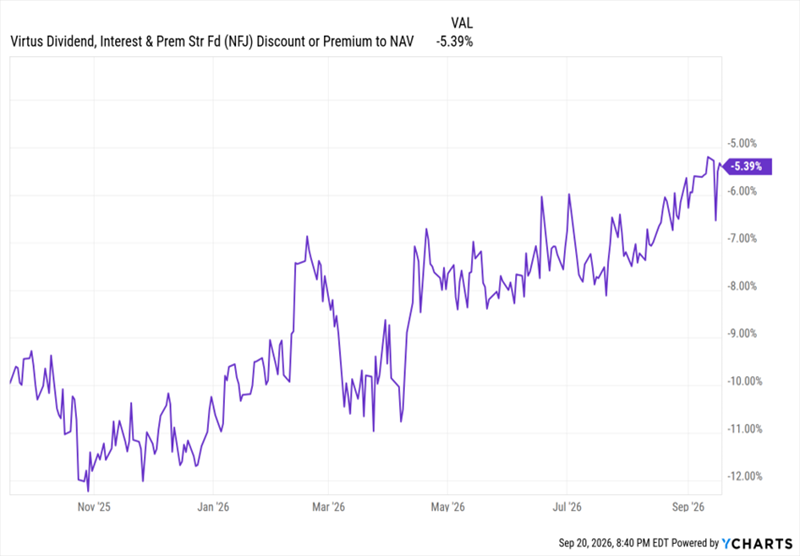
As you can see, NFJ has traded at a much wider discount in the past year, and in fact its average discount over the last decade is 11.5%.
Right now, NFJ yields 8%, which is normal for this fund. And if you buy when it’s at a wide discount and then sell at a smaller discount (or premium), you also set yourself up for gains. This is the magic of CEF investing. And a tender offer, in essence, supercharges it.
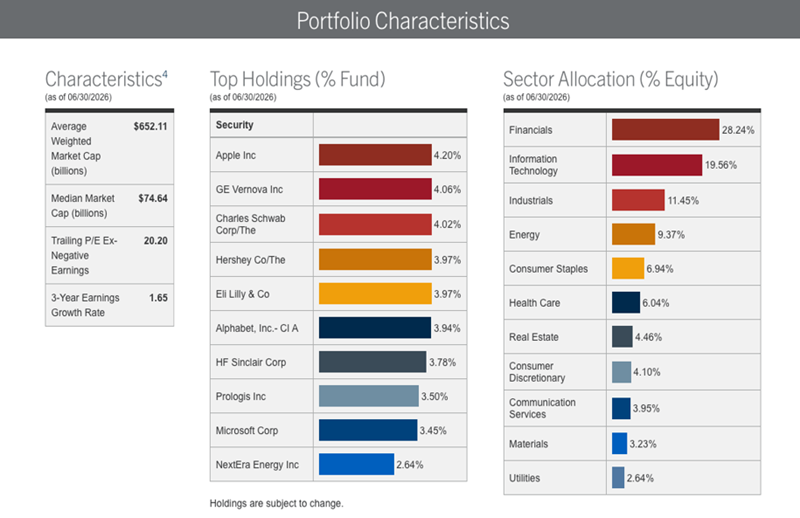
Source: Virtus Funds
NFJ, as you can see above, mostly holds large-cap stocks across sectors, making it a decent replacement for an S&P 500 index fund. That is, except for a critical detail: that 8% income stream. Most index funds pay around 1%. We’re obviously not retiring on that.
There’s a catch, though: NFJ has underperformed the S&P 500 in the long run:
NFJ: A Strong Fund, But Only for Short Periods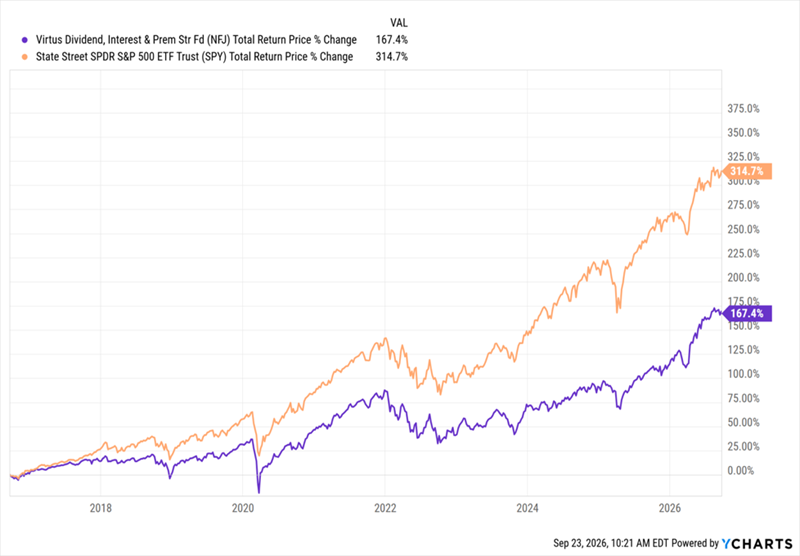
With this in mind, the best strategy is to hold NFJ for short periods and collect income while profiting from changes in the discount. CEF managers (including those at NFJ) are aware of this—and they’ll do what they can to ensure discounts don’t stay too wide for too long.
If they fail to narrow those markdowns, they open the door for activist investors to come in, buy up shares and force a vote that could remove those managers.
How NFJ’s Tender Offer Works
This was the situation for NFJ, which is why management announced a tender offer. This offer is the result of an agreement with activist investor Saba Capital Management.
Under NFJ’s offer, which opened on September 1, 2026, the fund aims to buy back up to 25% of its outstanding shares at 99% of its NAV at the close of trading on October 5 (the offer’s expiration date). If investors holding more than 25% of NFJ’s shares outstanding tender their holdings, management will buy them on a pro rata basis.
If you bought at a wider discount than that at which the fund is buying (again, just 1% below NAV)—and with a 10-year average discount of 11.5%, most long-term holders did—you get to cash in at close to full value. Essentially, the average buyer over the last decade picked up the fund for 88.5 cents on the dollar and can now tender at 99 cents.
Note that you have to elect to tender through your broker.
I think you’ll agree that this is a nice upside kicker. And of course it comes alongside any other gains you booked from the fund, as well as the dividends collected (noting, of course, that the payout has risen about 36% in the last five years, with a special dividend issued, too).
(That also, of course, means that if you buy near the current discount, you’ll get a smaller return from the tender offer than those who bought earlier, at bigger discounts, would.)
So where does that leave us? I like to think of tender offers the same way we would a takeover in a regular stock. They unlock value, but we can’t, of course, invest only with the hope of attracting one. The best thing to do is buy cheap, which puts us in a better position to profit if and when one comes along.

Thursday 1 October
Custodian Property Income REIT PLC ex-dividend date
F&C Investment Trust PLC ex-dividend date
Henderson Smaller Cos Investment Trust PLC ex-dividend date
Invesco Asia Dragon Trust PLC ex-dividend date
International Trust PLC ex-dividend date
Murray International Trust PLC ex-dividend date
North American Income Trust PLC ex-dividend date
Pantheon Infrastructure ex-dividend date
Polar Capital Global Financials Trust PLC ex-dividend date
RIT Capital Partners PLC ex-dividend date
RM Infrastructure Income ex-dividend date
Schroder Income Growth Fund PLC ex-dividend date
Schroder Japan Trust PLC ex-dividend date
Value & Indexed Property Income Trust PLC ex-dividend date
Murray International Trust PLC ex-dividend date

I have bought an opening position in PCT. (see earlier post)
28 Shares for £200.The purchases will make very little difference to the SNOWBALL until a meaningful amount is invested.

© 2026 Passive Income Live
Theme by Anders Noren — Up ↑