
Investment Trust Dividends


2024 Target
When the transaction for RGL completes, the target for the blog may be able to be increased to 9.5k, which would equal the planned target for the end of 2027.

How to target a £60,000 second income with a brand-new investment portfolio© Provided by The Motley Fool
by Zaven Boyrazian, MSc
So with that in mind, let’s explore some best practices for income investing and how to aim for a £60k long-term portfolio income stream.
Across the UK, the average household is able to save roughly £450 a month. Suppose that money is allocated to a FTSE 100 index fund today. In this scenario, investors can expect to earn between 6% and 8% a year moving forward, based on the historical performance of the UK’s flagship index.
Around half of these gains stem from dividends. And at a 4% yield, each £450 monthly investment would unlock roughly £18 of annual passive income. Needless to say, that’s not exactly a life-changing sum. But that quickly changes once compounding enters the picture.
Having an extra 26 grand in the bank each year is certainly nothing to scoff at. But by being shrewd and taking on a bit more risk, it’s possible to more than double this second income.
Instead of mimicking market returns with an index fund, investors can take their income portfolio into their own hands. The London Stock Exchange is filled with dividend shares offering yields significantly higher than 4%.
Suppose a portfolio of these enterprises delivers a 6% yield while still delivering another 4% in capital gains? In that case, after 30 years of £450 monthly deposits, a portfolio would reach into the seven-figure territory, generating £60,000 of dividends each year.
Earning almost twice the average national salary without having to lift a finger is an undeniably awesome prospect. But it’s important to realise that none of it is guaranteed.
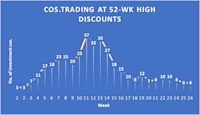
We estimate there to be six Investment Trusts trading at 52-week high discounts with three new names making it into the latest Discount Watch.

ByFrank Buhagiar•01 Jul, 2024•

We estimate there to be six investment companies trading at 12-month high discounts over the course of the week ended Friday 28 June 2024 – the same number as the previous week.
Discount Watch
We estimate there to be six Investment Trusts trading at 52-week high discounts with three new names making it into the latest Discount Watch.
By
Frank Buhagiar
We estimate there to be six investment companies trading at 12-month high discounts over the course of the week ended Friday 28 June 2024 – the same number as the previous week.
There are a couple of of new names to highlight, or in the case of Downing Strategic Micro-cap (DSM), a reappearing name. DSM, which is in wind-down mode, last appeared on the Discount Watch List on 10 June 2024. It subsequently disappeared from the list only to find itself among Winterflood’s top-five monthly movers. The sharp turnaround in fortunes appears to be down to the fund’s ongoing managed wind-down.
On 18 June 2024, DSM announced a third special interim dividend of 17.5 pence per share, equivalent to, in aggregate, £8.0 million. Fast forward to 27 June and DSM shares went ex-dividend. That means those who buy the shares now will no longer be eligible for that special dividend. To reflect this, the share price dropped by the amount of the dividend to be paid. The dividend is due to be paid on 18 July so net assets haven’t yet been adjusted downwards. Share price down + net assets unchanged = shares back on the Discount Watch. Question is, will DSM’s shares muscle their way back into Winterflood’s top-five movers once the dividend is paid in July?
Next new name to mention, The Renewables Infrastructure Group (TRIG). No news out this past month apart from Company announcements detailing fractional movements in wealth manager Brewin Dolphin’s interest in the fund. Not much to write home about there. And not much in the way of press coverage either. Something of a mystery then as to why the shares are trading at a year-high discount to net assets. Does Mr Market know something the rest of us don’t ? One to keep an eye on.
Finally, Henderson High Income (HHI). Only new news out, the latest monthly factsheet on 21 June 2024 showing a NAV total return of +2.7% for May compared to the composite benchmark’s (80% FTSE All-Share Index/20% ICE BofA Sterling Non-Gilts Index) total return of +2.1%. Imagine what the shares would have done if the fund had underperformed the index.
The top-five discounters
Fund Discount Sector
Ground Rents Income GRIO -70.60% Property
Ceiba Investments CBA 69.64% Property
Downing Strategic Microcap DSM -69.40% UK Smallers
The Renewables Infrastructure Group TRIG -26.08% Renewables
Henderson High Income HHI -11.08% UK Equity & Bond Income
The full list
Fund Discount Sector
Ceiba Investments CBA -69.64% Property
Ground Rents Income GRIO 70.60% Property
Renewables Infrastructure Group TRIG -26.08% Renewables
Diverse Inc DIVI 10.91% UK Equity Income
Henderson High Income HHI -11.08% UK Equity & Bond Income
Downing Strategic Microcap DSM -69.40% UK Smallers
A fundraise, an insider purchase and yet another tender offer in this week’s
Frank Buhagiar
02 Jul, 2024
Regional REIT launches £110.5 million fundraise
Regional REIT (RGL) announced a £110.5 million capital raise via a fully underwritten Placing, Overseas Placing and Open Offer at 10p a share to repay a £50 million Retail Bond, reduce bank facilities and fund selective capital expenditure on assets. Winterflood explains, RGL ‘is seeking to raise more than double the amount needed to repay this bond in net proceeds, which could indicate Board concerns regarding potential breaches of other debt facility covenants or concerns over the ability to maintain the dividend over the medium term in the absence of earnings enhancements from CapEx.’
The 10p per share issue price represents a sizeable 82.3% discount to the latest published NTA per Share of 56.4p. Back to Winterflood, ‘The extent of the discount to EPRA NTA per share at which this fundraising will occur will clearly be highly dilutive to shareholders. We would expect shareholders to approve the fundraising at the EGM given that it should enable the fund to remain a going concern and continue its dividend payments, but suspect that this event may weigh on investor sentiment for some time. We continue to view RGL as a special situation.’
Cordiant Digital Infrastructure Chairman tops up holding
Cordiant Digital Infrastructure (CORD) Chairman and Co-Founder, Steven Marshall, purchased a total of 800,000 CORD shares at an average price of 78.7p per share on 20 June 2024. Not the first time Mr Marshall has dipped into his pockets to buy shares – he now owns a total of 9,075,200 ordinary shares in the fund.
Schroder Japan’s enhanced dividend
Schroder Japan’s (SJG) 24 June 2024 press release set out plans to adopt an enhanced dividend policy to pay out 4% of average net asset value in each financial year. Not that SJG hasn’t been generous when it has come to paying shareholders dividends. Over the last 10 years, the fund’s dividends have grown by 12.7% on an average yearly basis. But with dividends playing an increasingly important part of shareholder returns in Japan, the Board believes there’s scope to enhance the dividend policy further.
That’s not all. A new Conditional Tender Offer mechanism is also being proposed. If the fund does not perform at least in line with the Tokyo Stock Price Index Total Return in sterling terms over a five-year period starting from 31 July 2024, then the Board will put to shareholders a proposal for a tender offer of 25% of the issued share capital at a price equal to the prevailing net asset value less costs.
Numis: ‘Schroder Japan currently has a similar mechanism in place, whereby a tender for 25% of share capital is triggered if NAV total returns do not exceed the Topix by 2% pa over the four years to 31 July 2024, although this is highly unlikely to be triggered given the funds outperformance over this period.’
Bankers on course for 57th year of dividend growth
Bankers (BNKR) expects to increase its full-year dividend by at least 5%. If it does, and as explained in the Half-year Report, this would maintain the Company’s progressive dividend policy of successive annual dividend growth which it has achieved over the past 57 years.
The Results Round-Up –
Which investment company has grown its NAV per share by +891% over the last 15 years? And what gets Monks’ investment managers excited?
By
Frank Buhagiar
05 Jul
Monks’ (MNKS) Investment Managers Reveal What Gets Them Excited
MNKS’ NAV total return came in at +17.6% for the full year while the share price total return matched the FTSE World Index’s +19.1% exactly. On the one hand, Chairman, KS Sternberg, is encouraged by the return to positive relative performance after the last two years’ declines but on the other ‘we are well aware that on a NAV basis, this is the third year of underperformance.’ In response, the investment process has been refined with a particular focus on valuation discipline. The managers explain, however, that the core approach to managing Monks remains consistent: selecting stocks on the basis of their fundamental attractions without reference to the index; investing in a diversified portfolio of companies that can deliver superior levels of earnings growth; and allowing compounding to ‘work its magic’ by being patient.
The investment managers go on to talk about what gets them excited ‘Growth companies excite us. From AI, to gravel, to storm drains, to digital payments, Monks seeks to give shareholders exposure to the world’s leading beneficiaries of change, whatever the sector, wherever in the world.’
Numis: ‘Monks is differentiated from its stablemates: Scottish Mortgage (more concentrated plus unquoteds); Edinburgh Worldwide (smaller companies); and Scottish American (income mandate). Since the team took over management on 27 March 2015, Monks’ NAV has risen 172% (11.4% pa), slightly underperforming FTSE World Index which has returned 187% (12.0% pa).’
JPMorgan: ‘MNKS is large for an investment company with a market cap of £2.4bn and has low competitive costs (44bps) and it trades at one of the wider discounts in the AIC Global sector at 11.6% vs the average of 9.0%. In our view MNKS is one of the better global equity growth options in the sector and we remain Overweight.’
Investec: ‘We regard Monks as a core strategic holding for investors looking for a well-managed, lower-risk and low-cost exposure to Baillie Gifford’s best global growth ideas. A differentiated philosophy, strong corporate governance and a strong balance sheet represent solid foundations and Monks is well-positioned when markets broaden from historically narrow levels.’
Artemis Alpha (ATS), Showing How It Can Pay to Be Different
ATS’ NAV per share gain for the year was double that of the FTSE All-Share – up +15.1% compared to the index’s +7.5% on a total return basis. According to Chairman, Duncan Budge, ATS was able to achieve this because the portfolio bears little relationship to the FTSE All-Share and ‘the stock-selection is not constrained by it. As the last three years have shown, short-term performance is likely to bear very little resemblance to the benchmark; our aim remains to out-perform it over the long term.’ Vive la difference!
Looking ahead, Budge cites an improving macro environment and low valuations across the UK market as reasons to be optimistic. ‘Many of our investee companies stand to benefit from the improved prospects for consumer spending reinforced by clear competitive advantages’. The Chairman is also looking forward to the prospect of a more stable political environment after the election’ as this may help to improve the rating of UK companies.
Numis: ‘Artemis Alpha (ATS) has a triennial tender for 25% of share capital at a 3% discount, with the next due to take place later this year at the AGM. Within its annual results, the Board comments that the tender will be subject to the level of the discount prevailing at that time as well as shareholder approval’.
BlackRock Sustainable American Income (BRSA), Focusing on Quality
BRSA’s NAV per share return marginally outperformed the benchmark over the half year – up +15% compared to the Russell 1000 Value Index’s +14.8%. The NAV performance wasn’t far off the +17.2% clocked up by the larger-cap S&P 500 (sterling). The biggest contributor to relative performance was stock selection, particularly in the healthcare and consumer discretionary sectors. The investments managers believe the current “late cycle” economic environment in the US is ‘best suited for ‘quality’ companies, i.e. those which demonstrate consistent earnings, have strong balance sheets and have savvy management teams among other characteristics. These companies should be well positioned to manage through the economic cycle’.
Valuation discipline is important too ‘we feel valuation discipline is key given higher than average forward price-to-earnings ratios for equity markets.” As is a “focus on more secular themes which may offer more attractive investment opportunities, such as reshoring and AI/digitalisation.’ What could be called the QVT approach – Quality, Valuation, Themes.
Winterflood: ‘Share price TR +15.9% as discount narrowed slightly from 10.1% to 9.6%; 2.9m shares (3.6% of shares in issue) bought back for £5.6m. EPS -20.5% YoY to 1.59p, reflecting portfolio mix tilting to lower yielding stocks’.
Oryx International Growth (OIG) Cashed Up and Ready to Go Again
OIG reported a +12.2% increase in NAV for the full year. As Chairman, Nigel Cayzer, writes ‘When compared against the smaller companies indices, this is a good result.’ The longer-term track record is even more impressive. Over 15 years, NAV per share is up +891.0%; 10 years +211.7%; five years +76.3%; and three years +0.8%. The equivalent figures for UK small caps are +265% over 15 years; +29% for 10 years; +17% for five years; and +6% over three years. Apart from the three-year timeframe, a full house.
Back to the year under review, performance was driven by an outbreak of M&A activity among the portfolio holdings. As the investment managers write ‘Recent corporate actions will substantially increase our cash reserves, enabling us to take advantage of opportunities as they arise.’ And so, the cycle begins again.
Winterflood: ‘Share price TR -1.8% as discount widened from 19.0% to 29.1%; no shares repurchased.’
Polar Capital Global Financials (PCFT) Getting More Active
PCFT outperformed over the half year – NAV and share price total return came in at +18.2% and +23.3% respectively compared to the MSCI ACWI Financials Index’s +15.9% net total return. As the investment managers explain, the global financials sector has been a beneficiary of the higher interest rate environment, ‘the rapid rise in interest rates has been a tailwind for the banking sector’ That’s not all. ‘Equally insurance companies have benefited from the rise in interest rates and bond yields, which has boosted investment income and therefore profitability’.
With interest rates expected to start coming down (at some point), the managers believe they may have ‘to be more active than we would otherwise be in positioning the Trust’s portfolio to benefit from the sector’s tailwinds as well as navigate around some of the risks.’
Winterflood: ‘Europe allocation was the largest geographic contributor to relative performance, while India and Philippines detracted. Overweight allocation to alternative asset managers contributed. The managers remain constructive on the outlook for Financials, and note that, as the biggest spender on technology, the sector is expected to be one of the key beneficiaries of AI efficiencies.’
Numis: ‘Since the fund’s reconstruction in April 2020, PCFT has returned 112.8% on a NAV total return basis, as compared to 112.5% for the MSCI ACWI Financials. We believe the fund is an attractive holding for exposure to financials. PCFT is currently trading on a 8% discount to NAV.’

Why You Need Passive Income: Building Financial Freedom For The Future
Melissa Houston
As financial stability and independence are increasingly valued, setting up passive income streams has become a crucial goal for many. Whether you’re looking to supplement your current income, save for retirement, or achieve complete financial freedom, passive income offers benefits that can pave the way to a more secure and fulfilling future.
Let’s explore why you should prioritize building passive income and how it can transform your financial landscape:
The bottom line is that setting yourself up for passive income is not just about earning money; it’s about securing your financial future, gaining freedom, and creating opportunities for yourself and your loved ones. Whether you’re just starting out or looking to expand your existing income streams, the benefits of passive income are undeniable.
Start today, invest wisely, and reap the rewards of passive income for years to come.
ForbesWomen: Get the ForbesWomen newsletter, and supercharge your mission with success stories, tips and more.


Updated List
© 2026 Passive Income Live
Theme by Anders Noren — Up ↑