
A Trust for DYOR, could be a buy one day, although today is not one day.
Investment Trust Dividends
A Trust for DYOR, could be a buy one day, although today is not one day.
With most of the dividends declared for the first six months of the year the first income prediction at the half way stage for 2024 is around £5,100.00
Which is ahead of the fcast of 8k and the target for the year of 9k, which equates to the plans target for the end of 2027.
Stick to your plan until it sticks to you.

Who Was Micawber and What is His Principle?
In the book David Copperfield, written in 1850 by Charles Dickens, the orphaned title character is sent to work in a factory in another town. Arrangements are made for young David to rent a room in the home of Wilkins Micawber. Mr. Micawber is fond of offering advice to David and not long after he moves in Mr. Micawber confidently states:
Annual income twenty pounds, annual expenditure nineteen, nineteen and six, result happiness. Annual income twenty pounds, annual expenditure twenty pounds ought and six, result misery.
Although impressed with this sound financial advice it soon becomes obvious to David that Mr. Micawber is completely unable to follow it, as he faces one financial crisis after another. Mr. Micawber becomes a father figure to David (it is widely thought the character is based on Dickens’ own father, who also had severe financial troubles) and David is able to observe firsthand the negative consequences of living beyond your means. Mr. Micawber’s financial advice, in spite of his inability to live it, has resonated over the years and has come to be known as The Micawber Principle.
There you have it. In two short, simple sentences Charles Dickens stated the fundamental law of personal finance in an unforgettable way. Spending less than you earn – consistently, over time – will lead to at least some degree of financial success. Spending more than you earn will lead to financial misery, which is likely to negatively affect other areas of your life. It really is that simple. If you can’t live The Micawber Principle no other financial advice matters. It is the foundation of personal financial success.
Of course, we need to acknowledge that while the principle is simple, putting it in practice, as Wilkins Micawber illustrates, is difficult. That is because it requires disciplining ourselves, which is never an easy thing to do.
What We Learn from the Micawber Principle
Although The Micawber Principle is short and simple it communicates several important truths about personal finance. Among these are:
Spending is More Important than Income – The difference between financial happiness and misery isn’t how much you make (annual income is twenty pounds in both scenarios) but in spending less than you make. I think we can all agree that more income is better than less, but if we use our income as an excuse for not living the Micawber Principle we will likely find we cannot live it no matter how much we make. The key is to discipline ourselves to live within our means now and then widen the gap between income and spending as we make more.
Little Things Matter – The difference between financial success and financial difficulty is often small in the short term, but is magnified over time. This leads to the inescapable conclusion that to win we have to keep score. If we don’t know whether we are winning or losing we are more likely to let questionable financial decisions become habits, and before we know it we are in real trouble.
Direction is More Important than Speed – The Micawber Principle could be described as a Get Rich Slow Scheme. Small financial wins give us hope and build momentum for greater wins in the future.
There are Consequences to Financial Decisions – The Micawber Principle clearly illustrates the universal law that there are consequences to our actions. We can choose our actions, but not the consequences.
What Becomes of Wilkins Micawber?
When we left Mr. Micawber he was bumbling through life completely unable to follow his own financial advice. At the end of the story Mr. Micawber and his family emigrate from England to Australia. Mr. Micawber makes the most of his fresh start and becomes a respected lawyer, achieves financial success, and continues teaching the principle that bears his name (now both by word and example). The happy ending should give all of us hope that, regardless of the past, it is never too late to change our financial habits and fortunes. Your new beginning starts now, and you don’t even have to move to Australia.

Shares magazine
Can I avoid emergency tax on a pension withdrawal?
There’s a danger of facing an extra levy from HMRC when taking cash out of a retirement pot
Thursday 02 May 2024 Ask Rachel
I have a SIPP I haven’t yet touched. I would like to take money from that pension pot – both my tax-free cash and another lump sum.
However, I have been told that if I take this other lump sum, I will have to pay emergency tax on this amount. Why is this, and can I avoid it?
Fran
Rachel Vahey, AJ Bell Head of Public Policy, says:
Pension savers have a great deal of flexibility to decide how to take money out of their pension plans. As well as being able to take 25% of it as a tax-free lump sum (usually up to a total of £268,275 across all their pension plans), people can take the remainder out as a regular taxed income stream, which can be turned on or off, or increased or reduced whenever they want. They can also take it out as an ad-hoc lump sum, as and when it suits them, for example to pay for a child’s tuition fees, pay for house repairs, or splash out on a luxury Caribbean cruise.
If taking an ad-hoc lump sum, pension savers need to watch out for a pitfall which could see them hit with an unexpected tax bill possibly running into thousands of pounds. If they do nothing, then they will have to wait until the start of the next tax year to get their money back. And even then, they’re relying on the efficiency of HMRC in sorting out their tax position.
The problem can affect anyone who takes a taxable pension freedoms payment from age 55 – either through drawdown or through an ‘Uncrystallised Funds Pension Lump Sum’ (UFPLS) withdrawal.
Where the pension saver cannot provide a current year tax code, HMRC requires their pension provider to use either an emergency tax code on a ‘Month 1’ basis, or if they have a current year P45 this is applied on the same basis. This means the Revenue only gives them 1/12th of the usual tax allowances available on the withdrawal. This results in many savers being severely overtaxed. (A current year tax code is usually only supplied by HMRC after the first payment is made.)
For example, a pension saver with no current year P45 who has no other income and takes £50,000 from their pension pot – £12,500 as a tax-free lump sum and £37,500 as taxed income – would have to pay around £15,250 in emergency tax. Whereas the tax due is only around £5,000.
HOW TO GET MONEY BACK QUICKLY
Pension savers can, however, take action to get their money back quickly, hopefully within 30 days.
They do this by filling out one of three reclaim forms. Which one depends on the nature of the withdrawals made from the pension and their personal circumstances.
The guidance says:
If the payment entirely used up the pension pot and the pension saver has no other income in the tax year, fill in form P50Z;
If the payment entirely used up the pension pot and they have other taxable income, fill in form P53Z;
If the payment didn’t use up their pension pot and they’re not taking regular payments, fill in form P55. Pension savers can only use this form if their pension provider can’t refund them.
Another option is to take a small taxable withdrawal from the pension before taking the larger one. This will ‘set’ the right tax code for the later payment. Although people may not want this extra administration.
All of this adds up to extra hassle for a pension saver wanting to take their first ad-hoc taxed lump sum from their pension. And although HMRC are reasonably prompt in repaying overpaid tax, this time lag should be built into plans.
£££££££££
Remember even after u have taken your tax free amount, dividends go into the un-accessed pot and can provide a life long, under current tax laws, of a 25% tax free withdrawal.

There is a capital return from VPC next week, to be re-invested in either
PHP or AGR.

Not naval gazing that’s an entirely different topic.
If u have a Trust earning ten percent per year, u have the following options.
U could spend the dividend to pay for a luxury or to put towards paying your bills.
If u could re-invest the dividends back into the trust whilst it continues to pay an above market yield, or if the yield falls u could re-invest in another high yielding Trust.
U could re-invest the dividends in a low risk option, a deposit account or Government Gilts. After ten years* u will have achieved the holy grail of investing of having a position in your portfolio providing an income at zero, zilch, nothing cost. Even if u re-invested into a savings account u should be receiving income of around 14% pa. I haven’t mentioned, today anyway, that a comparable income from an annuity is around 7% and u have to gift your capital to a pension provider. The worst thing that could go wrong, u will still achieve the income but it may be in a longer time-frame depending on the market.
* Less if u re-invest the dividends.
11 April 2024
TwentyFour Select Monthly Income Fund Limited
Re: Dividend Announcement
The Directors of TwentyFour Select Monthly Income Fund Limited have declared that a dividend of 0.5 pence per share will be payable, in line with the Prospectus, representing the regular monthly targeted dividend for the financial period ended 31 March 2024 and an additional dividend of 0.25 pence will be paid as follows:
Ex-Dividend Date 18 April 2024
Record Date 19 April 2024
Payment Date 3 May 2024
Dividend per Share 0.75 pence (Sterling)
Given the ongoing interest rate environment the Directors have given careful consideration to the Company’s projected income for the year balanced against their assessment of risks inherent in achieving its target dividend payment of 6 pence per share per annum. Based on this analysis the Directors believe that dividends payable in respect of the year ending 30 September 2024 are likely to be in excess of 6.5 pence per share, and consequently believe it is appropriate to pay an additional 0.25 pence per share, in addition to its regular monthly targeted dividend of 0.5 pence per share, for the period ended 31 March 2024.
The Directors will continue to monitor the position during the remainder of the year ending 30 September 2024 and, where possible to do so, will provide appropriate updates on dividend expectations.
There is a sister fund
11 April 2024
TwentyFour Income Fund Limited
Re: Dividend Announcement
The Directors of TwentyFour Income Fund Limited have declared that a dividend will be payable in respect of quarter end 31 March 2024 as follows:
Ex Dividend Date 18 April 2024
Record Date 19 April 2024
Payment Date 3 May 2024
Dividend per Share 3.96 pence ** (Sterling)
Current yield 9% trading at a discount to NAV of 2%
** The final dividend is often an enhanced dividend the current dividend paid quarterly is 2p.
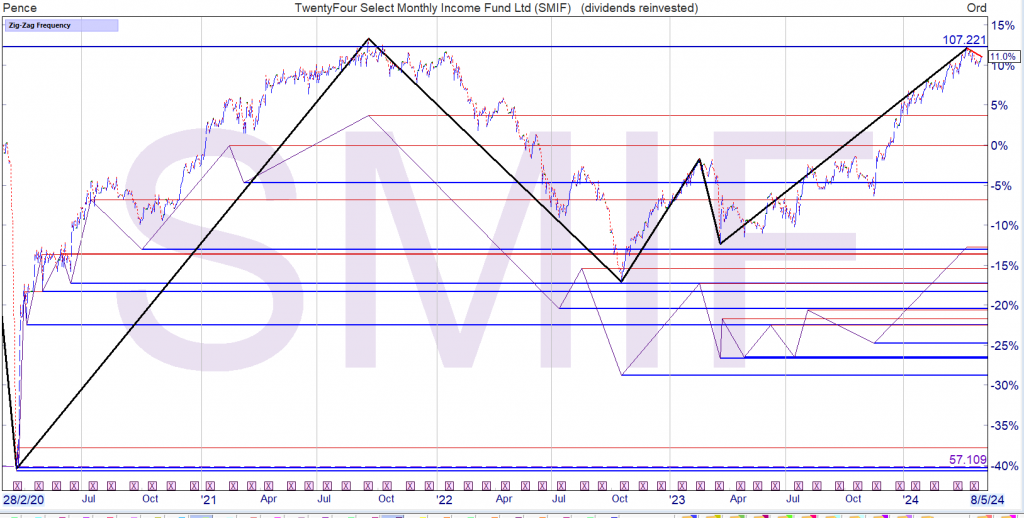
When/if the share price doubles u could take out your stake and re-invest in another high yielder around 8% and your yield on your initial investment would equate to 17% per year and your Snowball would grow faster than u ever thought possible.
I’ve bought for the portfolio 12100 shares in SMIF TwentyFour Select Monthly Income fund.
The current yield is 9% but because a dividend is paid monthly, if these are re-invested the yield is nearer 10%.
Because of the high yield the Trust trades at a small premium to NAV of 2%.
I’ve sold the portfolio shares in GCP for a profit of £248.00 including the earned dividend but not yet received. An acceptable addition to the Snowball for a couple of days investing.
© 2026 Passive Income Live
Theme by Anders Noren — Up ↑