If I wanted to buy SEIT, I’m personally not interested in the Trust at the moment
as the major trend is still down, I would wait until it trades above the 60p area,
no guarantees that support is then going to hold.
Investment Trust Dividends

If I wanted to buy SEIT, I’m personally not interested in the Trust at the moment
as the major trend is still down, I would wait until it trades above the 60p area,
no guarantees that support is then going to hold.
The Motley Fool
Mark David Hartley
I believe that investing in high-yield dividend stocks can provide me greater returns than a standard savings account. To maximise returns, I’d open a Stocks and Shares ISA, allowing me to invest up to £20,000 a year tax-free.
I formulated the following strategy to get the most out of my initial £5,000 and build towards a goal of £4,752 of passive income by 2034.
The first step in my plan is to do the research. I need to find several reliable FTSE 100 companies with a proven track record of paying dividends. Dividend yields change constantly and companies can choose not to pay them at any time, so I must find companies with a history of reliable payments to improve my chances.
Three FTSE 100 companies that I would consider for reliable dividends include Unilever, Phoenix Group, and National Grid. Although results over the past 12 months aren’t great, I believe they have a decent record of dividend payments.
While good dividend stocks alone could bring in more profit than my standard savings account, the real magic is in compounding gains. By reinvesting my dividends back into the stock via a dividend reinvestment plan (DRIP), I can maximise my profits.
If I were new to investing, I would consider an index like the iShares Core FTSE 100 ETF (LSE:ISF). This index exposes me to well-performing FTSE 100 stocks without needing to pick them myself. It has delivered a three-year daily total return of 7.83%, which is relatively good and would be difficult to beat if I wasn’t an experienced investor. With a total expense ratio of only 0.07%, it’s also one of the cheapest FTSE 100 indexes to invest in.
If the iShares Core FTSE 100 ETF continues to deliver an average annual return of around 7.83%, investing in it would accrue me a meagre £405 of returns after a year. However, by compounding my gains over 10 years, my savings would grow to £10,912 and I’d be earning over £800 a year in passive income.
While my initial £5,000 savings can bring me some profit, I’ll need to continue adding to it if I want to see real gains. I would plan to continue investing a further £300 a month into my portfolio.
Using the iShares Core FTSE 100 ETF as an example, adding £300 per month could build up to £65,278 after 10 years. This would earn me £4,752 of passive income in 2034. After 20 years, my investment would be worth almost £200,000 and bring in over £15,000 of passive income in the following years. With a portfolio of well-selected FTSE 100 dividend stocks, I may even be able to improve on this.

Created with thecalculatorsite.com© Provided by The Motley Fool
Octopus Renewables Infrastructure Trust plc
(“ORIT” or the “Company“)
Increased Dividend Guidance
In line with the Company’s progressive dividend policy, the Board of Octopus Renewables Infrastructure Trust plc is pleased to announce an increase in the target dividend to 6.02p* per ordinary share for the financial year from 1 January 2024 to 31 December 2024 (“FY 2024”).
This increase of 4.0% over FY 2023’s dividend target is in line with the increase to the Consumer Price Index (CPI) for the 12 months to 31 December 2023, and marks the third consecutive year the Company has increased its dividend target in line with inflation. The FY 2024 dividend target is expected to be fully covered by cashflows generated from the Company’s operating portfolios.
The Company is on track to deliver its dividend target for FY 2023 of 5.79p per ordinary share* and expects the dividend to be fully covered by cashflows arising from its operating assets. The fourth interim dividend for FY 2023 is expected to be declared in late January 2024.
Phil Austin, Chairman of Octopus Renewables Infrastructure Trust plc, commented: “We’re pleased to once again announce a dividend target increase in line with CPI, marking our third consecutive increase in line with inflation. This can be attributed to the Investment Manager’s progress in the successful delivery of construction projects, with operational capacity now at 536MW, generated by 29 assets across 5 countries, equivalent to providing enough electricity to power 242 thousand homes. For 2024, 82% of ORIT’s forecast revenues are fixed and 53% are explicitly inflation linked, and this is expected to contribute to stable cash generation over the year.”
| NewRiver REIT plc – Q3 Company |
NewRiver REIT plc
Third Quarter Company Update
Continued strong operational performance
Allan Lockhart, Chief Executive, commented: “Our strong operational performance continued into the third quarter, reflecting that our occupational market is, in our opinion, in its best shape for five years. This view is endorsed by the Christmas trading results reported to date by NewRiver’s top 10 retailers, including B&M, M&S, Boots, Superdrug and Sainsburys, which have been excellent. The continued importance of the physical store is becoming increasingly clear to best-in-class retailers, be they omni-channel operators with a clear understanding of the role of the physical store in the fulfilment of online orders, or retailers operating right-sized store-based models.
We delivered another quarter of positive leasing performance, a further expansion of our Capital Partnerships and have seen an increase in potential acquisition opportunities delivering attractive returns which we believe will be supportive of the future growth of our business. In the meantime, our activities continue to be underpinned by our clear strategy, well-positioned portfolio and the strength of our balance sheet.”
Strong operational metrics underpinning growth potential
| ● | Record occupancy maintained at 97.9% |
| ● | Continued strong leasing performance during Q3 with 222,900 sq ft of leasing transactions; long-term transactions +2.6% vs previous rent and +1.6% vs ERV; year to date in FY24 we have completed 587,500 sq ft of leasing transactions; long-term transactions +6.8% vs previous rent and +1.5% vs ERV |
| ● | Maintained consistently high leasing retention rate of 97% |
| ● | Average rent remains affordable at £11.70 per sq ft |
| ● | Rent collection stable at 97% vs 97% at the equivalent point in FY23 |
| ● | Capital Partnerships expanded further in Q3: appointed to manage an additional large retail park taking the total number of assets managed on behalf of M&G Real Estate to 17 retail parks and two shopping centres |
| ● | Major regeneration planning application submitted in Grays to redevelop the shopping centre for a high-density residential-led redevelopment of up to 850+ homes |
| ● | Further progress made with Work Out disposal programme: of the four assets identified for disposal by the end of FY24, one disposal has now completed, one disposal has exchanged and one is under offer |
| ● | GRESB score improved to 72 from 70 and maintained Gold Level for EPRA Sustainability Best Practice Recommendations |
Balance sheet strength maintained and Investment Grade Credit Rating reaffirmed by Fitch Ratings
| ● | Refinanced £100 million undrawn Revolving Credit Facility to extend maturity to November 2026 at reduced cost |
| ● | Fully unsecured balance sheet with interest rate fixed at 3.5% on drawn debt and no maturity on drawn debt until March 2028 |
| ● | Cost of drawn debt compares favourably to portfolio Net Initial Yield of 7.9% as at 30 September 2023, one of the highest spreads in the real estate sector |
| ● | Strength of balance sheet position recognised in December 2023 when Fitch Ratings reaffirmed our Long-Term Issuer Default Rating (IDR) at ‘BBB’ with a Stable Outlook, senior unsecured rating (relating to £300 million unsecured 2028 bond) at ‘BBB+’ and Short-Term IDR at ‘F2’ |
CQS New City High Yield Fund Limited
(“the Company”)
Second Interim Dividend Declaration
The Company announces its second interim dividend of 1 pence per share (2023 – 1 pence) payable on 28 February 2024 to shareholders on the register on 26 February 2024, having an ex-dividend date of 25 January 2024.
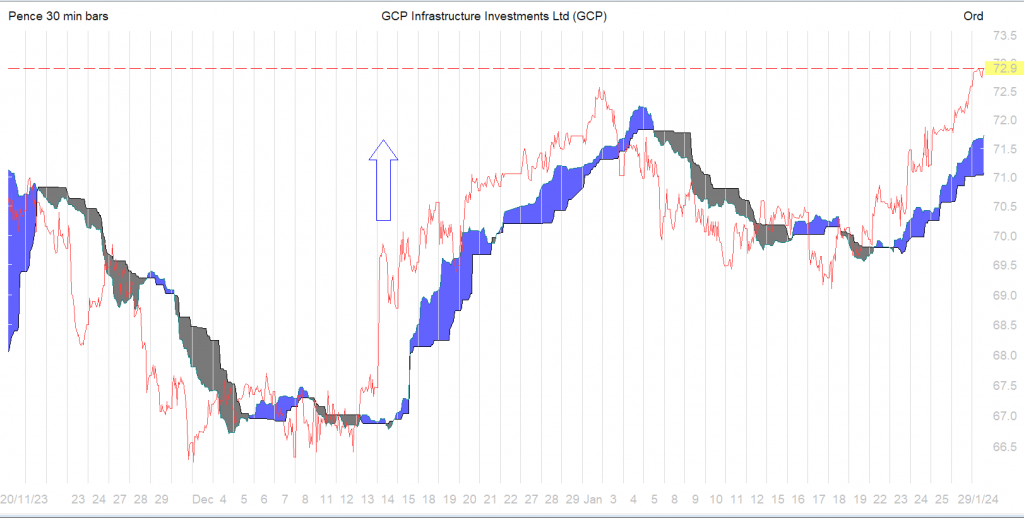
CH has emailed me re my SUPR buy before xmas
which I sold to buy TENT. A picture saves a thousand words.

Obviously if I was Captain Hindsight I could have sold later and still bought
TENT at a better price. TENT has earned a dividend and still in the
portfolio awaiting news.

Is support going to act as support ?
If so which one but the advice is ‘never catch a falling knife’.

Real Estate Credit Investments Limited
Transaction in own shares
Real Estate Credit Investments Limited (the “Company“) announces that on 16 January 2024, it bought into treasury 800,000 ordinary shares of no par value in the capital of the Company (the “Shares“):
| Date of purchase: | 16 January 2024 |
| Number of Shares purchased: | 800,000 |
| Price paid per Share (GBp): | 124.25 |
The last published NAV of the Company was 144.2p as at 31 December 2023.
The Motley Fool
Here’s how I’d try to build a second income with £10 a day
Want to build a second income to help with the costs of retirement? Anyone who can use their full £20,000 Stocks and Shares ISA allowance each year should be able to do it.
In fact, more than 4,000 UK investors have already built a million pounds or more that way.
But that’s nearly £55 per day. And most of us can’t do that. What about £10 a day, for a more modest £3,640 a year (or £3,650 this year)?
Regular savings
Long-term investing success needs time and consistency. That means putting cash away regularly, before I spend it.
Most ISA providers these days will let us set up direct debits from as little as around £25 a month.
So my first step would be to open one of these. Next, I’d set up a regular monthly transfer. I’d round my £10 a day up a bit to £305 a month. And I’d set that to go out just a few days after each payday.
Growing returns
What might my £3,660 a year get me? I’d put it mostly into FTSE 100 dividend stocks, each time I built up enough for a buy.
If I could manage, say, a total yield of 7%, that could get me an extra £256 in a year.
Have a nice drink at Christmas from that? Not a chance. It would all stay in my ISA, and get rolled into my next share buys.
Compound it!
And that’s where compounding comes in. You see, next year I could have £3,916 more to invest. And at the end of two years, assuming the same 7% return, I could have £8,107 to start my third year.
Dividends are never guaranteed though. And they’ll probably be up and down in the coming years.
But over the long term, the best companies do seem to pay out the most cash. I’m thinking about names that have been around for decades, and have been near the top of the pile year after year.
Quality yields?
Legal & General, for example, is forecast to pay 7.8%. And British American Tobacco is on 9.8%. Even NatWest Group looks like it’s on for 7.3%.
Glencore offers 7.9%, for a bit of variety. I expect that to be one of the more volatile ones though.
To reduce the risk of not getting my dividends, I’d keep away from firms that pay big yields but also carry very large debt. I don’t see that as very prudent long-term cash management.
For me, that means BT Group and Vodafone would be ruled out.
That’s the plan
So keep my money going in and spread it among top-quality companies in different sectors (to get some safety through diversification).
Then plough all my dividends back in, maybe top up with any spare cash I had, and raise my daily amount as time goes on. And then just sit back.
Not always smooth
I’ll expect some short-term shocks, like 2020 when the average Stocks and Shares ISA lost 13%. But keeping it up for decades has to be the best way to deal with the risk.
© 2026 Passive Income Live
Theme by Anders Noren — Up ↑