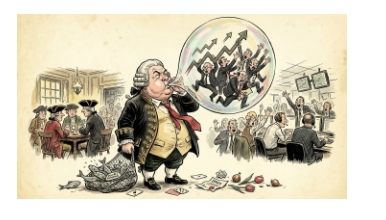
Can you see any bubbles today?
I’m sorry I’m not half as eloquent as Thomas D’Urfey. He had many fellow bubble sceptics too. Some were equally brilliant. It seems there was an entire industry in stock market bubble satire. Songs, artwork, prints, poetry, and more.
There isn’t much of that today. Curmudgeonly bubble sceptics stick to banging away at their keyboards, occasionally going on TV to be hounded by a panel of believers.
Sadly, the genius of the projectors matches that of their counterparts from 1720 quite well.
They promise profits from a venture, but focus more on the financial engineering than the business itself.
Soon, the speculation takes a momentum of its own. Few shareholders could tell you what the underlying business they own actually does.
Eventually, those who launched the enterprise walk away with money somehow. The slowest to sell are left holding the bag.
But I’d like to leave you with one last thought. An important one that is almost always missed.
Both the South Sea Bubble and the Mississippi Bubble were actually attempts to consolidate the government’s national debt. The speculative frenzy was part of this scheme, knowingly aided and abetted by the governments of the time.
Today, our governments are back in debt. Wild stock market frenzies are back. And financial engineering puts government bonds at the heart of the financial system, creating artificial demand for them.
If all you see is a stock market mania, you are being bubbled by the government.
What’s an investor to do in Huva world of bubbles?
There are several options.
You could join the latest frenzy in the hope that you buy and sell early enough.
You could invest outside the industries caught up in the latest bubble.
Or you could stick to sound, fundamental analysis of good companies that are steady performers.
Or you could do all three.
Until next time,
Nick Hubble
Leave a Reply