From BDCs to CEFs, Here’s How We’re Getting 8%+ Dividends in 2026
Michael Foster, Investment Strategist Updated: December 25, 2025
If you’re reading this, I probably don’t have to tell you that the stock market beats most (all?) other ways of building wealth.
It’s not even close!
Over time, the S&P 500 has generated around a 10% annualized return. But of course, that line does not go straight up and to the right. There have been long periods when stocks have moved sideways, and occasional years (I’m looking at you, 2022), when they’ve taken a header.
At those times, in particular, we’re all keenly aware of the S&P 500’s lame dividend yield (around 1% as I write this). It means that those who hold, say, an index fund and need cash face the soul-crushing prospect of selling at a low (or maybe even a loss).
This is why a lot of investors (including us!) like to hold alternatives to stocks. I’m talking about assets with dividends high enough to complement our stock holdings. That way, we can lean on those payouts in a rough market without having to sell a single share.
This, in fact, is our mantra here at Contrarian Outlook. And in recent years, more investors have been looking at private investments to provide that income.
BDCs Offer Another Way to Build Your Dividend Income
One popular way to tap into private investments (private credit, to be exact) is through business development companies, or BDCs. These firms mostly lend to small- and mid-sized US firms.
The sheer diversification of America’s small- and mid-sized businesses means BDCs are naturally diversified, too. That’s a clear strength. And on the income side, we get support from the law, which says BDCs must pass 90% of their income on to investors as dividends (a structure similar to that of a real estate investment trust, or REIT). If they do, they get a pass on paying corporate income tax.
But we do have to be selective with BDCs. After all, these companies focus on smaller firms, which are naturally riskier than bigger companies. Some BDCs also come with high fees to manage their loan portfolios. And, as more BDCs enter the picture, competition for quality borrowers heats up. That can lead some BDCs to take greater risks in the loans they write (and who they lend to).
Beyond that, many BDCs have hundreds of loans, each requiring a lot of due diligence and monitoring (and more so, again, because these borrowers tend to be riskier, smaller companies).
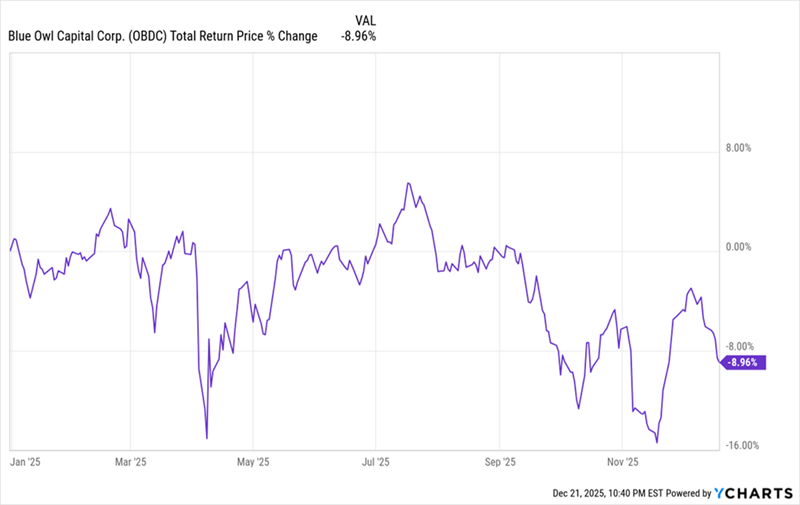
All of these factors can drag on performance. Consider, for example, Blue Owl Capital Corporation (OBDC), which has $6 billion in assets and attracts a lot of attention with its 11.7% yield. That’s been cold comfort for investors, since OBDC has dropped 9% this year, even with dividends included.
High Yield Didn’t Save OBDC Investors in ’25
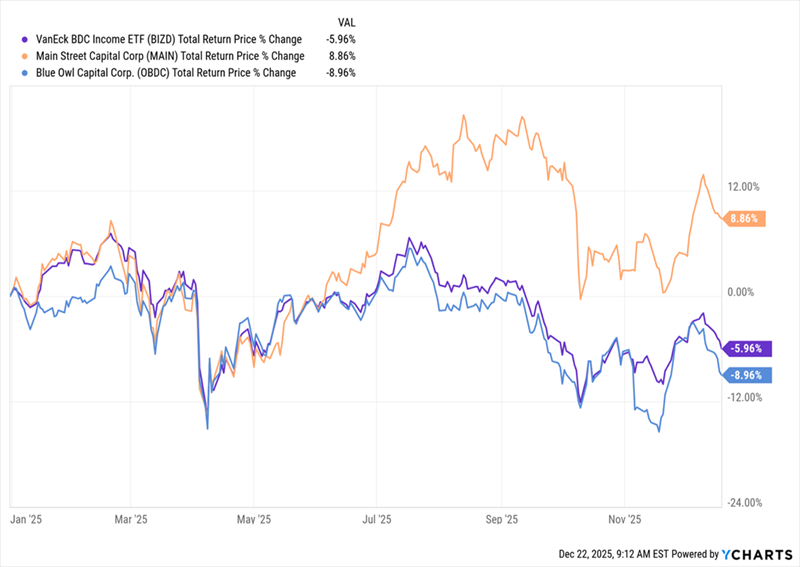
Now don’t get me wrong. I’m not saying BDCs are to be avoided. But quality is critical here. One of the best BDCs out there is Main Street Capital Corporation (MAIN), which yields around 5% today (though it has paid closer to 7% on a trailing-12-month basis, thanks to its frequent special dividends).
MAIN (in orange below) has returned more than both OBDC (in blue) and the benchmark BDC ETF (in purple) this year.
MAIN Outruns the Competition
That’s not bad! MAIN is “returning its yield,” which is exactly what we want to see in a BDC. But when we combine, say, BDCs with closed-end funds (CEFs)—particularly equity focused CEFs—we can add more growth.
And better still, thanks to CEFs’ roughly 8% average dividends, we get a big slice of that growth “translated” into dividend income for us. So in essence, we’re getting the best of stocks and the best of BDCs here.
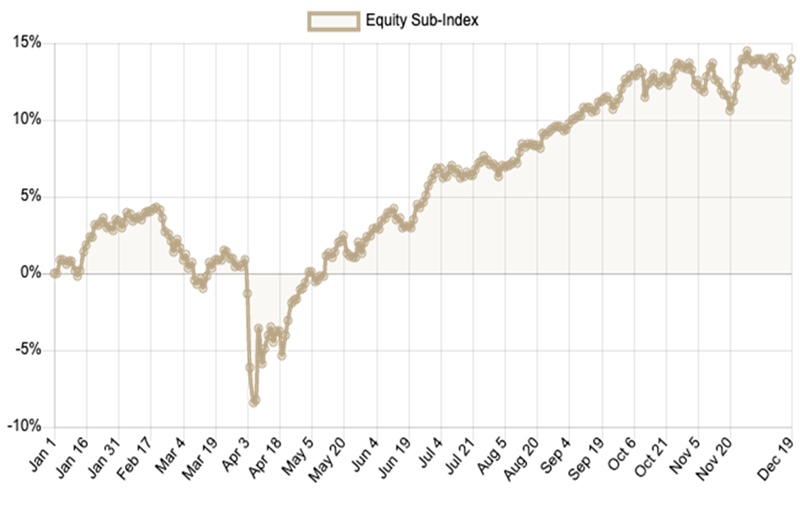
The best equity CEFs track, and better yet beat, the S&P 500 on a total-return basis. In fact, the equity CEFs tracked by my CEF Insider service’s Index Tracker have returned a bit more than 14% this year, just a shade off the S&P 500’s 17.5%, as of this writing:
Equity CEFs Post Another Strong Year Source: CEF Insider
That slight underperformance is a small price to pay if you’re getting an 8% dividend (which is right around the average for all CEFs as I write this)!
And as I hinted at a second ago, some CEFs have done even better, like the Adams Diversified Equity Fund (ADX), a long-time CEF Insider holding that’s delivered a market-beating 23% total return this year, as of this writing.
This 8%-yielding fund can deliver that high payout because it translates growth (and some dividends) from its portfolio of US blue chips into cash for us. NVIDIA (NVDA), Amazon.com (AMZN), Microsoft (MSFT) and JPMorgan Chase & Co. (JPM) are among its top holdings.
Plenty of other CEFs deliver this mix of growth and income, too. Consider these numbers, which I think you’ll find pretty surprising:
97.7% of the CEFs tracked by CEF Insider have turned a profit over the last decade (or since their IPO for funds less than 10 years old).
20% of those funds have a 10% or higher return.
CEFs trade at an average 5.3% discount to net asset value (NAV, or the value of their underlying portfolios), letting us buy in at less than market price.
Most CEFs trade in publicly listed securities (stocks, bonds, public real estate).
These are clear strengths I see attracting more investors to CEFs in 2026, especially if we see more stock-market volatility (as I expect). In fact, it’s already happening: CEFs started the year with over 8% discounts to net asset value (NAV) on average and are now closing it with discounts at that 5.3% level I just mentioned.
A further push toward par—and the upward pressure on CEFs’ market prices it would bring—seems only a matter of time.
Vanguard Flips The Script On 60/40 Investment Strategy
The Wealth Advisor Contributor December 24, 2025 (Yahoo! Finance) – Vanguard is singing a new tune for investors in 2026.
It goes like this: Out with the standard portfolio mix of 60% equity and 40% fixed income. In with the opposite — a 40% equity share (20% US stocks and 20% international stocks) and 60% fixed income.
“This is a significant shift,” Roger Aliaga-Diaz, Vanguard’s global head of portfolio construction and chief economist for the Americas, told me. “It’s almost like a tectonic shift.”
Here’s what’s behind it.
Vanguard expects investors in the short term to realize returns from high-quality (both taxable and municipal) US and foreign bonds similar to the performance they would see from US equities — about 4% to 5% — but with lower risk.
Aliaga-Diaz also expects non-US equities to outperform US stocks over the next decade. Vanguard’s outlook for international stocks is 5.1% to 7.1% per year over the next 10 years, higher than US stocks.
“This is a position we suggest investors consider for the next three to five years, but it depends on risk tolerance and time horizon,” Aliaga-Diaz said.
Hedging against a tech bubble Vanguard’s new advice is for investors with a “medium-term” outlook, and it stems from growing fears — at Vanguard and elsewhere — about an AI bubble.
The “Magnificent Seven” — Apple (AAPL), Alphabet (GOOGL, GOOG), Microsoft (MSFT), Amazon (AMZN), Meta (META), Tesla (TSLA), and Nvidia (NVDA) — are the linchpin for the S&P 500’s growth these days. The S&P 500 index rose about 17% for the year, after a 23% gain in 2024. But analysts are increasingly concerned that they’re overvalued.
“We see that overvaluation of equity markets more as a risk to the investor than as opportunity,” Aliaga-Diaz said. “Importantly, US fixed income should also provide diversification if AI disappoints and fails to usher in higher economic growth—a scenario with odds that we calculate to be 25%–30%.”
Investing for longer-term goals Many retirement savers, however, may be saving for longer — say, to retire in two decades or more.
How does Vanguard’s new formula apply to them?
I talked to several retirement experts about whether it’s a good idea to change course.
“Given today’s high equity valuations and higher bond yields, I certainly think it’s reasonable that a more conservative portfolio may have a better risk-return profile for the coming decade than in years’ past,” Tyson Sprick, a certified financial planner with Caliber Wealth Management in Overland Park, Kan., told me.
“Overall, I think this reinforces the value of diversification and should serve as a warning to investors having FOMO with regards to this year’s AI-driven returns,” he said.
“The end of a big year in the market is a perfect time to step back and ask, ‘What am I trying to accomplish? Do I need to reach for returns to support my desired lifestyle?’ Remember, a rate of return is not a financial goal,” Sprick added.
For retirees, the playing field can be nuanced, according to Lazetta Rainey Braxton, a financial planner and founder of The Real Wealth Coterie.
“If you’re a retiree, you may not be where you need exceptional growth and want to protect some of the recent gains by making that shift to 40/60, and it’ll be comfortable for you throughout your retirement,” she said. “It’s not about chasing returns. If you’ve done the right calculations, with a rate of return that feels good for you to solve your goals about having income now and not outliving your money, then a 40/60 could absolutely be totally fine for you.”
Lots of financial planners, however, told me “nope”— shifting to 40/60 is not what they will advise retirement savers. They universally pointed out that the 60/40 portfolio is built around balance to go the distance and achieve long-term growth in equities and stability with bonds.
It’s normal to pull back on equity holdings as retirement nears, meaning a 40/60 strategy is not out of the ordinary for this cohort. If you’re retiring within three to five years, then, generally speaking, you might want to shift to a portfolio with less risk by diversifying out of equities and more into fixed income holdings.
Target date funds are designed to do just that, and they are now the investment of choice for many retirement savers.
No rash moves The consensus advice: Walk softly.
“I would not urge anyone to do drastic selling,” Joseph Davis, Vanguard’s global chief economist and head of Vanguard’s Investment Strategy Group, previously told me.
“This is where I say ‘stay the course,’ but start thinking about diversifying,” Davis said. “It could be smaller-cap companies in the United States, which have trailed over the past 10 or 15 years, as well as non-US investments. Every market has trailed the United States almost without exception.”
Added Aliaga-Diaz: “The bottom line is we don’t get better returns from the 40/60 — we get the same return as the 60/40, but with much less risk,” he said. “That’s really the point.”
By Kerry Hannon – Senior Columnist December 24, 2025
The Snowball is expected to receive income in excess of £10k next year.
But for comparison purposes let’s use 10k. If you can compound your income at 7% pa you should double your income in ten years, if you cannot compound at 7%, you will still double your income but it will take longer to reach 20k of income.
The Snowball uses a comparative share VWRP and the current value is £151,533.00
Using the 4% rule to achieve a income of 20k, your fund would have to be valued in ten years time at £500k and as it is recommended to have a cash buffer of 3 years when you start to withdraw income from you fund it would need to be valued at 560k. Good luck with that. As you can see from the graph you will have many years of your fund not increasing in value but trending sideways after periods of strong gains.
Cash Flow Is The Only Retirement Goal That Matters
Dec. 26, 2025
Rida Morwa
Investing Group Leader
Summary
Avoid vague wealth goals; set specific, realistic targets for retirement.
Portfolio value fluctuates wildly; rely on stable income generation instead.
Don’t sell shares to pay bills; replace income with dividends.
Reinvest 25% of income to grow your cash flow and safety margin.
Track your income CAGR to ensure that you are on pace for retirement.
alexfiodorov/iStock via Getty Images
Co-authored with Beyond Saving
Today, I want to have a “back to the basics” article discussing an important topic for the upcoming year. The New Year is a time for us to look back at what we did right or wrong and look forward to what we want to achieve in the future.
Setting goals is an important component in any plan, so that you know what you are trying to achieve, you can track whether you are on pace to achieve it, and you know if what you’re doing is working.
When it comes to investing, the most common goal that people are trying to achieve is to be able to fund their retirement. Also, something that many people struggle with is coming up with a goal that is both specific and realistic.
The Importance of Being Specific
“I want to have billions” – ok, that’s nice, but are you going to make billions from having $500,000 in your portfolio and working a salary job that pays you $70,000/year? Probably not. Most people who have billions made millions by doing something extraordinary in their careers. They built companies that changed the world. If that’s your goal, great; I wish you the best of luck. The Elon Musks, Jeff Bezoses, and Mark Zuckerbergs of the world made their fortunes living a lifestyle that combined an absolute obsession for their work, a spark of genius, and made a significant impact on the entire world in a way that most of us won’t. They didn’t make $100 million because they made some crazy trade in the stock market; they built multi-billion/trillion-dollar companies in which they maintained a sizable ownership stake.
For most of us, that isn’t a practical goal. Most people have chosen careers where making tens of millions, let alone hundreds of millions of dollars, isn’t possible.
If you approach the stock market imagining that you’re going to make millions/billions while starting out at $100,000, that isn’t practical. You can’t always get what you want, and the stock market isn’t a place to get rich quickly. If you set some insane goals that aren’t achievable, you aren’t likely to achieve any goal. You are going to give up because you aren’t making any meaningful progress.
We want our goal to be specific. Something that you can look at every year and tell if you are moving closer or further away. As with any large project, the sooner you identify that you are falling behind, the easier it is to catch up.
We also want our goal to be practical. Something that can reasonably be achievable and can be broken into smaller bite-sized chunks.
Why Value Is a Poor Goal
The most common mistake I see among those looking to plan their retirement is that they set goals in terms of portfolio value. In the old days, it was always $1 million. It sounds like a lot of money, and it is. Yet today, many experts suggest that you need $2 million or $3 million to ensure that you have a comfortable retirement.
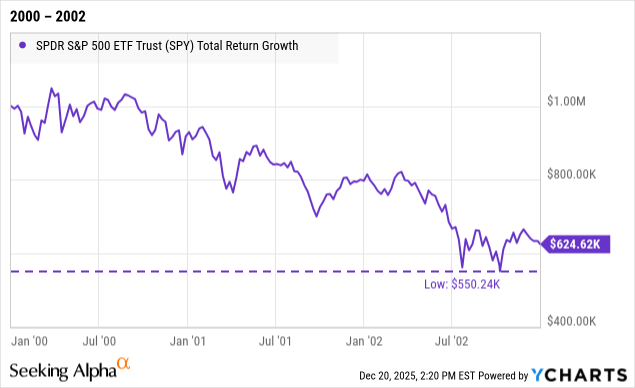
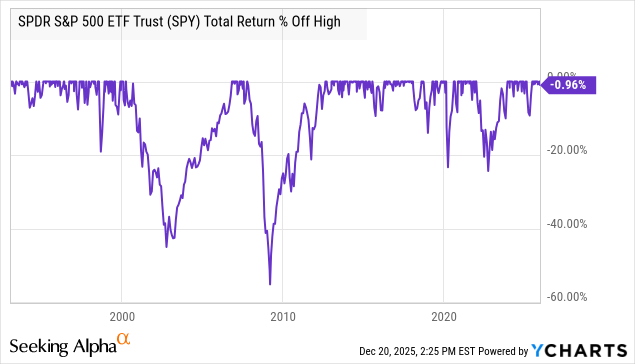
All this advice has one major problem: $1 million in stocks today is not the same as $1 million in stocks yesterday or tomorrow. Someone working on retiring in the 1990s might have been thrilled to hit their $1 million goal early and retire in January 2000.
However, over the next three years, the market fell, and their $1 million became just ~$600k. This is even before we account for any money they needed to withdraw:
This isn’t an idle or theoretical risk. The stock market declines frequently, with 5-10% dips being very common. Dips of +40% are rare, but when they happen, it is usually many years before it goes back to all-time highs.
Yes, the stock market has trended upward over long periods, and it is a great generator of wealth for those who are willing to hang on through the swings. But for those who retired in 2000, thinking they had enough, seeing 40% of their retirement disappear in just three years is devastating. When you retire, you often can’t go back to a position that has comparable pay to what you were getting before you retired.
And are you comfortable taking out money when the stock market is far down? We’ve discussed in recent articles the potential risks of withdrawing too much. The response of experts in the field has been to generally suggest a very conservative withdrawal strategy. Many fall back on the work of William Bengen, who suggested that 4% withdrawals from a portfolio of 60% equity and 40% bonds, adjusting for inflation, were sustainable in any scenario.
If you are looking to be certain, then yes, the 4% rule is going to create a portfolio that will survive almost anything. As a result, it’s a very safe recommendation for those in the business to suggest because it does avoid the ultimate worst-case scenario of a retiree outliving their portfolio.
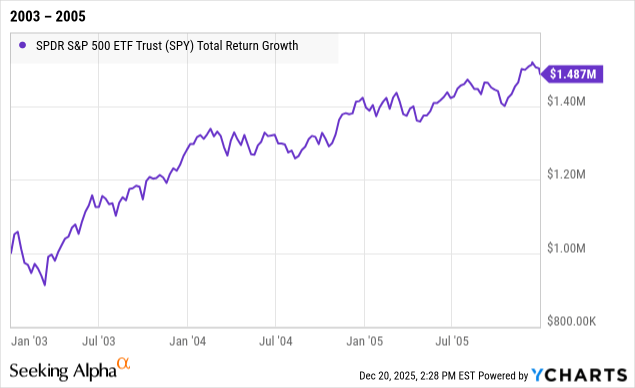
The problem with that rule is that in many cases, a retiree could withdraw a lot more and be just fine. The investor who retired at $1 million in 2003 can safely withdraw a lot more than the investor who retired at $1 million in 2000.
The challenge is to know how much you can withdraw in real time. The risk is that of living your life poorly, when you have built up a portfolio that is more than capable of supporting the lifestyle you want to live. Life is precious, and you only get to live it once. When you’re sitting there at 100 years old, you don’t want to be sitting on millions looking back at the life experiences you passed up on when you were younger and in better health—that is a risk. Maybe being completely broke is a worse scenario, but living in poverty to die wealthy is also a bad scenario.
The problem is that you can’t look at the value of your stock portfolio and know whether it is going to be safe to withdraw 7% or only 4%, because it really matters whether you are retiring in 1997, 2000, or 2003. $1 million in asset value is dramatically different for each year in terms of its ability to fund your retirement for the next 30 years.
Set an Income Goal
Stock market valuations and prices change frequently. Interest and dividends change more rarely, and in a diversified portfolio, by much smaller amounts. Whether market prices are relatively high or low isn’t particularly relevant to the income that a portfolio is generating.
You’ve spent your entire life working on a budget. You make $X in income. You made money from your job, maybe your spouse worked as well, maybe you owned a rental property, or other sources of income. You made money, and you spent less. It’s a process we are all familiar with. And that money wasn’t static. Who hasn’t lost a job, had variable hours, or worked on commissions or ran a business, having extremely variable income?
Why do we suddenly treat retirement differently? You have the same bills coming in every month. The only thing that’s changed is that you will no longer receive income from working. That income will be replaced by some combination of a pension, social security, and income derived from your retirement nest egg.
Many will sit there and tell you that you should maximize the value of your nest egg with the intent to sell it off in pieces, hoping that you don’t live too long or sell such small pieces of it that even in a crashing market, it won’t run out. If that idea fills you with dread, it’s because it isn’t natural and you have common sense. Selling assets to pay the bills is like the person who goes to the pawn shop to pay rent. It might solve the immediate problem, but that problem is going to come next month. Your bills don’t stop, and those shares you sold are gone forever.
It’s very difficult to know how big your nest egg has to be because you don’t know how the market value is going to change. It could go up or down 40% next year. That’s normal for the stock market, and normal things should be expected to happen. We shouldn’t retire and cross our fingers, hoping that normal things don’t happen.
How much income do you need to retire? Well, that’s easy. You can just look at the income you want to replace. You are still going to live on less, and you are still going to reinvest a portion of it for the future. Just because you are retired doesn’t mean life is over. You still have a future; you still need to invest in it!
We recommend planning on reinvesting at least 25% of your income. If you can reinvest more, that’s great because it will help your portfolio’s income grow faster and provide a larger cushion from disruption.
This provides you with a solid and tangible number to aim for. You know how much needs to be replaced, so you can track your path to get there.
Estimate Your CAGR
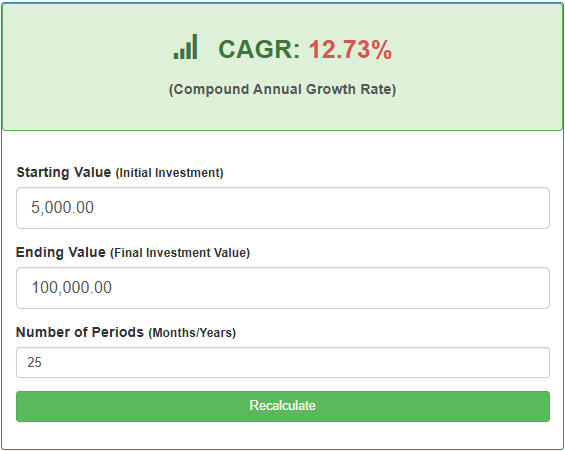
If your goal is to have $100,000/year in cash flow by the time you retire, and you are at $5,000/year now, that looks intimidating. However, if you are 40 and looking to retire by 65, you have 25 years to get there—so, you need to grow your cash flow at a pace of 12.7%/year. You can calculate this easily with a CAGR calculator. Source
CAGR Calculator
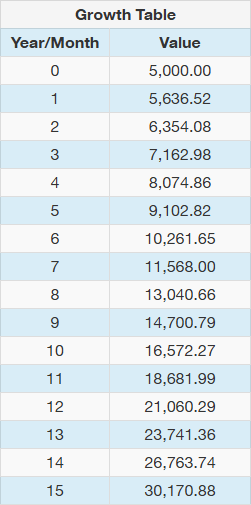
You can then look to see what your trajectory should be to keep this pace:
CAGR Calculator
So, your goal next year isn’t to get your cash flow “as high as possible”, it is to get it to a pace of ~$5,640/year. To the extent that you exceed that amount, you are on pace to exceed your $100k goal, allowing you to retire earlier or with more income.
If you fall behind because there are dividend cuts, investments don’t work out well, or you weren’t able to invest as much new money as you intended, you will know you are off pace immediately, and you can make relatively small changes.
You can use a calculator like this to figure out the pace you need to achieve your long-term goals. Put your current income, your target income, and how many years you want to achieve that goal within.
This will give you a tangible annual goal to target to ensure that you are on track to meet your 5, 10, or +20 year goals.
Ideas to Get You Started
So, you know how much income you need in 2026, but which picks to buy?
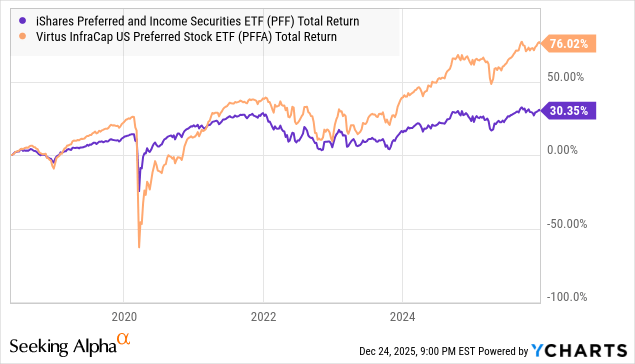
Virtus InfraCap U.S. Preferred Stock ETF (PFFA), which yields 9.4%, is an ETF that invests in preferred equities. PFFA is an ETF that is actively managed and uses leverage to amplify returns. As a result, PFFA management is frequently identifying opportunities that can outperform.
PFFA has materially outperformed peers that focus on following the index. We strongly encourage you to build up a portfolio of preferred equity and bonds as a base for your income portfolio. Yet that is a task that takes time. PFFA can provide quick diversification while you take the time to do your due diligence on individual picks.
Realty Income (O) is a REIT (Real Estate Investment Trust) yielding 5.8% that has trademarked “The Monthly Dividend Company”. It follows a business model of investing in triple-net leases, which make most property-level expenses the responsibility of the tenant. O has scaled up to become the largest company in its sector. O pays a dividend monthly and raises its dividend numerous times per year. It has increased its dividend every quarter since 1998. The raises often are not large, but they are frequent, and O highlights the power of compounding income.
Annaly Capital Management (NLY) is a 12.2% yielding mortgage REIT that invests in agency mortgage-backed securities, or MBS. Agency MBS is a unique asset class because the principal is guaranteed by agencies like Fannie Mae and Freddie Mac. NLY’s business strategy is to invest in agency MBS on a leveraged basis, profiting from the difference between the yield on MBS and its borrowing rate tied to SOFR. NLY’s business is very sensitive to interest rate changes but carries very little credit risk. As a result, NLY tends to outperform during periods when the stock market is crashing. In other words, it is countercyclical. Having a few countercyclical holdings can really help your portfolio during periods of economic turmoil.
Life is what happens when you are making other plans. So, it is very likely that you won’t achieve your annual goals every single year, and that’s ok. There are going to be challenges, and in a future article, we will discuss some typical challenges that income investors face and how to deal with them.
What’s important is that you determine what your personal goals are and chart a path to achieve them. We believe that setting a goal focused on cash flow is far more useful than one based on the big number in your portfolio. It provides something that is tangible and directly relates to your ability to withdraw cash from your portfolio. It is also less volatile. As you work towards retirement, you can’t know if you need $1 million, $3 million, or some other number, and you don’t really know if you’re making the right progress since your portfolio value will go up and down frequently.
You might decide that $100,000 in income isn’t enough, or maybe that you don’t really need that much. You are allowed to change your goals. But your pace towards achieving it will remain relatively stable. You’ll know the target you are aiming for every year, and if you get off pace or are ahead of pace, you will know it. And when you retire, you won’t be guessing how much you can withdraw any more than you were guessing how much you could spend when you were working. You have an income, spend less, and set aside a portion for the future. It’s common sense budgeting that everyone reading this knows how to do.
Top Voted Idea by Readers – so it joins the picks for 26
The Oak BlokeDec 23
NB – these are best guess estimates based on newsflow.
Dear reader
I previously wrote “Sometimes a share moves (back) to a tempting level.”
Well 99.8p a share is tempting for sure here.
So much so that CEO Mr Inglis has bought £100k more shares in the past 3 months, and a new NED at RGL bought £10k too. Shallower pockets maybe.
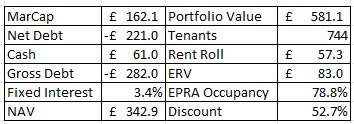
At a 52.7% discount to the book value of its assets and a fully covered and growing 10% yield is this a tempting level?
Based on a recent further sale of a £13m property sold for 1% above book (not 52.7% below), that was leased for ~£0.6m per year at 65% occupancy that’s yet another great result.
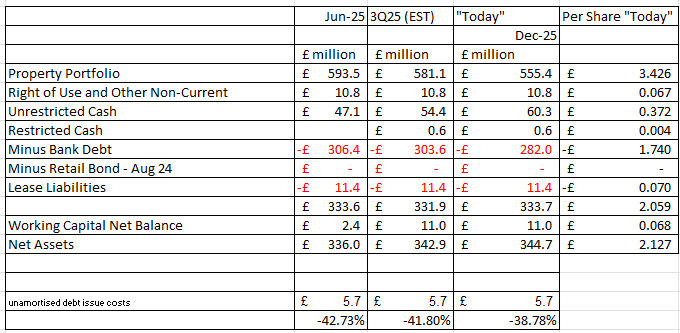
RGL gets you an estimated £3.43 worth of property (at book value) for a net -£1.30 of debt to give you just over £2.10 of “stuff” for just a pound.
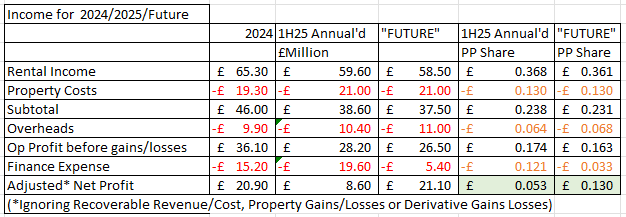
“Stuff” that delivers 5p today of rental income, and prospectively 13p in the future.
The above estimate is based on disposals but also execution of its renovation strategy to get more of its offices into a better grade of Energy Performance but also modernised and tarted up.
No more Tea around the Tea Urn, we are talking Barista Coffee makers, and no more open office we are talking aesthetic glass pods and collaboration spaces.
No more smoke stack view of the city, we are talking Costa Rican jungle paradise backdrops. Oh wait, maybe I’m exaggerating on that one – but you get the idea. Aesthetics matter.
(RGL year end is 31st December)
Disposals
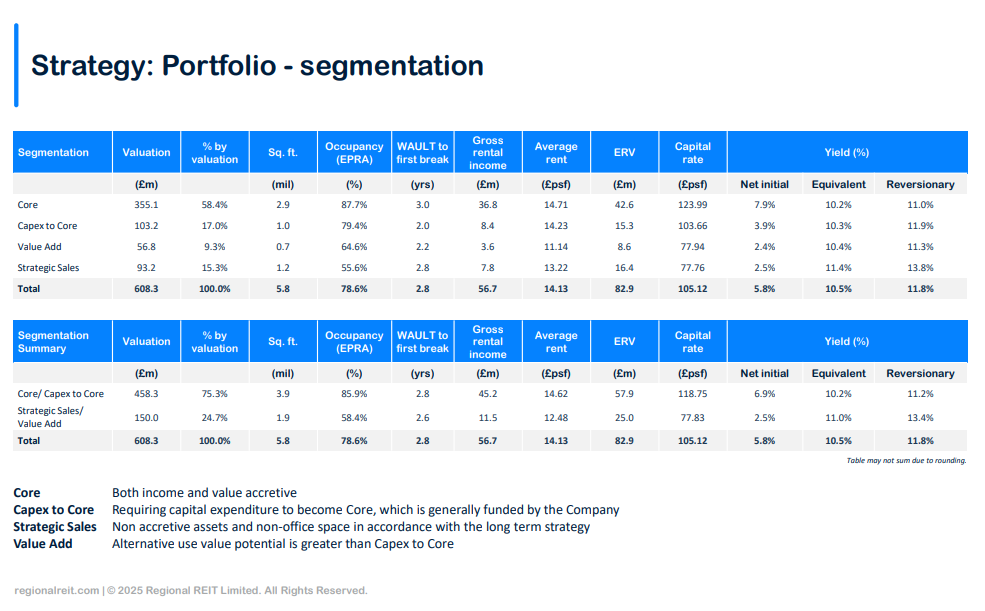
I will admit to scepticism as to the speed of disposals. In the past it had been slow. Yet in 2025 I was wrong. RGL have been successful (as at 23rd December 2025) in exceeding their target and disposing of over £51m of property during FY25 at slightly above book value (before sale costs).
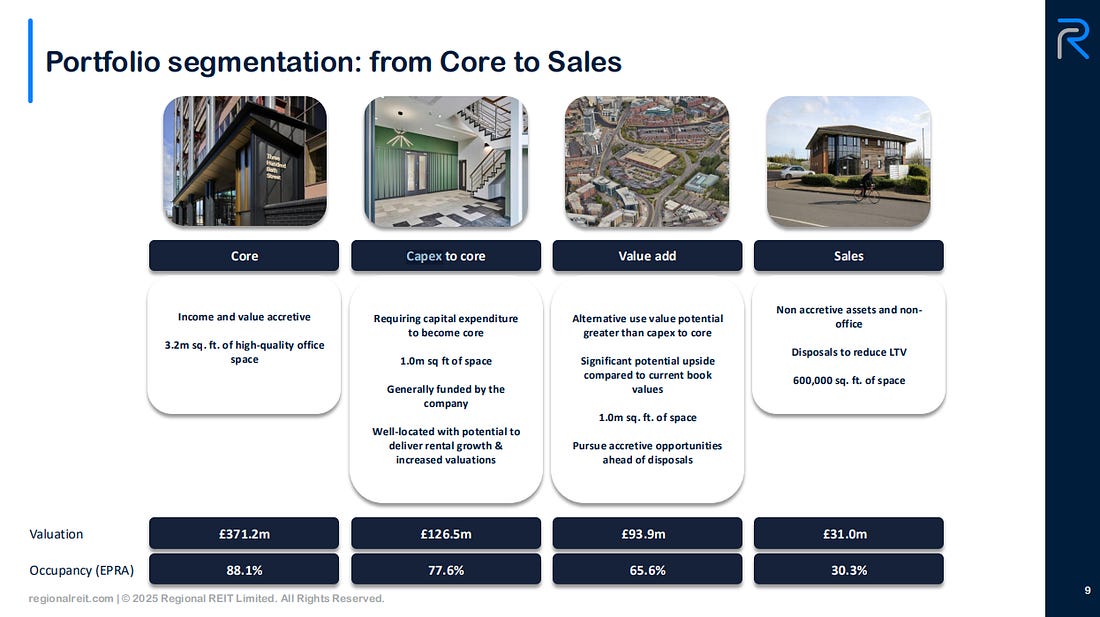
So it’s achieved success in selling 40% of its dustbin “Sales” segment of a £93.2m valuation at slightly above that valuation and driving up its occupation levels. That’s really, really, encouraging.
If the dustbin is being sold slightly above book that implies the Core and Capex to Core (once it becomes Core) could be worth quite a bit more than book value.
Disposals (net of costs) were £28.6m in 2024 (at a -£3m loss) and £25m in 2023 (at a -£1m loss) so the 2025 result is well ahead of previous years suggesting a strengthening market particularly the fact that the sales price is ahead of book value (albeit only by small amounts). Post costs RGL will at best break even to that gain or up to a -£1m net loss on disposal – net of selling costs.
But disposals are not being discounted by 53% as the REIT currently is.
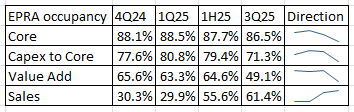
RGL’s “Core” segment are now at a 86.5% level. It is true it fell slightly in 3Q25 ahead of Rachel’s budget. Boo.
It was not just RGL that suffered falling occupancy levels in 3Q25. The whole sector Trinity Capital, Schroders, Picton Property, Apex Capital all reported a similar issue of uncertainty ahead of the budget as well as Rachel’s prior Employers NI tax of +2%.
But Rachel’s new taxes in the 2025 budget largely did not materialise. No horrors in that budget for Offices and REITs. Well one actually – but one that benefits RGL. The government have introduced a tier of above and below £500k rateable value which will hit London offices with a higher multiplier and drive demand to cities outside the Big Smoke (more typically rateable below £500k which will henceforth enjoy lower mutlipiers.
Outside London Grade A availability of offices is tightening, and the word shortages of prime stock is now being spoken of. That word hasn’t been spoken of for a long while.
Just like Rachel’s pal Kier there are two tiers emerging where low quality offices in low quality locations remain unloved and low value. But ESG-compliant offices in key cities outside London are seeing a definite uptick. RGL’s strategic of refurbishment and upgrade to achieve higher EPC and improve aesthetics is well situated for this “K curve” dynamic to offices – and the market hasn’t woken up to this – yet.
Capex To Core
RGL’s “Capex to Core” segment are the properties that shall be upgraded and therefore become core and enjoy a higher per square foot rental. £9m has been spent on capex during 2025. I’m assuming post conversion (as has thus far proved) a 25% increase in rate can be achieved and that the occupancy moves from 77.6% to 88.1%.
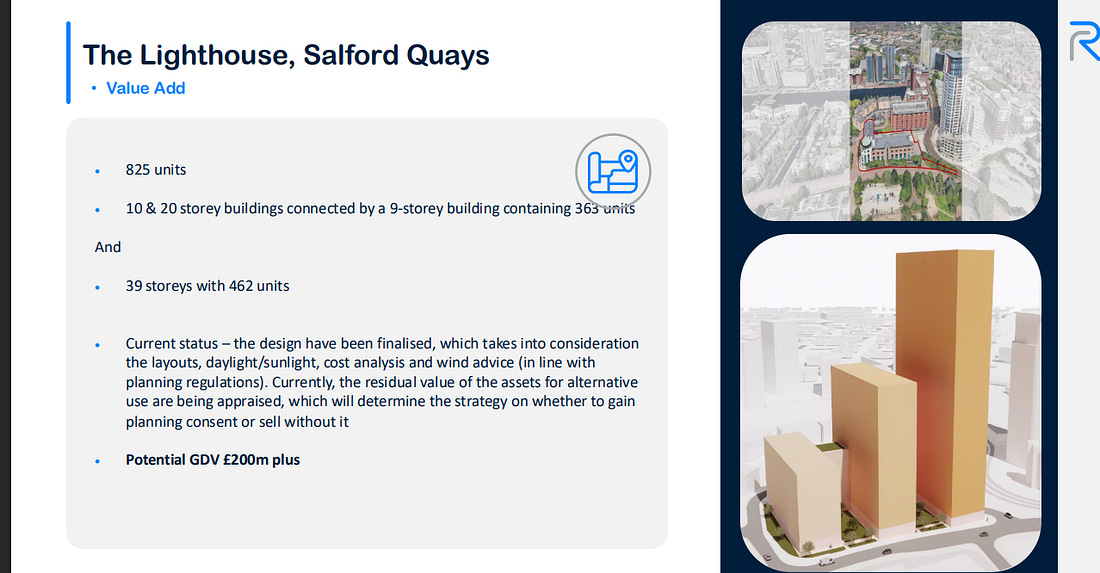
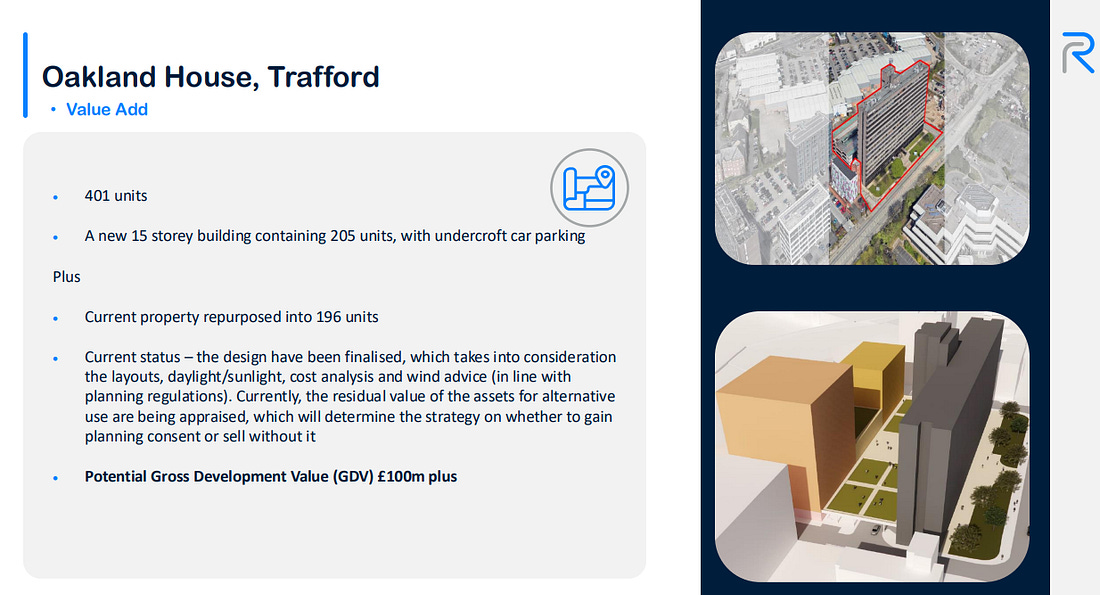
The third type “Value Add” are all about adding value and doing stuff to achieve a higher disposal value than its current book value. This will typically be a change of use and potentially involve obtaining planning permission. RGL speak of “greater potential” and quote examples with strong upside.
I’d assumed the “Sales” segment meanwhile would lose about 20% of their value i.e. they get realised for 80% of their valuation – so far that’s far from the case.
If the Value Add and Sales can be sold at book value only (i.e. Value Add adds no value ironic huh?) then here’s the result:
Based on 30/06/25 position
£150m of disposals (from Value Add and Sales) means a -£150m reduction in debt. That would leave net debt below -£100m once that sales programme is complete.
The Capex to Core is assumed to rent at 25% above current levels and the 5.2% increase already seen in 2025 is used to model the “future rental” based on current occupancy. Even after disposal (to nearly no debt) the rent roll pays nearly £50m a year.
If we then consider the ERV at 100% occupancy then we actually get to a £65m rent roll – or £90m if the value add and sales segments were not fully disposed and instead fully occupied at the ERV price point.
None of that potential income increase is anywhere in the price today.
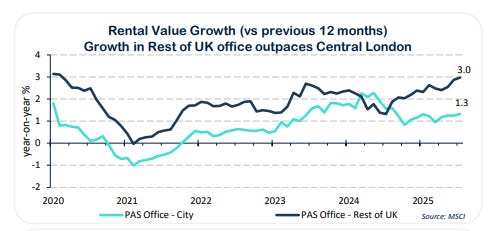
Of course that model assumes a single increase of 5.2%. What if actual increases are accumulating at up to 3% per year – as MSCI tell us is currently the case?
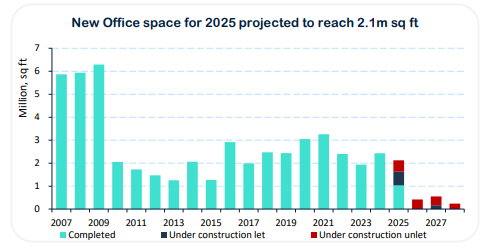
There is a substantial slow down meanwhile in the supply of new office space. What does rising demand and declining supply mean for the price of UK regional Offices do you think?
Covenants and Debt
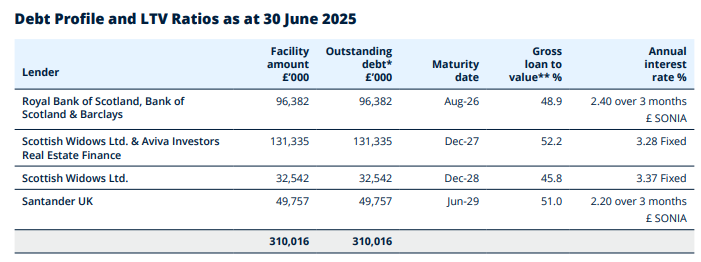
With gross debt now at an estimated -£282m (net -£221m est.) and LTV at just under 40% (est) it is true that only 8 months remain until the 1st tranche of debt needs to be rolled. 2.4% + SONIA is 6.7% so it is likely that interest costs will remain static in 2026 with a potential -£2m to -£3m of additional costs in 2027 as the 3.28% fixed gets renewed. Less repayments through disposals between now and then.
If RGL can dispose another £40m-£50m in 2026 then its net debt might be an estimated circa -£160m in 12 months.
Under a sub £100m debt model then there is over 3 years until the Scottish Widows £32.5m debt needs to be renewed.
This kind of freedom and indeed achieving sub 40% LTV is something unrecognisable to a RGL-er from a few years ago where “Covenant Breach” was a constant concern. An acute concern.
Circumstances might determine that minimising debt is not the way RGL needs to go.
Despite Andrew Bailey’s hesitancy there is every chance that interest costs will continue to fall. Evidence for a UK recession is growing. Will inflation remain sticky or will we see that fall further in 2026? Unemployment hit 5% recently, GDP growth is decelerating, most forecasters see today’s UK 3.75% BoE rate falling to 3% by 2027.
At 3.75% plus 2.2% that’s debt costing sub 6%. Such leverage should be inherently profitable in a robust rental market.
Rents
Evidence exists meanwhile that the ERV (Estimated Rental Value – the value of the current market rent) is growing fast. New leases were 8.3% above ERV, and have been consistently above ERV by 5.1% in 2025, including on renewals.
Remember ERV is the theoretical market value – not RGL’s current rate – think of it as the potential upside. So “above ERV” think upside to the upside.
Consider the gap between the £56.7m actual gross rent in 1H25 vs the £82.9m ERV.
If that 5.1% above ERV is the “true ERV” then that means the ERV is approximately £87.2m; and that would mean up to a £30.5m per year difference to future rents….
…..that’s a potential 53.8% uplift to rental income!
If we consider the expiry profile let’s see what that means for income.
Assuming It would increase the ERV by the 5.1% YTD with the 8% achieved in 3Q25 being the 2026 value, and a further 2% per year after that.
Nearly £6m is added to the ERV of the annual rent potential by 2035, even at a modest 2% rise.
This analyses the rising ERV value + £5.8m over 10 years (at an assumed +2% per annum)
But this is based on the rent already being at ERV. But it’s not.
If RGL can achieve the same 5.1% uplift PLUS grow occupancy/rents to its ERV levels then the increase in rental income is dramatic.
Plus £32.3m pre tax income per year.
This analyses the rent roll uplift at ERV + 5.1% compared with current rents – assumes current occupancy.
A +£32.3m per annum difference over the medium-long term (i.e. 10 years) and +£9m per annum difference in the near term – as shown below – i.e. based on disposing of the “Value Add” and “Sales” segments of property.
A risked model.
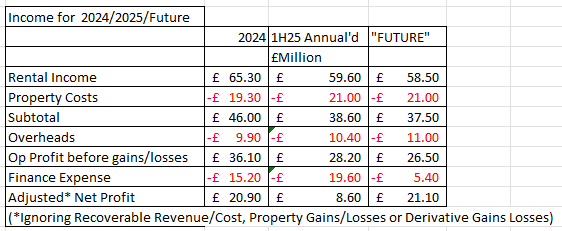
If we take the £65m future ERV less 10% (i.e. based on 90% occupancy) and assume disposals are complete then we see a more than doubling of profit from today.
This assumes no gains (or losses) from the portfolio and ignores pass through costs. It assumes property costs at a much higher rate than today (i.e. -£21m on a much smaller footprint post disposals).
The below model is based on an interest bill of 6% on £90m of borrowings, and assuming only a 90% lettings rate (i.e. not 100%)
£21m on £100m market cap is a 21% yield remember!
Is Zero Gains and Perpetual Losses to Commercial Property Capital Values Realistic?
RGL-ers have become so used to property portfolio capital losses the idea of this reversing one day is anaethema. However it shall revert. It always does.
Demand and supply eventually dictate that it shall. Is “eventually” now?
The replacement cost of commercial property and the rewards for improving property clearly show that upside can be obtained. With rising rental prices it makes no sense for capital costs to continue to fall. Yield percentages would grow at a double speed until they do stop falling.
Even a 5% per annum capital gain on a ~£500m portfolio is worth an additional £25m or ~15p per share per year to each RGL-er.
What if RGL throws the dice on its “Value Add”?
Another view of reduced debt (and assumed it is refinanced with the same levels of headroom) is that RGL gets £200m+ of headroom “to do something”.
Perhaps RGL might directly develop one or more of its assets under the “value add” category – although there’s no evidence yet that they shall.
But if they did using existing debt headroom and cash to fund one or two potential GDVs of gross development values of £100m+ and £200m+ on properties that today are valued circa £10m, that leaves potential for RGL plus a developer to make a mutual return. OB idea Watkin Jones is one such example of a potential partner.
Valuation
RGL has always been a good dividend payer and its recent news to increase the dividend to 2.5p per quarter means 10p a year and that’s a 10% yield at today’s prices.
But then you must compound the expectations that a ~£500m property portfolio of mainly freehold offices can expect to appreciate in value too. By 5% a year? That’s a £25m gain on top.
10% yield becomes a 25% ROE. Now we’re talking.
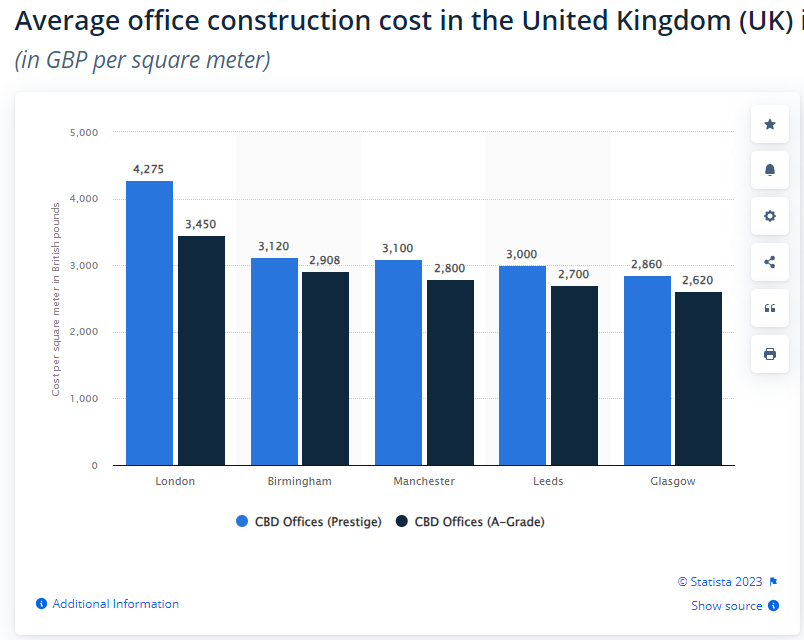
The ~£500m of property are valued at £106.1m per square foot. That’s £1,141 per square metre. That’s about 60% BELOW the replacement cost of building an office. These construction cost numbers are from 2023 so are proably higher in 2025 too.
Conclusion
The fall in share price for RGL despite the turning of the tide we are beginning to see, makes this an interesting idea to include in the picks for 26 despite being much unloved.
Rents outside London are growing at 3%. We have seen repeated evidence in RGL’s lease renegotiations with tenants that the market is recovering.
RGL was so unloved it was the also most voted for. Hence here it is. Either the contrarian in me is also the contrarian in my readers – or my substack is full of wind up merchants who voted for this. Should you believe in the wisdom of crowds? You decide.
Regards
The Oak Bloke
Disclaimers:
This is not advice – you make your own investment decisions.
Micro cap and Nano cap holdings including REITs might have a higher risk and higher volatility than companies that are traditionally defined as “blue chip”.
This is a non-independent marketing communication commissioned by Aberdeen. The report has not been prepared in accordance with legal requirements designed to promote the independence of investment research and is not subject to any prohibition on the dealing ahead of the dissemination of investment research.
Kepler
Invests in high-quality UK companies, overlayed with a sustainability framework.
Overview
The most significant development for Dunedin Income Growth (DIG) this year has been the board’s introduction of an enhanced Dividend policy. Dividends will now be funded from both income and realised capital, rather than being tied predominantly to the portfolio’s natural income generation. The board has committed to a minimum dividend of 6.0% of NAV (based on the NAV as at 31/07/2025) for the financial year ending 31/01/2026, equivalent to at least 19.1p per share, a 34.5% increase year-on-year, implying a yield of around 6.4% based on the current share price. Annual income and realised gains will provide the primary funding source, alongside revenue and capital reserves of £298m, underpinning the distribution for the long-term. Additionally, funding from both income and capital gives the managers greater flexibility to focus on total-return generation.
Despite this, the investment process remains unchanged. Managers Ben Ritchie and Rebecca Maclean continue to target high-quality companies with durable cash flows, strong balance sheets and supportive long-term growth characteristics. Combined with the trust’s sustainability framework (see ESG), which blends exclusions, positive allocation and active engagement, this keeps the portfolio anchored in fundamentals whilst maintaining responsible positioning.
Portfolio activity over the past year has reflected the opportunities emerging in a historically undervalued UK market. The managers have added to areas where valuations appear to underappreciate cash-flow durability and long-term compounding potential, particularly across smaller companies, with new positions including Kainos and XPS Pensions Group.
Performance over the 12 months to 15/12/2025 was mixed. A positive NAV total return of 9.7%, was supported by strong contributions from Prudential and Chesnara, though in relative terms, DIG lagged the FTSE All-Share Index’s 19.9% return, reflecting style headwinds and lack of exposure to stocks outside its quality and sustainability criteria.
At the time of writing, DIG trades at an 7.6% Discount, wider than the five-year average of 5.9%.
Analyst’s View
We believe DIG offers a compelling route into the UK equity market, particularly for income-focussed investors, with the enhanced dividend policy the most notable development this year. Committing to a minimum 6% of NAV and drawing from both income and realised capital provides a materially higher yield, whilst giving the managers greater freedom to target total-return opportunities. This shift may broaden the trust’s appeal, and as sentiment improves or awareness of the new policy grows, we see scope for the discount to narrow.
The managers’ investment strategy remains unchanged, centred on a concentrated portfolio of high-quality companies with robust financials operating in structurally growing markets. The trust is overweight smaller companies, reflecting conviction in the long-term opportunities available in this segment of the UK market. This positioning aims to capture undervalued growth and improve returns, whilst maintaining downside resilience through strong balance sheets and cash generation. Meanwhile, the valuation premium of DIG’s quality income holdings versus the wider UK market has compressed to levels not seen for many years, signalling a potentially compelling valuation opportunity.
That said, this same positioning has weighed on performance over the past five years. DIG’s quality-growth, sustainability-aligned approach has struggled in periods where large-cap value and cyclical sectors, such as banks and defence, have dominated market returns. Nevertheless, these characteristics have historically provided downside resilience, and the focus on high-quality, cash-generative businesses positions the trust well for any future shift in leadership or increased focus on ESG considerations.
Overall, we think DIG’s investment process sets it apart from its peers in the UK Equity Income sector, and its enhanced dividend policy further helps position it as a genuinely differentiated option for investors seeking exposure to the UK’s long-term potential.
Bull
Highly differentiated approach, with a focus on quality and sustainable income, to both the peer group and index
Well-diversified list of UK businesses that also derive revenues overseas
Use of option writing gives managers greater flexibility to invest across the market-cap spectrum
Bear
ESG exclusions will result in underperformance if stocks and sectors associated with higher ESG risks rally
Exposure to mid-cap companies may bring more sensitivity to the UK economy
Balanced-investment approach may lag a value style-driven market
Forget the Fear: These 3 Dividends (Up to 17.9%) Are Built for 2026
Michael Foster, Investment Strategist Updated: December 22, 2025
Stocks are about to do something almost totally unheard of: chalk up three winning years in a row.
And no one is celebrating.
Instead, worry is everywhere: about an AI bubble. Sticky inflation. Or the Fed—everything from the bank’s next chair to its independence and the direction of rates.
This combo—a strong market tempered with a big dose of anxiety—has set up a rare setup in our favorite high-income plays: 8%+ yielding closed-end funds (CEFs). It comes in the form of a pattern I don’t see often, but when I do, it’s almost always a buying opportunity.
That pattern is the following: A drop in a CEF’s market price (driven by investor sentiment), while its underlying portfolio (driven by management’s talents) keeps on growing.
This can only happen with CEFs: Since they have a roughly fixed number of shares, these funds can (and often do) trade at prices higher or lower than their portfolio value (the net asset value, or NAV, in CEF-speak). If the market price is higher than NAV, it’s a premium. Lower, a discount.
And right now, plenty of CEFs are showing just this kind of setup: Their market prices are dropping while their portfolios keep rolling higher. We’ll look at three examples yielding up to 17.9% (not a typo!) in a moment.
But before we do, I have to tell you something else working in our favor with these high payers: market history.
You see, in most cases when investors fear a downturn, that’s when a downturn is least likely. Few called, or even expected, the 2008 recession, for instance. That’s partly why it was so painful.
It was only when Wall Street “wisdom” was to sell that stocks began to recover in 2009. And, of course, they kept soaring for the next decade and a half.
Which leads us to today, where we have a kind of ambient worry that makes contrarian bullishness more likely to pay off in the coming years. We can also see this weird meeting of paranoia and profits in those three CEFs, which we’ll get into now. All of them are underpriced as a result.
Bargain CEF #1: Portfolio Up, Price Way (Way) Down
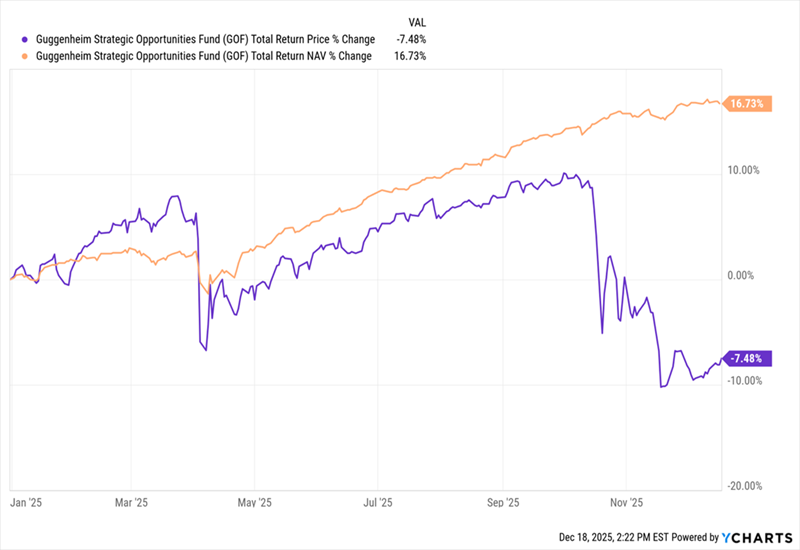
The first is the Guggenheim Strategic Opportunities Fund (GOF), which sports that crazy 17.9% yield.
Let me be clear: That yield is unsustainable, but that’s fine by us. Even if it were cut in half, it would still be around 9%, or more than the CEF average. So there’s room for that dividend to move around, and for the fund to still be a strong income provider. Plus there’s this:
Portfolio Gains, Share Price Tanks
Even though its portfolio is performing well (the orange line above), GOF’s market price-based return (in purple) took two big dips in 2025 and is now way behind.
This fund’s portfolio gains stem from its focus on relatively low duration debts (a 2.7-year weighted average, which cuts its interest-rate sensitivity). GOF also holds a range of credit, including bank loans, corporate bonds and mortgage-backed assets.
But that hasn’t been enough to keep investors onside.
Before we move to our next CEF, one thing to note here is that the drop in the fund’s market price doesn’t make it a buy just yet, as it still sports a 6.7% premium. But it does make GOF worth watching, as that premium has been fading, due to the fund’s sinking share price, and could turn into a discount. If it does, that’ll be the time to pounce.
Bargain CEF #2: A Dip Even a Patriotic Ticker Couldn’t Stop
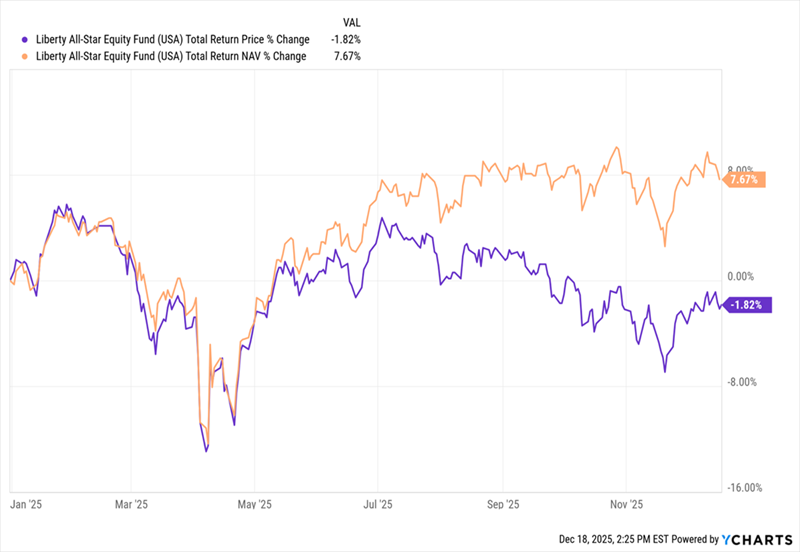
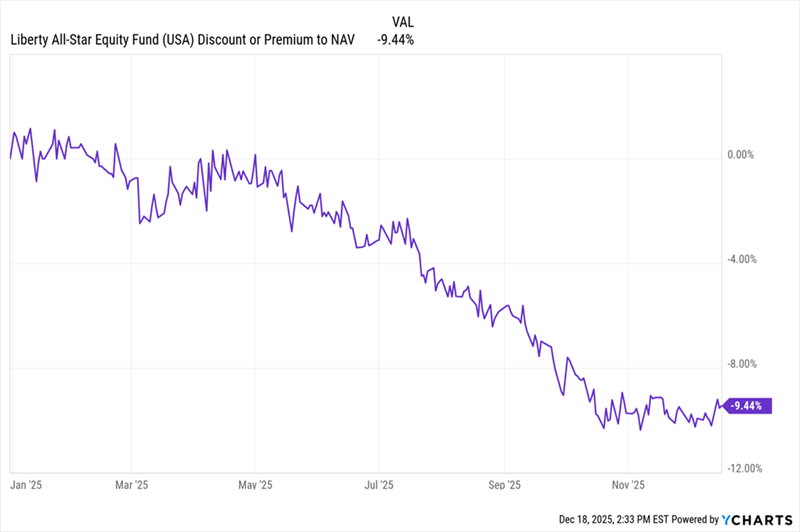
Next up is one of my personal favorites: the Liberty All-Star Equity Fund (USA). Not only does this all-stock CEF have the best ticker on the market, it’s also got one of the best portfolios, including NVIDIA (NVDA), Microsoft (MSFT), Visa (V) and many other American mega-caps.
Another Strong, but Unloved, Portfolio
The profits from those holdings are why the fund’s NAV return (in orange) has risen in 2025. But look at its price return (in purple): It’s actually gone negative! That’s very odd, and it’s why USA’s pricing has tanked.
A Rare Buying Opportunity
With a 9.4% discount, USA is cheaper than it’s been at any point in the last five years. That alone makes this fund a smart pickup if you’re looking to bolster your stock holdings. The dividend is another: an 11% yield that looks sustainable.
Bargain CEF # 3: An 11% Payer Built for an Uncertain Fed
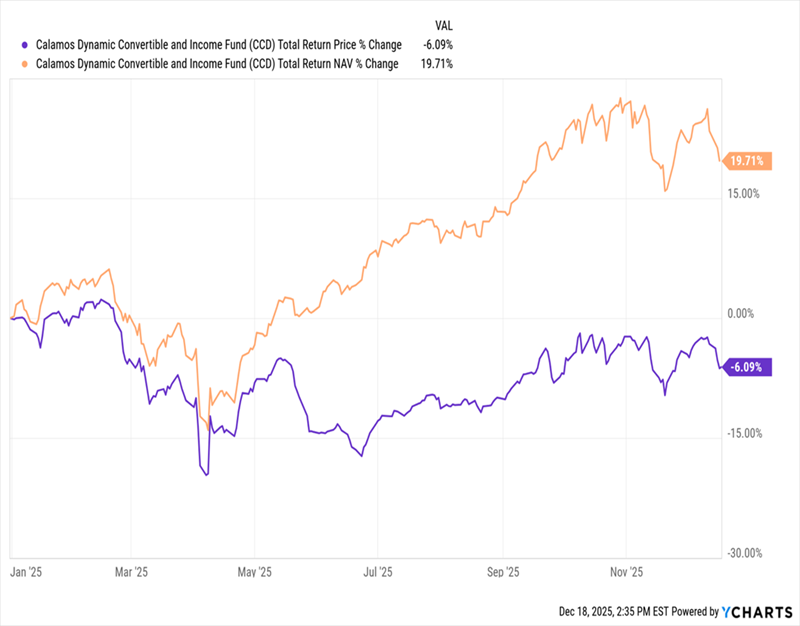
Another high-yielding credit CEF that’s fallen into the bargain bin is the Calamos Dynamic Convertible & Income Fund (CCD). Its 11% yield is sustained by a mix of convertible bonds and high-yield corporate bonds. CCD’s weighted average duration of just two years also lowers its rate sensitivity.
That’s why CCD’s portfolio value has soared in 2025, as the Fed’s slower-than-expected rate cutting helped grow the fund’s portfolio (in orange below).
Big Profits, Falling Prices
Investors didn’t see it that way, though, which is why CCD’s price return (in purple) is down for 2025. That sort of disconnect doesn’t tend to last, so expect CCD’s price to gain in the future.
Now there is a catch with CCD: It still trades at a 1.9% premium. That’s small, but we could see it flip to a discount before it reverses course. But that’s no guarantee, so one approach would be to add a bit now, wait for the discount to appear, then buy more. And all the while, hold on to USA and keep an eye on GOF.
There are plenty of interesting opportunities available to investors in UK stocks in 2026, argue City analysts. Graeme Evans explains why and where to find them.
22nd December 2025
by Graeme Evans from interactive investor
An attractively valued FTSE 250 index has the chance to shine in 2026 as mid-cap stocks benefit from tailwinds including lower interest rates and an improved earnings outlook.
The optimism, which follows a long period when UK equities have been low down on the global shopping list, comes amid hopes that the chancellor has done enough to break the country’s so-called gilt doom loop.
The Budget’s largely disinflationary policies provided some reassurance to financial markets and appear to have opened up a pathway for more interest rate cuts by the Bank of England, fuelling hopes that long-term gilt yields will stop rising after five years.
Broker Panmure Liberum said that this should help lower discount rates for future cash flows and reduce the cost of capital: “The result should be a further re-rating of UK stocks, but growth stocks should benefit more than value stocks. Switch to stocks with faster earnings growth.”
The FTSE 250 delivered robust growth in excess of 6% in the year but remains some way short of the all-time high of 24,250 set in September 2021.
Its performance has been in contrast to the best year since 2009 for the FTSE 100 index, fuelled by strong demand for lenders, defence and commodities-focused stocks.
Panmure Liberum noted recently that the FTSE 250 is valued at about 12.4 times forward earnings, whereas the FTSE 100 is on 13.1 times and the S&P 500 index on 22.4 times after the blue-chip benchmarks set record highs during 2025.
It adds that the dividend yield in the FTSE 250 is 4.3%, which on this metric alone means the mid-cap index looks the cheapest in 23 years compared to the FTSE 100 at about 3.5%.
The UK-focused benchmark often flies under the radar for income investors, including the fact that the spread of top payers is much broader than in the top flight.
As Octopus Investments points out, the top 10 dividend payers account for more than half of the FTSE 100’s total dividend payout compared to 28% for the FTSE 250.
Rathbone UK Opportunities Fund I Acc fund expects to see small and mid-caps’ discounts close sharply in 2026, particularly as global investors may look to diversify away from US mega-cap concentration.
It adds that FTSE 250 has an abundance of high-quality businesses that investors most favour.
Fund manager Alexandra Jackson added in a recent report to clients: “UK equities are cheap compared to history and compared to their global peers. UK mid-caps are cheaper still (despite typically commanding a premium).”
She pointed out that falling borrowing costs tended to be very supportive of the performance of mid-cap stocks over larger ones.
For Sanford DeLand’s TM SDL UK Buffettology General Acc Fund, the kind of long duration quality equities in its portfolio has seen a substantial de-rating due in no small part by the rise in the UK’s long-dated gilt yield since 2021.
It told investors following the Budget: “Our firm belief is that this headwind has now run its course and going forwards it is more likely to be a tailwind for our way of investing.”
However, RBC Wealth Management has flagged the risk that an increasingly unpopular Labour government abandons fiscal discipline.
Frédérique Carrier, its head of investment strategy, said: “If the government loosens its fiscal stance to spur growth — and its approval rating — financial markets would likely turn jittery, in our view, especially as the UK relies heavily on foreign investors to finance its debt.”
Capital Economics also warns that the risks to its interest rate and gilt yield forecasts are skewed to the upside, particularly if Keir Starmer and Rachel Reeves are ousted from their jobs.
The consultancy added: “There are question marks over whether the chancellor’s plans to hike taxes and to reduce real terms day-to-day spending growth to zero in the 2029-30 election year materialise. And party politics may force the chancellor to raise public borrowing.”
A backdrop of weak economic growth and higher-for-longer interest rates failed to stop 2025’s strong performance by UK equities, although idiosyncratic drivers at a stock level were behind much of the UK market’s return.
UBS expects returns to broaden out as the economic outlook improves, although these gains are likely to lag the pace of earnings given the strong valuation re-rating that’s already taken place.
The bank said: “While we see UK equities as well supported and expect the economy and earnings to accelerate over the next 12 months, we favour opportunities in the region with higher exposure to structural growth trends or those more cyclically exposed to a pickup in economic activity, especially in goods/manufacturing.”
Earnings have fallen around 15% over the past two years, but UBS is backing growth to improve in 2026 as US policy clarity, lower interest rates and an expected drop in energy prices begin to support end-demand.
It forecasts profits growth of 5% in 2026 and around 15% in 2027.
The bank holds a Neutral stance on UK equities, with a base case for the FTSE 100 index of 10,000 by the end of 2026. Its upside scenario highlights a year-end 10,800, dropping 7,200 under its most pessimistic forecast.
The outcome is likely to depend on continued confidence in richly-valued US equities and on commodity price trends given that this sector contributes around 25% of FTSE 100 earnings.
A reversal of recent pound strength could also support higher local currency returns, with 75-80% of FTSE 100 revenues generated outside the UK.
The bank added: “We favour structural and cyclical beneficiaries in the region. We continue to like the banking, industrials, IT, real estate and utilities sectors as beneficiaries of a combination of global secular changes, an improving cyclical outlook and supportive policy.”
Invesco believes lower interest rates should help encourage reluctant households to start spending again, adding that UK households are sitting on savings equivalent to 14% of GDP and which could be deployed as they become more confident.
It said: “We see interesting opportunities in utilities and internationally orientated consumer staples, many of which are at attractive valuations compared to their overseas counterparts.
“Healthcare remains out of favour for many, so it’s an opportunity we want to take advantage of. While already performing strongly, domestic UK banks are still well placed to deliver strong returns.”
A reckoning is coming for unnecessary investment trusts
Investment trusts that don’t use their structural advantages will find it increasingly hard to survive, says Rupert Hargreaves
By Rupert Hargreaves
(Image credit: Getty Images)Share
Investment trusts are one of the best vehicles for creating wealth over the long term. Yet many of today’s trusts should not exist. Some are too small to make a difference and lack economies of scale. Others are not making the most of the benefits that the investment company structure offers.
An investment trust is set up as a public limited company, which has several advantages over other collective investment vehicles. Their closed-ended structure with fixed capital means that they don’t have to worry about money flowing in and out. That’s perfect for holding illiquid assets and also for borrowing money to improve returns. Meanwhile, the oversight provided by the board of directors should hold the investment manager accountable if the trust underperforms for too long.
However, this structure has two obvious drawbacks. One is overheads. Having an independent board of directors is expensive. Valuing and managing illiquid assets can also be costly and time-consuming. Paying for active investment managers has never been cheap, and it’s even more dear if the trust has an in-house management team, rather than sharing a manager who works across several funds. The combined impact of these costs means that many smaller trusts look expensive to their larger peers or open-ended funds with comparable strategies.
Get 6 free issues + a free water bottle
Stay ahead of the curve with MoneyWeek magazine and enjoy the latest financial news and expert analysis, plus 58% off after your trial.
The other is that the share price can – and usually does – deviate from net asset value (NAV). So shareholders cannot be sure if they will be able to sell at close to the value of the assets. In contrast, open-ended funds and exchange-traded funds (ETFs) trade at NAV.
Investment trusts need to start taking their advantages
So trusts need to employ their advantages to justify the disadvantages. Take leverage, which is one reason why trusts have tended to outperform similar open-ended funds over the long term. Trusts can usually borrow at highly attractive rates for long periods. The Scottish American Investment Company (LSE: SAIN), for example, issued three lots of loan notes several years ago, with maturities extending out to 2049 at rates of 2.23% to 3.12%. Yet most trusts just don’t make the most of this opportunity.
Nick Train’s Finsbury Growth and Income (LSE: FGT) has gearing of just 2.4% despite its scale and the manager’s conviction. So investors, managers and boards need to ask if the strategy would work as well in an open-ended structure. For an equity strategy that uses no leverage and invests in liquid stocks, the answer is likely to be yes. If so, there’s no need to operate with the added costs of the investment trust structure. The news that SmithsonInvestment Trust (LSE: SSON)will convert into an open-ended fund is a good example of this lesson being accepted.
Investment trusts must act soon
The market is slowly getting to grips with these realities. There were five mergers of similar trusts in 2025, with one more planned for early 2026, according to the Association of Investment Companies. Seven trusts and real estate investment trusts (Reits) were privatised – although long-term investors were not happy to see some of them go (eg, BBGI Global Infrastructure). There were 14 liquidations in 2025, the highest number since 2016; one of these, Middlefield Canadian Income, was a conversion to an exchange-traded fund (ETF).
To their credit, some trusts are making changes. There were 40 examples of trusts reducing their fees this year, compared with 32 in 2024 and 26 in 2023. There is more focus on closing discounts, albeit with mixed results. But many need to do more while they still have the chance.
Investors should consider if the trusts they own are worth their place on the market. If they’re not, it may be time to find something better – unless there is a realistic chance of activists forcing a restructuring that could bring windfall gains.