
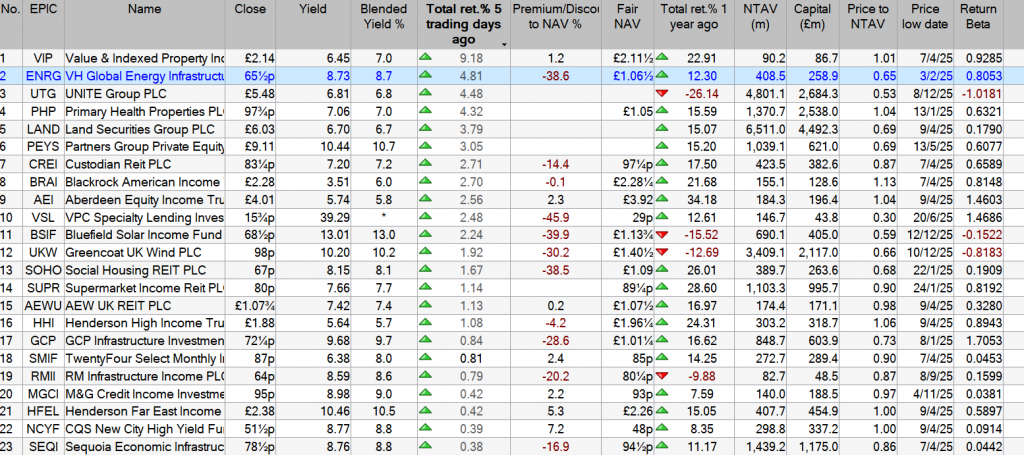
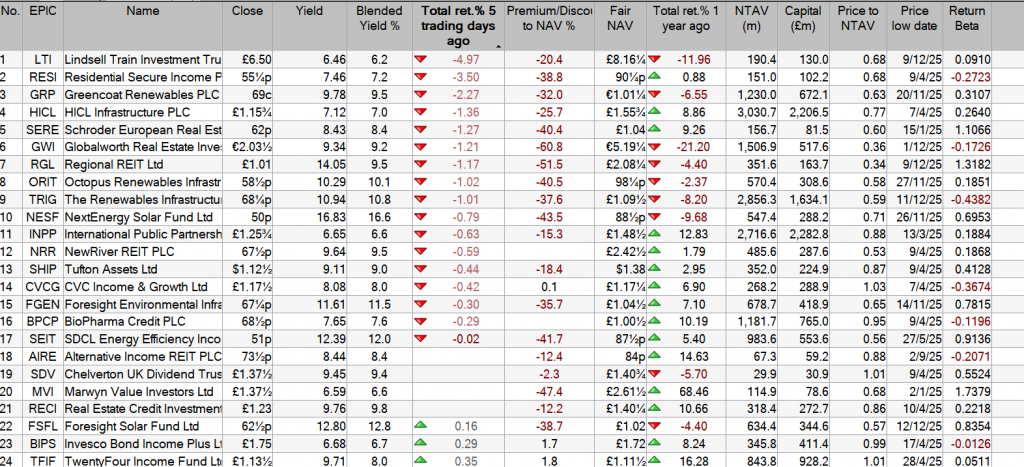
VIP closing price is most probably a false price.
Investment Trust Dividends
VIP closing price is most probably a false price.

Our investment specialist hunts for some alternative growth plays.
Jo Groves
Updated 14 Dec 2025
This is not substantive investment research or a research recommendation, as it does not constitute substantive research or analysis. This material should be considered as general market commentary.
It’s getting to the business end of the year. The Budget is finally behind us, with a veritable advent calendar of 24 tax rises to open and savour or, as Kemi Badenoch put it, a smorgasbord of misery.
But it’s not all doom and gloom in the Kepler office. This year’s Christmas party features an inaugural guess-the-baby photo competition, sparking a few, erm, “safeguarding concerns” among those longer in the tooth. Thankfully, a few strategically-placed unicorns and emoticons have (just about) restored public decency.
Love is also all around on Regents Street, where we’re treated to a daily parade of influencers preening and pouting their way to TikTok glory from the central reservation. A strong contender for next year’s Darwin Awards for death-by-rotating-ring-light, or natural selection at its finest, depending on your inner Grinch.
Anyway, enough festive digression and back to the equally sparkling topic of my investment portfolio.
As we edge towards a new year, thoughts naturally turn to portfolio allocations (or maybe that’s a damning indictment on my social life?).
Top of my list (along with much of the planet) is whether the AI bubble will burst, pop or, well, just quietly deflate. Apparently, we can dial down the bubble-on-bubble anxiety, as searches for “AI bubble” have already burst (and that’s probably enough of the b-word for now).
Source: Google Trends
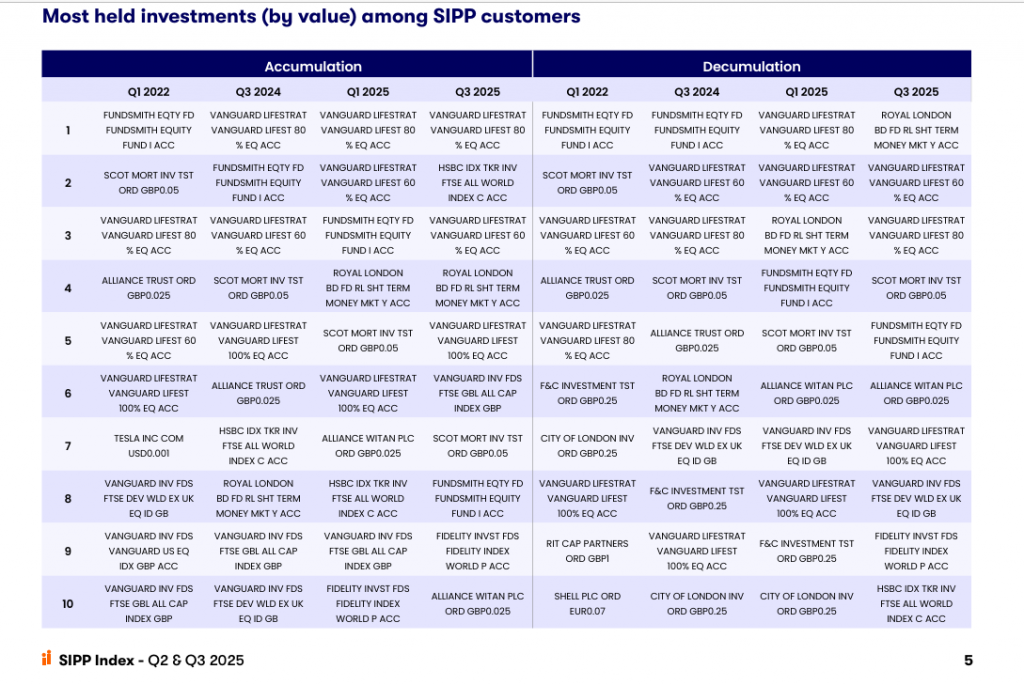
Given the US accounts for around 65% of the MSCI ACWI, I’m still meaningfully underweight at a quarter of my portfolio though not a complete anomaly (at least on the investing front). A recent Visual Capitalist study revealed that UK investors typically hold a third of their portfolio in US equities, a far cry from the near-80% exposure of American investors who are nothing if not a patriotic bunch.
In a recent podcast, veteran manager Terry Smith (who, it must be said, is more of a defensive-leaning chap) suggested that most investors own AI stocks simply because they’re going up, not because they’ve any idea how AI will actually play out. He may well have a point.
My tech exposure is via Landseer Global Artificial Intelligence, Fidelity Global Technology and, to a lesser extent, Alliance Witan (ALW) and Scottish Mortgage (SMT). NVIDIA (NVDA) is my only direct holding, which is up almost 50% or so in the 10 months I’ve owned it.
Interestingly, the elite tribe of Warren Buffett and besties seem to have no room at the inn for the world’s most valuable company. Microsoft, Alphabet, Meta, Amazon and Apple dominate their top tens (in that order), yet NVIDIA is conspicuously absent.
With full disclosure that I’m no algorithm-wielding quant wizard, here goes with my back-of-a-fag-packet sense check, ranking the Magnificent Six (I’ve excluded Tesla given its valuation defies earthly analysis) from most to least expensive, alongside some key metrics.Source: Financial Times & company accounts. Based on last financial year, trailing 12 month p/e ratio & the median of the 12-month share price analyst forecasts from FT data.
Past performance is not a reliable indicator of future results.
NVIDIA may have the punchiest valuation but it’s also delivered almost double Microsoft’s revenue growth, wins hands-down on margins and its latest quarterly net income even beats the combined revenue of rivals Intel and Broadcom. Admittedly all rear-view mirror stuff but it could still have legs with the highest share price forecast amongst the group.
However, when you’re sitting pretty on a quasi-monopoly and your training rigs cost the GDP of a small nation, there’s undoubtedly a very large target on your back. Meta’s recent tie-up for Google chips is a reminder that even old rivals can find common ground when there’s enough zeroes at stake.
So what’s the takeaway for NVIDIA? Its priced-for-perfection valuation does suggest caution, even if bull markets supposedly climb a wall of worry. As Smith warns, a cooling of AI hype could see NVIDIA tumble 80%, which may explain why the super investors are parking their chips in the more diversified mega-caps. That said, I’m happy to hold for the longer term even if there’s near-term pain ahead.
For once I’m not banging on about undervalued UK equities and instead casting a critical eye over my alternative growth plays for 2025 when tech valuations felt a bit toppy.
First on my shopping list was International Biotechnology (IBT) in December 2024. On the back of political headwinds clearing and interest rates falling, the biotech recovery is in full swing, with IBT chalking up a stellar 60%-plus return in the last six months.
Managers Ailsa Craig and Marek Poszepczynski have an impressive track record of uncovering the best opportunities across the sector, with a particularly high hit rate on the M&A front. And if you’d like to find out more about the outlook for biotech, have a listen to our recent podcast with Ailsa.
Next up was Asia: with more than double the number of listed companies of the UK, Europe and the US combined, I’ve opted for the on-the-ground, big-hitting resources of Schroders and BlackRock.
Asia isn’t often seen as a typical income play but Schroder Oriental Income’s (SOI) five-year return of 65% not only tops the AIC Asia Pacific Equity Income sector but is more than double the highest-returning fund in the Asia Pacific sector too. Proof that income doesn’t need to come at the expense of growth, with manager Richard Sennitt showcasing the merits of a steady hand on the tiller in a heterogeneous universe.
Stablemate Schroder Japan (SJG) was added in February to plug the gap in my Asian exposure. There’s plenty going for Japan, from corporate governance reform to rising household income, and SJG’s small and mid-cap tilt has served it well this year, underpinning a one-year return of more than 20%.
Last on the list was BlackRock Frontiers (BRFI) with manager Emily Fletcher gracing our October Market Matters podcast. Emerging markets tick the box on the growth front but are increasingly resembling a Magnificent Seven proxy play given the dominance of the likes of TSMC, Tencent and Alibaba. BRFI avoids the eight largest emerging markets entirely, offering genuine diversification away from both US tech and EM heavyweights.
So how did my picks fare as alternative growth plays to the S&P 500? Well, IBT took top honours with more than four times the S&P 500 return but all the other funds have comfortably outperformed too. Bubble or no bubble, perhaps there is life beyond the Magnificent Seven after all.
Source: HL & FE Analytics (as at 08/12/2025. Returns based on the date of purchase to the current date.
Past performance is not a reliable indicator of future results.
And, finally, may the only bubbles you need to worry about this festive season be the ones in your glasses. Here’s to a jolly Christmas and we hope you join us for more portfolio ponderings in the new year.
All numbers as at 08/12/2025 unless stated otherwise, returns based on share price total returns.


Disclosure – Non-Independent Marketing Communication
This is a non-independent marketing communication commissioned by Sequoia Economic Infrastructure Income (SEQI). The report has not been prepared in accordance with legal requirements designed to promote the independence of investment research and is not subject to any prohibition on the dealing ahead of the dissemination of investment research.
SEQI generates an exceptional yield by lending against critical modern infrastructure.
Sequoia Economic Infrastructure Income (SEQI) offers yield high enough to rival most alternative assets or fixed income trusts from an ungeared portfolio of loans to borrowers in the infrastructure sector. The portfolio has a number of defensive properties, being highly diversified by sub-sector, borrower and asset, majority senior secured debt and managed with a conservative approach that has seen very low realised losses in the portfolio.
The infrastructure referred to includes new economy industries and themes like the physical support for artificial intelligence and new and greener energy supply like renewables and nuclear. With loans being made on a three to five-year basis, there is a constant flow of money back into the portfolio allowing the managers to be flexible with their positioning. Having been an early mover in the data centre space and generating attractive returns, they are currently finding lending standards on new loans slip due to the artificial intelligence boom, meaning this allocation has been falling. Instead, the team have been investing further down the chain in the power supply and networks connecting these to the grid, taking advantage of the same trends via loans with better rates and covenants.
SEQI’s Dividend yield of 8.8% reflects the impact of a Discount of 18%. This compares highly favourably to the company’s AIC Infrastructure and AIC Debt – Loans & Bonds peers. The dividend is fully cash covered, and the team report this cover should increase in the coming months as new loans start paying interest. The board has bought back substantial amounts of shares in recent years to tackle the discount, and states that managing the discount remains a priority.
Analyst’s View
We think SEQI is an attractive income product in the current economic environment. The portfolio is invested in defensive, non-cyclical sectors and in crucial infrastructure with strong economic and policy support behind it. The lack of fund-level gearing is notable, as it means that the NAV should be more stable than many other high-yielding options, and that financing costs don’t affect profitability. With the strong focus on new economy infrastructure like data centres, broadband and power networks we think the trust offers a way for income investors to generate a high return from these secular growth themes without taking equity risk.
We think the discount largely reflects the higher interest rate environment since 2022 which has seen capital go into cash and government bonds, and so as rates continue to come down demand for SEQI’s shares should rise. In that light, buying a portfolio of ungeared loans on an 18% discount looks attractive, particularly when considering the board’s commitment to buybacks and the fact the NAV includes a pull-to-par gain of c. 2.8p, or 3%, on loans trading below 100. While falling interest rates should see yields available fall across fixed income sectors, it is notable that SEQI has maintained its portfolio yield and dividend target while rates have fallen between 125bps and 235bps in the major jurisdictions. We think this speaks to the diversity of the opportunity set, which continues to benefit from strong technicals, and the conservative approach of the management team, who have plenty of levers to pull to maintain the yield without massively tramping up risk.

| fdertol mrtokev fdertolmrtokev.comx Timbers51000@gmail.com 204.217.130.252 | Hello would you mind stating which blog platform you’re using? I’m going to start my own blog soon but I’m having a difficult time making a decision between BlogEngine/Wordpress/B2evolution and Drupal. The reason I ask is because your design and style seems different then most blogs and I’m looking for something unique. P.S Apologies for being off-topic but I had to ask! |
It’s WordPress thru Fast Hosts



This Flawed Chart Could Spark a 2026 Selloff
by Michael Foster, Investment Strategist
Every year, the stock market has a theme. And I’ve got a pretty good idea of what 2026’s will be.
Simply this: If you buy stocks in the new year, your return will be zilch – at best – for a decade. Maybe more.
Why do I say that? Because the market’s price-to-earnings (P/E) ratio is high by historical standards.
Trouble is, most people are reading this popular indicator all wrong. That disconnect (and the fear it’s starting to cause, which could get worse in 2026) is setting up a nice short-term buying opportunity for us.
Valuation worries are being amplified by this chart from Apollo Global Management, which could easily become the poster child for fearful investors next year:
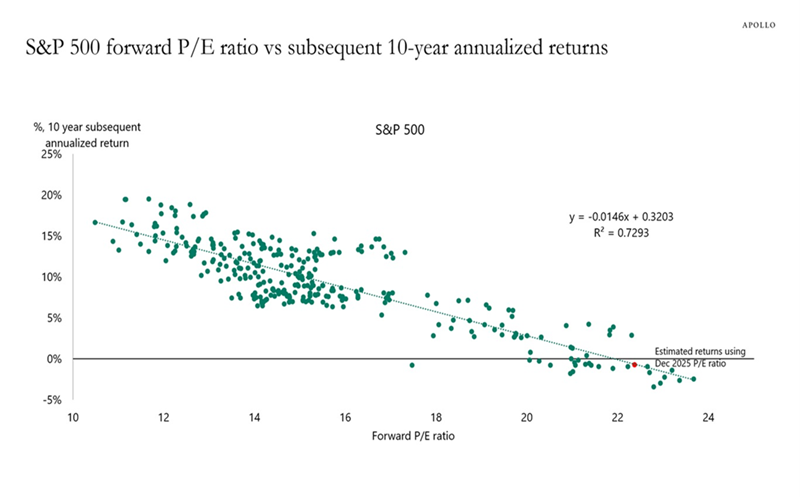
It comes from Apollo’s chief economist, Torsten Sløk, who notes that the estimated returns we should expect from the S&P 500 over the next decade are zero. This argument is based on that “high” P/E ratio I just mentioned. In other times where we saw a similar P/E ratio, according to Apollo’s analysis, we saw 10 years of flat to negative returns.
This argument has a logical end point: You may as well sell, because we’re in for a long period of flat returns at best.
Except the argument is wrong, and it’s not as logical as it looks.
The issue in the chart above is with what each of these dots represents. The S&P 500 as an entity has only existed since 1957, and the first ancestor to the index showed up about 100 years ago. So at most, we should have 10 dots here to cover 10 decades. Instead, we have many more than that because Apollo is using monthly reads of the index to fill out the chart and get more data points.
That’s not a small decision. It means that many of these dots are almost identical, just shifted forward a bit. For instance, the dots for November and December 2015 share 119 out of 120 months of the same data, so the chart looks like it has lots of separate data points, but it really doesn’t.
Statisticians call this “autocorrelation,” and it often results in charts that look like they have conclusive results when they really don’t say much at all.
Plus, let’s not forget that P/E ratios can be “high” for different reasons. Consider, for example, the spring of 2009, when the S&P 500’s P/E ratio shot above 120. I think we know how the following years played out.
Those Who Sold This “High” P/E Missed Years of Gains
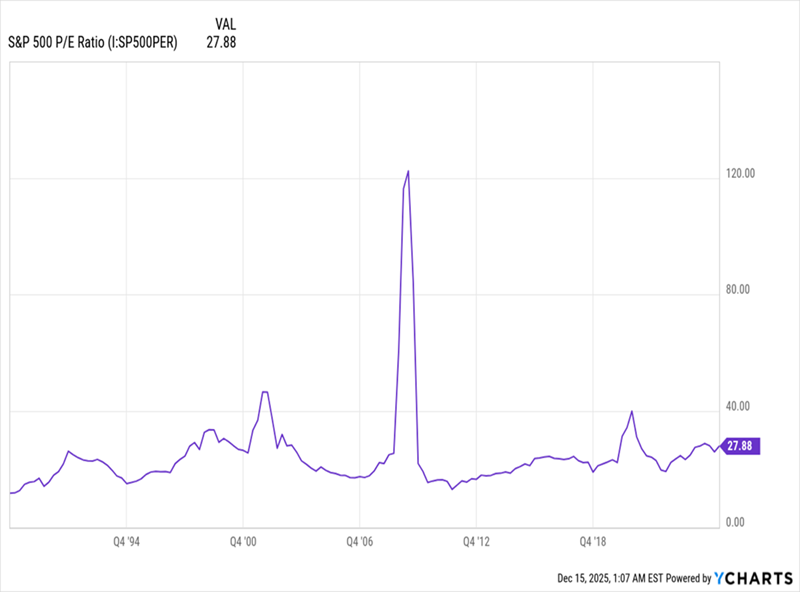
An investor who bought the S&P 500 at its highest P/E in living memory earned a 14.5% total return in the next decade, as the index’s P/E dropped to a more “normal” range.
S&P 500 Returns Soared as Valuations Dropped
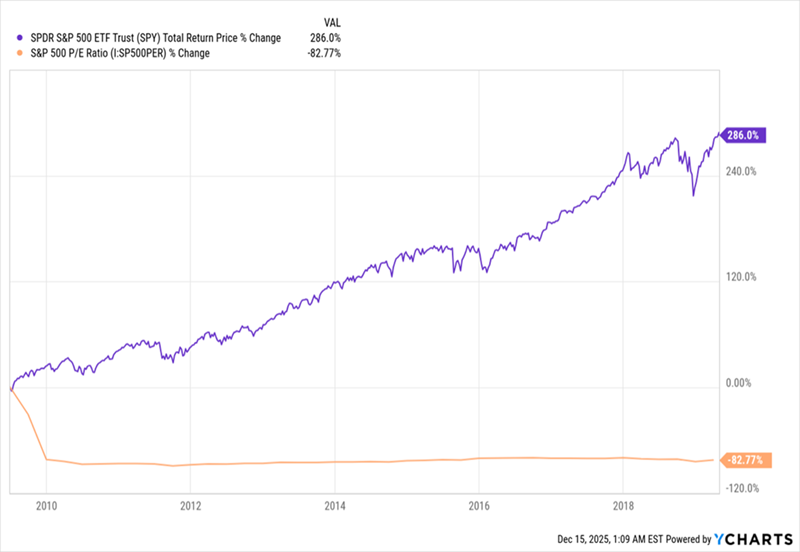
In this case, the logic of “Don’t buy stocks when P/E ratios are high” doesn’t work. That’s because – and this is the real takeaway – P/E ratios can jump because prices get too high, sure. But they can also soar when the “E” part of the equation, earnings, slump, as they did in early 2009.
The real question, then, is “Are companies growing profits now?” The answer is yes.
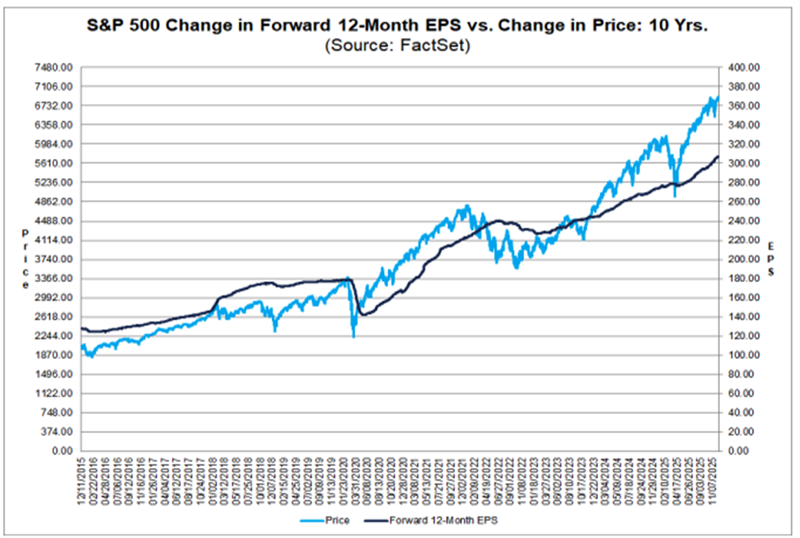
In 2025, US companies saw a 12.1% rise in earnings per share from a year ago. This suggests stock prices should rise at least 12.1% just to maintain the same P/E ratio.
But since earnings growth is surging (an 11% rise in 2024, up from 1.1% in 2023 and 4.1% in 2022), and since revenue growth is unusually high (up 7% for 2025), we should see more than 12.1% yearly gains. That’s exactly what we’re seeing now. It wouldn’t be surprising if we keep seeing this in the future.
Flawed Logic Can Still Crash Markets
Nonetheless, most people put more weight on the “P” than the “E” in “P/E ratio,” so we should expect Apollo’s chart to be replicated, and even take hold in investors’ minds. If that happens, we should be cautious and ready to buy when others sell.
That’s why I’m starting to like funds like the Nuveen NASDAQ 100 Dynamic Overwrite Fund (QQQX). This one is a nice, cheap 8%-paying hedge against uncertainty. It sells covered-call options, or the opportunity to buy its stocks – the tech-focused names in the NASDAQ 100 – at a fixed future price and date.
No matter how these trades play out, QQQX keeps the fee, or “premium,” it charges for this right. Plus, its focus on the big-cap tech stocks of the NASDAQ also means this index tends to have higher volatility when markets get scared, juicing payouts further.
This strategy generates more premium cash in volatile markets. That’s the opposite of what we’re seeing now, as the VIX – the so-called “fear indicator” – remains low.
Market Stays Calm, Despite Investor Fears
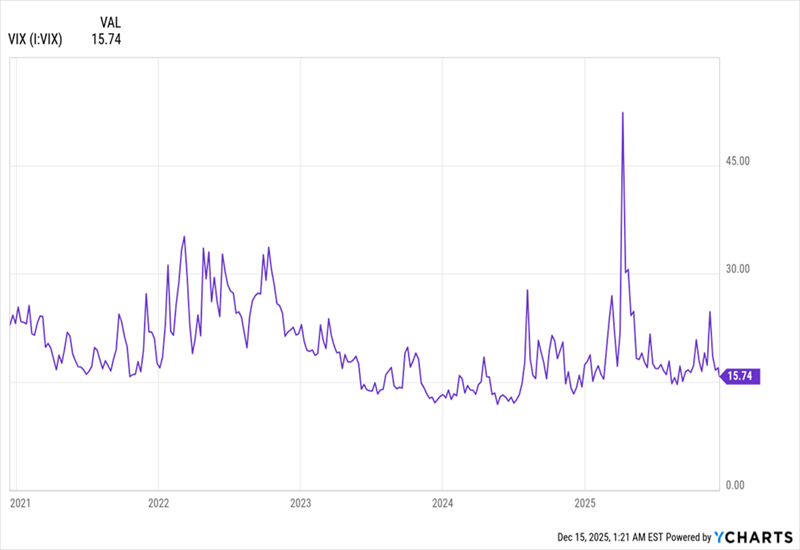
In other words, we have a relatively calm market as I write this. That, in turn, means options are selling for cheaper than normal. And unusually cheap options compound the discounts to NAV on option-selling funds like QQQX. Right now, the fund’s discount is at a multi-year low.
Calm Markets Put QQQX on Sale
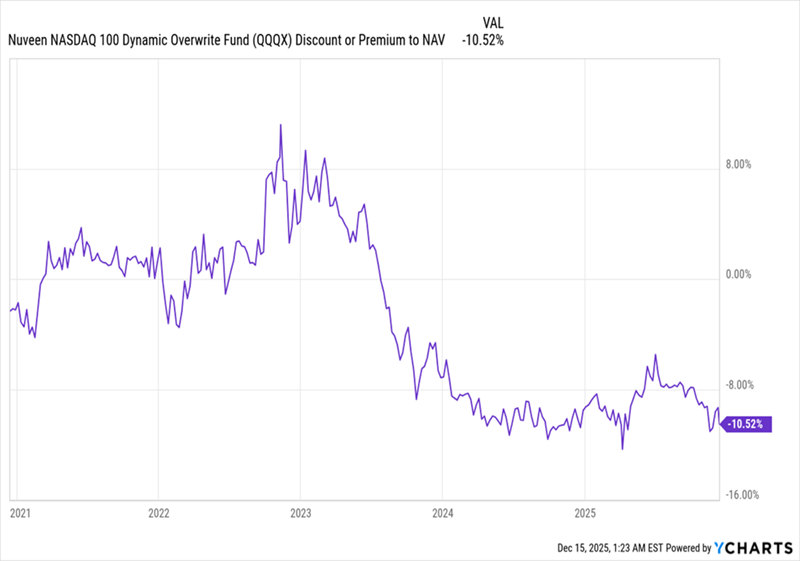
We saw that discount fade a bit in April, when volatility spiked, only for it to drop back to double-digits as markets remained calm and stocks steadily gained.
But if the narrative behind Apollo’s chart catches on, it could narrow that discount again, driving gains and bolstering QQQX’s 8% dividend. That possibility alone makes the fund a nice hedge against a market panic in 2026.


The renewable energy infrastructure sector was dealt a blow last month as the government outlined plans to change the inflation link in existing clean energy incentives from the traditionally-higher RPI to CPI from next year – four years ahead of the planned changeover. The impact on Foresight Environmental Infrastructure (FGEN) would be marginal under this option (0.5% reduction in NAV), due to the diversified nature of its portfolio. However, a more radical second proposal was also put forward that would freeze uplifts until the perceived overpayments are clawed back. This move calls into question the UK government’s reputation as a sound investment partner for private capital and has the potential to damage long-term investment in UK infrastructure.
Meanwhile, FGEN’s portfolio continues to produce robust revenue streams – more than covering its progressive dividend, which currently yields almost 12% – and it will soon benefit as its growth assets become fully operational.
FGEN aims to provide its shareholders with a sustainable, progressive dividend, and to preserve capital values. It invests in a diversified portfolio of environmental infrastructure technologies, targeting projects characterised by long-term stable cash flows, secured revenues, and inflation linkage. Investment in these assets is driven by the need to address climate change and societal demand for sustainability.

| 12 months ending | Share price TR (%) | NAV total return (%) | Earnings per share (pence) | Adjusted EPS (pence) | Dividend per share (pence) |
|---|---|---|---|---|---|
| 31/03/2021 | 6.9 | 1.5 | 1.5 | 6.7 | 6.76 |
| 31/03/2022 | 7.3 | 34.1 | 30.6 | 7.0 | 6.80 |
| 31/03/2023 | 12.2 | 13.1 | 14.9 | 6.7 | 7.14 |
| 31/03/2024 | (15.8) | (1.8) | (2.1) | 7.5 | 7.57 |
| 31/03/2025 | (15.9) | 0.6 | (0.4) | 8.6 | 7.80 |
Source: Bloomberg, Marten & Co
UK government proposes change to inflation measure in existing incentives
Government proposals to change the inflation measure used in existing clean energy incentives have hit share prices across the renewable energy infrastructure sector. The Department of Net Zero and Energy Security launched a consultation in October on changing the inflation indexation calculation used in the renewables obligation (RO) and feed-in-tariffs (FIT) schemes from RPI to CPI.
Two options have been put forward to the industry. Option one is for a simple switch to take effect in 2026; four years before the planned 2030 changeover. Option two is more radical and would involve freezing the subsidy until 2035 to claw back what the government views as historic overpayments to renewable operators.
The impact on FGEN and the wider sector’s NAV of the two proposed outcomes is shown in Figure 1. FGEN’s diversified portfolio means that a lower percentage of its portfolio revenue (around 29%) is subject to RO and FIT incentives than its pure-play renewable peers, and as such, it should be the least impacted.
| Company | Option 1 (%) | Option 2 (%) |
|---|---|---|
| FGEN | (0.5) | (6.3) |
| Bluefield Solar | (2.0) | (10.0) |
| Foresight Solar | (1.6) | (10.2) |
| Greencoat UK Wind | (1.7) | (7.5) |
| NextEnergy Solar | (2.0) | (9.0) |
| Octopus Renewables Infrastructure | (1.1) | (4.0) |
| The Renewables Infrastructure Group | (0.5) | (2.2) |
Source: Company announcements
Option one impact FGEN the least among peers
The manager estimates that option one would reduce FGEN’s NAV by 0.5p per share or 0.5%, while option two would knock 6.6p, or 6.3%, off the NAV. In both scenarios, the manager adds, dividend cover would not be materially impacted in the near-term.
The government is seeking to reduce energy bills and estimates that the changes under option one would see the average household bill for 2026-27 fall by just £4. This increases to £13 under the second option (before any costs such as an increase in the cost of capital).
The proposal follows the Office for National Statistics’s call for RPI to be dropped in favour of its preferred measure of CPIH, which includes housing costs, because RPI has tended to over-estimate inflation, thereby inflating contractual payments linked to it. The government has not commented on why it is not proposing a change to CPIH.
The government said that using CPI to annually adjust the RO and FIT buyout price (which were withdrawn in 2017-2019 but will continue until 2037 for renewable energy operators that built wind and solar farms under the schemes) was “proportionate and fair”, ensuring a stable and predictable return for generators and savings for consumers. It added that this would also prevent the risk of overpayment, as occurred when energy prices and inflation soared after Russia’s invasion of Ukraine in 2022.
Move could erode investor confidence in UK government
To unilaterally change the terms of its contract with the renewables industry would not only undermine confidence in the sector and create an unwelcome precedent, but would also erode investor confidence in the UK government as a business partner – at a time when private investment in UK infrastructure is critically needed. The short-term saving on consumer bills is very likely to be overshadowed in the long term by a higher return demanded by infrastructure investors and developers to compensate for an unreliable partner. The UK government’s actions echoes a similar move by the Spanish government in the mid-2010s, which retrospectively altered the terms of existing renewable energy projects, replaced FITs with new schemes and levied a tax on electricity producers. Investor confidence was irreparably damaged and led to a wave of legal challenges that is still rumbling on today.
FGEN reported a NAV of £652.7m or 104.7p per share at 30 September 2025 – a 1.7% fall over the six-month period. Factoring in dividends of 3.94p, this equated to a 2.0% NAV total return in the period.
Distributions received from projects over the six months was £39.7m (six months to September 2024: £46.6m). This underpinned the dividend with a coverage of 1.22x, and helped fund further share buybacks. The value of the portfolio fell £13.8m over the period, as shown in Figure 2.

Source: FGEN, Marten & Co
Several factors impacted FGEN’s NAV. We detail these factors and their sensitivities below, beginning with inflation.
Short-term RPI inflation assumptions raised 50bps
Inflation assumptions used to value FGEN’s portfolio (based on actual data and independent forecasts) were raised 50bps to 4.0% RPI inflation for 2025 and 3.5% for 2026 and then falling to 3% until 2030 and 2.25% thereafter. This resulted in a £6.1m uplift in NAV.
As mentioned earlier, it is likely that the inflation measure used on RO and FIT contracts will revert to CPI next year. FGEN’s CPI inflation assumptions are 2.75% in 2025 and 2.25% thereafter. CPI was at 3.6% at the end of October 2025. Figure 3 shows RPI and CPI inflation over the past five years.

Source: ONS, Marten & Co
Power prices have fallen slightly over the six months, as shown in Figure 4, and a marginal change in forecasts for future electricity and gas prices compared to forecasts at 31 March 2025 resulted in a £6.5m reduction in FGEN’s NAV.

Source: Bloomberg – UK baseload
Fixed prices secured on the majority of portfolio
FGEN looks to fix the prices for most of its output, in an attempt to de-risk its exposure to volatile market prices. At 30 September 2025, the portfolio had price fixes secured at 63% for the Winter 2025/26 season, 24% for Summer 2026 season, and 25% for Winter 2026/27.
Over the life of the asset, an increase in electricity and gas prices of 10% would add £33.8m (or 5.4p) to NAV and a 10% fall in power prices would take off £33.1m (or 5.3p).
FGEN’s manager states that in the event that electricity prices fall to £40/MWh (they are currently at around £70/MWh) and gas prices fall by a corresponding amount, the company would maintain a resilient dividend cover for the next three financial years.

Source: Bloomberg, Marten & Co
The weighted average discount rate now sits at 10.1%
Despite a slight fall over recent months, UK gilt yields remain at elevated levels, as shown in Figure 5. The discount rates used to value FGEN’s portfolio remained unchanged. However, FGEN’s weighted average discount rate moved out slightly to 10.1% (from 9.7%), primarily due to ongoing investment into growth assets and increases in their values. There was no change to NAV resulting from changes to the discount rate.
A reduction in the discount rate of 0.5% would result in an uplift in value of £19.4m (or 3.1p per share), while a downward movement in the portfolio valuation of £18.2m (2.9p per share) would occur if discount rates were increased by the same amount.
FGEN has one of the most diversified portfolios among its renewable energy infrastructure peers, with it currently invested in 10 sectors across 39 projects. The manager splits the portfolio into three key environmental infrastructure pillars: renewable energy generation (71% of the portfolio – wind, solar, AD, biomass, energy from waste, and hydropower); other energy infrastructure (11% – battery energy storage and low carbon transport assets); and sustainable resource management (18% – waste and water management assets and controlled environment assets).

Source: FGEN, Marten & Co
Source: FGEN, Marten & Co
Figure 6 displays FGEN’s portfolio by project type, as at 30 September 2025. The weighted average remaining asset life of the portfolio was 16.2 years, although the manager feels it is being conservative in this area, especially in its AD portfolio.
Potential Life extensions for AD assets could result in a substantial valuation uplift
These are currently conservatively valued over the life of the renewable heat incentive subsidy (RHI) that they receive. The manager says that there is growing evidence, including several market transactions, pointing to valuing these AD facilities beyond the end of the tariffs and possibly into perpetuity. It has modelled extension scenarios for its AD portfolio, including revenues being derived from corporate offtakes, green certificates and/or a lower level of government support mechanisms. It has modelled that this would result in a substantial valuation uplift of between £10m and £20m (1.6p to 3.2p) and significantly extend the weighted average life of the portfolio.
Some clarity is required on the position that biomethane will take in the wider net zero and energy transition plans in the UK, with the government currently developing a biomethane policy framework, which the manager expects to be released next year.
The majority of its portfolio (88%) is located in the UK, with the 12% outside the UK accounted for by FGEN’s Italian and Norwegian investments.

Source: FGEN, Marten & Co
Source: FGEN, Marten & Co
FGEN’s construction exposure has reduced to 3%, with the Rjukan asset transferring to early-stage operations (detailed below).
The top 10 largest assets make up 54% of the total portfolio value. Figure 10 details the assets in FGEN’s portfolio, at 30 September 2025. The company has low exposure to individual assets, with no asset accounting for more than 10% of the portfolio.
| Asset | Location | Type | Ownership | Capacity(MW) | Commercial operations date |
|---|---|---|---|---|---|
| Renewable energy generation | |||||
| Bilsthorpe | UK (Eng) | Wind | 100% | 10.2 | Mar 2013 |
| Burton Wold Extension | UK (Eng) | Wind | 100% | 14.4 | Sep 2014 |
| Carscreugh | UK (Scot) | Wind | 100% | 15.3 | Jun 2014 |
| Castle Pill | UK (Wal) | Wind | 100% | 3.2 | Oct 2009 |
| Dungavel | UK (Scot) | Wind | 100% | 26.0 | Oct 2015 |
| Ferndale | UK (Wal) | Wind | 100% | 6.4 | Sep 2011 |
| Hall Farm | UK (Eng) | Wind | 100% | 24.6 | Apr 2013 |
| Llynfi Afan | UK (Wal) | Wind | 100% | 24.0 | Mar 2017 |
| Moel Moelogan | UK (Wal) | Wind | 100% | 14.3 | Jan 2003 & Sep 2008 |
| New Albion | UK (Eng) | Wind | 100% | 14.4 | Jan 2016 |
| Wear Point | UK (Wal) | Wind | 100% | 8.2 | Jun 2014 |
| Biogas Meden | UK (Eng) | Anaerobic digestion | 49% | 5.0 | Mar 2016 |
| Egmere Energy | UK (Eng) | Anaerobic digestion | 49% | 5.0 | Nov 2014 |
| Grange Farm | UK (Eng) | Anaerobic digestion | 49% | 5.0 | Sep 2014 |
| Icknield Farm | UK (Eng) | Anaerobic digestion | 53% | 5.0 | Dec 2014 |
| Merlin Renewables | UK (Eng) | Anaerobic digestion | 49% | 5.0 | Dec 2013 |
| Peacehill Farm | UK (Scot) | Anaerobic digestion | 49% | 5.0 | Dec 2015 |
| Rainworth Energy | UK (Eng) | Anaerobic digestion | 100% | 5.0 | Sep 2016 |
| Vulcan Renewables | UK (Eng) | Anaerobic digestion | 49% | 5.0 | Oct 2013 |
| Warren Energy | UK (Eng) | Anaerobic digestion | 49% | 5.0 | Dec 2015 |
| Amber | UK (Eng) | Solar | 100% | 9.8 | Jul 2012 |
| Branden | UK (Eng) | Solar | 100% | 14.7 | Jul 2013 |
| CSGH | UK (Eng) | Solar | 100% | 33.5 | Mar 2014 & Mar 2015 |
| Monksham | UK (Eng) | Solar | 100% | 10.7 | Mar 2014 |
| Pylle Southern | UK (Eng) | Solar | 100% | 5.0 | Dec 2015 |
| Codford Biogas | UK (Eng) | Waste anaerobic digestion | 100% | 3.8 | 2014 |
| Bio Collectors | UK (Eng) | Waste anaerobic digestion | 100% | 11.7 | Dec 2013 |
| Cramlington Renewable Energy Developments | UK (Eng) | Biomass combined heat and power | 100% | 32.0 | 2018 |
| Energie Tecnologie Ambiente (ETA) | Italy | Energy-from-waste | 45% | 16.8 | 2012 |
| Northern Hydropower | UK (Eng) | Hydropower | 100% | 2.0 | Oct 2011 & Oct 2017 |
| Yorkshire Hydropower | UK (Eng) | Hydropower | 100% | 1.8 | Oct 2015 & Nov 2016 |
| Other energy infrastructure | |||||
| West Gourdie | UK (Scot) | Battery storage | 100% | n/a | May 2023 |
| Clayfords | UK (Scot) | Battery storage | 50% | n/a | Pre-construction |
| Sandridge | UK (Eng) | Battery storage | 50% | n/a | Under construction |
| Asset | Location | Type | Ownership | Capacity(MW) | Commercial operations date |
| CNG Fuels | UK (Eng) | Low carbon transport | Minority2 | n/a | Various |
| Sustainable resource management | |||||
| Glasshouse | UK (Eng) | Controlled environment | 10% | n/a | Mar 2025 |
| Rjukan | Norway | Controlled environment | 25% | n/a | Early stage operations |
| ELWA | UK (Eng) | Waste management | 80% | n/a | 2006 |
| Tay | UK (Scot) | Wastewater treatment | 33% | n/a | Nov 2001 |
Source: FGEN, Marten & Co. Note 1) excludes projects in FEIP’s portfolio. Note 2) FGEN holds 25% of CNG Foresight Holdings Ltd, which owns 60% of the shares in CNG Fuels Ltd (FGEN look-through interest 15%) and holds £150.15m in 10% preferred return investments issued by CNG Fuels (FGEN interest £37.5m).
As part of FGEN’s re-focus on core environmental assets, its three growth assets – the two controlled environment projects (the Glasshouse and Rjukan) and the CNG portfolio – will be sold over the medium term once operations have ramped up and their valuation uplifts booked. We profiled all three in our previous note, a link to which can be found on page 16.
The valuation of Rjukan asset rose as it transitions from construction to operational
All three assets have progressed in line with the manager’s expectations. The value of the Rjukan land-based trout farm in Norway rose as it transitioned from construction to early-stage operational, with the first harvest and sales in the summer. As such, it moved from being valued at cost to DCF method, and increased in value by £2.9m over six months. FGEN’s manager says the valuation will increase further as operations are ramped up.
Operations at CNG Fuels also grew, with volumes of gas dispensed (+15%), truck numbers (+18%) and pricing (+21%) all up significantly over the year. This contributed to a £2.2m uplift in value for the asset.
Meanwhile, the Glasshouse secured further sales and market penetration, with customers now including six of the eight largest clinics in the UK. The business target is being cash flow break-even in the new year, ahead of a full ramp-up by 2026/27.
FGEN sold its stake in a BESS project and is considering options on another BESS asset
There has been very little activity in the way of acquisitions and disposals since our last note in July. However, FGEN did sell its 50% stake in its Lunanhead battery energy storage (BESS) project for £1.25m, in line with book value, in August. The sale was made in preference to making a follow-on investment in the project. The manager says that it is continuing to explore options for the Clayfords BESS asset, in which it owns a 50% stake.
The company made several follow-on investments over the six months totalling £7.9m, including into the CNG platform and into Vulcan Renewables.
FGEN’s solar assets exceeded generation targets by 6.2% in the period, but was offset by disappointing performance of its wind assets, which was 6.5% below target. FGEN’s largest asset, the Cramlington biomass scheme (which accounts for 9% of portfolio value), generated 44.3% below target in the six months to the end of September, due to a six-week extension of a planned outage in July. FGEN’s manager has advanced a liquidated damages claim with the O&M contractor and expects the shortfall to reduce to 9.5% once the minimum expected compensations are received.
FGEN’s NAV returns over the past three years have been flat, despite substantial headwinds that it and the renewable energy infrastructure sector have faced over the period contributing to portfolio valuation declines. Robust portfolio revenues have allowed for a progressive dividend distribution, which has offset the fall in asset value.

Source: Bloomberg, Marten & Co
| 3 months (%) | 6 months (%) | 1 year (%) | 3 years (%) | 5 years (%) | |
|---|---|---|---|---|---|
| FGEN NAV total return | 2.0 | 2.1 | 2.7 | 1.9 | 52.4 |
| FGEN share price total return | (10.5) | 2.7 | (14.6) | (24.8) | (14.8) |
Source: Bloomberg, Marten & Co
| Market cap (£m) | Premium/(discount) (%) | Yield(%) | Ongoing charge (%) | |
|---|---|---|---|---|
| FGEN | 422 | (35.3) | 11.8 | 1.24 |
| Aquila Energy Efficiency | 20 | (46.1) | 0.0 | 3.80 |
| Aquila European Renewables Income | 121 | (38.3) | 14.1 | 1.10 |
| Bluefield Solar Income | 401 | (41.1) | 13.2 | 1.02 |
| Ecofin US Renewables Infrastructure | 21 | (50.3) | 2.3 | 2.30 |
| Foresight Solar | 358 | (38.7) | 12.5 | 1.17 |
| Gore Street Energy Storage Fund | 272 | (40.2) | 13.0 | 1.38 |
| Greencoat Renewables | 683 | (30.4) | 9.7 | 1.18 |
| Greencoat UK Wind | 2,106 | (31.5) | 10.6 | 0.95 |
| Gresham House Energy Storage | 461 | (30.4) | 6.8 | 1.29 |
| Hydrogen Capital Growth | 19 | (59.0) | 0.0 | 2.53 |
| NextEnergy Solar | 291 | (42.9) | 16.7 | 1.18 |
| Octopus Renewables Infrastructure | 314 | (39.8) | 10.4 | 1.21 |
| SDCL Efficiency Income | 572 | (40.9) | 12.0 | 1.16 |
| The Renewables Infrastructure Group | 1,651 | (36.9) | 10.8 | 1.04 |
| US Solar Fund | 79 | (45.2) | 10.1 | 1.54 |
| VH Global Energy Infrastructure | 249 | (41.4) | 9.2 | 1.50 |
| Peer group median | 314 | (40.2) | 10.6 | 1.21 |
| FGEN rank | 6/17 | 4/17 | 7/17 | 10/17 |
Source: QuotedData website
You can access up-to-date information on FGEN and its peers on the QuotedData website.
FGEN has one of the broadest remits of the 17 companies that comprise the members of the AIC’s renewable energy sector. Most of these funds are focused on solar or wind or some combination of the two. Two of these funds are focused solely on energy storage. There is variation of geographic exposure within the peer group too, with a number of funds that are heavily exposed to the North American market (which has a different risk/reward structure).
The sector has been shrinking over the past 12 months through a combination of private acquisitions (taking advantage of the wide discounts in the sector) or through managed wind-downs. We have lost Downing Renewables & Infrastructure since our last note, while Aquila Energy Efficiency and Hydrogen Capital Growth are in a managed wind-down. Meanwhile, Bluefield Solar Income put itself up for sale in November after shareholders voted against a proposal for it to merge with its manager, Bluefield Partners.
The proposed merger of The Renewables Infrastructure Group (TRIG) and infrastructure trust HICL Infrastructure (which are both managed by InfraRed Capital) was abandoned in early December after a HICL shareholder revolt. TRIG is facing a continuation vote in 2026.
FGEN is one of the larger funds within this peer group. Whilst its discount is narrower than most, the whole sector derated following the government proposals on bringing forward a change in the inflation measure on ROs and FITs. Wide discounts have distorted yields across the sector. Nevertheless, FGEN’s yield is highly attractive, with coverage of 1.22x. Its ongoing charges ratio ranks middle of the pack, but is expected to fall when the impact of a reduction in the management fee is felt.
| 1 year(%) | 3 years(%) | 5 years(%) | 10 years(%) | |
|---|---|---|---|---|
| FGEN | 2.7 | 0.6 | 8.8 | 7.3 |
| Aquila Energy Efficiency | (19.3) | (7.1) | – | – |
| Aquila European Renewables Income | (28.3) | (14.5) | (5.7) | – |
| Bluefield Solar Income | (2.8) | (0.5) | 6.8 | 7.8 |
| Ecofin US Renewables Infrastructure | (39.9) | (25.1) | – | – |
| Foresight Solar | (2.4) | (0.5) | 8.3 | 7.1 |
| Gore Street Energy Storage Fund | (6.0) | (0.7) | 4.7 | – |
| Greencoat Renewables | 3.6 | 4.2 | 5.9 | – |
| Greencoat UK Wind | (5.0) | 9.3 | 9.7 | 9.4 |
| Gresham House Energy Storage | 6.1 | (6.7) | 6.7 | – |
| Hydrogen Capital Growth | (59.1) | (24.4) | – | – |
| NextEnergy Solar | (0.7) | (2.9) | 5.3 | 5.6 |
| Octopus Renewables Infrastructure | 0.8 | 1.8 | 5.5 | – |
| SDCL Efficiency Income | 1.9 | (0.4) | 2.8 | – |
| The Renewables Infrastructure Group | (3.7) | (0.9) | 5.4 | 7.4 |
| US Solar Fund | (16.5) | (11.2) | (3.0) | – |
| VH Global Energy Infrastructure | 1.5 | 3.5 | – | – |
| Peer group median | (2.8) | (0.7) | 5.5 | 7.3 |
| FGEN rank | 3/17 | 5/17 | 2/13 | 4/6 |
Source: QuotedData website
FGEN’s discount had been narrowing from all-time lows at the start of this year; however, the government proposals to bring forward the change in the inflation measure for incentives saw the discount widen (along with the wider peer group).
Over the year to 30 September 2025, FGEN’s shares traded in range of a 17.4% and a 38.8% discount to NAV, and averaged a discount of 28.6%. FGEN’s discount at 15 December 2025 was wider than its 12-month average at 35.3%.

Source: Bloomberg, Marten & Co
Further information can be found at FGEN.com
FGEN invests in a diversified portfolio of private infrastructure assets that deliver stable returns, long-term predictable income, and opportunities for growth while supporting the drive towards decarbonisation and sustainable resource management.
FGEN invests in three core areas of environmental infrastructure: renewable energy generation, other energy infrastructure, and sustainable resource management. Renewable energy generation investments include wind, solar, AD, biomass, energy from waste, and hydropower. Other energy infrastructure assets include battery energy storage and low carbon transport. Sustainable resource management includes wastewater, waste processing, and sustainable solutions for food production such as agri- and aquaculture-controlled environment projects.
FGEN’s portfolio is diversified across complementary sectors, technologies and geographies which substantially de-risks it from exposure to fluctuations in weather patterns and helps differentiate the company from its peers.
FGEN’s mandate allows it to invest in emerging areas of environmental infrastructure, provided that they are sufficiently mature and display strong infrastructure characteristics.
FGEN’s AIFM is Foresight Group LLP (Foresight). Foresight is one of the best-resourced investors in renewable infrastructure assets, with £13.6bn of AUM at 30 September 2025. This includes Foresight Solar Fund, which sits in FGEN’s peer group. Foresight has a highly experienced and well-resourced global infrastructure team with 185 infrastructure professionals managing around 5.0GW of energy infrastructure. It is a global business, with offices in seven countries. The co-lead managers for FGEN are Chris Tanner, Edward Mountney and Charlie Wright.
| Strengths | Weaknesses |
|---|---|
| Continued robust revenues from core portfolio | Sensitive to market sentiment and interest rate volatility |
| Progressive dividends, with comfortable coverage by income | |
| Opportunities | Threats |
| Valuation uplifts from growth assets moving to fully operational | Potential discount widening with Option 2 of government proposal |
| 35%+ discount to NAV could narrow if sentiment improves and interest rates fall |
Source: Marten & Co
| Aspect | Bull case | Bear case |
|---|---|---|
| Performance | Capital appreciation of growth assets as operations ramp up. Core portfolio continues to produce strong cash flows | Growth assets take longer than anticipated to become fully operational. Energy prices dive, impacting income streams |
| Dividends | Strong track record of increases, which the board are committed to continuing | Increases potentially not sustainable if conditions change |
| Outlook | Structural increase in renewable energy demand looks set to continue | Government scales back climate commitments |
| Discount | FGEN’s wide discount could narrow as interest rates subside and sentiment towards the sector turns positive | The discount could widen further due to detrimental government proposals |
Source: Marten & Co
This marketing communication has been prepared for Foresight Environmental Infrastructure Plc by Marten & Co (which is authorised and regulated by the Financial Conduct Authority) and is non-independent research as defined under Article 36 of the Commission Delegated Regulation (EU) 2017/565 of 25 April 2016
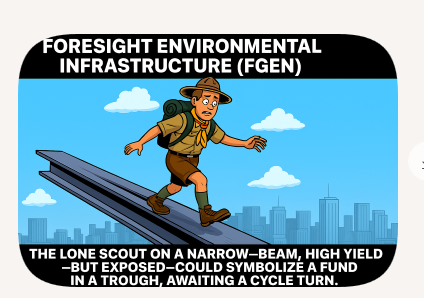

I’ve bought back for the Snowball 8802 shares in TFIF Twenty Four Income Fund for 10k.
With the UK stock market closing over the Xmas and New Year period, I would prefer to be making a small contribution to the Snowball rather than the cash sitting in the account earning nothing. All baby steps.
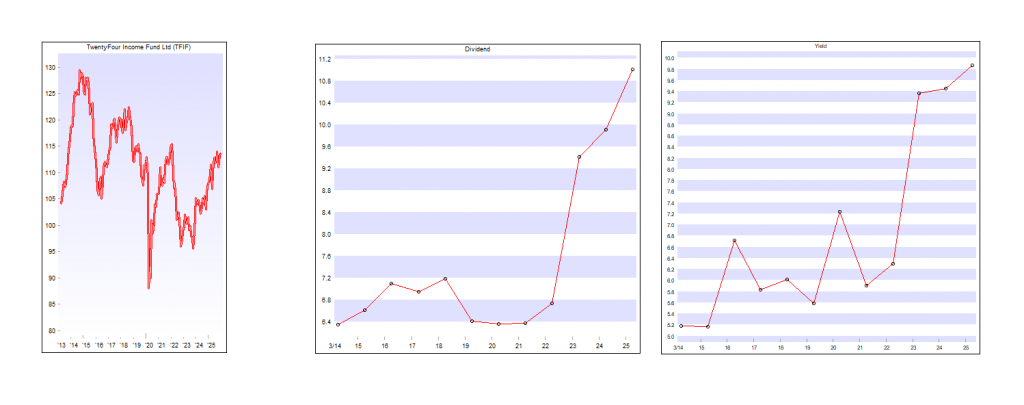
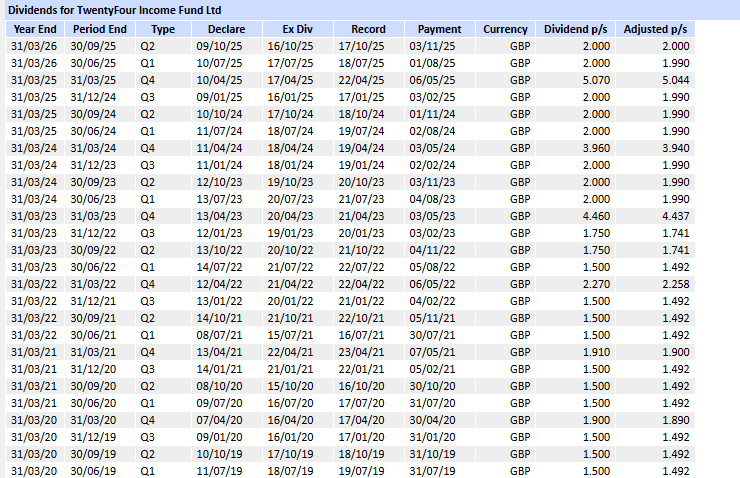
Current yield 8% which could be enhanced if they pay a higher dividend in April, trading at a small premium to their NAV.
Next xd in January for 2p


I’ve sold SEIT xd for a profit of £221.00
© 2026 Passive Income Live
Theme by Anders Noren — Up ↑