Investment Trust Dividends

Category: Uncategorized (Page 4 of 412)

REITO

These 7%+ Dividends Have Been Sold Off Since 2020. It’s Gone Too Far

Michael Foster, Investment Strategist
Updated: May 28, 2026

Let me take you back to April 2001 for a second. Because that year brought a key turning point for income investors.

I’m talking about the launch of the SPDR Dow Jones REIT ETF (RWR). The fund rolled down the skids with a simple mission: Give investors an easy way to buy a diversified basket of real estate investment trusts (a.k.a. REITs) in one low-cost index fund.

It was exciting because, back then, REITs had outperformed stocks when their high payouts were reinvested. And their dividend yields were much higher than those of the typical S&P 500 name, too.

Backed by reliable rents, as well as the constant need for space to store and sell things (for businesses), as well as places to live, work and have fun (for individuals), the sense was that demand for real estate would never end.

As Mark Twain once said, “Buy land—they aren’t making any more of it!”

How have things played out since the fund’s launch? Pretty much as they had been before, with REITs continuing to outperform (even through the 2008 mess).

That is, until around 2020, when the pandemic threw them for a loop.

REITs have been lagging ever since, but the fact of the matter is, this underperformance has dragged on for far too long. With the economy and corporate profits growing strongly, I see real-estate demand outpacing the fear around the sector (including around interest rates, which we’ll talk about more in a moment) in the coming months and years.

Let’s get into why I feel that’s the case now. I’ll also show you a 7.9%-paying REIT-focused closed-end fund (CEF) that’s been unfairly caught in the downdraft (as well as another 12.9% payer to avoid).

REITs Crushed Stocks—Until They Didn’t

As you can see above RWR (in orange) did well against the S&P 500 for a long time. From 2001 to 2020, the ETF’s annualized total return beat that of stocks: 8.5% versus 7.7% for the S&P 500 benchmark State Street SPDR S&P 500 ETF (SPY).

Also keep in mind that this period includes the subprime-mortgage crisis. RWR fell (and briefly underperformed SPY) in that time, but recovered fast and was back in the black before the S&P 500 was.

REITs Survive a Real Estate Recession

In fact, on May 26, 2009 (shown at the right side of this chart), while the US was still in the throes of the Great Recession, RWR, in orange, was posting a positive return while SPY (in purple) was negative.

One thing made this possible: dividends.

At this time, RWR’s yield was a little higher than SPY’s: 2.3% versus 1.9%. It climbed from there as RWR’s price fell, since yields and prices move in opposite directions. That cash distribution was a real benefit to investors in those stressful times.

But as we saw a couple charts ago, in 2020, REITs started underperforming, a streak that continues today. Why?

Stocks are part of the reason: Since the pandemic, they’ve been roaring, up 14% per year on average over the last five years, much higher than their historical 10% annualized gain. This is great for stock investors, of course, but it does raise the odds of a correction, so we still want to be sure we’re well-diversified.

REITs Are to Blame, Too

Stocks’ strong performance is only one side of this story, though. On the other, REITs have seen a 5.7% annualized gain over the last five years, far lower than when they were beating stocks. That’s unusual, and it’s particularly strange that it’s lasted so long.

As a result, REITs—and in particular REIT-focused CEFs—are now providing a nice opportunity to diversify some of the profits many investors have made in stocks.

An Oversold 7.9%-Paying REIT Fund With a Solid Monthly Payout

One strong REIT fund to consider is the Cohen & Steers REIT and Preferred Income Fund (RNP), a CEF that yields 7.9% today and, yes, pays monthly, too.

Over the last five years, RNP has returned around 30%—so right around the index fund’s performance. But the key difference has been that the bulk of that return has come in cash. That’s thanks to the fund’s steady monthly payout, which has not only held steady but grown in the last five years, with a special dividend thrown in:

RNP’s “Storm-Proof” Monthly Dividend

Source: Income Calendar

RNP, as the name suggests, holds REITs and preferred shares, the latter of which trade like stocks, but in a narrow range, with fixed dividends. As such, they’re best thought of as a kind of stock-bond hybrid. Those make up around half of the portfolio and bring additional stability (as well as income).

On the REIT side, which is nearly all of the other half of RNP’s holdings (there’s about 1% in cash), we’ve got a diversified set of names. They include healthcare REITs, such as Welltower (WELL); data-center and telecom firms like Digital Realty Trust (DLR) and American Tower (AMT); as well as self-storage, in the form of Extra Space Storage (EXR); housing, shopping-center REITs and more.

Both REITs and preferreds are sensitive to higher rates, which is part of the reason why the fund sports a 5.7% discount to net asset value (NAV, or the value of its underlying holdings) as I write this.

That’s far more than enough to price in today’s “sticky” rates, which are largely the result of the Iran situation. Until that’s resolved, this fund is overly marked down, especially when you consider that it’s traded at premiums many times in the past, including in 2019, 2023 and as recently as last year.

This 12.9% Payer Is Always on Sale

With all that said, not all REIT CEFs are attractive right now. Take the Principal Real Estate Income Fund (PGZ), which has a 12.2% discount and a 12.9% yield. Unfortunately, that discount never closes.

PGZ’s “Perma-Discount”

There are plenty of reasons for this, but past performance is likely the biggest thing keeping investors away: Over the last five years, PGZ has only returned around 11%, or about a third of what RNP and RWR have delivered.

A few bad years can be a sign to buy into a fund, but when that performance trails this badly and management hasn’t changed its strategy much in response, the fund is best avoided. That’s true no matter what the discount, or dividend yield, might say.

This REIT Fund Is an Ignored AI Winner, Pays a Reliable 8.7%

REIT CEFs aren’t just due for a rebound—they’re set to soar. And an unlikely “suspect” is the reason.

I’m talking about AI.

All across the economy, AI is making REITs’ properties hot commodities, including cellphone towers, data centers—even factories and warehouses.

I know we don’t often see “AI” and “factories” in the same sentence, but hear me out here. Because one thing we don’t hear about AI (and we should!) is how it’s set to reinvent the factory floor through robotics.

Sure, robots have worked in factories for decades. But now, with AI, they can do much more, including quickly changing their roles to build new products. These new machines can also make decisions for themselves if, say, a defective part comes down the line.

Before, such a thing would have ground an assembly line to a halt for hours, even days.

As AI-powered robots improve, they’ll slash manufacturers’ costs and boost their output, setting off a factory-construction boom. And the top industrial REITs will be there, ready to cash in

Market comment

One of the most dangerous phrases in investing is: “This time is different.”

Usually, it isn’t.

Governments tell themselves deficits don’t matter until bond markets disagree.

Politicians convince themselves voters will tolerate higher taxes until they don’t.

Businesses spend years following regulatory incentives only to discover customers want something entirely different.

And investors regularly convince themselves that cycles have been abolished right before they come roaring back.

Reality has a habit of winning eventually.

This week’s essays all explore different versions of that same theme. From defence stocks and government spending to Net Zero policy, taxation, and the future of British politics, each story asks the same question:

What happens when theory collides with reality?

Investor’s daily

No Hiding from the Boom/Bust Cycle

Bill Bonner

25 May 2026 

US vs China thumbnail

Publisher’s Note: British investors should resist the temptation to read this essay purely as an American story about Trump, Congress, or China.

The more important issue is much broader than that.

For decades, much of the Western world, Britain included, operated under the assumption that finance, consumption, and asset inflation could substitute for genuine industrial strength. We outsourced manufacturing, neglected energy security, hollowed out domestic production, and assumed globalisation would keep costs low forever.

Now that model is beginning to fracture.

Governments across the world are rediscovering industrial policy, strategic resources, tariffs, subsidies, and state intervention. China embraced that approach years ago. The United States is increasingly moving in the same direction. Europe and Britain are trying to catch up after years spent believing such things no longer mattered.

That does not necessarily mean China “wins” or America “loses.” History is rarely that tidy.

But it does suggest we are entering a world where physical production, energy, commodities, industrial capacity, and national resilience matter far more than they did during the era of cheap money and frictionless globalisation.

For investors, that shift could prove enormously important over the next decade.

What’s your retirement plan ?

I Wouldn’t Want To Retire Without These 3 Investments

May 30, 2026, 7:05 AM ETGLDSLVGDXIAUILQDBIPBEPSCHDUTGAMLPXLUVNQOMPLXNEEBEP.UN:CABIP.UN:CA

Samuel Smith

Summary

  • A common misconception is that generating enough dividend income to cover living expenses is all that you need to retire.
  • I detail the three investments that I would use as the foundation of my retirement strategy.
  • I discuss how these three work together to cover a wide range of macro scenarios and help me sleep well in retirement.
  • Looking for a portfolio of ideas like this one? Members of High Yield Investor get exclusive access to our subscriber-only portfolios. 
Step-by-step path to a goal
patpitchaya/iStock via Getty Images

Many investors who are focused on building up a passive income stream from dividend- and interest-paying investments focus solely on yield. In fact, they may even focus on what they would deem to be sustainable yield, namely, yields that come from blue chip stocks, preferreds, and even bonds that they believe they can count on to be paid out consistently through thick and thin. While this is certainly important, it is not a complete approach to retirement income investing because it fails to account for some key considerations.

We Are Living in Historically Dangerous Times

In fact, we are currently in more dangerous times than we have seen since perhaps World War II, with breathtaking budget deficits, national debt levels in Europe, China, Japan, and the United States reaching levels that are nearing the point of no return, and the geopolitical situation is as fragile as ever, with the US-led global order appearing to have increasingly large cracks in it, and a threat of major economic and/or military conflict between the US and China, and Europe and Russia seemingly growing by the day. Thus, it is more important than ever for investors to ensure that they are adequately protecting their income stream from downside risks.

With this in view, in this article, I detail the three investments that I would not want to retire without to make sure that I could sleep well at night knowing there was a high probability that my investments would fund my living expenses in retirement, even if the macro situation deteriorates significantly.

Pillar #1: The Ultimate Safe Haven

The first investment that I would want to have before any other is gold (GLD). The reason I put so much emphasis on gold is that it has a longer track record than any other economic asset out there, besides perhaps land, and it has zero counterparty risk.

Additionally, given that it has survived every financial collapse, every currency failure, and every major war that has occurred throughout human history, and still retained its value, I view gold as an indispensable downside hedge, with silver (SLV) playing a similar, albeit secondary, role. There are numerous reasons why I feel especially bullish on gold today:

  1. The aforementioned runaway debt and deficit spending in the US and throughout much of the rest of the developed world will inevitably lead to more inflation and more money printing by governments, as well as an increasing loss of confidence in fiat currencies. Remember that, throughout history, fiat currencies have inevitably all gone to zero, and it appears that the dollar, the euro, the yen, and the yuan are all well on their way toward that fate.
  2. Additionally, de-dollarization is accelerating, especially with global foreign exchange reserves shrinking consistently, with central banks like China and others diversifying away from dollar holdings, and instead snatching up gold as an increasingly popular reserve asset.
  3. The geopolitical risk that was already mentioned, with potentially major conflict over Taiwan or even an expansion of Russia’s aggression in Europe as the US pulls out and Europe continues to race to get its defenses unified, could also lead to a major risk-off movement in markets, which would undoubtedly benefit gold.
  4. Finally, gold tends to outperform during economic downturns and is also relatively non-correlated with the broader stock market, making it a good portfolio diversifier and stabilizer.

The other good thing about gold in a retiree’s portfolio is that while you can simply hold the bullion (that’s the safest way to do it, especially if you have a secure yet accessible storage place), you can also invest some of it in ways that generate income, whether that be gold mining stocks (GDX), options writing ETFs like the NEOS Gold High Income ETF (IAUI) that throw off attractive monthly distributions while still maintaining some upside exposure to gold, or even investing in gold and silver bullion leases that give you full ownership of the underlying bullion, full upside potential, and a pretty nice yield paid monthly.

Ultimately, the role of gold is to provide decent returns and even potentially some income in good times, and serve as the ultimate hedge during bad times, so that when all your other investments crash and/or go to zero, you have an asset that likely will be shining and outperforming significantly, that can still deliver you the returns you need to fund your living expenses in retirement.

Pillar #2: Dependable Current Income

The next investment I would not want to retire without is investment-grade fixed-income investments (LQD) or something that appears to be the equivalent, such as a well-diversified and actively managed fixed-income fund. The reason why I would want to have this in my portfolio while in retirement is that it should serve as the core of my current income engine to meet my living expenses today. Fixed income tends to pay higher yields than common equity, since it does not have a growth component. The investment-grade rating on it means that it should be able to withstand periods of economic distress without the company having to default on its debt. In fact, even in major downturns like COVID, where they may take precautionary measures to cut their dividend, the balance sheet will likely remain sound, and they’ll be able to continue servicing their debt.

Additionally, companies often cherish their investment-grade credit ratings, therefore being more likely to circle the wagons around their balance sheet in the event that their credit rating comes at risk. They would want to do everything they can, even if it is at a major expense to the common shareholders, to protect their debt investors. Therefore, investment-grade fixed income is a great way to generate attractive yet low-risk passive income in retirement. The best part of it is that you don’t even need to sacrifice much and take only a low- to mid-single-digit yield. You can actually get 7% to 8% yields on your investment while still getting access to investment-grade securities, whether it be in the preferred, baby bond, or even the corporate bond world.

I especially like real asset-backed opportunities, as these tend to have more stable cash flows and more defensive business models and can also liquidate assets more easily and get good value for them in order to protect their balance sheets. In particular, I like the Brookfield Infrastructure Partners (BIP) and Brookfield Renewable Partners (BEP) preferreds (BIP.PR.A) (BIP.PR.B) (BEP.PR.A), as they combine attractive yields with investment-grade credit ratings and durable and defensive real-asset-focused underlying business models.

Pillar #3: Inflation-Fighting Income Machines

The third investment I would not want to retire without is dividend growth stocks, especially those that pay out decent dividends and are backed by durable and defensive business models and strong balance sheets. I think a great place to start is investing in a fund like the Schwab U.S. Dividend Equity ETF (SCHD) because it combines a dividend yield of over 3% with a dividend growth track record of over 10% per year on average over the past decade. It is filled with over 100 blue-chip dividend growth stocks diversified across a broad swath of industries.

I would want to complement that with some other attractive dividend growth sectors where it lacks much in the way of exposure, including:

  • Infrastructure (UTG)
  • Midstream (AMLP)
  • Utilities (XLU)
  • REITs (VNQ)

where you can find powerful dividend growth names like Realty Income (O), MPLX LP (MPLX), NextEra Energy (NEE), and several others.

The reason these investments are so important to me in rounding out the other two pillars is that dividend growth stocks combine current income, which can augment the income from the fixed income pillar to meet current expenses, with the growth that helps offset the long-term corrosive nature of inflation. They are also backed by durable and defensive business models and strong balance sheets, and also tend to be able to sustain their dividends better during economic downturns, thus making this pillar more sustainable as well.

Why All Three Pillars Work Together, and How to Cycle Between Them

I still think it’s important to have a fixed income pillar in addition to dividend growth stocks as a retiree because you can increase your yield a bit and also still keep your downside risk protected to a greater extent than you get with many dividend growth stocks. Thus, combining the two enables you to cover all your bases, especially alongside a disaster hedge position like gold. During strong bull markets and periods of economic expansion, having that equity exposure can give you capital appreciation and ultimately significant total return potential, which is also nice to have over the long term. This is especially true, because, in epic bull markets where valuations perhaps are getting a bit stretched, and if the Fed is having to raise rates to try to help fight an overheating economy and inflation getting too high, you can recycle some capital opportunistically into fixed income, thus locking in your income and your profits with a more defensive position, or potentially even recycling it into gold if it is out of favor.

Whenever fixed income and/or gold are in favor, you can opportunistically recycle some of that capital into dividend growth stocks that may be out of favor, to continue growing your income stream and ultimately your net worth over the long term.

The Retirement Strategy That Lets You Sleep Well at Night and Still Beat the Market

While focused primarily on dividend growth stocks, I also have significant allocations to fixed income in our retirement portfolio and to income-generating gold investments in both my core and retirement portfolios at High Yield InvestorOpportunistic capital recycling between all three of these pillars has enabled me to not only sleep well at night but also generate significant long-term total return outperformance along with below-market beta since launching our portfolio over five and a half years ago.

Today’s Quest

casca de copiat
sistemegsm.rox
Kohlman32146@gmail.com
165.140.119.146
I am extremely impressed with your writing skills as well as with the layout on your weblog. Is this a paid theme or did you customize it yourself? Anyway keep up the excellent quality writing, it is rare to see a nice blog like this one nowadays..

The blog is WordPress thru FastHosts, there is a modest monthly charge. If you can copy and paste you are good to go.

TR versus Dividend Re-investment

CTGlobal managed has two classes of shares Growth and Income. You can swap between the two classes at anytime.

Above income, with a dividend re-investment policy price

111p > 222p

Current dividend 7.6p a yield on buying price of 6.8%

Price 145p > 324p

Both shares have doubled over ten years.

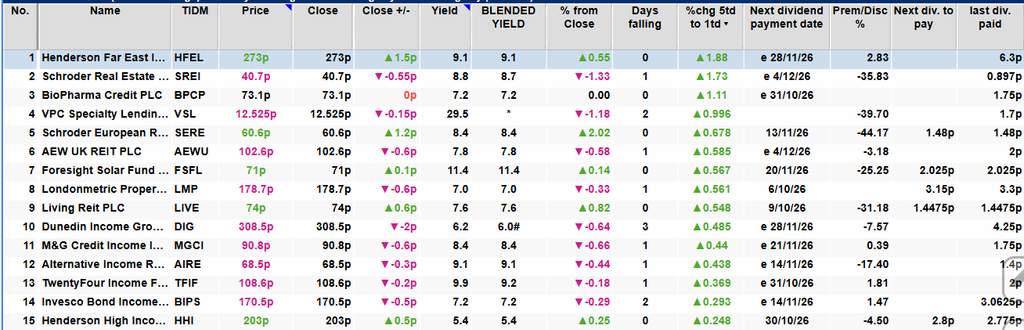
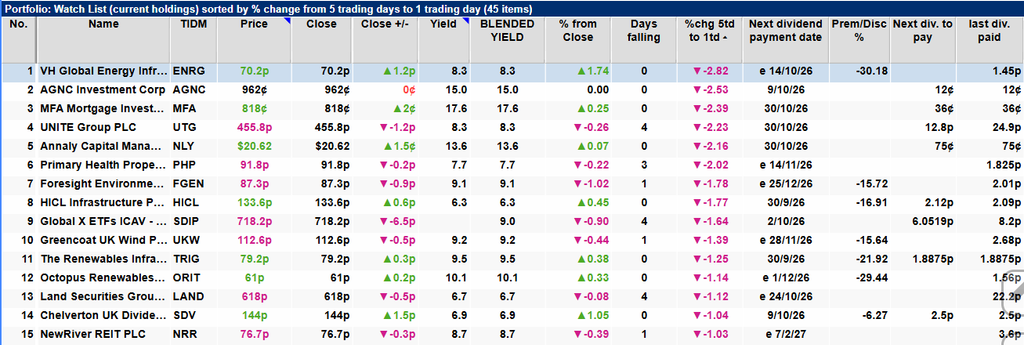
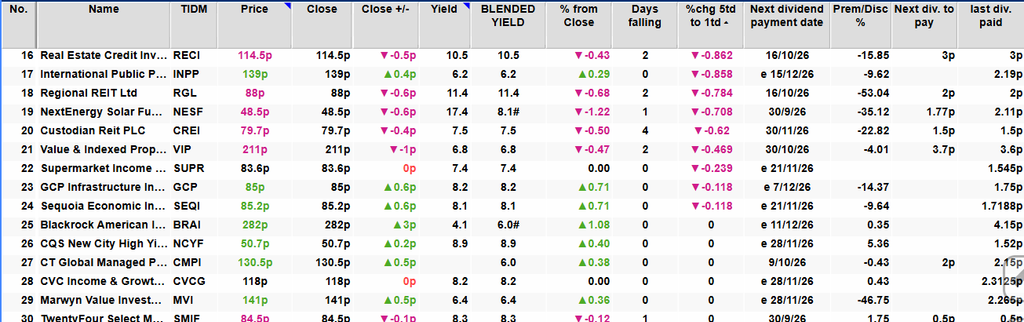
Watch List Leaders

Note you may not be able to trade at closing prices, when the market re-opens.

Any watch list share where the fcast yield falls below 5% will be removed from the watch list.

Wall Street Is Betting On A Ceasefire

Markets are ending May with a strange but powerful mix: huge enthusiasm for AI-linked companies, relief over lower oil prices, and a broader rally that has spread well beyond tech. The result is a market that looks confident.

Romain Fournier

Published on 05/29/2026 at 08:57 am EDT – Modified on 05/29/2026 at 09:09 am EDT

DELL TECHNOLOGIES INC.

+3.84%

Stock Dell Technologies Inc.

THE GAP, INC.

+3.95%

Stock The Gap, Inc.

HEWLETT PACKARD ENTERPRISE COMPANY

+2.72%

Stock Hewlett Packard Enterprise Company

S&P 500

+0.58%

Index S&P 500

MICROSOFT CORPORATION

+3.47%

Stock Microsoft Corporation
Wall Street Is Betting On A Ceasefire

May is coming to an end on markets, and it is time to take stock of what the month has delivered. Dell jumped 39% after hours after reporting results and raising its guidance. The company is worth about $206 billion, which means it could be closer to $280 billion when trading opens on Wall Street. Anthropic, the private AI group behind Claude, has raised funds at a valuation of $965 billion, just above OpenAI’s latest valuation. SpaceX has reportedly trimmed its valuation target for next month’s planned IPO: the new goal is said to be closer to $1.8 trillion than the hoped-for $2 trillion. Given that people were still talking about $1 trillion only a few months ago, this is the kind of downgrade most companies would frame and hang in reception.

The common thread linking Dell, Anthropic, and SpaceX is their close connection to AI. Yet exuberance is not limited to that part of the market. Yesterday, discount retailer Dollar Tree and electronics chain Best Buy each surged more than 15% after their results. In short, there is action almost everywhere.

The S&P 500 gained 4.9% in May and is up 10.5% in 2026. That still leaves it well behind Japan, which rose 9.4% in May and 28.4% this year. But both have been flattened by South Korea, up 24% in May and 94% in 2026. Oil is down 17% in May, helped by hopes of easing tensions in the Middle East. That is good news for the economy, although crude remains up 50% this year. Gold is down 2.5% for the month and is now up only 4.4% in 2026. Bitcoin fell 4% in May and is down 16% for the year.

Today, investors are buying the idea that the Middle East may be stepping back from the edge. The S&P 500, Nasdaq, and Dow all moved higher as reports of a tentative U.S.-Iran agreement gave markets something they badly wanted: a reason to worry a little less. The reported deal would extend the U.S.-Iran ceasefire by 60 days and ease restrictions on shipping through the Strait of Hormuz, one of the world’s most important oil routes. Brent crude fell to about $91 a barrel, while West Texas Intermediate dropped to around $88.

Still, the ceasefire story comes with several asterisks. Donald Trump has not yet approved the memorandum. Iran has not formally responded to the latest version. Vice President JD Vance said talks are progressing but remain ongoing, while Treasury Secretary Scott Bessent described the negotiations as a continuing back-and-forth. There are also hard reminders that this is not a done deal. Iran reportedly fired missiles at unidentified targets on Thursday. The Pentagon said Iran launched a ballistic missile toward Kuwait and used attack drones in the Strait of Hormuz.

Today’s company news shows the AI narrative is still strong. As I mentioned above, Dell surged after raising its full-year revenue and profit forecasts, a sign that the AI infrastructure boom still has plenty of market power behind it. Hewlett Packard Enterprise and Super Micro Computer rallied too.

But not every corner of the economy looks so confident. The Gap shares fell sharply after the retailer cut its annual sales forecast, pointing to pressure on budget-conscious consumers. Costco, meanwhile, reported higher fiscal third-quarter earnings and revenue, offering a more stable read on consumer spending. The company is often treated as a rough thermometer for the American household. Its results suggest consumers are still spending, especially where they see value.

Today’s economic calendar gives investors more to chew on. The April trade-in-goods report is expected to show the deficit narrowing slightly to about $87 billion from $87.4 billion. The Chicago purchasing managers index is expected to rise to 50.3 from 49.2, which would put it just above the line separating contraction from expansion. Several Fed officials are also speaking today, including Michelle Bowman, Anna Paulson, Neel Kashkari, and Mary Daly.

Change to the SNOWBALL:Buy

I’ve bought for the SNOWBALL, using spare cash, 13 shares in XSTR for £2,367.00

Only yields 4% but builds up the cash pot to buy some bargains when the market turn downs, until then keep banking the dividends when they are paid.

« Older posts Newer posts »

© 2026 Passive Income Live

Theme by Anders NorenUp ↑