Can Law Debenture keep delivering for investors?
The UK income trust is performing well but has an unusual structure. We take a deep dive into its portfolio and positioning
Published on September 4, 2026
UK equity income trust Law Debenture (LWDB) has had a strong 2026 so far, returning around 21 per cent – well ahead of the 12 per cent delivered by its benchmark, the FTSE All-Share.
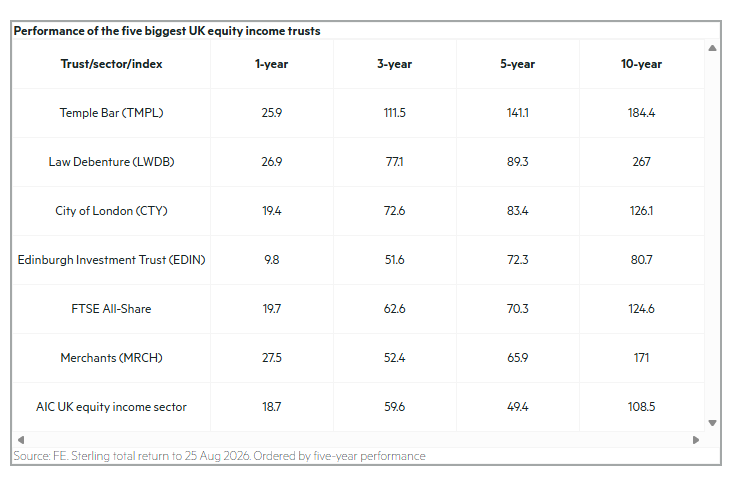
Its longer-term performance looks even more impressive: over three and five years, it is the second-best-performing trust in the 17-strong UK equity income sector and takes the top spot over a decade with returns of 267 per cent.
A consistent approach has been key to this result. James Henderson has been involved in running the trust for over 30 years and was joined by Laura Foll as joint portfolio manager in 2019.
In July, the trust announced that Henderson will be retiring next June, leaving Foll at the helm. Such a high-profile departure would typically spark concerns about style drift, but analysts seem to think it is unwarranted this time because Foll and the veteran manager have worked side-by-side for many years.
We take a deeper look at Law Debenture’s approach and speak to Foll about how the managers are positioning the portfolio.
Approach and structure
The pair adopts a moderately contrarian approach to find well-managed companies at low valuations. They seek to avoid concentration, maintaining around 140 holdings. “This is not a shortlist, high-conviction portfolio. It’s about having a long list of companies that we think are, on balance, too cheap,” Foll tells the IC.
This means they do not take big bets on individual stocks, and instead aim to invest across a broad range of assets. The top 10 holdings make up just 25.9 per cent of the portfolio. “We’re deliberately not taking too much stock-specific risk. We want [the portfolio] to be diverse rather than having big chunky holdings in any particular name,” explains Foll.
On this front, Law Debenture differs from rival Temple Bar (TMPL), which is the best-performing UK equity income trust over five years and has benefited from taking bigger contrarian bets.
Law Debenture is unique in that 15 per cent of its net asset value (NAV) comprises an independent professional services (IPS) business it owns.
This provides third-party financial services, such as pension trusteeship, and the profits it generates are redistributed as dividends to Law Debenture shareholders. Martyn King, an analyst at Edison, describes it as “a very important part of the trust’s overall performance” as the business has funded roughly a third of the dividends the trust has paid in the past 10 years.
This makes for a dependable income stream. “I basically know that at the start of any calendar year, when I turn up on day one, a third of the income is pretty much in the bag,” says Foll. This, in turn, affords the managers flexibility to invest in stocks not paying dividends that are not traditionally found in other UK equity income portfolios.
That’s not to say the trust eschews the usual UK income payers altogether. A look under the bonnet reveals HSBC (HSBA), Shell (SHEL), GSK (GSK) and Rio Tinto (RIO) among the five largest holdings.

Leave a Reply