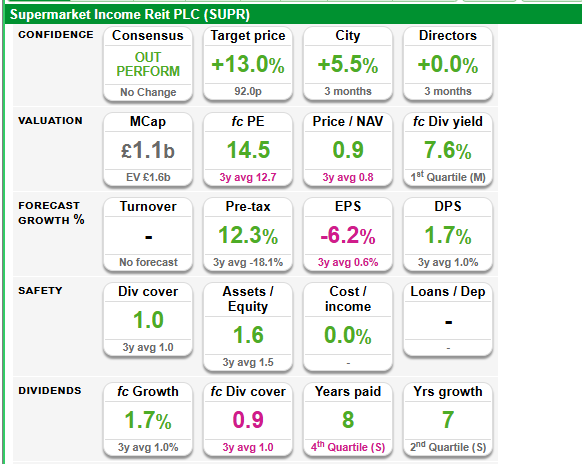
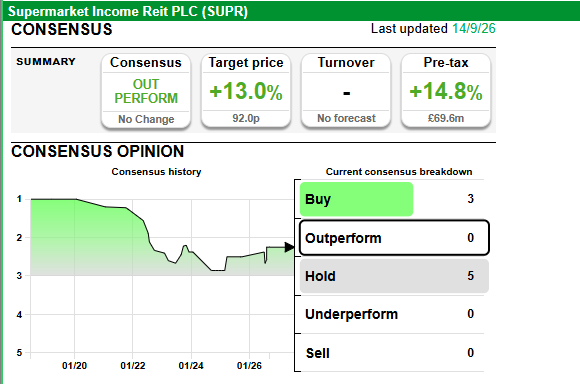
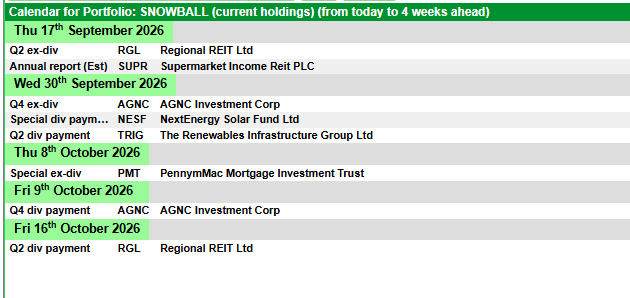
Supermarket Income REIT (SUPR) shares have re-rated in response to the strategic “transformation” made since the start of last year, the company said in annual results today. Shares in the £1.1bn real estate investment trust rose 1.8% to 84p, narrowing the gap to net tangible assets (NTA) of 87.5p per share to 4%. That compares to a 15% discount in March last year when the shares stood at 75p compared to NTA of 88p. Internalising fund management had cut the cost ratio from 13% to 9.2% in the year to 30 June, releasing more money for dividends that are set to grow by at least 2% a year from 2027, helped by a portfolio enlarged by the expanded joint venture with Blue Owl and a £100m equity raise this summer. For the latest year dividends rose 1% from 6.1p to 6.2p per share, with cover for the pay-out falling to 93% from 98% as refinancing costs temporarily knocked earnings per share by 4.1% to 5.7p from 6p last year. The shares yield 7.4%.
Matthew Read said: “Supermarket Income REIT has undergone considerable change over the past 18 months and these results demonstrate the scale of its ambitions. The portfolio has grown to £2bn, the Blue Owl joint venture has expanded rapidly and costs continue to fall, with the EPRA cost ratio down to 9.2%. With the proceeds of July’s equity raise already deployed, SUPR needs to show that it can convert this growth into higher earnings and deliver on its commitment to increase the dividend by at least 2% a year. The grocery property market remains supportive and SUPR appears to have plenty of opportunities to grow within it.”
5.6% Dividends. 31 Straight Hikes. A 16% “Discount” (Thank the Trade War)
Brett Owens, Chief Investment Strategist Updated: September 15, 2026
One of our favorite pipeline plays—Enbridge (ENB)—has taken a tumble. It’s set up a sweet buying opportunity.
We can thank rising rates (with an “assist” from overdone trade war fears!) for this opening.
Here’s the state of play with this one, which I’ve nicknamed the “natty” king because, despite its Canadian domicile, it ships 20% of the natural gas consumed in the US.
The stock yields a gaudy 5.6%.
Enbridge is a “toll booth” on North American energy consumption, collecting fixed rates for the use of its pipelines and storage facilities, no matter what oil and gas prices do.
The stock has returned 56% for us since we bought it in March 2023.
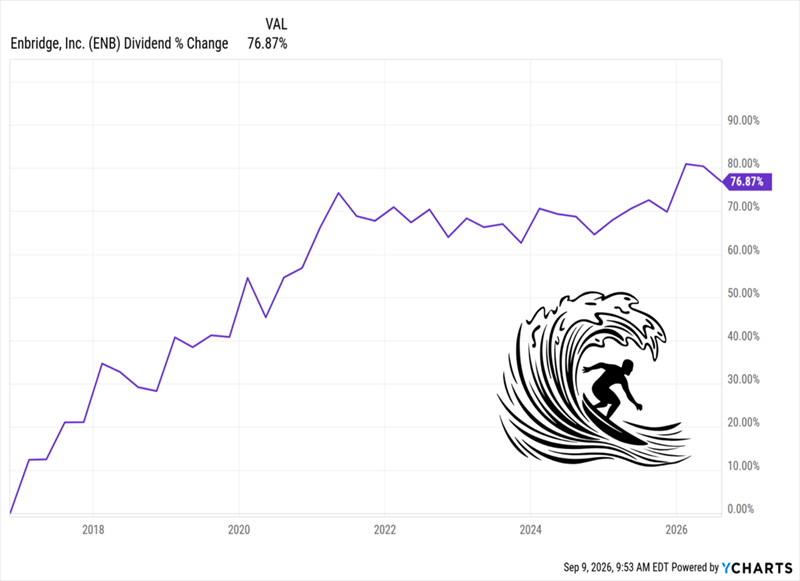
Its payout has jumped 77% in the last decade (more on that below).
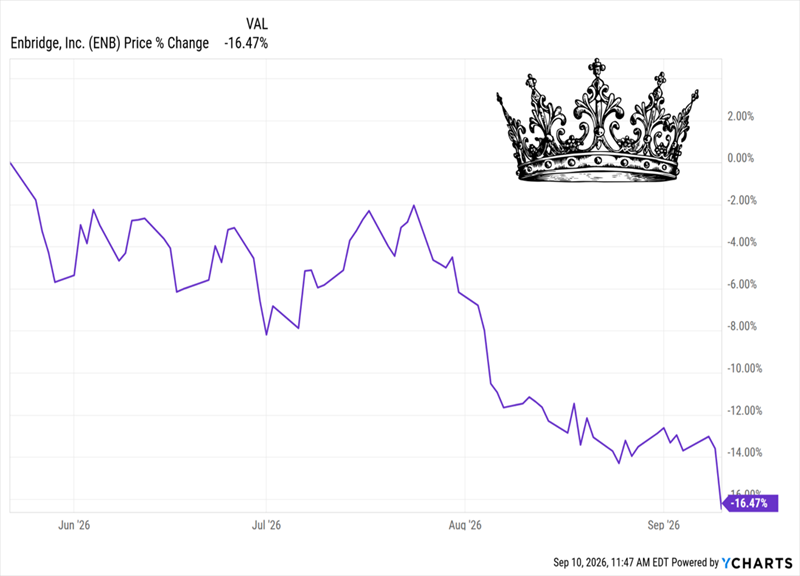
Right now, the natty king is showing an attractive blend of strength and value. Even with that 56% total return, the stock is still down—off 16% on a price basis from its May highs. That’s a big part of our opportunity here:
The “Natty” King’s (Temporary) Fall
Beyond rates, some investors see the company as a potential trade-war victim. That’s in part because Enbridge is also a major oil shipper: Its 8,600-mile Mainline system, an important part of its operations, ships Canadian crude to refineries in the US Midwest.
But these folks are missing the point. For one, to date, oil and gas have been exempted from the trade spat.
That’s by design: The administration doesn’t want to raise fuel costs, and the Canadian side doesn’t want to antagonize its resource-producing western provinces. Plus, those Midwest refineries are set up to process Canadian “heavy” crude, and that can’t be easily changed.
Yes, Venezuela produces a crude similar to Alberta’s. But as we discussed last week, the country’s battered oil infrastructure needs many years, and billions of dollars, of investment.
As I write this, Enbridge’s project backlog has grown to $41 billion Canadian . And it’s deploying $10 billion Canadian in growth capital this year alone. Current projects stretch into the 2030s.
It’s already making news on this front: Last Thursday, Enbridge announced a US$2.55-billion deal to buy a 75% stake in the 1,050-mile, 460,000-barrel-per-day Pony Express pipeline, which ships crude from the US Rockies to the key storage hub at Cushing, Oklahoma.
The deal also covers 51% of the Powder River Gateway system, which can ship up to 240,000 barrels a day, as well as other storage and marketing assets.
It’s a cash deal, but the company will come up with some of the purchase price through a C$2.6-billion share offering. The resulting dilution prompted a selloff last week. We’re fine with that, as Enbridge expects the deal to add to its cash flow right away, after it expects to close the deal later this year (pending regulator sign-off, of course).
Finally, Enbridge said CEO Greg Ebel will retire December 31. Michele Harradence, who’s been with the company since 2014 and is now president of Enbridge’s gas-distribution and storage operation, will take over. Her familiarity with the business (and the fact that Ebel will advise her until next May) tees up a smooth transition.
Steady Payout Growth, With a Potential Currency “Kicker”
Now let’s talk dividends. Earlier this year, the company treated us to a payout hike—its 31st consecutive increase.
And that payout is well-covered, with Enbridge kicking out $3.88 (Canadian) in annualized dividends and guiding to$5.70 to $6.10 in distributable cash flow per share in 2026. The midpoint of that estimate translates to 66% of DCF going out as dividends—very reasonable for a “toll booth” like ENB.
Take a look at this payout picture—I’m sure you’ll see something interesting (beyond the rarity of a 5.6%-yielding stock hiking payouts 77% in 10 years):
Enbridge’s Payout Surfs FX Rates
As a Canadian company, Enbridge issues dividends in “loonies” (shorthand for the country’s loon-emblazoned one-dollar coin). That’s why you don’t see the clean “dividend staircase” we’re used to in our stocks.
As a result, the US dollar’s strength versus the loonie weighs on our payouts. But that could be a plus in the long run. Here’s why: In the US, the Fed’s target range is 3.5% to 3.75%, compared to the Bank of Canada’s 2.25% policy rate. The gap between the two central banks’ rates is a big reason for the greenback’s strength versus its Canadian cousin.
The Iran situation is a driver of inflation in both countries. But it will end at some point. When it does, the Fed will have more room to cut than the Bank of Canada, by virtue of its higher “starting point.”
As rates fall, they should put upward pressure on shares of “bond proxy” utilities and pipelines. They could also weigh on the greenback, potentially boosting our dividends when they’re converted to US dollars.
To be sure, the trade war could push rate cuts down the road, but we’re fine with that: While we wait, we’re locking in Enbridge’s 5.6% payout.
(One thing to note before I wrap up here: Since Enbridge is a Canadian company, US investors face different tax treatment in the form of 15% withholding on dividends, though an offsetting tax credit may be available. This explainer lays out the details.)
Where does all this leave the natty king? While the rest of the world gets riled up by the headlines, Enbridge hardly notices. It simply goes on quietly collecting tolls on the rising tide of oil and gas flowing through its pipes.
Enbridge Pays Us 5.6%.
As I just said, Enbridge is a top play on overdone fears around trade and rates. The stock’s payout growth lets us build on the 5.6% dividend on a buy made now.
In short, the Canadian “natty king” is one of those stocks you can buy now and lock away forever.
BlackRock World Mining Trust PLC ex-dividend date Fidelity European Trust PLC ex-dividend date Regional REIT Ltd ex-dividend date Unite Group PLC ex-dividend date
Parents could potentially amass a fund of approximately £65,000 for their child through one straightforward early action, an expert has revealed.
While many believe that accumulating wealth involves selecting winning stocks, forecasting market trends or making a few shrewd financial choices, one specialist suggests the genuine secret is far more mundane – it’s simply time. Paul Denley, CEO at London-based Oakham Wealth Management, highlighted that the strength of compound growth remains one of the most undervalued forces in personal finance.
He explained: “As (entrepreneur) Naval Ravikant said, ‘all the returns in life, whether in wealth, relationships or knowledge, come from compound interest’. That observation applies remarkably well to investing because long-term financial success is often not about finding the next hot stock. It is about allowing compounding to work quietly over time.”
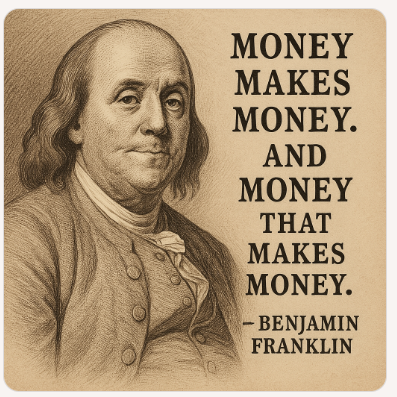
Compounding refers to the mechanism whereby investment profits themselves generate additional returns. Benjamin Franklin famously characterised it as: “Money makes money. And the money that money makes, makes money.”
Mr Denley emphasised that this straightforward concept underpins the effectiveness of long-term investing.
He elaborated: “The mathematics are extremely powerful. Returns generate further returns, creating a snowball effect that becomes increasingly significant as time passes.
“The challenge is that compounding is almost invisible in its early years. Progress can feel slow and the real benefits often only become obvious much later.”
That’s precisely why beginning early can yield such remarkable results. A parent putting aside £150 monthly into a Junior ISA from their child’s birth could accumulate approximately £65,000 by the time they reach 18, based on an average yearly return of 7%. When adjusted for inflation, that sum would equate to roughly £50,000 in current terms.
Mr Denley explained: “The exact contribution matters less than the principle. Whether someone invests more or less than £150 a month, the important point is that the earlier investing begins, the longer compounding has to do the heavy lifting.”
This same logic extends to pension savings. Many people concentrate almost exclusively on contribution amounts, when frequently the more crucial factor is timing. An additional decade of compound growth can sometimes outweigh attempting to make substantially larger payments later on.
Mr Denley said: “People often think they can make up for lost time later, but time itself is the most valuable ingredient. Once those early years have gone, you cannot get them back.”
Warren Buffett, who amassed his fortune across more than 70 years, famously attributed his wealth to “a combination of living in America, some lucky genes, and compound interest”. According to Mr Denley, the key takeaway isn’t that compounding generates rapid wealth, but rather that it rewards patience, discipline and consistency.
He concluded: “Compounding is not exciting day to day. It does not feel dramatic. But, over long periods, it can be transformational.”
In an investment landscape where short-term predictions, market chatter and daily news cycles reign supreme, Mr Denley reckons countless investors are missing the most straightforward advantage at their disposal.
He explained: “The greatest edge most people have is not prediction. It is time. Start early, stay invested and allow compounding to do the heavy lifting.”