Passive Income Live

Investment Trust Dividends

Page 316 of 456

NESF

Having researched the criteria, u know the yield and the discount to NAV.

Then only the criteria is the prospect of the current dividend being paid.

Dividend:

·     Attractive high dividend yield of c.10%, as at closing share price on 9 August 2024.

·   Total dividends declared of 2.10p per ordinary share for the Q1 period ended 30 June 2024 (30 June 2023: 2.08p).

·     Target dividend of 8.43p per ordinary share for the year ending 31 March 2025 (31 March 2024: 8.35p).

·     Forecasted target dividend cover of between 1.1x-1.3x for the year ending 31 March 2025.

·     Total ordinary dividends declared since IPO of £357m.

NESF

The next criteria, can u trust the company guidance and their dividend history.

Let’s assume, I know assume can make an ass out of u and me, but u have to trust the company until u have a reason not to.

The price doesn’t rise over the ten years but falls from here.

a. In nine years time u will have received all your capital back, either to re-invest the dividends or to pay your bills, and u have achieved the holy grail of investing in having a share in your portfolio, that cost u nothing, zero, zilch paying u a dividend of ten percent a year, most probably more. The asset life is currently expected to be around 25 years.

b. The price rises to the net asset value and u have made a gain of 20%, if u took the gain it would depend on at what yield u could re-invest at. If u crystalize the gain u could maybe re-invest back into NESF if the price fell back.

If the price rises 20% the yield will fall but still pays a yield of 8%.

The buying yield will still be 10%.

The running yield will be 8%.

Example dividend on 10k invested – 1k- 10% yield

Running yield 12k – 1k- 8% yield

A hold for the Snowball

FSFL

Foresight Solar Fund Limited

(“Foresight Solar” or “the Company”)

Declaration of Dividend

Foresight Solar is pleased to announce the second interim dividend, for the period 31 March 2024 to 30 June 2024, of 2.00 pence per ordinary share. The shares will go ex-dividend on 24 October 2024 and the payment will be made on 22 November 2024 to shareholders on the register as at the close of business on 25 October 2024.

The Board confirms its annual dividend target of 8.00 pence per ordinary share for the 2024 financial year.

Doceo weekly gainers

Weekly Gainers

What do a UK mid/small-cap investor, a build-to-rent REIT, two aircraft leasing funds and a Japanese smaller companies trust all have in common? They are the latest top-five monthly performers in London’s investment company space.

ByFrank Buhagiar•02 Sep

The Top Five

Crystal Amber (CRS) holds on to top spot on Winterflood’s list of highest monthly movers in the investment company space, AGAIN – shares are up +21.7%, a slight improvement on last week’s +20.9% gain. And that’s despite no news out over the past seven days. Shares still benefiting from a run of good news, including share buybacks and a positive update on Investee company: Morphic Medical. This last highlighted how CRS’ interest in Morphic had been independently valued at around US$75.8m (£59.1m), which potentially increases CRS’ unaudited NAV per share to 172.67p from 117.85p. The news triggered a 20% share price gain on the day. Thing is, the day in question was 31 July 2024, which means the one-month anniversary has been and gone. Share price in need of a further boost otherwise it will likely be goodbye top spot.

PRS REIT (PRSR) comes from nowhere to claim second place. No mystery behind the +18.2% share price gain – a letter. Not just any letter but a requisition letter. As announced by the company, the letter calls for a general meeting at which shareholders will vote to replace two of the five existing independent non-executive Directors, including Chairman, Stephen Smith, with Robert Naylor as non-executive Chairman and Christopher Mills of Harwood Capital Management. Shareholders with a combined interest of 17.3% in the build-to-rent REIT put their signatures to the letter including Harwood itself.

Winterflood thinks “the requisitioning shareholders have particular concerns regarding the management contract extensions announced in July. The inability to terminate the manager until 2029 is considered problematic from a governance perspective.” This one could have further to run.

Doric Nimrod Air 3 (DNA3) drops one place to third despite holding onto the majority of its share price gains – up +14.8% compared to +15.4%. Last week’s news from stablemate Doric Nimrod Air 2’s (DNA2) that it is selling its remaining five Airbus A380-861 aircraft to Emirates for higher than expected still having a positive effect on DNA3. Same goes for DNA2 itself, a +14.6% share price gain on the month good for fourth spot on the list. Both funds still flying high then.

JPMorgan Japan Small Cap Growth & Income (JSGI) completes the top five, courtesy of a +9.6% share price rise. Put this down to the proposed merger with JPMorgan Japanese (JFJ) which was announced on 31 July 2024. Fair to say, it’s not been all plain sailing for JSGI’s share price. Shares initially spiked 8% higher on the day of the announcement only to give these all up and a little more a few days later on 6 August 2024 when markets, and Japan’s in particular, had their mid-summer wobble on the back of US recession fears, higher Japanese interest rates and the unwinding of the carry trade. Ah the heady days of summer – the best of times, the worst of times.

Scottish Mortgage

Scottish Mortgage’s (SMT) share price finished the week ended Friday 30 August 2024 with a monthly loss of -4.2%, that’s down on the -1.7% deficit seen seven days earlier. Similar story with NAV, off -4.3% having previously been down -1.7%. The wider global sector fared much better, down -1.5% although it had been flat on the month. Finger of blame for SMT’s relatively poor showing can perhaps be pointed at Nvidia. The megatech’s share price had a volatile time of it, finishing the week off -3.6% after a disappointing quarterly revenue report – at 9.4% of total assets, Nvidia is SMT’s largest holding.

SUPeR

Current yield 8.2%

Discount to NAV 17.6%

Next dividend xd date next month

A reminder of the rules for the Snowball, there are only 3.

One. Buy Investment Trusts for their dividends and re-invest those dividends in more Investment Trusts to earn more dividends.

Two. Any Trust that drastically alters it’s dividend fcast must be sold, even at a loss.

Three. Remember rules one and two.

UK equity market

Following July’s general election, the UK now offers a new diversification benefit, according to James Klempster, deputy head of the Liontrust multi-asset team. It has become “a relative haven of stability after nearly a decade of political uncertainty”.

“This reinforces our confidence in the UK stock market, which has been driven by valuations and the potential for capital flows,” he noted.

The UK’s role as a ballast within portfolios is partly due to its sector composition. The domestic market has more of a defensive, value tilt with higher weights to financial services, energy and healthcare, in stark contrast to the technology-heavy US market.

Furthermore, the power of dividend compounding in the UK equity market helps underpin returns, Cobbe pointed out. “Dividends are a major driver of total returns in the UK equity market given the slower earnings growth and lower multiples in the UK compared to the US, so for a defensive posture, a dividend-focused strategy such as VT Munro Smart-Beta UK fund should prove an even more effective diversifier in challenging markets,” he said.

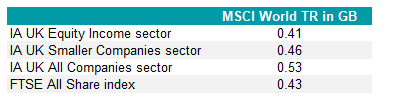
Equity income funds offer even greater diversification benefits to the broader stock market. The IA UK Equity Income sector has the lowest one-year correlation to the MSCI World amongst all of the Investment Association’s UK equity fund sectors, as the table below illustrates.

Correlations between UK equity sectors and the MSCI World Index over 1yr

Source: FE Analytics, data to 29 Aug 2024 in sterling terms 

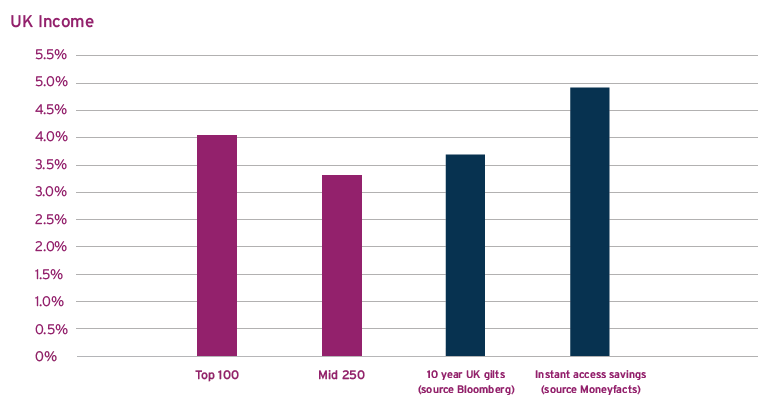
Dividend income from equities is set to become a more attractive source of income as the Bank of England cuts rates and yields on savings accounts and gilts falls commensurately. Computershare expects UK large-caps to yield 4% based on its forecasts for regular dividends in the year ending 30 June 2025, as the chart below illustrates.

Source: Computershare UK Dividend Monitor, Q2 2024 edition

While Cobbe argues that diversification is the main reason for an investment in UK stocks, Klempster is confident of the market’s potential to outperform. “We believe the UK could turn versus the other majors. It is hard to predict when, but to our mind it will not require a major catalyst. UK stocks have already had a relatively strong start to 2024 and its economy has surprised on the upside as the UK emerges from the shallow recession that started at the back end of 2023,” he explained.

Meanwhile, Ben Conway, chief investment officer of Hawksmoor Investment Management, thinks the most exciting aspect of the UK stock market is the level of valuation dispersion. “We find that the lower down the market-cap spectrum one goes, the cheaper stocks become,” he said.

Trustnet

XD dates this week

Thursday 5 September

abrdn European Logistics Income PLC ex-dividend payment date
BlackRock World Mining Trust PLC ex-dividend payment date
Capital & Regional PLC ex-dividend payment date
CT UK Capital & Income Investment Trust PLC ex-dividend payment date
Dunedin Enterprise Investment Trust PLC ex-dividend payment date
Empiric Student Property PLC ex-dividend payment date
JLEN Environmental Assets Group Ltd ex-dividend payment date
MIGO Opportunities Trust PLC ex-dividend payment date
Triple Point Energy Transition PLC ex-dividend payment date

Chart of the day VWRP

Average expected return around 7.5%. Things to know if u want to trade.

VWRP accumulation ETF where any earned dividends are automatically re-invested.

From the covid low, if u bought in 2019 u were printing a low but that would be the same for most Trusts/ETF’s.

A definition of an uptrend a series of higher highs. With hindsight u can see when the ETF printed £90 it was reluctant to go higher, u do not need to know the reason why, just to realise it isn’t go higher yet (resistance).

Upon reaching resistance the chart has 3 options, to continue higher, go lower, or go sideways.

Once u realise it isn’t go higher, u can draw a line on your chart and wait for the price to go higher, sometimes there is a false breakout (bear trap) where the price goes above the line and then falls back, no one said making money is easy.

U can see there was no clear breakout for 2 years.

U could use the trading period to accumulate shares using your dividends or wait for the breakout, knowing that if u can choose the time to sell, that u will not lose any of your hard earned.

Chart resistance is clear to see, remember the 3 options. If u had accumulated under resistance, u may wish to take some of your profit or u may wish to hold for the hope of more profit.

Different strokes for different folks.

Compound growth

U should make more in the last years of your Snowball, whatever time frame u use, so that’s why lifestyling is detrimental to your final retirement ‘pension’.

Remember falling markets are a plus as the price of Investment Trusts fall the yield rises.

Note: although it’s possible to have a Snowball yielding 8% at present it may not be possible to re-invest your dividends at the same rate.

In a rising market your Trusts should increase in value and u may be able to re-invest any profits back into your Snowball, thus achieving 8% compound growth. Of course any Trusts already in you Snowball will return the same amount of dividends gently increasing, hopefully, overtime.

Dividend stocks the best way to earn passive income?

Are dividend stocks the best way to earn passive income? Mark Cuban is a fan.
by Mark David Hartley

The Motley Fool

Nasdaq recently published an article detailing Mark Cuban’s ideas on passive income. The world-famous investor is known for his role on Shark Tank and as the owner of the NBA basketball team, the Dallas Mavericks.

He made his fortune selling a tech startup during the dot-com bubble and has gone on to become a well-known and respected investor. The article outlines his preferred investment options, such as private equity, AI companies, and the S&P 500. As a contrarian investor, many of his ideas go against traditional advice.

But his feelings on dividends struck a chord with me.

He notes how their regular cash payments equate to real-world value. The best part is, that these payments can be reinvested to maximise gains through the miracle of compound returns.

Crystal ball gazing

With two dividends to be announced next week the Snowball fcast of 8k and target of 9k should be confirmed.

The fcast/target for next year can also be made an increase of 1k.

The current indication for dividends earned this year is around 10k but will depend on when the December dividends are paid, as some may be held back to be paid in January for tax purposes. This of course would give a boost to the 2025 fcast total.

If income of 9.8k is received this year that equals the year 2028 fcast so the Snowball will be well ahead of the plan and halfway to doubling the income.

« Older posts Newer posts »

© 2026 Passive Income Live

Theme by Anders Noren — Up ↑