A very weak sector.
Investment Trust Dividends
A very weak sector.
Story by John Plender
The Financial Times
Looking back over my five and a half decades exploring investment and finance, I have to ask the inevitable question: what have I learned from it all?
My early education in investment started in the great bull market of the late 1960s, in which a heady pace was set by the so-called Nifty Fifty growth stocks on the New York Stock Exchange. In the brief period I spent in the City of London, becoming a chartered accountant, I had the good fortune to be sent on the audit of the Imperial Tobacco pension fund. This was run by one of the great investment gurus of the postwar period, the actuary George Ross Goobey.
When Ross Goobey went to the Imperial fund in 1947, pension funds were mainly invested in gilt-edged securities, which were regarded as safer than equities. In his view this was a nonsense.
Against the consensus
Equities, by contrast, looked to him absurdly cheap. Ross Goobey managed the remarkable feat of persuading the fund’s trustees to let him invest in equities and dump the fund’s gilts.
In the bull market conditions of the late 1960s the Imperial fund’s portfolio struck me as bafflingly cumbersome. It contained nearly 900 holdings in mainly small and medium-sized — far from nifty — quoted UK companies. The fund was stuck with them regardless of their performance because Ross Goobey insisted his managers should never trade, only buy and hold.
Particularly unfathomable to me was his injunction to his managers to buy nothing that yielded less than 6 per cent. In a raging bull market this ensured exposure to some of the shakiest companies on the London Stock Exchange.
A few went bust in the subsequent recession. Yet, thanks to the policy of extreme diversification, the portfolio damage was marginal. In addition the high-yield injunction protected the fund from exposure to the most overvalued (and thus low-yielding) companies in the boom.
Here was an object lesson in the workings of diversification, though not quite as envisaged by economists such as Harry Markowitz, for whom the “free lunch” of diversification came primarily from spreading bets across different asset classes. Ross Goobey instead took a very risky bet on a single asset class while diversifying within it. The risk of capital loss was mitigated by the yield discipline he imposed.
So great were the returns that Imperial enjoyed pension contribution holidays for years. Other institutional investors followed suit by dropping gilts in favour of ordinary shares. Ross Goobey was credited with founding what came to be known as “the cult of the equity”.
Among the enduring lessons: diversification is an invaluable risk management tool. High yield, though often an indicator of dividend cuts to come, can be a good defence in an overheated market; equating risk with volatility, as so many economists do, may be less helpful, especially for private investors, than focusing on avoiding loss of capital. Meanwhile, reducing transaction costs by minimising share trading bolsters investment performance. That logic has turbocharged the rise of passive investing.
A decade of financial turbulence
The 1970s provided me with an induction course, first on the Investors Chronicle and The Times, then as financial editor of The Economist, in the dynamics of booms and busts. The unintended consequences of deregulation — a recurring theme in financial markets — helped shape what proved in economic and financial terms to be an exceptionally violent decade.
Exhibit A in the saga was US President Nixon’s cancellation in 1971 of the convertibility of the dollar into gold. The resulting deregulation of exchange rates unleashed volatile cross-border capital flows that caused wild swings in global asset prices. Exhibit B was the shift in the banking system from being a home for low-risk, highly regulated quasi-utilities — a product of the troubled 1930s — to an adventure playground in which bankers’ insatiable risk appetite was substantially liberated.
A radical and still instructive deregulatory experiment took place in the UK in 1971. The Bank of England scrapped quantitative ceilings on bank lending in favour of indirect controls, such as balance sheet ratios. This unleashed a wild acceleration of the money supply and credit. Excess liquidity poured into an overheating property market. Then came the 1973 oil crisis, soaring inflation, recession and financial crisis. Property, gilts and equities all plunged.
In equities, the dramatic share price collapse was driven by financial institutions’ selling. Their fear was not ill-founded. In confronting inflation, the Conservative government of prime minister Edward Heath removed key props of the capitalist system by adopting price, dividend and commercial rent controls.
At the same time companies faced not only spiralling wage bills but penal tax liabilities. This was because corporation tax was charged on paper profits from stock appreciation, the difference between the original cost of inventory and the inflated cost of replacing it. Result: British industry was going bust.
When Labour replaced the Tories in early 1974 chancellor Denis Healey intensified the corporate fiscal clamp. Yet by the autumn he had grasped that the corporate sector was being terminally throttled. He introduced tax relief for stock appreciation along with other breaks.
Timing the market
Policy U-turns often signal market turnarounds. Healey’s move to put British capitalism back on its feet should have ended the bear market. Yet in the fourth quarter of 1974, fearful insurance companies, pension funds, investment trusts and unit trusts together sold more shares than they bought for the first and last time during the decade.
Then on January 6 1975, after a peak-to-trough fall on the FTSE All-Share index of 72.9 per cent, the market inexplicably turned and rose vertically. It was impossible for the institutions to get back into the market without causing prices to move spectacularly against themselves.
That is a reminder of the futility, for most investors, of trying to time the market and of the difficulty of contrarianism, the art of investing against the consensus. Note, though, that Ross Goobey, hitherto an equity ideologue, once again defied convention.
When undated gilt yields reached 17 per cent in the mid-1970s the Imperial fund took a big bet on these government IOUs. Ross Goobey’s thinking was that if inflation came down this was an unbelievable bargain. But if the economy was going to hell in a handcart all bets were off anyway.
Of course, all bets are never off in financial markets, not least because when that becomes the common perception, gold comes into its own. There lies the case for the yellow metal as a hedge against catastrophe.
Why should this episode resonate with us today? While economists have explained exhaustively that we are not now reliving the 1970s the similarities remain more striking than the differences. Both periods saw supply side energy and commodity shocks, together with surging money supply. Governments turned on the fiscal tap in response.
Central bankers in both periods initially declared they could do nothing to curb an inflation induced by supply shortages. They were slow to see the demand side of the equation and the risk of second round effects in labour markets. And 21st century central banks’ economic models provided useless forecasts when confronted with supply shocks. So they fell back on a shaky, data-dependent (in other words, backward-looking) monetary policy.
One lesson is that investors, as well as central bankers, ignore money supply signals at their peril. Another is that in such inflationary periods government bonds cease to provide a diversifying hedge against supposedly riskier assets.
Dotcom delirium
Fast forward, now, to the second half of the 1990s, by which time I had been writing for the FT for a decade and a half. The dotcom boom was turning into a bubble, once again making a nonsense of mainstream economists’ belief that markets are “efficient” or reflect fair market values.
An important psychological factor in the tech euphoria was “Fomo” (fear of missing out) which goes back in history at least as far as the South Sea Bubble of the early 18th century. Fomo adds to investors’ myopia over the risk of capital loss.
For professional investors fear of missing out is more a matter of business and career risk. They are usually benchmarked against an index or peer group. So if they stand against a bubble and underperform the index, clients defect and they may be fired.
This was the fate of Tony Dye, the former chief investment officer of Phillips & Drew Fund Management, during the tech bubble. By shunning overvalued tech and going heavily into cash he seriously underperformed PDFM’s peer group, leading to his ousting just two weeks before the bubble burst. Small wonder fund managers tend to hug their benchmarks.
Central banks responded to the dotcom bust with rapid interest rate cuts. This cemented a view in the markets that policy was asymmetric. That is, the central banks would never lean against a bubble and would reliably extend a safety net when it burst.
The moral hazard implicit in asymmetric policy helped pave the way for the wild credit bubble of the 2000s (see below). Then came the great financial crisis of 2007-09. The central banks’ response was once again to come to the rescue and keep interest rates ultra low for a decade while buying up government bonds and other assets via so-called “quantitative easing”. A further round of propping up followed the pandemic and the war in Ukraine.
By the post-crash 2010s the UK investment scene had reverted to something like the pattern that confronted George Ross Goobey after the second world war. Pension funds had run down their equity holdings to near-zero. Quirky accounting standards and pressure from The Pensions Regulator had pushed them into liability-driven investment. Instead of seeking to maximise the return on their assets, trustees sought to match their liabilities by buying what economists and actuaries described as “safe” government bonds.
Yet nothing in investment is ever safe — witness how the collapse in US Treasuries contributed to the failure of Silicon Valley Bank and other US regional banks last year. And the regulators’ attempts to make individual pension funds risk-free makes the overall market structure more risky: if everyone pursues the same strategy, when the market moves, it moves all one way. That eternal verity re-emerged in the pension fund crisis in the gilt market in 2022.
After a lifetime spent watching the markets, I am struck how, with each new cycle in which central banks act as lenders of last resort, debt mounts inexorably. We continue to muddle through. But a great debt denouement is inevitable because debt cannot rise faster than incomes for ever.
Since debt implosions are inherently deflationary — see Japan in the 1990s — gold, ever resilient against inflation, may not provide insurance against falling prices but government bonds certainly will. To conclude; it is tempting to quote the US economist Herbert Stein who remarked that if something can’t go on forever, then it will stop. But as I have remarked here before, the wise rejoinder by fellow economist Rudi Dornbusch was: yes, but it will go on for a lot longer than you anticipate.
The intention is not to open a new position with earned
dividends as the more positions u own the bigger chance of owning
a clunker.
The portfolio is waiting for corporate updates from
ADIG, LBOW, VPC, TENT
where the funds may need to be re-invested into another high yielder.
I intend to add to existing positions to ensure roughly dividends of
1k a year per Trust.
This will mean going overweight in the lower yielders but
that is supposed to be a sign of safety.
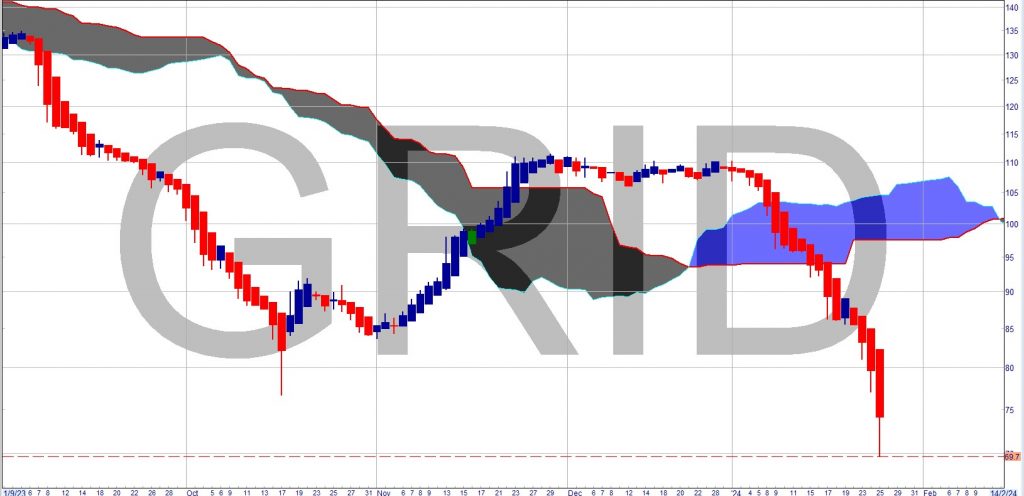
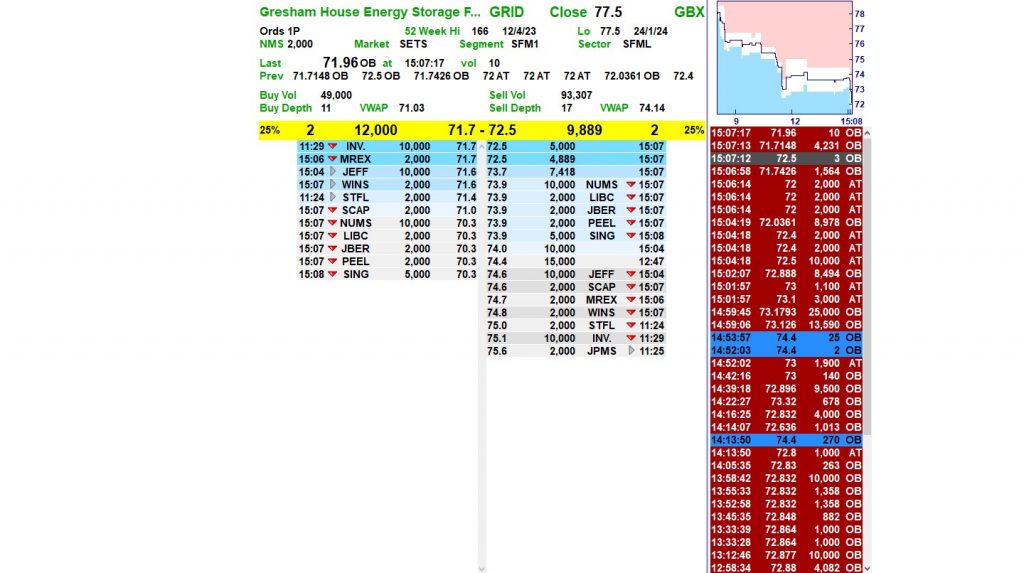
I’ve bought for the portfolio a further 1259 shares in GRID
for £900.00
Like bacon and eggs the chicken makes a contribution but the pig
makes a commitment.
Warehouse REIT plc
Dividend declaration
The Company has declared its third interim dividend in respect of the third quarter of the financial year ending 31 March 2024 of 1.60 pence per ordinary share, payable on 1 April 2024 to shareholders on the register on 1 March 2024. The ex-dividend date will be 29 February 2024.
The dividend of 1.60 pence per ordinary share will be paid in full as a Property Income Distribution.
Bluefield Solar Income Fund Limited
First Interim Dividend Announcement
Bluefield Solar (LON: BSIF), the London listed UK income fund focused primarily on acquiring and managing solar energy assets, is pleased to announce the Company’s first interim dividend for the financial year ending 30 June 2024 (the ‘First Interim Dividend’).
The First Interim Dividend of 2.20 pence per Ordinary Share (January 2023: 2.10 pence per Ordinary Share) will be payable to Shareholders on the register as at 9 February 2024, with an associated ex-dividend date of 8 February 2024 and a payment date on or around 9 March 2024.
The Board is pleased to reaffirm its guidance of a full year dividend of not less than 8.80 pence per Ordinary Share for the financial year ending 30 June 2024 (2023: 8.60 pence). This is expected to be covered by earnings and to be post debt amortisation.
More GRIM than GRID
Alan Ray
Merger of ORIT and AERI could make sense for shareholders
We ask what factors make for a good merger and ask if these apply to ORIT and AERI…
Disclaimer
This is not substantive investment research or a research recommendation, as it does not constitute substantive research or analysis. This material should be considered as general market commentary.
Just before Christmas, there was a light-hearted conversation on the Kepler internal chat system about who might put out an important announcement just as the market was closing for the festive period. It’s an ironclad rule that someone will. Sure enough, Octopus Renewables Infrastructure’s (ORIT) board announced that it had proposed a combination of ORIT and peer-group member Aquila European Renewables (AERI).
The board of AERI quickly confirmed that while it would consider the proposal, this was in the context of a wider process of thinking about future options. As a result, we got to thinking about what the ideal circumstances for a merger between two investment trusts might be. There is a lot of M&A going on in the trust sector right now. What are the factors that could make for an ideal combination?
While it’s not totally unheard of to include a change of investment strategy as part of an M&A transaction, this presupposes that investors a) want to invest in a new asset class and b) are happy that the board can take on the role of fund selector. In other words, investors may be very interested in a new direction, but might quite like to research a number of potential managers themselves and make their own choice, and so perhaps would rather see a trust wind up and return cash to give them the freedom to choose for themselves. Thus, the most likely scenario involves a combination of similar strategies, where investors aren’t being asked to embrace a new manager and a new strategy. In the case of ORIT and AERI, while a very detailed examination may reveal some differences, in terms of the role both play in investors’ portfolios, it is very similar indeed: a geographically and technologically diversified portfolio of renewable energy infrastructure assets, including the important ability to invest in construction and development assets, potentially boosting returns. So, in essence, the two sets of shareholders are on the same wavelength.
A constant mantra in the investment trust sector is that scale matters and small investment trusts must consider merging to achieve scale, thus improving dealing liquidity and achieving economies of scale. We think that while these often do matter, it’s also perfectly possible for a small investment trust to go about its business if shareholders are happy. Not all investment strategies need or benefit from vast amounts of money, and one thing investment trusts are very well suited to is investing in unusual or more difficult-to-do areas.
Renewables infrastructure is, though, somewhat a numbers game. Yes, there are parts of that world that smaller investment trusts can focus on, but in the end, this is about delivering power to whole countries. Three or four years ago, the model for investment trusts in this space was to achieve ‘escape velocity’ by raising the first £100–£200m at IPO, and then periodically raising further funds each year. Big investors really wanted to see these trusts grow rapidly to £500m and beyond to a) be confident that they could play a competitive role in sourcing new deals, b) achieve the cost and liquidity benefits of scale and c) be large enough to make a difference to portfolio performance.
Today, while it’s not inconceivable that the very largest investment trusts in this space will be able to raise capital again in the next 12–24 months, it’s not looking very likely that the sector-wide pattern of raising new capital to a timetable of the manager’s choosing will return any time soon. So, having scale is going to be even more valuable than before. In an era of higher interest rates, it’s also likely that larger trusts will be able to achieve lower borrowing costs, which for an asset class that is usually leveraged, could make a significant difference.
As noted above, that mantra about investment trusts having to get bigger to survive presupposes that all shareholders care about such things, and sometimes they don’t. It is though, a pretty safe bet that a share register of largely professional investors does like and want scale. While we can’t say that AERI shareholders necessarily want this particular transaction to happen, we can say that a process to look at options was already underway because a significant minority of AERI shareholders have already expressed a view to the board that they want alternatives to be considered. In our view, this won’t therefore be an unwelcome approach for shareholders, even if the result is simply to catalyse a competitive process.
Again, going back to the ‘scale matters’ argument, whereas ORIT is above the notional threshold of £500m, AERI is some way below this level but is still a meaningful size. The combination of the two would create a vehicle that was definitively above £500m, with combined assets of over £900m. So, there is something in this for both parties, meaning that this is a negotiation rather than a fait accompli. As readers may know from personal experience, the negotiation where no-one is totally happy is probably the one that achieves the fairest result for everyone. That’s a bit of a trite statement of course, but one that helps us get our point across efficiently. Both sides have something to gain, so there is scope to negotiate.
As we write this, we note that infrastructure investor Macquarie has just raised a record sum of €8bn to invest in European infrastructure, with renewable energy infrastructure very much on the radar. This goes to show that even while the listed sector trades at a discount for various reasons we’ve discussed in the past, there is still very strong appetite for these types of investments, and that speaks to a competitive landscape for new transactions, which brings us back to scale being important.
One certainly can’t blame the recipient of the offer, AERI, from playing it cool. To our point above, this is a negotiation and so why would one just say ‘yes, please‘ if a simple stock exchange announcement might yield what we call ‘competitive tension’. That’s totally fair enough and shareholders would be right to ask ‘why not?‘ if this hadn’t been done. But if one thinks through the criteria that can contribute to a successful merger, ORIT and AERI seem to meet many of them.
The updated fcast dividend for the 1st quarter is £2,524.00
but with 3 Trusts still to report their dividends.
£2,524.00 should not be multiplied by 4 for the yearly total.
© 2026 Passive Income Live
Theme by Anders Noren — Up ↑