Passive Income Live

Investment Trust Dividends

Page 440 of 456

GABI

Dividends

On 8 November 2023, the Directors declared a quarterly dividend in respect of the period from 1 July 2023 to 30 September 2023 of 1.58125p per share, which was paid on 15 December 2023. Aggregate dividend payments over the last 12-months represent a 9.5% yield on the Company’s closing share price at 24 January 2024.

BSIF

Bluefield Solar Income Fund Limited

(‘Bluefield Solar’ or the ‘Company’)

Completion of Phase One of the Strategic Partnership with GLIL Infrastructure (‘GLIL’)

·    Following approval under the National Security and Investment Act 2021, the Company is pleased to confirm the completion of its investment of £20 million of equity, alongside £200 million from GLIL, to fund the acquisition of a 247MW portfolio of UK solar assets.

·    The Company continues to progress the provisional agreement for GLIL to acquire a 50% stake in a portfolio in excess of 100MW owned by Bluefield Solar, in line with current valuation, which remains expected to complete in early 2024.

Bluefield Solar (LON: BSIF), the London listed UK income fund focused primarily on acquiring and managing solar energy assets, is pleased to report the completion of phase one of its long-term strategic partnership (‘Strategic Partnership‘) with GLIL. This marks the acquisition of a 247MW portfolio of UK solar assets from Lightsource bp (the ‘Lightsource bp Portfolio‘). GLIL is a partnership of UK pension funds currently with a £3 billion portfolio of core UK infrastructure assets. GLIL’s member funds include Local Pensions Partnership Investments, Greater Manchester Pension Fund, Merseyside Pension Fund, West Yorkshire Pension Fund and Nest.

As previously announced, the Lightsource bp Portfolio is predominantly diversified across southern and central England and comprises 58 operating sites: 184MW backed by Feed in Tariff (‘FiT‘) subsidies, 15MW by Renewable Obligation Certificates (‘ROCs‘) and two subsidy-free projects totalling 48MW.  Through the period 2023 to 2035 the proportion of fixed and regulated revenues from the portfolio is projected to be approximately 80%.  The acquisition raises the level of regulated revenues in the Bluefield Solar portfolio, whilst also increasing the proportion of FiT income.

Bluefield Solar is investing £20 million, or 9% of the equity, with GLIL investing the balance.  The Company will fund the acquisition using earnings which arose in the financial year ended 30 June 2023, after the payment of dividends, debt amortisation and the Electricity Generator Levy (‘EGL‘).  In addition, Bluefield Solar has used £10 million of earnings to pay down a portion of the Company’s revolving credit facility (‘RCF‘).  Total retained earnings prior to this announcement were approximately £60 million.  Following the Lightsource bp Portfolio acquisition and the partial repayment of the RCF, the Company’s UK holding companies’ RCF balance will stand at £167 million, with long term amortising debt being £430 million.  Overall, the Company’s UK holding companies and its subsidiaries have total outstanding debt of £597 million, with a leverage level of circa 41% of Gross Asset Value (broadly unchanged from 30 June 2023).

The Company continues to progress phase two of the Strategic Partnership, where GLIL has provisionally agreed to acquire a 50% stake in a portfolio of more than 100MW of operational UK solar assets currently owned by the Company (the ‘Bluefield Portfolio‘).  The provisional acquisition price is in line with the Company’s current valuation.  The Strategic Partnership intends to reach financial close in the first half of 2024.  The sale of a stake in the Bluefield Portfolio, as described, will provide Bluefield Solar with additional liquidity, the proceeds of which provide the opportunity to continue to pay down the drawn RCF. This phase is expected to complete in early 2024.

As announced on 22 December 2023, in phase three, Bluefield Solar and GLIL intend via the Strategic Partnership to commit capital in a selection of the Company’s development pipeline, assuming market conditions are supportive.  The identified development assets are expected to be grid connected over the next two to three years.

UKW

David Kimberley

Disclaimer

Kepler

Disclosure – Non-Independent Marketing Communication

This is a non-independent marketing communication commissioned by Greencoat UK Wind. The report has not been prepared in accordance with legal requirements designed to promote the independence of investment research and is not subject to any prohibition on the dealing ahead of the dissemination of investment research.

Greencoat UK Wind (UKW) announced last month that Laurence Fumagalli will be stepping down from his role as co-head of the UKW management team at the beginning of March 2024. Laurence played a significant role at the trust, having helped launch it as the first listed renewable infrastructure fund in 2013, alongside co-manager Stephen Lilley.

Although he will stepping down from his role at UKW, Laurence will remain a part of the senior management team at Schroders Greencoat, notably chairing the fund manager’s valuation committee.

Stephen will also remain in his role and will be joined by a new co-manager, Matt Ridley, who is currently Head of Private Markets at Schroders Greencoat and has close to two decades of experience investing in renewable energy infrastructure.

Managerial changes may unnerve some investors, particularly given the volatile few years we’ve had. However, even though UKW may have a new co-manager in 2024, the investment process and ultimate objective remain the same – namely delivering strong total returns for shareholders via real NAV growth and a dividend that rises in line with RPI inflation.

That the trust is capable of delivering on that objective was illustrated at the end of October. UKW announced a £100m buy back scheme and increased its dividend for the 2024 financial year to 10p per share. The dividend increase represents a 14.2% uplift to 2023, far exceeding the rate of inflation in the UK of 5.2%.

The higher dividend and new buyback programme were a more tangible illustration of some of the points the managers made earlier this year when the trust released its half-year results. These included a simple breakdown of the trust’s dividend coverage, based on various changes to the power price.

We have covered those figures in more detail previously, but the key takeaway was that, even if we assume there is a substantial decline in the power price and higher levels of inflation, UKW would still be able to pay a growing, fully covered dividend.

The trust managers have also been more conservative in terms of valuations, increasing UKW’s discount rate to 1% above the level it was at when it held its IPO a decade ago. Today this stands at 11%, which implies a prospective forward return of 10% when management fees are factored out. However, that is on a NAV basis and, given UKW trades at a 12.4% today, the implied return is higher for potential investors.

Given that the implied returns on a NAV basis already offer a roughly 6% equity risk premium, you would think that there is reason for the discount to tighten. That has happened to an extent over the past two months, with the trust discount’s tightening from over 20%.

However, the lingering discount likely reflects the fact that investors have focused on the trust’s yield, as opposed to its total return. The forward yield on the trust now stands at approximately 6.9%. This still offers a healthy premium over gilts but clearly it is not the same as the return implied by the discount rate.

To understand that discrepancy, it’s worth looking at the reinvestment that UKW has undertaken. From IPO in 2013 through to the end of September this year, UKW paid £887m in dividends but also reinvested £877m of excess cash flow.

This has enabled the trust to grow its NAV in real terms substantially since listing, which in turn has fed into its ability to increase dividend payouts. Rate hikes have meant the managers’ ability to enhance returns through leverage have been made more difficult. However, higher discount rates have also offset this to a large extent, meaning borrowing is still additive to returns for the trust.

Despite these positives, UKW has continued to linger on a wide discount in 2023 – an unusual phenomenon for a trust that traded at an average premium every month from IPO until the end of last year.

But the trust has not been alone in this. As one UK equity fund manager noted recently, 2023 has been something of a strange year, with the fundamentals for trusts like UKW suggesting they were attractively valued, but few investors that were willing to buy.

That appears to be changing. As noted, the trust’s discount has tightened substantially in the past two months, perhaps inspired by the buyback programme and increased dividend. Broader coverage of how distorted valuations have become may have played a role as well.

Heading into 2024, the prospect of the rate hike cycle hitting its peak also looks like another potential catalyst for the UKW discount to tighten, with the high yield that UKW currently offers starting to look more appealing relative to bonds than it does today. Assuming that’s the case, it may provide a happy start for the new co-manager.

Dividend Heroes

Building blocks for a dividend portfolio, where u can sleep soundly

at night. HFEL as a higher yield but is more risky than the other Trusts.

If u wanted to buy MRCH and target a 7% yield, u would have pair it with a higher yielder.

Chart of the day

The emotional benefits of taking some money off the table.

Trading.

Apart from buying a clunker the next worse thing is

to see a profit turn into a loss.

If u book a ‘profit’ and the share continues to rise, u can take

more money off the table.

If it falls back to your previous buying area u can do it all

again as long as the story hasn’t change.

If u buy at the wrong time u have the yield of 8.5% to re-invest

in the portfolio.

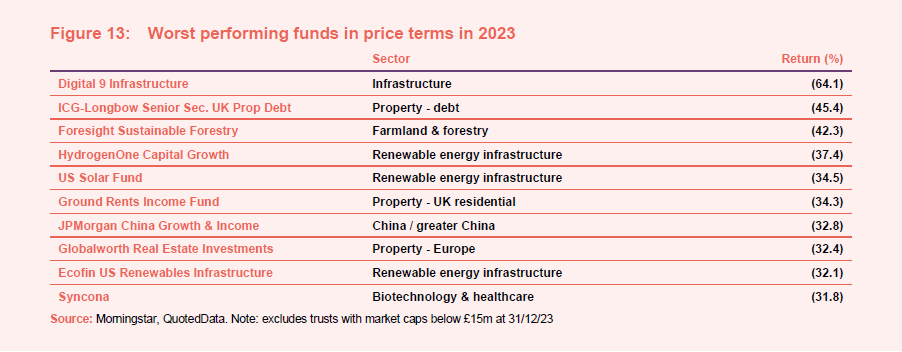
2023 Worst Performing Trusts

Worst performing trusts

QuotedData

Share price moves

On the negative side, Digital 9 Infrastructure led the pack. It was impacted by issues surrounding its debt, having been too aggressive with its leverage and exposure to cash-hungry companies in prior years. Its debt burden had become so high that the board was required to cut to its dividend, widening its discount in the process. It was also impacted by the delay to the sale of its prize asset Verne Global. The terms of this sale then disappointed investors. Digital 9 now trades on a roughly 70% discount, having traded on a premium in 2022. Its board has announced a strategic review.

Second on the list is ICG-Longbow Senior Secured UK Property Debt, which is in wind-up mode, and this distorts its returns.

In a world of 6% cash deposits, the returns from forestry assets seem pale in comparison. This has certainly been true for Foresight Sustainable Forestry, which returned -6.3% in NAV terms. Rather than there being any trust specific announcement, it seems that the return profile of the trust is no longer attractive in the current market environment, especially when one considers that it pays no dividend.

HydrogenOne is invested in cash consumptive growth stocks and like other funds with similar exposures has suffered since interest rates began to climb. The portfolio is still quite new and will take time to mature. Nevertheless, encouraging progress is being made within many portfolio companies.

Hydrogen is a beneficiary of the Inflation Reduction Act, which also supports the development of renewable energy generation in the US. However, sentiment towards US Solar (USF) and Ecofin US Renewables (RNEW) have been hit hard by higher interest rates. USF underwent a management change during the year and tried and failed to sell its portfolio. RNEW was forced to suspend its dividend following a tornado strike on the grid link to its wind farm investment.

Ground Rents Income Fund will wind-up in light of a more challenging market environment, specifically the likely reforms from the Leasehold and Freehold Bill introduced by the government. Its independent valuer took the opinion that there was material uncertainty around the value of the trust’s assets because of the bill.

Globalworth Real Estate Investments invests in central and eastern European properties and continues to trade. Though given the economic weakness of Europe and large portfolio of corporate properties, investors may have become concerned around the return potential of these assets.

We have covered the reasons behind the decline in demand for Chinese equities, and JPMorgan China Growth & Income, previously.

Despite an active 2023 for Syncona, its discount has still widened, reflecting the general lacklustre returns of the biotech and healthcare sector over the year, increasing costs of capital, and stock specific issues. Syncona was forced to write off a £54.5m earn out from the sale of its Gyroscope experimental eye treatment after the buyer Novartis elected to stop its development.

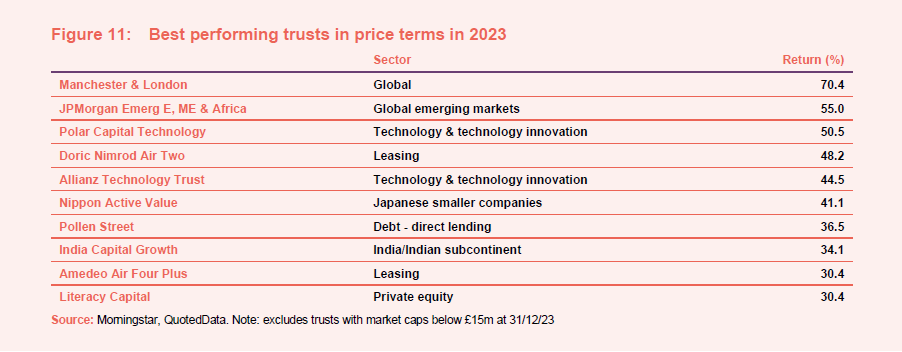
Best performing Trusts QuotedData

Best performing trusts

Manchester and London, with its mega-cap, AI-focused technology portfolio, was the best performing trust in share price terms, and the biggest beneficiary of the tech rally. Its high allocation to the likes of Microsoft and Nvidia put it front and centre of the AI-frenzy, as well as the wider rally in growth stocks over Q4. Its impressive returns were compounded by increased demand for its shares in the latter months of 2023. For similar reasons, Polar Capital Technology and Allianz Technology Trust saw strong share price performance, compounding both their NAV returns with a narrowing discount. However, they lacked the high concentration of Manchester and London’s portfolio and thus benefited less from the rally.

The performance of JPMorgan Emerging Europe, Middle East, and Africa was less a reflection of its NAV returns, as it generated a mere 5.1% over the period, but a quirk of its previous life as a Russian equity strategy. With its previous portfolio having been effectively written down to zero, its share price rally reflects investors speculating on the potential value that they may one day be able to realise from the stranded Russian assets.

The rally in the airline leasing trusts was evidenced by the returns of Doric Nimrod Air Two and Amedeo Air Four Plus. However, DNA2, which has more exposure to the previous unloved A380, generated stronger NAV returns, at 32% versus 6%.

Nippon Active Value benefited from the double whammy of the broader rally in Japanese equities and within that the impact of further corporate governance reforms. Trust-specific factors included mergers with abrdn Japan and Atlantis Japan, its migration to a premium listing, and several of its activist campaigns bearing fruit over the year.

Pollen Street proposed to leave the investment trust sector and re-list as a commercial company. Its discount narrowed on the back of the proposal being passed in its October AGM.

India Capital Growth was the standout performer in a buoyant Indian market. It generated both the highest NAV and share price returns in the period in this market thanks to some good stock picking.

Literacy Capital was once again the winner within the private equity sector and was the only constituent to achieve double-digit NAV returns. Its performance can be placed at the feet of its management team, who made several profitable disposals over the year, often at impressive premiums to carrying value.

« Older posts Newer posts »

© 2026 Passive Income Live

Theme by Anders Noren — Up ↑