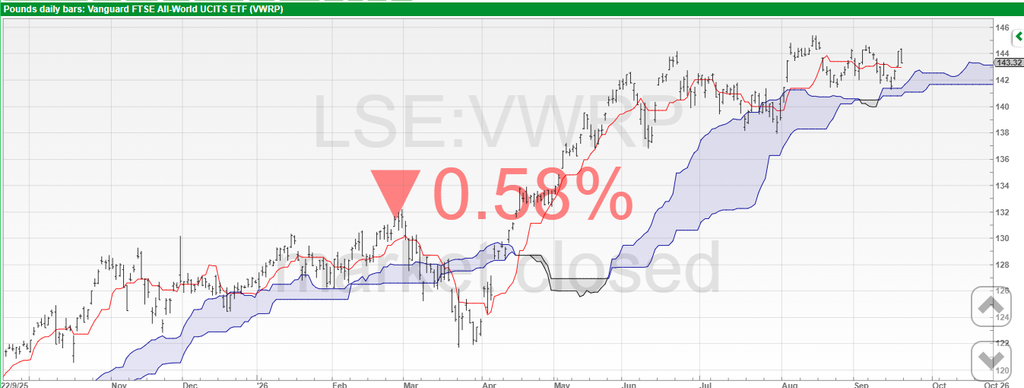
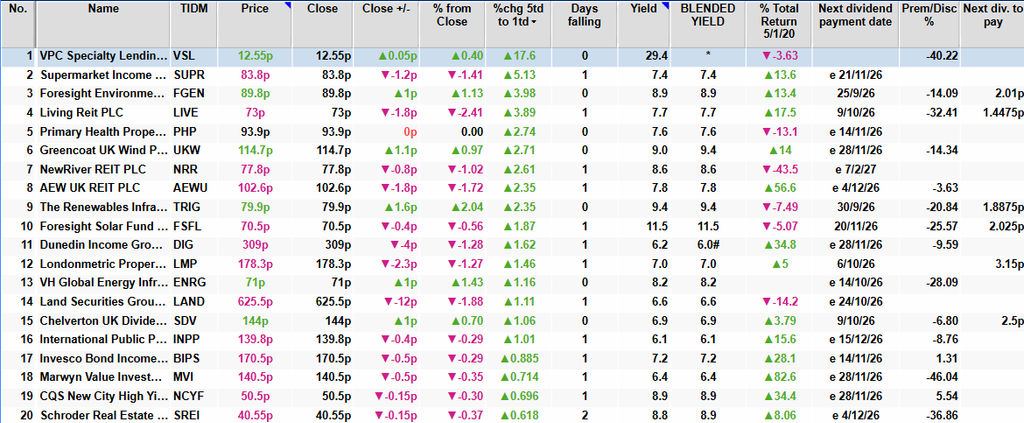
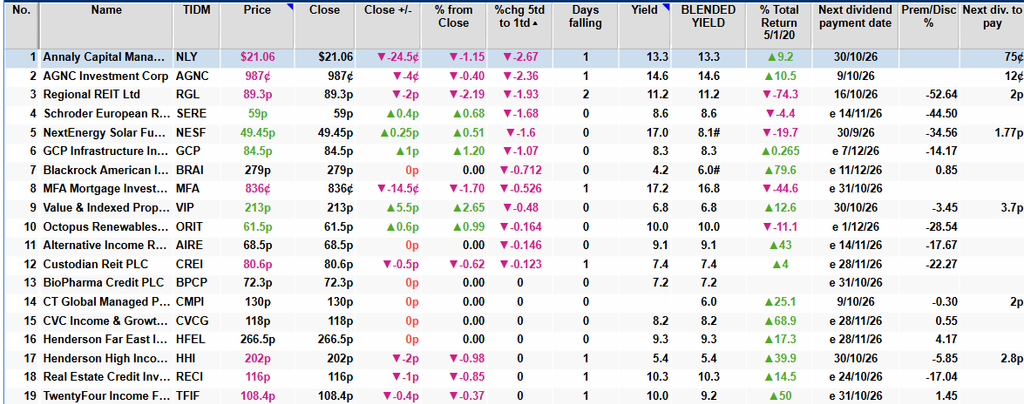
Properties were the place to be, as the assumption is that interest rates may not have to rise if the oil price continues to fall.

Investment Trust Dividends

Properties were the place to be, as the assumption is that interest rates may not have to rise if the oil price continues to fall.


GREENCOAT UK WIND PLC
Removal of Carbon Price Support
Yesterday the Government stated that it will legislate to remove Carbon Price Support (“CPS”) with effect from April 2028.
CPS is a tax on fossil fuels used in electricity generation and was designed to ensure a minimum carbon price for electricity generation. It sits alongside the UK Emissions Trading Scheme (“UK ETS”) and serves to top up the UK ETS price by £18/tonne of CO2. CPS feeds into electricity prices where a carbon emitting generator, such as a gas plant, is the marginal price setter.
The forecasts in the Investment Manager’s valuation assumptions had anticipated that CPS rates would reduce significantly. Further, CPS was expected to become less meaningful to electricity prices in the longer run as UK renewable generating capacity expands and carbon emitting generators set the marginal price less frequently. Yesterday’s announcement brings this forward.
Initial analysis by the Investment Manager indicates that electricity prices used in the Company’s NAV could fall by approximately £4 – 5/MWh from April 2028 to the early 2030s, and by £2 – 3/MWh thereafter. The Investment Manager’s preliminary assessment is that this could reduce the Company’s NAV by 3 – 5 pence per share.

(Alliance News) – UK Chancellor Rachel Reeves has said she and Energy Secretary Ed Miliband are looking at ways to break the link between the cost of electricity and gas prices.
Gas almost always sets the price of electricity under the marginal cost pricing model the UK uses.
Speaking in Washington, the chancellor said: “So, this is something that I’ve been attracted to for quite some time, delinking electricity and gas prices.
“At the moment, when gas prices are high, we end up paying more for our electricity, even though the cost of producing it doesn’t change.
“And so myself and Ed Miliband are now working to come up with a practical way that we can delink those prices.
“It is quite a big change but is absolutely the right thing to do, especially as electricity makes up an increasing part of our energy mix, and we hope, within the next sort of few days, weeks, to be able to give more details on what that looks like.”

Miliband has long touted Labour’s energy policies and shift to renewables as a bid to get the UK off the “fossil fuel rollercoaster”.
Renewables have cut the amount of time gas sets the wholesale price of electricity in Britain by about a third since the early 2020s, according to the Department for Energy Security and Net Zero.
The head of Energy UK said earlier this week that decoupling electricity prices from gas was something that would come gradually with the transition to clean power.
“Over time, that will decrease as we get more renewables on to the system,” Dhara Vyas, chief executive of the industry body, said.
Reeves also spoke on Thursday about the North Sea oil and gas tiebacks – satellite wells to exploit existing fields – that the government is encouraging investment in.
The chancellor said: “I announced in the budget last year that we were going to allow tiebacks.
“We’re now working through pretty intensely the technical details with the energy companies.
“What tiebacks are is where you use existing infrastructure to exploit a larger geography of oil and gas.
“It is the quickest way to bring on stream more oil and gas, and it’s important that we get the detail right, so that companies have the confidence to exploit those resources.”
Greenpeace has proposed decoupling by moving gas plants into a so-called regulated asset base to make gas a strategic reserve and reduce its impact on market prices.
Its UK head of politics Ami McCarthy said: “It’s absurd to let volatile gas dictate the cost of electricity in this country, and the price shock caused by Trump’s reckless war on Iran is just the latest reminder of that.
“As our proposal shows, we could be saving billions every year by taking control of our electricity prices away from the gas industry, and letting bill payers benefit from cheaper, homegrown renewables.
“It’s basic common sense, and it’s encouraging that the Government is considering it.”
By Helen Corbett and Nicholas Lester, Press Association Political Correspondent
source: PA


1.# Dividend income is predictable. Stock prices go through both bull and bear markets, with the latter often showing up at the worst times. Managing high-yield investments, as I recommend, will produce an income stream that grows every quarter.
2# Managing a portfolio to grow your income makes it easy to live through market downturns. When stocks go down, income-paying investments go “on sale,” allowing dividends to be reinvested at higher yields, growing income even faster.
3#Investing to build an income stream makes it easy to determine how much you can pay yourself in retirement. When you stop working, you start drawing a portion of your dividends, knowing exactly how much you can pay yourself out of your retirement savings. I get many notes from subscribers saying their retirement income is much higher than they planned for.
by Tim Plaehn


Regional REIT (RGL) owns a highly diversified commercial property portfolio located in the regional centres of the UK.
Regional REIT’s commercial property portfolio is located wholly in the UK and comprises predominantly offices located in the regional centres outside of the M25 motorway. The portfolio is highly diversified, with more than 100 properties, containing over 1,000 units and let to well over 600 tenants. The portfolio value at the end of 2025 was £555m.
Responding to significant and challenging structural shifts in the office market, Regional REIT is well-advanced with a major repositioning of its portfolio, while reducing gearing. Meanwhile, there are a number of factors that suggest the performance of the office sector relative to the wider commercial property market may be at a turning point.
There are four main reasons why now may be the right time to look at Regional REIT.
1. Good quality assets are generating premium rental growth.
There is now much greater visibility on the post-pandemic use of office space; most employers have adopted some form of hybrid working, and office attendance has returned to normal levels. However, occupier demand is not spread equally across the sector. There is a flight to quality with many occupiers willing to pay higher rents for good quality, energy-efficient space, while lower quality, hard-to-let assets have continued to leave the sector, often for alternative use. It is estimated that less than a quarter of regional offices meet the energy efficiency standards that are expected to become a legal requirement and which are already being demanded by occupiers. With little new development on the horizon, the outlook for rental growth looks promising.
2. The majority of Regional REIT’s office portfolio already meets these occupier requirements or will soon do so.
At the end of 2025, 85% of Regional REIT’s current portfolio was EPC rated C or better and compliant with the expected 2027 regulatory standards. Core, good quality, long-term income generating properties were 63% of the portfolio, and another 19% were expected to become so through refurbishment and improvement. The balance of the portfolio will be sold, usually outright, but in selected cases after first obtaining part or full planning consent to create additional value. In 2025, Regional REIT completed more than £50m of disposals at a small premium to book value before sales costs, using the proceeds to fund capex and reduce debt.
3. Significant potential to grow net rental income.
The overall leasing market has remained challenging amid economic and political uncertainty, but the potential for Regional REIT to grow its net rental income is significant. There is a wide gap between existing rents and the level of market rents estimated by the external valuers. This is available to be captured by letting vacant space, and, encouragingly, recent lettings have been at rents above the estimated market level. Leasing vacant space does not just increase rental income but also reduces the property costs that must otherwise be paid by the company. The sale of underperforming, low occupancy properties reduces costs more than the income.
4. A significant discount to net assets with a high covered yield.
Regional REIT’s shares trade at around a 50% discount to the NAV and offer one of the highest, fully covered dividend yields in the sector. Within the commercial property market, the office sector has underperformed significantly, particularly since the pandemic, and investor expectations are low. Given these low expectations, improving demand-supply fundamentals and continuing market rental growth, combined with a successful execution of the company’s strategy, could be powerful drivers of dividend-led investment returns.
Published 15 April 2026


Brett Owens, Chief Investment Strategist
Updated: April 15, 2026
“Adrian, it’s going to Jack. But you have to act like you have the ball.”
My star adjusted his mouthguard and nodded, still breathing heavily.
“Everyone’s gonna follow you.”
I looked around our huddle. Adrian had just motored for a 95-yard touchdown run on our first play from scrimmage—the very first play of our season. Now we were going for the two-point conversion to take the lead.
I knew the defense was dialed in on Adrian. The opposing coach, Jersey Mike, was now ranting and raving like a lunatic. His Eagles had put together a somewhat disjointed but ultimately effective drive in our YMCA contest, eventually scoring a touchdown.
My Bills answered in one play. Which really frustrated the previously ebullient Jersey Mike. (Act like you’ve been there before, JM! Ha!)
Our two-point play relied on Adrian pretending he had the football again while I sent Jack around the other side of the quarterback for an end around. Jack would receive the handoff from our quarterback and run in the opposite direction that Adrian was heading.
Our decoy played it perfectly. Still huffing and puffing from his epic sprint, he ran his distraction assignment to perfection. The entire defense followed him. Jersey Mike even screamed, “Hey! Watch the kid in the blue jersey!”
Meanwhile, Jack trucked around the other end untouched, putting a smile on his face and his parents’ faces. (Would have put a smile on my face too, but unlike my counterpart I stay relatively level-headed for the kids.) The two-point conversion was good. Eight to seven, Bills, en route to a 26-13 opening week victory.
In eight-to-ten-year-old flag football, the key is the play the defense can’t see: The decoy matters as much as the actual ball carrier.
And hey, we contrarian investors live on misdirection, too. When the suits zig, we zag!
Vanilla investors always assume that what just happened is going to happen again. Stocks sold off, so they will keep declining. Or, a hot stock will stay hot. These Jersey Mikes of the investing world think it’s going to Adrian again on the New York Stock Exchange.
The profitable action is what’s about to unfold. The counter move. The invisible company that nobody knows about.
Linde (LIN) is the world’s largest industrial gas company. Everybody knows heating gas, but nobody thinks about industrial gas. Yet, every single AI chip made in America requires Linde’s ultra-high-purity nitrogen to exist. No gas, no chips. No chips, no AI.
Linde builds production plants directly on-site at its biggest customers’ facilities next to chip fabs, oil refineries, and steel mills. Its customers sign 10-to-20-year contracts that include minimum volume commitments. Once that plant is built, it is not going anywhere.
And because industrial gases are heavy and expensive to transport, Linde has geographic moats around each of its production hubs. A competitor can’t just roll into Arizona and undercut Linde’s local pipeline network. Too hard, too costly, and simply too late.
Last month, I recommended LIN to my Hidden Yields subscribers. The stock has already moved 3% higher while the S&P 500 has been gyrating wildly. Nice!
And the best part? Linde is still a great buy at today’s price!
The run is likely to continue. Linde just announced its 33rd consecutive annual dividend increase—a 7% raise year over year. The company has more than doubled its divvie over the past decade. And its payout ratio sits at a historically low 41%, which means the next raise has room to accelerate.
This Doubling Dividend is About to Speed Up
Remember the dividend magnet? When a company like Linde hikes its payout year after year, the stock price follows like a magnet pulling iron filings. Linde’s dividend is marching higher. The stock price will follow. It always does.
Plus, Intel, TSMC, and Samsung are all building new semiconductor fabs in Arizona and Texas today. We’re talking billions of dollars of construction—all requiring Linde’s gases every single day for decades. This is recurring revenue locked in by long-term contracts.
And the big number is the clean energy project backlog: $10 billion. Yes, despite Washington battles, clean projects are still happening and they require Linde’s specialty gases.
Management expects $2.5 to $3 billion of these projects to start generating revenue in 2026 alone. Linde’s 2026 guidance reflects this, expecting 6% to 9% EPS growth:
Linde’s EPS Growth, Already Strong, About to Hockeystick Higher
There are only three companies on the planet that can supply industrial gases at this scale, but Linde is the biggest and most profitable:
Linde Leads the Industrial Gas Oligopoly in Profitability
The defense chased Adrian. Jack scored. That’s how we invest—buy what the herd overlooks, collect the dividend, and let the vanilla crowd figure it out later. Linde is our Jack.
Linde is already profitable for us. But you know our contrarian offense—we’re on to the next play!
This month, I’m recommending a new pick in my Hidden Yields service—a Dividend Aristocrat with 31 consecutive years of payout boosts quietly riding one of the biggest commodity comebacks of the entire decade. While the world watches Adrian and then gets distracted by Jack, this is the third play I’ve got in my back pocket. And the defense hasn’t seen it yet.
I’ve built an entire portfolio of these “invisible” dividend growers in Hidden Yields. These are companies with rising payouts, lagging stock prices, and the kind of competitive moats that let you sleep at night.
Nothing in Contrarian Outlook is intended to be investment advice, nor does it represent the opinion of, counsel from, or recommendations by BNK Invest Inc. or any of its affiliates, subsidiaries or partners. None of the information contained herein constitutes a recommendation that any particular security, portfolio, transaction, or investment strategy is suitable for any specific person.


Including the latest changes to the SNOWBALL the projection for the first six months of 2026 is £8,104.00.
Do not scale to reach a year end figure as it includes some special dividends and a dividend for NESF which will be trimmed after the next dividend is paid but it should ensure the SNOWBALL finishes the year ahead of the current plan.
The fcast remains £10,500 but the target is now £11,235

The SNOWBALL will

and sold MRCH and TMPL for a total profit of £538.00
As a replacement share it has bought 8951 shares in TFIF for 10k.
TwentyFour Income Fund Limited
Dividend of 10.81 pence per share for the Full Year to 31 March 2026 significantly in excess of minimum target
TwentyFour Income Fund Limited (“TFIF” or “the Company”), the FTSE 250-listed investment company that invests in less liquid asset-backed securities (“ABS”), is proud to announce a balancing dividend of 4.81p per share for the period ending 31 March 2026. This takes the total dividend for the full year (“FY”) to 10.81pps , significantly in excess of its minimum dividend target of 8p per share. The FY dividend is equivalent to a yield of 9.70% on the share price (as at 10 April 2026), which follows 2025’s exceptional FY dividend of 11.1p per share.
The dividend is payable as follows:
Ex Dividend Date 23 April 2026
Record Date 24 April 2026
Payment Date 29 May 2026
Dividend per Share 4.81 pence per Ordinary Share (Sterling)
TFIF operates a full payout model, meaning substantially all income is paid out as dividends to shareholders. The Company currently pays shareholders 2p per quarter, in line with its target for the year, with the final balancing dividend announced after the year-end.
Managed by TwentyFour Asset Management LLP (“TwentyFour”), a leading ABS portfolio manager, TFIF’s portfolio has delivered a strong and consistent income stream to shareholders since inception, with dividend targets both met and raised, and achieved throughout the interest rate cycle

| Investor’s Daily brought to you by Elizabeth Cox | April 15, 2026 |
Dear Reader,
A few weeks ago we asked Southbank readers a simple question.
How are you feeling about your finances right now?
We expected a range of views. Some cautious optimism. A few concerns about inflation. Perhaps some questions about specific sectors.
What came back was something else entirely.
The same feeling, expressed in hundreds of different ways.
Not panic. Something more subtle than that. And in some ways harder to sit with.
Paralysis.
Investors who have spent decades building their wealth, people who have navigated recessions, rate cycles, and political upheaval, were telling us they simply don’t know what to do next.
One reader put it plainly: “I have money ready to deploy but I cannot bring myself to commit to anything. Everything feels like a trap.”
Another said he had stopped reading his portfolio updates altogether. Not because he had given up. Because the noise had become genuinely overwhelming.
This is not a small minority. It was the dominant mood.
And it stopped us in our tracks.
Because these are not inexperienced people. These are people like you. Thoughtful. Self-directed. Used to making clear decisions with incomplete information.
The fact that so many of you are frozen right now tells us something important. It’s not a personal failing. It is a rational response to a genuinely disordered world.
But here is what I also know.
Staying frozen has a cost. Every week without a clear system is a week the market moves without you. Sometimes in your favour. Often not.
Which is why I want to make sure you hear more about something we are putting together (I’ve hinted at it over the last several Sunday Brunches).
And Sam mentioned it briefly yesterday. I want to add a little more colour.
We’re hosting a private briefing on Tuesday 21 April at 4 pm GMT. It’s specifically designed for investors who are tired of the noise and want a clear, rules-based way to approach their portfolio with genuine conviction.
Not tips. Not predictions. A SYSTEM.

Your Snowball should be different to the SNOWBALL, which only invests in Investment Trusts, ETF’s and CEF’s.
In a rising market.
As prices rise yields fall, so you could take out the profit, leaving the original amount invested and invest in another high yielder in your Snowball or open a new position, which you could add any earned dividends to.
In a falling market.
As prices fall, yields rise so you could re-invest any earned dividends back into your Snowball or open a new position.
In a sideways market.
Re-invest any earned dividends back into your Snowball or open a new position buying more shares that pay more dividends.

Consider your Snowball to be your business and remember the rules.


The Snowball historically reported on yearly income that is dividends earned and then re-invested. Early this year I had to change my share programme and I changed to reporting income for the tax year. I have found a way to report income for the financial year without having to add up all the dividends received.
The Journey
For comparison purposes I copy the numbers below
2023 £9,422
2024 £10,796
2025 £11,914
2026 to date £4,151

The fcast for this year remains at £10,500, looking at the table you will see the SNOWBALL has achieved the plan and is ahead of the plan. The SNOWBALL should achieve year eight of the plan this calendar year.

© 2026 Passive Income Live
Theme by Anders Noren — Up ↑