The Renewables Infrastructure Group Limited The Renewables Infrastructure Group (“TRIG” or “the Company”) is a London-listed renewable energy investment company. TRIG creates shareholder value through a resilient dividend and long-term capital growth, underpinned by a diversified portfolio of renewable energy infrastructure that is actively managed by specialist investment and operations managers.
Net Asset Value update – Q1 2026
TRIG announces an estimated unaudited Net Asset Value as at 31 March 2026 of 104.1 pence per share, an increase of +0.1 pence per share in the quarter principally due to:
·
Good portfolio performance particularly across TRIG’s UK and German wind projects;
·
Actual inflation is running at a rate higher than was assumed in the valuation as at 31 December 2025;
·
Power price fixes at elevated levels including those placed following the escalation of the conflict in the Middle East; and
·
The benefit to NAV per share delivered by share buybacks; offset by
·
Lower medium-term revenue forecasts, particularly associated with removal of the Carbon Price Support in the UK.
The Board reaffirms the dividend target for FY 2026 at 7.55p per share
Gross cash cover for 2026 is expected to exceed 2.0x, calculated based on forecast operational cash flows before the c. £170m repayment of amortising project-level debt. Net dividend cover for 2026 is expected to be c. 1.1x.
Fcast income from TRIG over the next 12 months £1,088. The current plan is to re-invest earned dividends to either GCP and or SEQI.
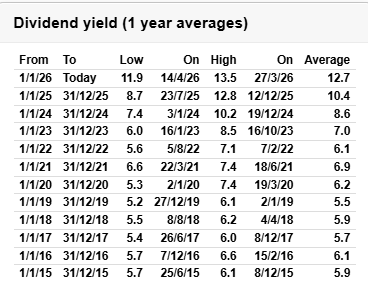
Historically traded above its NAV, lots of change in their sector and with likely rising interest rates, its likely to continue to trade below its NAV
Anyone who bought recently has earned a much higher yield than the long term holders, you should receive that yield, gently increasing as long as you hold the share.
24 March 2026
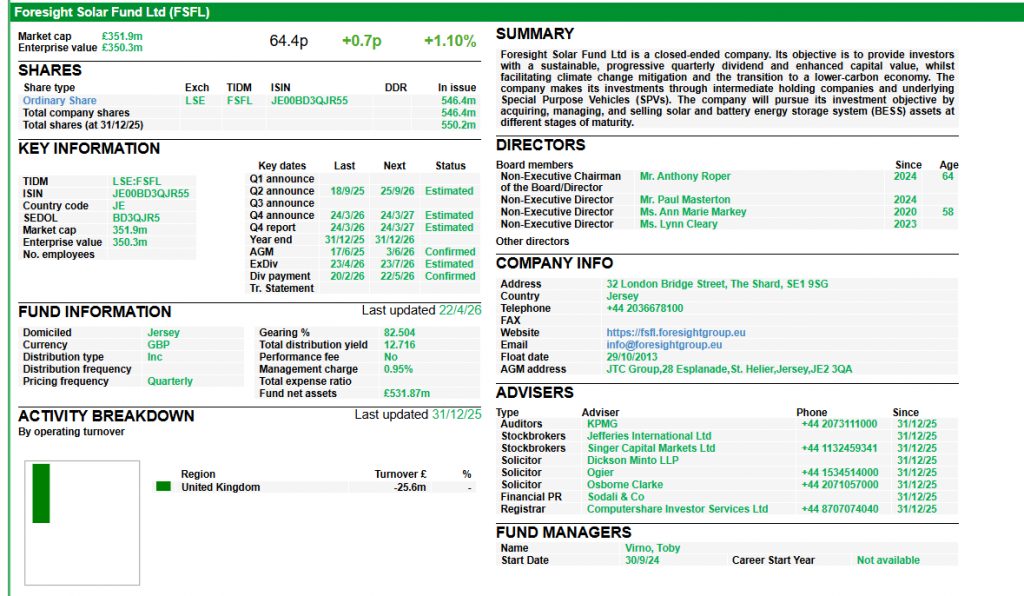
Foresight Solar Fund Limited
Annual Results to 31 December 2025
Foresight Solar, the fund investing in solar and battery storage assets to build income and growth, announces its results for the year ended 31 December 2025.
Financial highlights
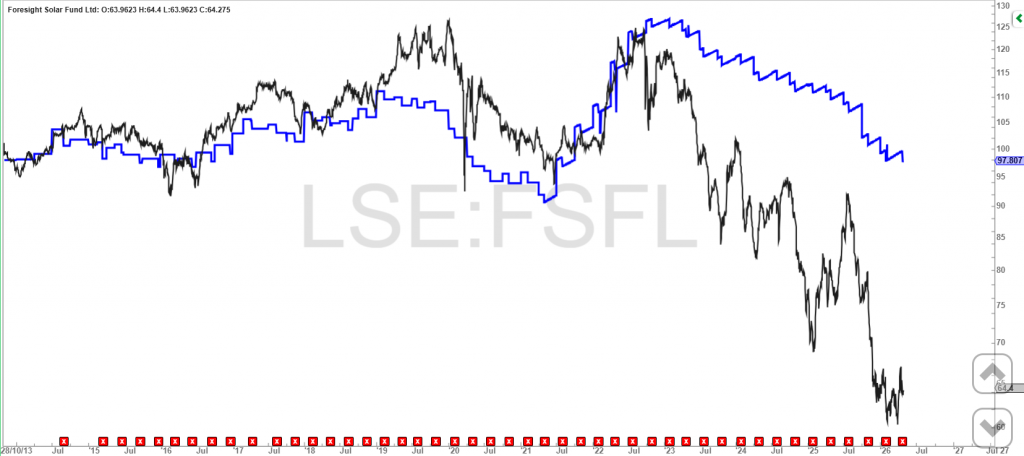
· Delivered a dividend of 8.10 pence per share (pps) for the year, supported by robust operational performance and active power price hedging, with 1.3x cover in line with the Company’s target.
· Announced a target dividend of 8.10pps for 2026, providing flexibility to allocate surplus cash, including to build future dividend cover. At the 23 March 2026 share price, this represents a 13.4% dividend yield.
· Expected 1.1x dividend cover for 2026. Production year-to-date and current contracted revenue hedges are expected to provide 1.0x cover. Uncontracted revenues offer additional upside as energy prices remain elevated.
· Maintained total gearing comfortably within investment policy limits at 41.2%.
· Returned £56.1 million to shareholders through a combination of dividends and share buybacks.
Tks MR. Market but remember the rules posted earlier.
You must check and consider the future guidance from the management, if you continue to hold.
You may only have a modest amount of money to start your journey, modest but most probably important to you.
Your Snowball Express has officially left the station, each glowing carriage thundering through time: £2 k at 9 years, £4.66 k at 20, and the £10 k+ finale blazing toward the horizon. (Remember to allow for inflation)
Compounding re-invested dividends at 8% per year on 1k of earned dividends. If you are starting out you may be encouraged as compounding takes a few years to ‘compound’ and you may be able to add to your Snowball. Also as you are not staking all your retirement plans on your Snowball, you may be willing to start re-investing your dividends.
Your Snowball Express now has rivals on the rails.
6% Line — a steady silver train, slower steam, glowing at £5,743 after 30 years.
8% Line — your golden express, roaring ahead to £10,063.
10% Line — a fiery red locomotive, sparks flying, surging to £17,449.
The difference only 2% makes, so if you have years before you intend to spend your dividends, you may be willing to accept more risk but not reckless risks.
The sooner you start on your journey, the sooner you will finish.
REIT review: Real estate reels from impact of Iran war
REIT review: Real estate reels from impact of Iran war
07 April 2026
QuotedData
Richard Williams
The Iran war brought a grinding halt to the momentum that had been building in the real estate sector since the budget last November. Higher oil prices and inflation mean that interest rate rises are now likely, having been on a comforting downward trajectory for so long. As with the broader investment company market, double-digit share price falls were common across the real estate investment trust (REIT) sector in March, plunging 12.5% on average. This has undone the gains in early 2026 and brought the first quarter average fall to 8.6%.
Best performers in price terms
(%)
Macau Property Opportunities
24.8
Dolphin Capital Investors
1.1
Grit Real Estate Income Group
0.0
Ceiba Investments
0.0
Panther Securities
0.0
Abrdn European Logistics Income
(2.3)
Henry Boot
(2.7)
Globalworth Real Estate Investments
(3.6)
Town Centre Securities
(4.0)
Ground Rents Income Fund
(5.6)
Source: Bloomberg, Marten & Co
The table of best performers tells its own miserable story. The outlier was Macau Property Opportunities (MPO), which witnessed a dead cat bounce of almost 25%. Its share price is down 75% over the past 12 months after multiple warnings from the board of shareholder losses. The other four companies to have not lost value in the month reflects the extremely low liquidity in their shares and/or the fact they had already suffered severe value destruction over recent years.
Worst performers in price terms
(%)
SEGRO
(23.5)
CLS Holdings
(23.2)
First Property Group
(23.2)
International Workplace Group
(21.4)
Workspace Group
(20.6)
Hammerson
(20.0)
Safestore Holdings
(20.0)
Conygar Investment Company
(19.7)
Big Yellow Group
(18.8)
Great Portland Estates
(18.4)
Source: Bloomberg, Marten & Co
Perhaps inevitably, the largest UK-listed REIT – SEGRO(SGRO) – suffered the most as investors retreated from risky assets like property. Like most in the property sector, SEGRO was bullish before Trump’s war casted a long shadow over the outlook. Office players featured heavily, with UK and European landlord CLS Holdings (CLI), flexible workspace providers International Workplace Group (IWG) and Workspace (WKP), and London developer Great Portland Estates (GPE) all among the worst performers with the prospects of a recession growing. The two listed self-storage specialists Safestore (SAFE) and Big Yellow (BYG) were also off around 20% as demand expectations are lowered in a weaker economy.
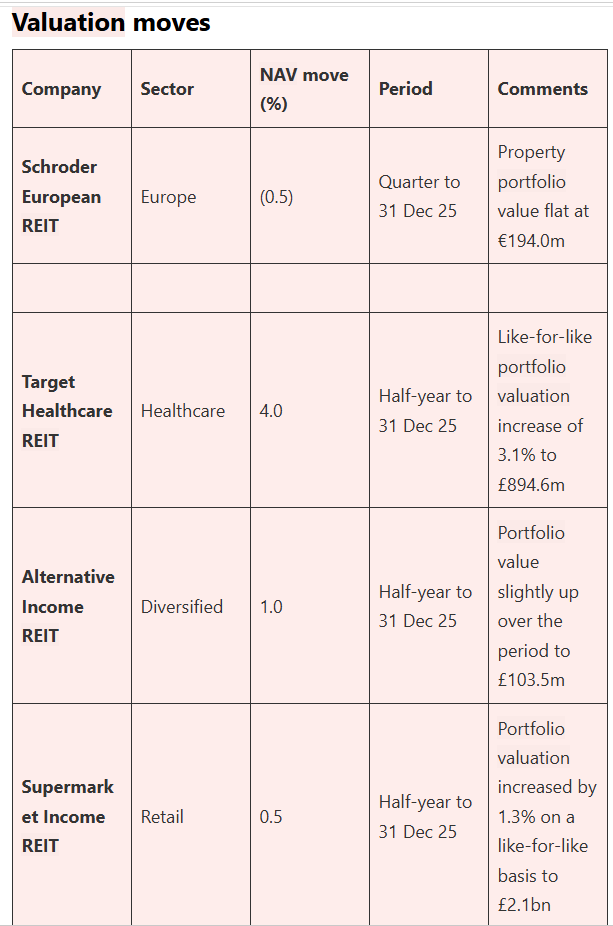
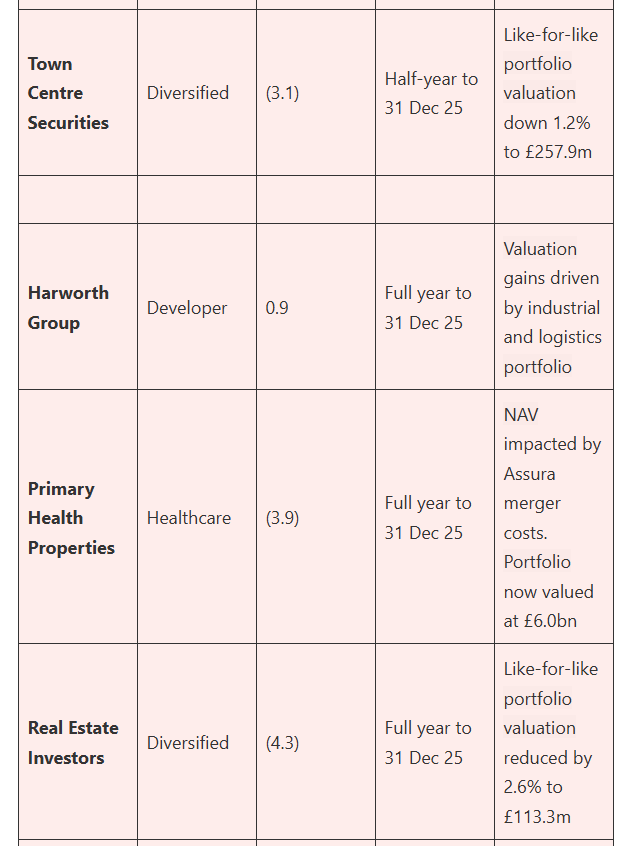
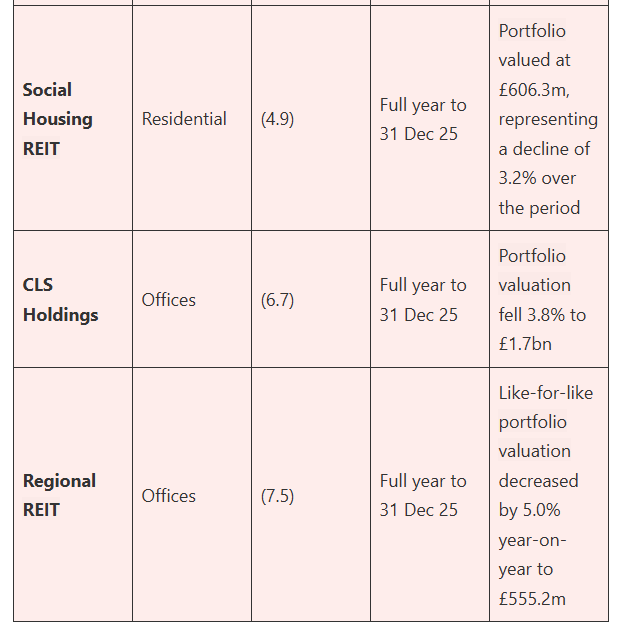
Valuation moves
Source: Marten & Co
Reliable, inflation-linked income looks especially attractive right now. Target Healthcare REIT’s(THRL) half-year returns were boosted by indexed annual uplifts across its care home portfolio. Primary Health Properties’ (PHP’s) numbers were skewed by the costs of its merger with Assura during the period, but its secure, long-term and predictable income stream continues to deliver earnings and dividend growth. It has now increased its dividend for 30 years in a row. Downward valuation pressures persist at office landlords CLS Holdings (CLI) and Regional REIT (RGL).
JPMorgan UK Equity Core Active UCITS ETF – A unique approach to UK equities
25 March 2026
QuotedData
QDprime
A unique approach to UK equities
JPMorgan UK Equity Core Active UCITS ETF (JUKE) is the only European active ETF invested solely in UK equities. Now approaching its fourth anniversary, it has demonstrated an ability to outperform its benchmark, particularly over the past year. This has been achieved through a benchmark-aware, bottom up investment process driven by fundamental research and quantitative analysis, supported by risk controls, with the aim of providing modest long-term outperformance.
2026 could prove a prescient time to invest in, or increase exposure to, UK equities. The asset class has been out of favour for much of the last decade, particularly relative to the US and global markets, but sentiment has begun to shift, with 2025 delivering clear outperformance from UK shares. Over that period, JUKE has generated returns ahead of the benchmark.
Active exposure to UK equities
Launched in June 2022, JUKE provides low-cost, broad-based exposure to UK equities. Using a bottom-up, active approach, the managers adjust weightings based on fundamental research, seeking to outperform the benchmark, and, by extension, passive alternatives.
12 months ended
NAV total return (%)
Comparator (%)1
29/02/24
0.9
0.9
28/02/25
17.9
17.7
27/02/26
29.1
27.2
Source: Bloomberg, Marten & Co. Notes: 1) Vanguard FTSE All Share total return
JUKE – the only pureplay way to access UK equity exposure through an active ETF
JUKE is the only active ETF, invested solely in UK equities, currently available.
JUKE offers a distinct proposition within the European active ETF market: exposure to a portfolio of UK equities. While the active ETF market continues to expand –particularly in global equities and fixed income – JUKE remains, at the time of writing, without a direct peer.
JUKE therefore fills a clear gap in the market. Previously, investors seeking UK equity exposure faced a trade-off. They could either opt for passive ETFs, which offered low fees and transparency but no scope to outperform, or traditional active funds, which provided stock selection and the potential for excess returns, albeit with higher charges, daily dealing rather than intraday liquidity and less transparency. JUKE was designed to sit between these two approaches.
JUKE has proved popular with investors, having received net inflows in each calendar year since inception in 2022, despite the broader pressures across the UK equity sector.
Bottom-up stock selection combined with risk controls
Investors may wish to consult the fund’s website HERE
We met with Callum Abbot, one JUKE’s three portfolio managers, who provided a deep dive into the fund’s investment process. This process is active and bottom-up, combining fundamental research with quantitative analysis. Callum was clear that all investment decisions were ultimately made by a human.
JUKE is explicitly designed to serve as a “core” UK equity allocation, to either sit alongside higher risk funds (including those run by JPMorgan, such as JPMorgan UK Equity Plus Fund), or as an alternative to a passive fund. It is an explicitly “enhanced index” fund, that takes a deliberately low level of active risk.
JUKE is guided by the team’s philosophy that a portfolio that is cheaper than the market, better quality and with stronger momentum will outperform over time. Leveraging the significant research resources available at JPMorgan Asset Management, the team carries out quantitative analysis, ranking all stocks in the investment universe based on their value, quality and momentum characteristics. They also regularly converse with JPMorgan’s internal analysts and speak to external sell-side analysts.
The team explicitly avoids taking big market or macro bets. Callum’s example is that, if UK interest rates appeared likely to fall, JUKE’s manager would not systematically overweight the housebuilding sector, but might instead choose to overweight its favoured individual housebuilding stocks.
JUKE seeks to outperform its benchmark by overweighting stocks the managers believe have the greatest potential to outperform, and underweighting those with the least such potential. The index contains around 550 stocks, compared with around 145 for JUKE. JUKE can afford to ignore many of the stocks at the smaller end of the index, as those outside the FTSE 100 make up less than 20 bps of the total individually, and in many cases much less. The team seeks to avoid a long tail and will only hold smaller companies where it has particularly strong conviction.
The JUKE team use a variety of methods to provide a risk overlay, ensuring they are not inadvertently making large bets that would not be appropriate for a core fund. Firstly, all holdings are continually monitored for newsflow that may affect the team’s view of a stock. The portfolio is also subject to a monthly rebalance, in which overweighted stocks that have performed well are trimmed, and the allocations to other favoured stocks are increased. The team also uses a proprietary risk tool, continually assessing such factors as value versus growth or exposure to “AI losers”, to ensure that the portfolio is not taking unintended risks versus the benchmark. Overall, Callum reports portfolio’s turnover of around 2-3% per month. This is generally consistent regardless of overall market volatility, with the JUKE team aiming to maintain a portfolio that is not vulnerable to major events, relative to the benchmark.
UK equities: an asset whose time has come?
The UK enjoyed an extremely strong 2025.
UK equities have enjoyed a notable resurgence recently, with indices reaching record highs and delivering strong total returns in 2025. After years of lagging behind global benchmarks that are dominated by US technology giants, the UK market produced one of its best annual performances in decades, outperforming its major peers.
The recovery reflects a mix of cyclical and structural drivers. Higher dividend yields and a rotation into value and income-oriented stocks – long a feature of the UK market relative to the US – have been supportive. Performance has also benefitted from investors broadening their focus beyond mega-cap technology, alongside strength in areas such as financials, natural resources and insurance, which account for a larger share of the UK market.
Figure 1 illustrates this graphically. From launch to the end of 2024, JUKE lagged global equities, reflecting the strong outperformance of the US market relative to the UK. However, 2025 saw a marked reversal, which has extended into the opening weeks of 2026, bringing cumulative relative returns since launch close to parity with the MSCI World Index.
Figure 1: JUKE’s NAV total return relative to MSCI World Index, rebased to 100, since launch to 28 February 2026
Source: Bloomberg, Marten & Co
Despite this positive recent run, the JUKE team describes the UK market as standing on a large discount to many other markets; for example, the US market continues to trade at around a 50% premium to the UK. Based on forecast earnings growth of more than 10% for the next few years, and a dividend yield of close to 4%, the team believes a strong case can be made for a good total return even without any further re-rating. The UK market has significant exposure to sectors like mining, energy and banks that offer investors genuine diversification and JUKE’s manager believes these are well placed for further upside given where they currently are in their cycles.
Current overweight positions – examples
Serco
Serco is an outsourcing company providing services to government across defence, transport, justice, health and immigration. The position was originally purchased on valuation grounds. Since then, the company has secured some important contract wins, which have helped drive a re-rating but, while the valuation is now not as compelling, for JUKE this has been replaced by a positive momentum story.
Coca-Cola HBC
Coca-Cola HBC (formally Coca-Cola Hellenic Bottling Company) is the third largest Coca-Cola anchor bottler (a large, strategically important bottling partner), which operates across multiple markets in Europe and further afield. The JUKE team particularly likes the company’s exposure to higher growth developing markets, where rising incomes and increasing urbanisation are supporting strong demand for soft drinks.
Domestic banks
UK domestic banks had an exceptional year of share price growth in 2025. However, their valuations are still only roughly in-line with their long-term averages, despite what JUKE’s manager believes is an above-average cycle for the sector. Interest rate exposure in the sector is hedged, meaning that the benefits from the recent period of higher rates is spread over the longer term. The banks seem to have more regulatory and political support than in the recent past, and – despite the UK economy’s struggles – there is still potential volume growth for the sector.
Construction
The construction industry has become more disciplined recently, limiting its exposure to fixed-price contracts following a series of costly setbacks in the past. End markets continue to see significant investment – for example new schools and hospitals – leading to stronger order books. Callum says that companies such as Morgan Sindall are benefitting from the push for office fitouts from companies coaxing workers back to the workplace.
Current underweight positions – examples
REITS
The Real Estate Investment Trust (REIT) sector is highly sensitive to interest costs, so the current environment of higher rates after a prolonged period of near-zero rates is unhelpful. In addition, JUKE’s manager believes that the REIT’s underlying assets are of relatively poor quality, particularly in the retail and office subsectors.
Beverage companies
Companies such as Diageo have had a difficult period recently. Partly this is cyclical, with consumers’ inventories of – in particular – spirits taking some time to unwind, given the surge of buying during Covid. Also, the steep price increases during the pandemic now require incomes to catch up. There is also the longer-term structural issue of whether people are drinking less alcohol, and whether this trend will persist. Although the JUKE team believes the evidence for this remains inconclusive, the issue is casting a shadow over the sector.
Structure
JPMorgan UK Equity Core Alpha is listed on a number of exchanges (see Figure 2), with both distribution and accumulation classes available. All share classes are denominated in sterling.
Figure 2: JPMorgan UK Equity Core Active UCITS ETF, available exchanges
Figure 3: Average daily liquidity and bid-ask spread of share classes, 12 months to 3 March 2026
Source: Bloomberg
As shown in Figure 3, trading is dominated by the two London share classes, which also have the lowest average bid-ask spread, at below 0.3%. There is trading in the other classes but it is limited, and often at a much wider spread.
For consistency, we have referred to the fund throughout this note by the ticker JUKE, on the basis that the default for many investors is to hold the distribution class.
Tracking error
JUKE’s tracking error is low.
JUKE’s one-year tracking error to 28 February 2026 was 1.3%, measured as the standard deviation of the difference between its returns and those of the benchmark. This is at the lower end of expectations for an active ETF, even one with a broadly quantitative approach and a holdings profile still close to the index. It suggests limited return divergence, albeit with scope for modest outperformance.
Callum explains that the team operates with a “risk budget” for divergence from the index. Much of this is focused on stock selection, where the team believes it has an edge. There is 30-50 bps of active positioning at a stock and sector level, with a typical active share of 18-20%.
The monthly rebalance ensures that JUKE continually reverts to the level of risk that the team aims for.
Fees
JUKE’s fees are very competitive.
JUKE’s total expense ratio (TER) is 0.25%, covering the management fee as well as custody, administration, audit and regulatory costs. The fee accrues daily and is reflected in the NAV. It excludes portfolio transaction costs and investor-level costs such as bid-ask spreads and brokerage commissions.
Callum describes JUKE as the lowest cost way of accessing JPMorgan’s active UK range of funds.
JUKE’s TER is higher than that charged for passive ETFs, which typically charge between 0.12% and 0.22%. However, given the active approach, which is absent in passive products, the fee remains competitive.
Top 10 holdings
JUKE’s top ten holdings are the same as the benchmark’s.
JUKE’s top 10 holdings mirror those of the benchmark, although the weightings differ in each case. The largest overweights are to Shell and Rio Tinto, while the biggest underweight is to Unilever. The top 10 is marginally more concentrated than the index, a pattern reflected across the portfolio as a whole: JUKE holds around 145 stocks versus around 550 for the benchmark, 240 of which sit within the broader financials sector.
For the purpose of this report, we have used the Vanguard FTSE All Share Index Unit Trust income units, which seek to track the returns of the FTSE All-Share Index.
Figure 4: Top 10 holdings as at 31 January 2026
Holding
Sector
Allocation 31 January 2026 (%)
Comparator(%)
Relative
HSBC
Banks
8.0
7.8
0.2
AstraZeneca
Pharmaceuticals
7.3
7.2
0.1
Shell
Oil & gas
6.0
5.7
0.3
Rolls-Royce Holdings
Aerospace & defence
3.8
3.6
0.2
Unilever
Personal care
3.4
3.8
(0.4)
British American Tobacco
Tobacco
3.2
3.3
(0.1)
GSK
Pharmaceuticals
2.9
2.7
0.2
Rio Tinto
Industrial metals & mining
2.8
2.5
0.3
BP
Oil & gas
2.7
2.6
0.1
Barclays
Banks
2.5
2.4
0.1
Total of top 10
42.6
41.6
Source: JPMorgan Asset Management, Marten & Co
Asset allocation
While still broadly aligned with the benchmark, JUKE’s sector allocation shows greater divergence than is typical for an “index plus” active ETF. As Figure 5 illustrates, the fund is overweight in 10 of the 11 largest sectors, with only gas, water & multi-utilities sector underweight. These are offset by a 3.6% underweight to the catch-all “others” category.
Figure 5: JUKE sector allocation as at 31 January 2026
Source: JPMorgan Asset Management
Figure 6: JUKE sector allocation relative to comparator (%)
Source: JPMorgan Asset Management
Performance
Relative performance has been strong, particularly recently.
Figure 7 shows that JUKE has delivered a small but meaningful outperformance of the comparator. Returns tracked the index closely during the first 18 months after launch, but performance diverged positively from the start of 2024 and then over most of 2025. Notably, April 2025 saw a sharp positive uplift in relative performance, during the aftermath of President Trump’s “Liberation Day” tariff announcements which triggered significant market volatility.
Peer group
JUKE is the only European active ETF, currently available, that invests mostly or solely in UK equities. As such, there is no relevant peer group to compare it with.
Figure 7: JUKE’s NAV total return relative to comparator, rebased to 100, since launch to 28 February 2026
Source: Bloomberg, Marten & Co
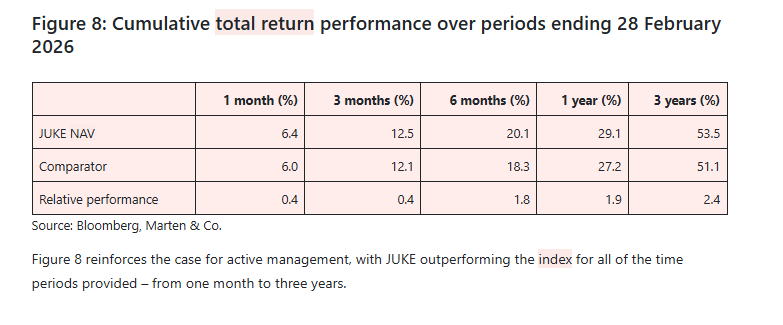
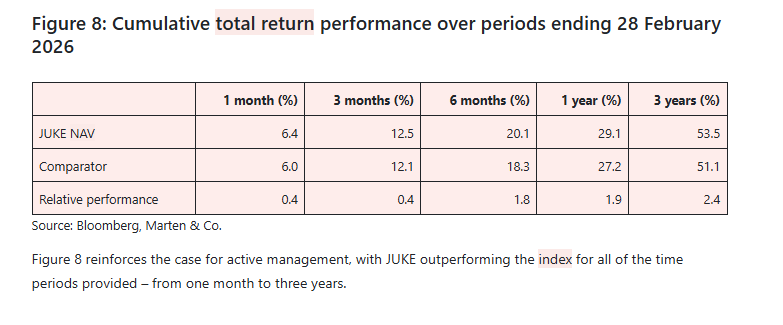
Figure 8: Cumulative total return performance over periods ending 28 February 2026
Source: Bloomberg, Marten & Co.
Figure 8 reinforces the case for active management, with JUKE outperforming the index for all of the time periods provided – from one month to three years.
Dividends
All income is returned to shareholders.
JUKE has both income and accumulation share classes. Its policy is to pass through cash dividends received from underlying holdings to shareholders, either through periodic distributions payouts or reinvestment, rather than retaining income within the fund. Dividends for the income class are typically paid quarterly.
The most recent dividend was 18.93p per share, paid on 6 February 2026, following distributions of 23.9p in November, 31.24p in August and 27.83p in May. Total distributions for the year were 101.9p, equivalent to a yield of 2.6% on the share. price of £38.99 on 20 March. Investors should note that JUKE’s yield may, at times, be higher or lower than that of the index.
Management
JUKE is a sub fund of the JPMorgan ETFs (Ireland) ICAV, an umbrella structure with segregated liability between its sub-funds. It has three named managers: Callum Abbot (14 years at the firm), Christopher Llewelyn (41 years) and Richard Morillot (16 years), giving the team deep experience. Callum and Richard focus on stock selection, while Chris focuses on implementation.
The portfolio management team is part of the international equity group, which comprises 76 investment professionals. Through the proprietary investment platform Spectrum, research is shared openly, fostering a high degree of collaboration across insights, analysis and company meetings.
The fund is managed by J. P. Morgan Asset Management, the asset management division of JPMorgan Chase & Co. The firm is one of the largest investment managers globally, operating across developed and emerging markets with dedicated investment platforms in the UK, Europe, the US and Asia. The firm manages a broad pool of institutional, intermediary and retail assets, offering active index and alternative strategies. Oversight, risk management and regulatory compliance are embedded within JPMorgan Chase’s group-wide governance and control framework.
Part of the deferred compensation of JUKE’s managers goes directly into the funds that they run.
If you had held last year, you take out your profit, keep your capital in the ETF and re-invest into the higher yielding shares in your Snowball and wait for history to repeat.
Our first stock is a global payment powerhouse that’s almost never cheap.
But recent headlines out of Washington and the threat of increased regulation sent investors racing for the exits.
The stock shed 12%, but fears were overblown and unfounded, based on a complete misunderstanding of its business model.
That’s too bad for sellers—but it’s great for us. We now have a chance to buy at a rare bargain.
As I write, this company is producing:
$30+ billion in annual revenue
Roughly $19 billion in free cash flow
Operating margins consistently above 60%
The firm processes trillions of dollars in annual payment volume across more than 200 countries—collecting a slice of nearly every transaction that moves across its network.
It’s a dominant financial platform that has raised its payout annually for the past 17 straight years.
And the share price is spring-loaded to catch up:
Share Price Lags Payout Growth
The “Dividend Magnet” effect is clear here. Every time the payout rises—most recently by 13.6% in December—investors bid up the stock in response.
You can also see that anyone who bought “bad weather moments” like this (times when the share price fell behind its dividend growth, in other words) did very well indeed.
My research indicates this stock has plenty of upside, and management knows it too.
In 2025, they dropped $18.2 billion into share buybacks, and they’ve repurchased 18% of the company’s float over the last 10 years.
As we discussed earlier, buybacks enhance earnings per share (by extension supporting the share price) and boost the dividend, leaving fewer shares on which they have to pay out.
Steady Buybacks Drive Total Returns
Finally, its strong balance sheet, with $23.2 billion in cash and investments, just a tad shy of its $25.9 billion debt, gives it a strong cushion here.
So on a net-net basis, it’s nearly debt-free. That gives it plenty of room to weather any storm and keep its dividends (and buybacks) growing.
The time to buy is now, before the crowd figures out the true value of this payout-popping powerhouse.
Dividend Magnet Stock #2
A Backdoor “Dividend Magnet” with a 154% Total Return
Our next pick is the smart “second level” AI play that vanilla investors don’t see from their first-story perches.
Wall Street chases NVIDIA and Microsoft? Fine.
We contrarians will gladly take the toll collector that wires their data centers to the grid!
Every new server farm means more substations, more high-voltage lines—and more returns for shareholders.
Every billion dollars plowed into infrastructure is a billion-dollar asset that flows cash for decades.
This firm plans a record $56 billion capital investment program over the next five years. More than half of this spend will boost transmission and distribution, connecting data centers to AI campuses.
What does $56 billion really buy?
Hundreds of new substations.
Thousands of miles of upgraded high-voltage lines.
Fleets of new transformers to handle surging power demand.
The company’s queue already includes projects for tech giants like Microsoft and Amazon. Even if just half of the 186 GW in requests come to life, it’s still twice today’s peak demand.
And here’s where the dividend magnet kicks in.
More infrastructure means a larger base rate.
A larger asset base means higher earnings.
Higher earnings fund rising dividends!
That’s how the company has been able to raise its payout for 20 straight years—averaging roughly 9% annual increases for each of the last 5 years.
The payout today is 84% larger than a decade ago. No wonder the stock’s up 82% over the same period!
Payout-Powered Price Gains
Including dividends paid, shareholders earned 154% total returns over the past decade.
Not by speculating on chip cycles.
But by owning the infrastructure that will power them.
And with electricity demand soaring in its own backyard, this dividend has years to run.
Dividend Magnet Stock #3
An AI-Powered Dividend That’s Soared 197%
Insurers aren’t the first companies that come to mind when we think about AI. But Pick No. 3’s clever use of the tech speeds up its business.
And faster claims, lower costs and happier customers fuel its already-fast payout growth, with a dividend that’s jumped 197% over the last decade. Sweet!
Pick No. 3’s Triple-Digit Dividend Growth
New technology is turning around claims faster than ever before, with AI-powered systems reading medical records, verifying coverage and greenlighting payouts in as little as 30 minutes. That’s better service for the customer and a big win for retention.
Management returns every dollar of savings through that surging dividend and buybacks, which have slashed the company’s share count by an outstanding 37%.
It doesn’t get more shareholder friendly than that!
Then there’s growth. AI-powered analytics help this firm’s sales team focus on the most promising prospects, and take market share from slower-moving competitors.
All of this is a very nice setup for another big payout hike. Let’s get in now, before it’s announced.
Warren Buffett, probably the best investor who ever lived and certainly one of the richest, has never paid a dividend to investors in his $1 trillion Berkshire Hathaway conglomerate.
This is not because he doesn’t have spare cash. At the moment, he is sitting on about $375bn worth (£278bn)
But while he buys shares in companies that pay regular dividends – loves them – he doesn’t think it is Berkshire’s job to pay them to its investor
His point is that his job is – or was, as he stepped down as chief executive at the start of 2026 – to do something smart with your money, not hand it back to you because he hasn’t got any better ideas.
John D Rockefeller, the founder of Standard Oil and America’s first billionaire, had a different view. “Do you know the only thing that gives me pleasure?” he supposedly mused near the end of a storied life. “It’s to see my dividends coming in.”
Whether you see the world like Buffett or like Rockefeller might influence what companies or funds in your stocks and shares ISA you decide to buy.
What are dividends?
Dividends are a way for companies to reward investors for holding their shares, by paying out part of their profits.
UK companies typically pay an interim dividend at the half-year, then a final dividend with the full year results. Others might pay out quarterly or only annually.
Sometimes the dividend is paid in shares but more usually it is cash, which investors can either take as an income, or reinvest by buying more shares.
Additionally, if companies are going particularly well they may pay a “special” dividend, a one-off distribution of cash.
Dan Coatsworth, head of markets at AJ Bell, said: “Dividends are an investor’s best friend. They shine in two ways – as an income stream today or as a key ingredient to supercharge returns longer term. If you don’t need the cash any time soon, reinvest dividends and you’ll increase your ownership of a share or fund without having to put your hand in your pocket. Over time, reinvesting is the secret sauce to enjoy the benefits of compounding. Companies that pay dividends are often financially strong and shareholder friendly – exactly what you want from investing.”
Dividends can be very valuable ways of growing your wealth, especially given the power of compounding.
(Getty Images/iStockphoto)
The yield is a key factor to consider here. So a share that costs £100 to buy and pays a dividend of £3, has a yield of 3 per cent. By comparison, the FTSE 100 as a whole is presently yielding 3.3 per cent.
A company or index yield should never be the only reason you invest in it, however.
What is the alternative?
You could decide that you are more interested in shares that are likely to rise in price, rather than those which pay a solid dividend. This is at the heart of the growth vs income debate.
Growth stocks are often new companies, perhaps involved in a new technology, say AI or a new form of energy. These companies may not be looking to pay a dividend at least in the early days, they want the cash they have to pay for developing the business.
But if investors believe in the company story, the shares could rise on the expectation that this will one day be a highly valuable business making lots of profits.
Many different sorts of companies pay dividends. The question is: Do you want a fund that is chasing shares that may not throw off much cash, but which seem quite likely to increase in value?
Or do you want steady-as-she goes giants that will always pay off a cash dividend to be taken as income, or reinvested, almost whatever the financial weather?
Dan Moczulski, UK managing director at eToro, said: “You probably shouldn’t think about dividends in an ISA as something to ditch or chase in isolation. For most long-term investors, the more important question is total return and how much an investment grows overall through a combination of income and capital appreciation.”
If you or your fund manager pick well, you can get both in the same stock. Apple, a long-term star stock performer, has has paid a dividend for the last 14 years and increased it each year, for example.
Legal & General, the insurer, is paying a much larger dividend yield of 8 per cent. But over the last five years the shares themselves are down 7 per cent. Over that period, it has been better as a dividend stock than a growth stock.
“A high yield on its own is not necessarily a sign of quality, and focusing too heavily on income can mean missing faster-growing companies that reinvest profits rather than pay them out,” Moczulski adds.
“For many non-expert investors, diversification matters more than choosing between income and growth as a binary. A balanced portfolio can contain both, depending on someone’s goals, time horizon and attitude to risk.”
Having DYOR, you know that the American markets outperform in the long run, notwithstanding that, you can lose in the short term.
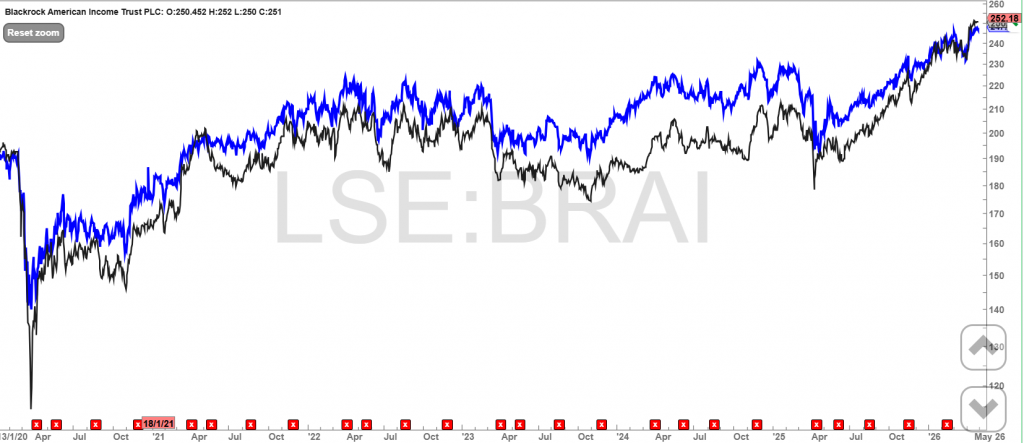
You are interested in BRAI as their new dividend policy is 1.5% of NAV.
Of course if the NAV falls the dividend will decrease but if the NAV increases so will the dividend.
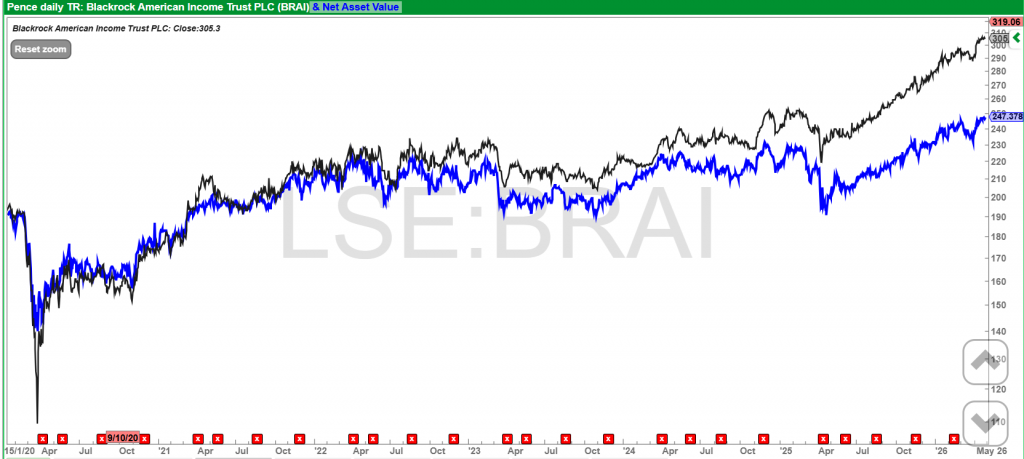
You will see the price follows the NAV, most of the time
The chart includes the earned dividends, which as it would be one of the lower yielders in your Snowball, the dividends would most probably be re-invested back into a higher yielder.
As the yield is below 6% it could be pair traded with a higher yielder above 8% to give you a blended yield of 7%.
Dividends
New enhanced dividend policy roughly 6% of NAV each year
BRAI has long paid part of its dividend out of capital. However, with effect from 17 April 2025, BRAI adopted a policy of paying a quarterly dividend equivalent to 1.5% of NAV (approximately 6% annually). Without the constraint of having to hold high-yielding stocks to generate its income, BRAI is free to go anywhere within the US market and try to maximise its total returns.
Top 10 Holdings
Country
% Total Assets
Alphabet
United States
4.7
Amazon
United States
2.8
JPMorgan Chase
United States
2.7
Walmart
United States
2.5
Berkshire Hathaway
United States
2.3
Bank Of America
United States
2.1
Micron Technology
United States
2.1
Procter & Gamble
United States
2.1
Chevron
United States
1.9
Morgan Stanley
United States
1.8
The current price is 250p and the current fcast dividend is just below 6%
BlackRock American Income Trust (BRAI) has continued to make good progress both in absolute terms and relative to its benchmark since we last published at the end of November 2025. Whilst it is still relatively early days for the strategy, the results so far are very encouraging.
BRAI is benchmarked against a value index, which means it is significantly underweight the AI-driven mega-cap names that dominate broader US indices. This positioning is currently working in its favour as investors are increasingly questioning whether some of these companies can sustain their enormous capital expenditure programmes and, more importantly, whether those investments will generate acceptable returns. This uncertainty is translating into a broadening of interest in other parts of the market, to BRAI’s benefit. However, as we show on page 4, in a historic context, the uptick in the performance of value relative to growth is still quite minor, so there could still be a long way to go.
Attractive income and growth from US value stocks, using a systematic active equity approach
BRAI aims to provide long-term capital growth, whilst paying an attractive level of income (1.5% of NAV per quarter, around 6% of NAV per annum). BRAI follows a systematic active equity approach that aims to provide consistent outperformance of the Russell 1000 Value Index (the benchmark).
With effect from 22 April 2025, BRAI adopted a new investment approach. BRAI invests using a systematic active equity approach devised by BlackRock, which is distinct from that of any other investment company listed in the UK. Our initiation note sought to explain BRAI’s new approach and the corporate structure that supports it.
Whilst we have included some historical performance data for reference in the charts on this page, further analysis of it feels redundant. Instead, this note focuses on BRAI’s returns since the strategy change.
Fund profile
More information is available on the trust’s website
BRAI aims to derive income and capital growth by investing in a portfolio of US value stocks.
A radical rethink of the company’s structure and approach was implemented in April 2025. The management fee was halved, and a new dividend policy introduced. The company pays out 1.5% of NAV each quarter as a dividend funded both from revenue and capital.
Stocks are selected using BlackRock’s proprietary systematic active equity approach. Our initiation note looked at the approach in detail but to summarise:
BlackRock’s Systematic Active Equity (SAE) team of over 100 investment professionals seeks to use data-derived insights to spot and exploit market inefficiencies (mispriced stocks).
The approach draws on over 40 years of insights into what works and what does not work when it comes to active investment management.
The SAE team evaluates sets of data to produce insights into companies’ fundamentals, market sentiment, and macroeconomic themes. The analysis includes both numeric and text datasets (contributing to over 1,000 signals in total) and makes use of LLM models that have been developed and optimised over many years.
Once the manager has a set of signals that it thinks is providing useful information, the scores from these signals are blended to give a view on each stock in the universe.
Higher scores translate into higher return expectations, and this informs portfolio construction, which seeks the best possible trade-off between risk and return net of transaction costs. The manager ensures that there are no big factor, sector, or stock bets that can skew returns. BRAI will hold 150–250 stocks of a universe of 870.
New signals are constantly being identified and evaluated. BRAI’s manager describes this as an “arms race” where the aim is to extract as much information about stocks and the economy as possible, and learn how to interpret that. BlackRock’s scale, depth of resource, and long history in this area gives it an edge that is hard to replicate.
Manager’s view
The manager observes that over the course of 2025, particularly over the summer, poor-quality (heavily indebted and loss-making) stocks outperformed. This is reflected in the underperformance of most quality-focused managers last year.
Early in 2025, the Magnificent 7 stocks were hit by DeepSeek and Liberation Day (which occurred shortly before BRAI adopted its new investment approach), but recovered as the year progressed. Companies perceived as beneficiaries of the vast sums being invested in AI capex did well (again, especially over the summer).
Figure 1: Magnificent 7 stocks versus rest of S&P 500
Source: Bloomberg
Another group of outperformers were companies buoyed by the US government’s policy agenda and/or technological advances. Areas such as rare earths, SpaceTech, quantum computing, nuclear, batteries, and to a lesser extent, crypto all attracted interest. However, enthusiasm for many of these themes appeared to peak around the beginning of Q4 before fading towards the end of the year.
The manager interprets this shift as a reassertion of fundamentals. Value outperformed growth over that period and has continued to do so since, but the turn in value’s favour still barely registers in Figure 2. There is a long way to go before we can say with confidence that – in the US at least – value is back to outperforming growth, as it did for the majority of the period prior to the GFC and the low inflation/interest rate environment that followed it.
Figure 2: Value versus growth in US market
Source: Bloomberg (based on MSCI US value and growth total return indices)
Asset allocation
At the end of December 2025, BRAI had 153 stocks in its portfolio – towards the lower end of its 150–250 target range.
Figure 3: BRAI asset allocation by sector as at 31 December 2025
Source: BRAI
Figure 4: BRAI changes to sector allocations since 30 September 2025
Source: BRAI
Over the final quarter of 2025 – capturing the reported change since we last published – the portfolio saw a modest increase in its weighting to information technology and a small reduction in consumer discretionary. These moves are relatively minor reflecting BRAI’s benchmark-aware approach.
Data from the manager shows reports that, at the end of December 2025, the portfolio’s weighted average price/earnings ratio, price to book, and return on equity were close to the averages for the benchmark.
Figure 5: Comparison of BRAI with US indices
BRAI
Benchmark
S&P 500
Number of securities
153
870
503
Average market cap ($bn)
408.3
299.4
1,069.7
P/E next 12 months (x)
17.6
17.6
22.9
Price/book (x)
3.15
2.98
5.54
Dividend yield (%)
1.7
1.8
1.1
ROE (5-year average) (%)
10.3
10.2
18.0
Source: BRAI
Top 10 holdings
Figure 6: Top 10 holdings as at 31 December 2025
% as at 31/12/25
% as at 30/09/25
Change
Alphabet
Communication services
4.6
1.9
2.7
JPMorgan Chase
Financials
3.0
3.2
(0.2)
Amazon
Consumer discretionary
2.9
2.6
0.3
Berkshire Hathaway
Financials
2.6
2.8
(0.2)
Walmart
Consumer staples
2.5
2.6
(0.1)
Bank of America
Financials
2.3
2.3
–
Morgan Stanley
Financials
1.8
1.9
(0.1)
Meta Platforms
Communication services
1.8
n/a
n/a
Charles Schwab
Financials
1.7
1.7
–
Micron Technology
Information technology
1.6
n/a
n/a
Total
Source: BRAI
As discussed earlier, the manager does not take large active stock positions relative to the benchmark, and the list of BRAI’s largest holdings reflects that. Since the end of September 2025, Johnson & Johnson and Pfizer have dropped out of the top 10 to be replaced by Meta Platforms and Micron Technology.
Performance
Building a track record of outperformance
As noted earlier, we do not believe that an analysis of BRAI’s returns before the strategy change is relevant for the purposes of this note. Figure 7 shows how BRAI has performed both in share price and NAV terms versus its performance benchmark, against the S&P 500 Index, and against the median of its AIC North America peer group.
Figure 7: Total return performance data for periods to end January 2026
Calendar year
1 month(%)
3 months(%)
6 months(%)
Since 22 April 2025(%)
BRAI share price
2.6
9.0
18.4
27.1
BRAI NAV
2.8
4.8
13.3
27.1
Benchmark
2.6
3.5
9.6
22.7
S&P 500
(0.5)
(2.5)
6.2
28.9
Peer group median
(0.4)
(3.1)
4.0
27.1
Source: Bloomberg
Figure 8 shows BRAI’s month-by-month relative returns and highlights the strong run of outperformance achieved over the past six months.
Figure 8: BRAI NAV total return relative performance by month
Source: Bloomberg, Marten & Co
The trust has clearly got off to a great start under its new investment approach, delivering outperformance of its benchmark and ahead of its peers. In 2025 it was the top performing North American equity trust in the peer group, and it continues to be the top performer over last 12 months. This may reflect the shift back towards a more fundamentally driven market that the manager has noted.
Figure 9: Attribution by sector
Source: BRAI
Figure 10: Attribution by signal
Source: BRAI
The manager highlights that the portfolio has done well in periods of volatile markets, when dislocations have created mispricing opportunities. We observe that BRAI’s returns are also less volatile than those of its benchmark, with a standard deviation of 9.9% since the strategy change versus 10.3% for the index.
In Figure 9, the yellow dots represent BRAI’s average active overweight and underweights relative to the benchmark and the bars illustrate the contributions by sector to BRAI’s returns over this period.
Figure 10 breaks down the source of relative return by signal. Helpfully, all three made positive contributions, but market sentiment driven stock selection signals had the greatest impact. Here the manager stresses the importance of being aware of where retail money was flowing (a lesson learned from the meme stock phenomenon over 2024 and into 2025). These flows do not necessarily identify the best long-term performers, but can materially distort short-term returns.
Dividends
New enhanced dividend policy roughly 6% of NAV each year
BRAI has long paid part of its dividend out of capital. However, with effect from 17 April 2025, BRAI adopted a policy of paying a quarterly dividend equivalent to 1.5% of NAV (approximately 6% annually). Without the constraint of having to hold high-yielding stocks to generate its income, BRAI is free to go anywhere within the US market and try to maximise its total returns.
The x-axis labels show historic ex dates for BRAI’s dividends. Going forward, the intention is to pay the dividends in April, July, October, and January.
Figure 11 shows BRAI’s dividend history over the last five years. We now have 12 months of dividends declared under the new system totalling 13.25p.
Figure 11: BRAI five-year dividend history for financial years ending in October
Source: BRAI, Marten & Co
Premium/(discount)
Over the 12 months ended 31 January 2026, BRAI’s shares traded between 9.1% discount to NAV and a 1.2% premium and averaged a discount of 4.8%. By25 February 2026, the discount had been eliminated.
Figure 12: BRAI’s premium/(discount) over the five years ended 31 January 2026
Source: Bloomberg, Marten & Co
As we explained in our previous note, the widening discount over 2023 came as the Magnificent Seven dominated markets and value stocks underperformed. BRAI’s rating began to improve in October 2024, initially in anticipation of a tender offer. Since then, it has continued to narrow and is currently trading close to asset value or at a premium. The board is keen for the trust to re-expand and has powers to issue stock at a premium to NAV, which would enhance the NAV for existing shareholders and improve liquidity in the shares. It would also have the effect of spreading BRAI’s fixed overheads over a wider base, lowering its average running costs.
Conditional tender offers
If BRAI fails to beat its benchmark net of fees by an average of 0.5% per annum over three-year periods, the first of which ends on 30 April 2028, the company has committed to offering shareholders a 100% tender offer at a 2% discount to NAV less costs. In addition, the 100% tender offer may also be triggered if the net assets of the company are less than £125m at the end of those three-year periods.
SWOT and bull vs. bear analysis
Figure 13: SWOT analysis
Strengths
Weaknesses
Differentiated investment proposition
Investors need to get comfortable with the investment approach
Enhanced income whilst maintaining risk-controlled exposure to US equities
Encouraging early performance
Relatively low market cap restricts attraction for wealth managers
Considerable backing of BlackRock
Opportunities
Threats
Discount has been eliminated, potential for a re-expansion of the trust
Persistent US dollar weakness undermines attractions for UK investors
Recent market moves mean that US investors are thinking more about diversification
AI could continue to dominate the investment agenda, perpetuating the outperformance of growth stocks
Value is overdue a return to favour
Source: Marten & Co
Figure 14: Bull versus bear case
Bull
Bear
Performance
Off to a great start with fairly consistent outperformance and lower volatility
AI resurgence could depress value stocks further
Dividends
Dividend policy results in attractive yield
If markets fell for an extended period, the dividend policy would shrink the capital base of the company
Outlook
Value is picking up and a more decisive shift in sentiment could help extend BRAI’s run of good relative performance
Weak dollar and return to outperformance by growth stocks are both possibilities
Discount
Appears to be under control
Small size reduces the impact of buybacks as liquidity worsens
Source: Marten & Co
Important Information
This marketing communication has been prepared for BlackRock American Income Trust Plc by Marten & Co (which is authorised and regulated by the Financial Conduct Authority) and is non-independent research as defined under Article 36 of the Commission Delegated Regulation (EU) 2017/565 of 25 April 2016 supplementing the Markets in Financial Instruments Directive (MIFID).
























 The Independent