The UK funds having an even better year than the record-breaking FTSE 100
Wednesday, August 5, 2026
Eve Maddock-Jones
Funds and Investment Trust Writer

The FTSE 100 is currently on track for its best year since its conception in 1984, defying a downturn in other equity markets which have been burdened by a fall in tech.
Year-to-date, the UK’s premier index is beating both the MSCI All-Country World Index and the S&P 500, with an 11.5% total return versus 11.3% and 9.8%, respectively, according to data from FE Analytics.
AJ Bell’s Head of Financial Analysis Danni Hewson said that part of this positive performance could be down to the rise in oil prices due to the ongoing war in Iran as the UK is home to some of the largest oil companies on the market, BP and Shell, alongside a strong earnings season from some of the FTSE’s big hitters.
While it’s been a strong year for the FTSE 100 so far, 95 out of 355 UK-focused funds have done even better.
AJ Bell took a deep dive into the dedicated UK funds which have beaten the main benchmark’s 11.5% total returns. And as a bonus, which ones have been doing so for many, many years now.
Small caps are leading the pack
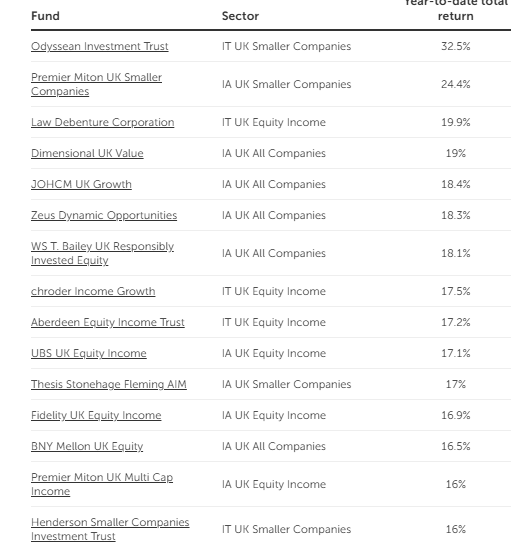
One group storming ahead of the FTSE 100 so far this year is UK small-cap funds.
The Odyssean Investment Trust and Premier Miton UK Smaller Companies have made the best returns so far this year among UK funds, up 32.5% and 24.4%, respectively.
They were joined by fellow small-cap funds Stonehage Fleming AIM and the Henderson Smaller Companies Investment Trust.
These funds invest in smaller stocks in the £400-500 million range, versus those that are part of the FTSE 100 and valued at billions of pounds.
It’s not a blanket case that the small-cap sector as a whole has outpaced the FTSE 100 though. The blue-chip index is the highest returning UK benchmark this year, with the FTSE Small Cap making 9.1% year-to-date, a 23% disparity.
But, the small-cap sector is as a whole, doing better this year than it has been longer term.
Over five years the average IA UK Smaller Companies fund would have delivered some of the poorest total returns available, ranking 48th out of 51 sectors. But looking over the past six months and this pattern has shifted, with UK Small-Caps now moving into the top 10.
There are several drivers behind this but two main ones are depressed valuations making UK stocks cheap, and ongoing merger and acquisition activities.
Smaller companies often are more closely tied to the economic health of the country they’re listed in than the big fish of the market, making them more sensitive to factors like higher interest rates, something investors have become increasingly concerned about with the ongoing war and rising cost of goods.
But, smaller companies have started to become more insulated from these bouts of domestic dysfunction than they have been historically due to how globalised markets as a whole have become.
Data by Artemis found that roughly 40% of UK small-cap sales are generated overseas now. This is a far cry from the FTSE 100’s 75-80% rate, but higher than it was a decade ago.
This means that UK-quoted smaller companies with predominantly global revenues have served investors well, helping to insulate returns from UK specific issues.
Income funds
Around a third of the funds beating the FTSE 100 were income focused, a sector which tends to have a high exposure to areas like banks, defense, energy, and commodities, which have rallied this year.
Higher interest rates boosted bank profitability and cash generation, allowing firms such as NatWest, Lloyds and HSBC to increase dividends and share buybacks. Financial stocks were among the strongest contributors to UK equity income fund returns this year, with Lloyds and NatWest’s share prices growing 20% and 13%, respectively, this year.
Funds beating the FTSE over a decade
The FTSE 100’s stellar run has drawn obvious attention to portfolios affiliated with it, but AJ found that 13 funds have actually bested the benchmark for least a decade.
Artemis SmartGARP UK Equity has made the most since 2016 at almost 275%, combining the active management of long-time manager Philip Wolstencroft and the firm’s in-house namesake stock-screening software, which aims to help them find ‘growth at a reasonable price’.
Many of the funds achieving this outperformance are stalwarts of the UK equity space, such as Fidelity Special Values, Temple Bar Investment Trust, JOHCM UK Equity Income and its sister JOHCM UK Dynamic. All of them boast over £1 billion in assets under management and are among the most widely held UK-focused funds with AJ Bell DIY investors as well.
All four of the aforementioned have been run by the same respective managers for the past decade but having varying investment styles and thesis, with Fidelity standing apart the most as a value focused fund.

Leave a Reply