Stockwatch: why ‘Sell in May’ could genuinely apply this year
Global stock markets remain near record highs but are volatile and vulnerable to shifts in the global geopolitical landscape. Analyst Edmond Jackson shares his new investment outlook.
5th May 2026
by Edmond Jackson from interactive investor

In King Lear, the phrase “all shall be well” represents a desperate, ironic, or deluded hope for peace amid overwhelming tragedy and madness.
Perhaps this, together with a collective willingness to “buy the drop” after authorities provided stimulus through financial crises since 2008, explains the social psychology propelling markets to record highs – despite the International Energy Agency (IEA) declaring the closure of the Strait of Hormuz to be the biggest energy security threat in history.
There was also the experience of equities rebounding strongly from April 2025 after US President Donald Trump imposed reciprocal tariffs.
But for how long can complacency run? With no sign of either the US or Iran blinking first over the oil deadlock, analysts predict a tipping point in four weeks as stocks of oil and commodities run down.
While UK government messaging reassures about petrol supply (chiefly to avert panic buying), as I cruised down the M40 on Sunday the gantries displayed “Beaconsfield Services: No Fuel”. It seems 20p or so on a litre of fuel is just a taste of things to come. And pick your own number as to where oil prices could go. At least crude markets sense what is happening, with Brent up from around $90 a barrel on 20 April to over $113 now.
Stock markets remain in happy-go-lucky mode
Besides “all shall be well” (by way of a Middle East settlement despite no real negotiations) traders have also assumed the “Trump Always Chickens Out” (TACO) rationale; that he would back down in the face of US discontent with high fuel prices ahead of mid-term elections. Most have underestimated the resilience of the hardline Revolutionary Guard now in effective control of Iran, with its fresh sense of power over the US and its allies via control of the Strait.
Last Thursday, the Bank of England left interest rates unchanged at 3.75%, but said the UK may need to brace for increases later this year given that “higher inflation is unavoidable” and would probably peak at 6% by the start of 2027 – in a worst-case scenario of oil over $130 and remaining high. Unemployment would rise to 5.6% and interest rates to 5.25% to combat this.
Interestingly, several housebuilders saw share prices bounce as much as 10% in response to “in line” trading updates – as if builders had already fallen so far this year that they’re pricing in a worst-case scenario for confidence among home buyers and industry operating costs.
Yet as with many shares currently, a happy consensus remains for moderate earnings growth in 2026 and 2027, which is at odds with the rising risk of mild recession. Without a resolution over the Strait, forecasts need a dose of realism. Even if it was to promptly reopen, economists say 2026 growth would be half what was previously expected. But longer closure implies a recession.
Iran has this morning warned the US against being “dragged back into the quagmire” after a day of attacks in the Strait, with Monday having seen the start of Trump’s “Project Freedom” where the US military supposedly guides stranded cargo ships out of the waterway. Of around 2,000 such ships, the US says two US-flagged vessels were able to leave yesterday.
I doubt the US will be able to walk away as TACO traders assume. Israel and United Arab Emirate (UAE) states will likely be pushing to “finish the job” militarily, although it’s unclear how realistic that is given an entrenched and resilient Iran.
A chief hope would appear to be Iran facing its own crisis as oil storage capacity fills up and the flow of money to its military may soon start to dry up.
Perhaps the stalemate will persist another month until another big jump in oil prices forces a decision by the US.
Meanwhile, US shares have continued to rally, aided by strong first-quarter earnings, but the S&P 500 looks exposed on a price/earnings (PE) ratio around 28-30x versus an historic mean average of 16-18x.
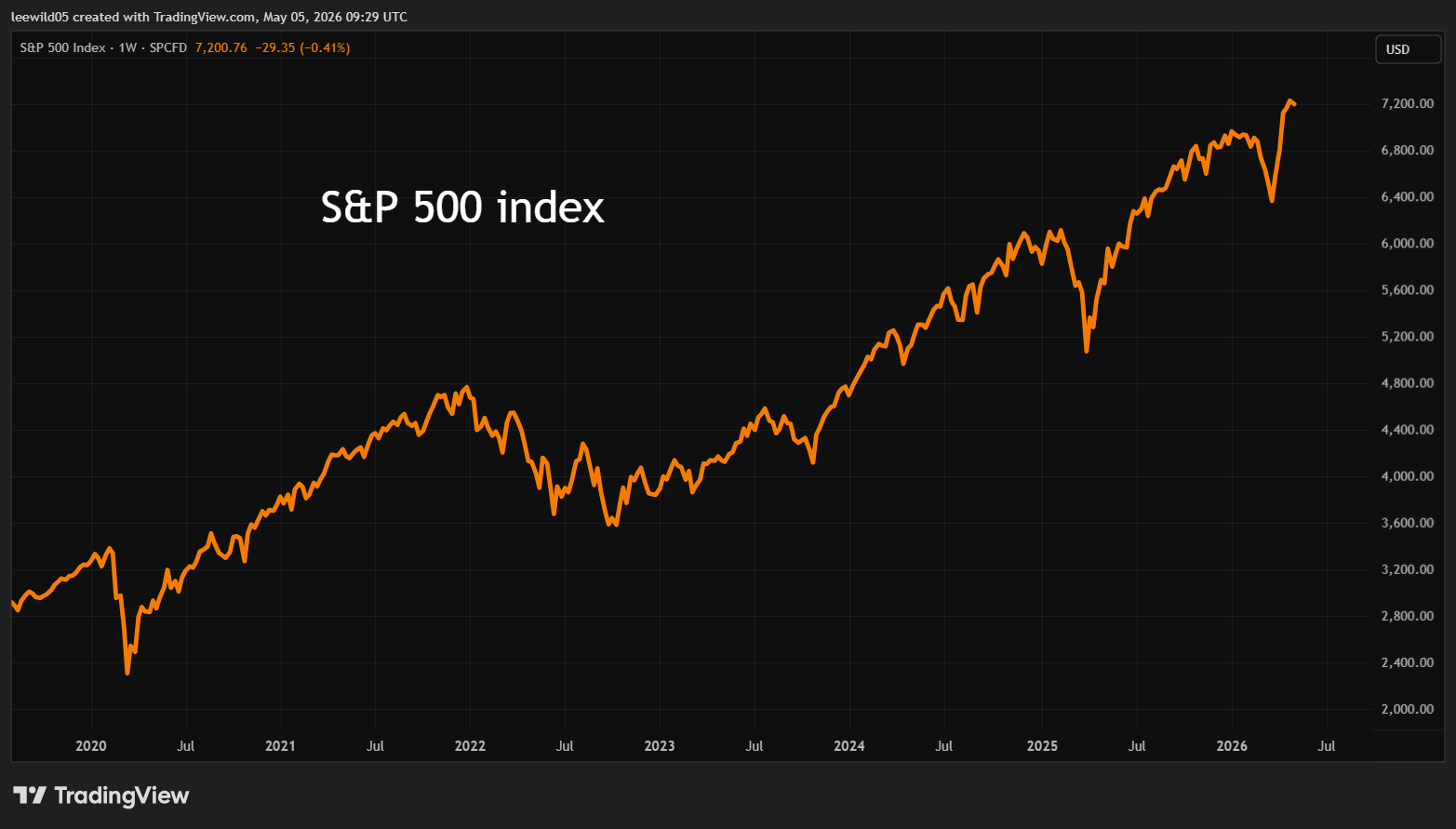
Source: TradingView. Past performance is not a guide to future performance.
Rising economic and political risk in the UK
While the government continues to reassure on fuel supply, a significant risk is US oil imports constituting nearly a third of the UK’s imported primary oil. If shortages continue to force US fuel prices up, then it seems to me that Trump’s America First agenda could see the US restricting exports. We have to hope the recent “soft diplomacy” of King Charles’ visit carries some influence, yet Trump is notoriously mercurial and it seems hard to envisage the UK being made a special case under export restrictions.
This Thursday’s local elections are an important test of the Labour government under Keir Starmer, where a drubbing will renew calls for a replacement prime minister. Andy Burnham, Labour mayor of Greater Manchester, has reportedly identified several seats where MPs are prepared to step aside, enabling a by-election for his return to Parliament. A formal challenge could therefore manifest shortly. The gilt market might see him as preferable – being relatively soft-left – than Angela Rayner, who still has to resolve her property tax affairs with HMRC.
If, therefore, Starmer is forced to step down by his Cabinet, it would create near-term uncertainty, but I do not think as serious a concern as, for example, the way Labour has run up welfare benefits ahead of income tax receipts (according to the Office for Budget Responsibility data in respect of the 2025-26 financial year).
A parallel with early 2020 as Covid spread from China?
If you recall, New Year 2019 already had reports about how the Wuhan virus was inevitably heading our way, yet stock markets continued to rally in January and February to record highs. It took until the week of 9 March 2020 for equities to fall sharply. While the ensuing lockdowns were obviously a starker hit to economic activity than high energy prices and possible fuel shortages, there seems a commonality in “reality postponed” as markets partied on.
It would seem to need price rises – air tickets, food and fuel especially – impacting inflation – to strike truth this time around.
Coincidental is the longstanding adage “Sell in May and go away”, which actually originated from farmers managing their cash flow in decades past, when the US market was dominated by individual investors. Yet various studies suggest it is not a reliable investment strategy despite summer and early autumn producing lower or more volatile returns than winter.
This is chiefly because you are then left with the dilemma when to buy back and may miss intervening rallies and compounding gains.
The same could be said to apply now, although a retreat from adding risk seems wise, if only to ensure cash is available for potential opportunities in what looks a volatile summer ahead.
Edmond Jackson is a freelance contributor and not a direct employee of interactive investor.
Leave a Reply