Dividend income is on offer from some troubled names, writes Dave Baxter.
27th August 2026
by Dave Baxter from interactive investor

Once a fashionable part of the investment universe, so-called alternative assets have run into all manner of problems in recent years.
Higher interest rates, combined with issues specific to the investment trust space, have dealt a bad hand to funds focused on areas such as renewable energy infrastructure, property and (to some extent) private equity.
And with plenty of disruption and consolidation still occurring here, bargain hunting for alternatives trusts has become a risky business.
- Invest with ii: SIPP Account | Stocks & Shares ISA | See all Investment Accounts
And yet these assets stand out most notably on the income front.
At a time when gains in equity markets have pushed down the dividend yields available, alternatives still offer some juicy numbers.
Many come with yields in either the double digits or the high single digits.
Even if overall performance is poor, some investors would argue that they are getting “paid to wait” through such chunky payouts.
There’s plenty going on with those names that do yield a lot, and many such funds are already in the process of winding up. Here, we look at some of the high yielders that are still active and assess their prospects.
Be wary of wind-downs
Investors can very easily look at investment trust share price dividend yields, for example using the Association of Investment Companies (AIC) website.
But it’s good to remember that high yields can be a sign of trouble, and that some of the funds standing out here are either in some sort of trouble, or looking to wind down.
A glance at some of the names with the highest yields confirms this.
Take Gore Street Energy Storage Fund Ord GSF
which comes with a 14.5% yield but has struggled on the performance front and is now facing calls to wind down from the US activist Saba Capital, as one example.
Elsewhere “high-yielding” names like
Aquila European Renewables Ord AERI
and GCP Asset Backed Income GABI are all looking to wind up.
There may be an argument for buying into a heavily discounted trust that is set to wind down – but this could ultimately be a trying experience.
Investors may have to wait for years to see their capital returned, especially when it comes to funds like these that hold illiquid assets.
High-yielding names still in the game
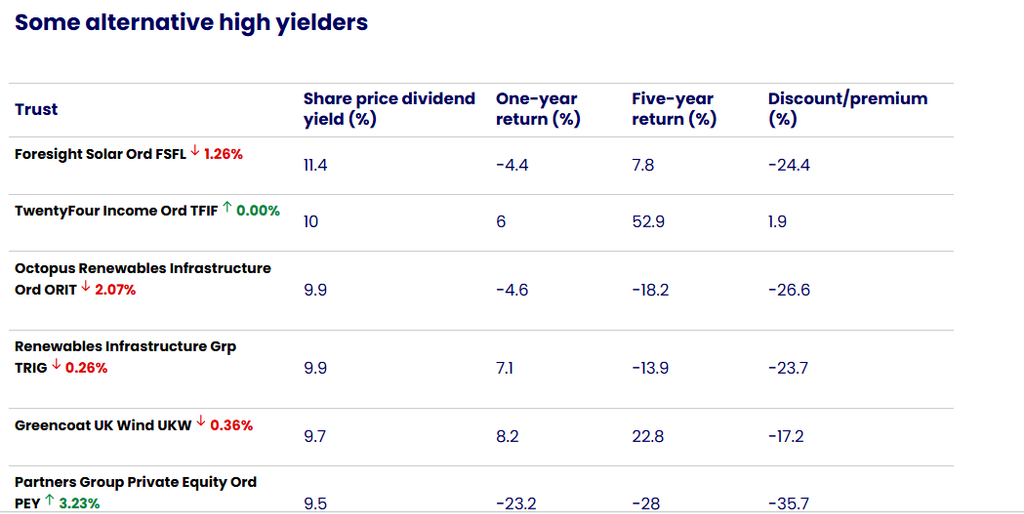
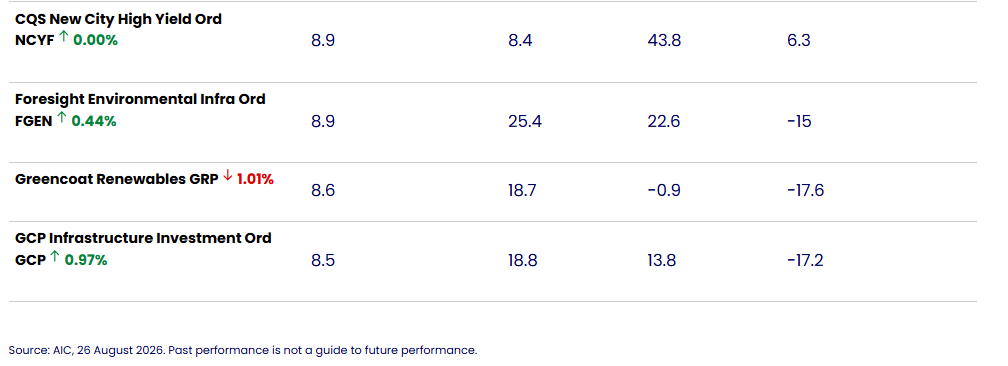
Below we list 10 funds that come with punchy yields and that are not in the process of winding down.
Half the names hail from the troubled renewable energy infrastructure sector, with some additional appearances from debt and private equity vehicles.
To start with renewables, the highest yielder is the very specialised Foresight Solar Ord FSFL
The fund has not dodged the issues blighting its sector, with a recent trading statement pointing to a 4.4% drop in portfolio net asset value (NAV) for the first half of 2026, thanks to the effect of rising bond yields and falling near-term power prices.
Iain Scouller, an analyst at Canaccord Genuity, described the update as “disappointing”.
“There is no update on any portfolio sales, and we suspect shareholders would like to see a Bluefield Solar style take-private transaction,” he said.
“However, we think that is easier said than done and if an offer materialised for Foresight Solar, it would probably be at a much higher discount than the 9% for Bluefield Solar Income Fund BSIF given Foresight’s poorly performing non-UK assets.”
Source: AIC, 26 August 2026. Past performance is not a guide to future performance.

Another specialist name comes in the form of Greencoat UK Wind UKW
a popular name among ii customers.
The trust has had some good fortune in recent times: its NAV was slightly up over the first half of this year and its level of dividend cover has improved. That’s good news after a 2025 in which low wind speeds hurt performance.
Given their reliance on one technology or energy source, the specialist renewables funds can be pretty volatile.
But the more diversified names also offer good yields even if they face a similar challenge, to sell assets at a decent price and reduce debt levels.
Here, take Octopus Renewables Infrastructure Ord ORIT
which launched something of a turnaround plan in late 2025 aimed at selling assets, buying back shares and reducing debt, as well as investing in higher-returning assets.
The fund, which has around half its portfolio in solar assets and most of the balance in onshore and offshore wind, has seen its NAV fall in the second quarter of 2026 and has continued to see its shares struggle.
Conversely, we have seen something of a resurgence for Foresight Environmental Infra Ord FGEN
and even Renewables Infrastructure Grp TRIG shares in the last year, in part thanks to investors paying more attention to the sector amid conflict in the Middle East.
But investors should pay close attention to how the funds are invested and how, for example, their plans to offload assets are progressing. TRIG has argued that it is doing well on that front, as it seeks to win over investors in the wake of last year’s botched attempt to merge with HICL Infrastructure PLC Ord HICL
On the portfolio composition note, Foresight Environmental Infrastructure stands out for being especially well diversified.
While some of the generalist funds tend to mainly invest in solar and wind, this fund has quite a mixed portfolio. Wind accounts for 23% and solar makes up 11%, but the fund also focuses on anaerobic digestion, biomass, energy from waste and hydro power.
Beyond renewables
Those tired of the renewables sector can bag some big yields elsewhere, from sectors with very different prospects.
First, it’s worth noting that debt funds continue to offer some big yields, with the popular TwentyFour Income Ord TFIF
and CQS New City High Yield Ord NCYF
both in the table. These funds have, unusually enough, managed to combine a high yield with strong total returns in recent years.
But investors are certainly paying a price for this, with shares in both trading at a premium to NAV.
The TwentyFour Income portfolio offers exposure to various forms of debt, from collateralised loan obligations to asset-backed securities and residential mortgage-backed securities. The fund also diversifies by the maturity, credit quality, and geography of the debt it holds.
There is an appeal to such a sector, and it should offer diversification to equities and other assets. But investors may well worry about the idiosyncratic risks that could come with such esoteric assets.
It’s finally worth pointing to the presence of a private equity fund, Partners Group Private Equity Ord PEY
in the table.
Like some of its rivals, it does pay out a dividend, although this can be a fraught model because this can sometimes involve paying from capital, and from an illiquid asset class.
The fund has also had a tough few years, and an update published today showed that its NAV had fallen by 8.6% on a total return basis in the first half of this year. However, the board argued that realisation activity, or the level of asset sales, “remained robust”, accounting for some 14% of net assets during this period.
As is often the case with seeking out the highest yields, investors will encounter some troubled names. But these might present a buying opportunity for the brave, and patient, individual.

Leave a Reply