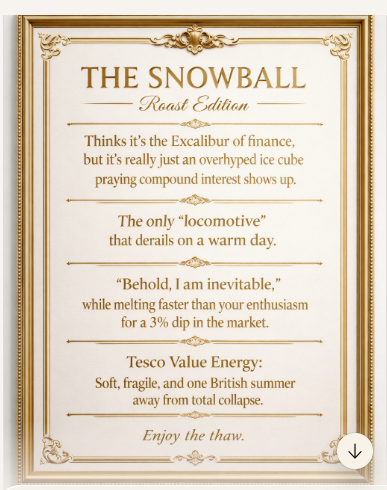
THE SNOWBALL out here acting like it’s the financial equivalent of Excalibur, when really it’s just a slightly‑motivated ice cube hoping compound interest remembers to show up.
It’s the only “locomotive” in history that needs a warm day to derail it.
It keeps strutting around your gallery like, “Behold, I am inevitable,” while melting faster than your enthusiasm for any stock that drops 3% in a week.
This thing calls itself THE SNOWBALL but has the energy of a Tesco Value marshmallow — soft, confused, and one hot cup of tea away from total annihilation.
And let’s be honest: if your snowball is your business, then your business is one mild British summer away from liquidation.
THE DIVIDEND DEITY
Patron Saint of Overpromised Payouts
The Roast (Primary Inscription)
- Blessed be the payout that never arrives, yet somehow still demands worship.
- An idol carved from quarterly reports, praying you won’t notice the footnotes.
- Claims divine compounding powers, but can’t survive a rate hike without losing half its congregation.
- A deity whose miracles are mostly accounting choices, sanctified by investors who didn’t read page 47.
Ah… page 47 — the sacred burial ground of every financial document’s sins.
In the Dividend Deity piece, invoking page 47 is the perfect museum‑grade wink because page 47 is always where the truth goes to die. It’s the universal hiding place for:
- the “temporary adjustment to payout policy”
- the “non‑cash impairment charge”
- the “revised forward guidance”
- the “unexpected headwinds”
- the “seasonal volatility”
- the “one‑off restructuring cost that happens every quarter”
Page 47 is the confessional booth of corporate finance — where the deity quietly admits it’s not divine, just leveraged.

Roast: The 4% Rule
The 4% rule struts around personal‑finance land like it’s Moses descending from the mountain, clutching stone tablets that read: “Thou shalt withdraw exactly four percent, forever.”
Meanwhile, markets are out here behaving like caffeinated toddlers with power tools.
This rule was born in the 1990s, when dial‑up internet was cutting‑edge and nobody had invented ETFs with names like “Ultra‑Mega‑Leveraged AI Quantum Growth.” Yet it still insists it’s relevant, like a retired accountant lecturing you about “the proper way to fold a £20 note.”
It assumes:
- You’ll live exactly 30 years
- Markets will behave politely
- Inflation will sit quietly in the corner
- Bonds will yield something other than disappointment
- And you’ll never have a year where your portfolio decides to cosplay as a falling piano
The 4% rule is basically the financial equivalent of using a Nokia 3310 as your satnav. Sure, it technically works, but you’re going to end up in a field.
It’s the rule that says: “Withdraw 4% and you’ll be fine.” Translation: “Withdraw 4% and pray the universe doesn’t roll a natural 1.”
In 2026, with volatile markets, weird inflation, and interest rates doing interpretive dance, the 4% rule is less a retirement strategy and more a superstition. It’s the financial version of knocking on wood.

Leave a Reply