Investment Trust Dividends

Turn a $14,000 TFSA into about $60 a month in tax-free income by pairing a senior-housing operator with a consumer-brand royalty collector.
Posted by Amy Legate-Wolf
Published July 23
One $14,000 Tax-Free Savings Account (TFSA) balance could trigger more than 120 tax-free deposits over the next decade, without selling a single share. How? At current prices, two monthly dividend stocks could produce about $60 every month, creating a small retirement paycheque that keeps showing up while the portfolio remains invested.
That income won’t replace a salary, but it can buy new shares, cover a bill, or grow into something far more useful over time. The key is building the payments around businesses supported by different sources of cash flow rather than chasing one enormous yield.
Once invested inside a TFSA, dividends and capital gains can grow without Canadian tax. That gives monthly payments more money to compound, which leads me to Sienna Senior Living (TSX:SIA) and Diversified Royalty (TSX:DIV).Z
SIA stock owns and operates retirement residences and long-term-care homes across Canada. Demand should continue growing as the population ages, while government funding and resident fees create recurring revenue from services people can’t simply postpone.
* Returns as of July 6th, 2026
The company’s retirement same-property occupancy reached 94.7% during the first quarter, while its adjusted funds-from-operations (AFFO) payout ratio improved to 68.5%. That coverage supports SIA stock’s monthly dividend of $0.078 per share, equal to $0.936 annually.
SIA stock therefore provides a relatively defensive starting point, but healthcare exposure alone won’t create a balanced income plan. The second holding adds royalties collected from a much broader group of consumer businesses.
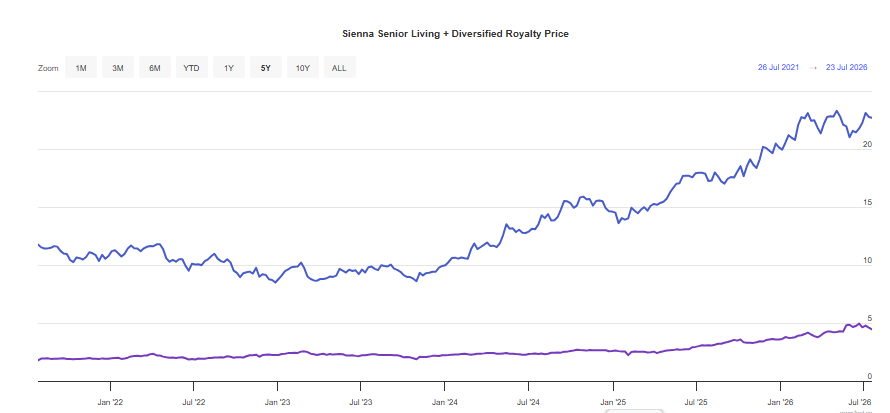
Diversified Royalty earns cash by owning trademarks and other rights used by brands including Mr. Lube, BarBurrito, and AIR MILES. Those partners pay royalties based on sales or fixed agreements, allowing Diversified Royalty to collect cash without operating every restaurant, tutoring centre, or automotive shop itself.
First-quarter revenue rose 11.8% to $17.5 million, while distributable cash increased to $12 million. The first-quarter payout ratio reached 101.1%, partly due to seasonal weakness among certain partners. Investors should watch that figure closely, although management aims to pay a stable monthly dividend and grow it as cash flow allows.
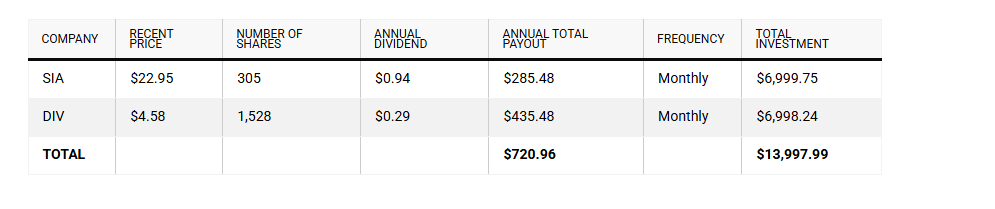
With that $14,000, I’d divide the money equally, giving SIA stock’s healthcare operations and Diversified Royalty’s consumer brands the same starting weight. Using recent prices, the portfolio could generate approximately $720.96 annually, or $60.08 per month.
Of course, SIA stock faces staffing expenses, government regulation, development costs, and substantial debt. Diversified Royalty depends on its partners remaining healthy enough to make their payments, while its first-quarter payout exceeded distributable cash.
Those risks make both holdings better suited to one portion of a broader collection of monthly dividend stocks. Reinvesting the income can also reduce the temptation to treat each deposit as guaranteed spending money.
SIA stock brings senior-housing demand and strong distribution coverage, while Diversified Royalty supplies a higher yield backed by several consumer brands. Holding both could keep monthly cash moving into a TFSA today, then let reinvestment turn that modest paycheque into a much larger source of retirement income.
Story by Laura Purkess
i paper
A big concern I hear from those who want to gift money is the fear of leaving themselves short in later life. But that is exactly what annuities are there for, and now is actually a great time to buy one.
Annuities were unpopular for many years because low interest rates meant they offered relatively poor returns, but higher interest rates over the past few years have meant they offer vastly better value.
The average annuity rate was 7.62 per cent as of March 2026, according to insurer Standard Life. That means a healthy 65-year-old with a £100,000 pension pot can lock in a guaranteed annual income of up to £7,620.
With £300,000, you could generate £22,860 income annually – with the full new state pension, that’s an annual income of almost £35,000 a year.

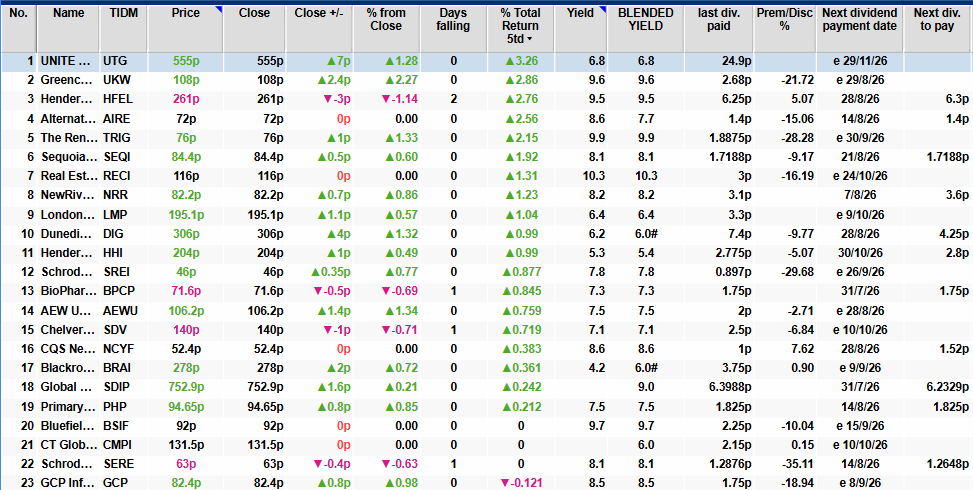
When today’s dividends are applied to the account current cash will be £1,258.
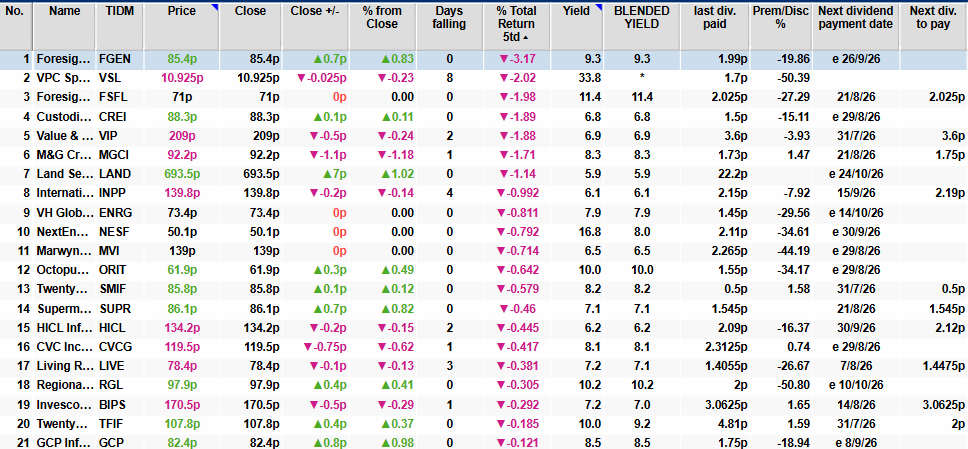
1k to added to RGL today.

Wednesday, July 22, 2026
Head of Personal Finance
If you’re waiting for the perfect moment to do anything in life, there’s a risk you’ll never get around to it. And when it comes to saving and investing, you’ll pay a real price for the delay. So, it can help to know when other people have taken the plunge, and just how they’re doing, to see whether we’re on track, or if we need to get cracking. Here are the ages that are financial landmarks among AJ Bell customers.
The most popular time to open an AJ Bell Junior ISA (JISA) is in the first year of a child’s life. It’s a great idea for when you have a newborn, so anyone who wants to celebrate the birth can do so with a gift into the JISA that they’ll appreciate far more than a new rattle or babygrow.
However, people aren’t just using them for one-off payments. The first year of a child’s life is also the most popular time to set up a regular direct debit into the account. If this is a bit of a stretch in the expensive early years, talk to grandparents and the wider family. They may be able to make manageable monthly payments that will keep building a valuable nest egg for when they’re 18.
The fact that the most common age to open a Stocks and shares ISA overall is 18 is a testament to the success of the Junior ISA, and how many people have already become investors before they leave childhood.
Excluding maturing JISAs, the most popular age to open an AJ Bell Stocks and shares ISA is either 25 or 26. By this age, people will have started work and have a few years under their belt. They’ll have got to grips with their expenses and are likely to have been in a workplace pension for a few years. They don’t necessarily have vast sums of cash to put away if they’re at the start of their career, but making a start investing this early can make an enormous difference to the rest of their life. If you reach this age and investments aren’t on your radar at all, it’s worth at least investigating what it has to offer.
This is the most common age to use an AJ Bell Lifetime ISA to buy a property (measured as people making penalty-free withdrawals). Given that, overall, the average age to buy a first property is 34 in the UK, there’s a decent chance the government bonus has played a vital role in helping people build the deposits they need to get onto the property ladder.
You can pay up to £4,000 a year into a LISA and the government will top it up by 25%. The LISA will eventually be replaced by a new scheme for first-time buyers, but the date of the replacement, and the size of the government top up on the new scheme haven’t been confirmed. Meanwhile, the government has emphasised anyone opening a LISA before it’s replaced will be able to pay into it and get the bonus as usual for as long as they want, so there’s still enormous benefit in taking advantage of the LISA. For anyone under the age of 27, it may be worth getting started at a younger age, while you still can.
ISA customers who are age 33 have the highest percentage making an ISA contribution than any other age group on the platform. Some people will be on higher incomes or have made investment a key priority early in life, so will have been making the most of their ISAs for years. However, others will have waited until they were on a firmer financial footing before they made a start.
If you haven’t started investing, it’s a decent time to take stock. You may have other pressing priorities, or a gap in income which means now isn’t the time for you. Otherwise, this may well be an opportunity to start your investment journey.
This is the oldest you can be when you open a Lifetime ISA, although once it’s open, you can keep paying into it until the age of 50. It’s also the age when people are most likely to open an AJ Bell LISA. The rush at 39 might be from some people keeping their options open, just in case they want to use a LISA later.
However, there’s more to it than that, because this is the age when people are most likely to start regular payments into an AJ Bell LISA too. It’s a flexible option for retirement savings, especially for basic rate taxpayers who work for themselves or who have already taken advantage of any employer contributions to their pension. It can also be helpful for anyone who has maxed out their pension contributions. If you want to take advantage of the LISA, it’s worth doing so sooner rather than later, while you still can.
Age 56 is the most common age to max out an AJ Bell Stocks and shares ISA.** One key driver is likely to be from people who have taken the tax-free cash from a pension, who want to keep it invested tax-efficiently.
If you want investments to grow within a tax-efficient environment, then there’s no need to take the cash at 55, because a pension is a great home for your money. By leaving your cash where it is, you also give the pot chance to grow, so you can eventually withdraw a bigger sum.
However, some people have taken tax-free cash because of a lack of reassurance from the government that they’re not going to tinker with the rules. While this is a decision which should be carefully thought through, if you’re going to do this, then a Stocks and shares ISA is a sensible home for your money.
The fact this is a key time for maxing out is also partly down to the fact many people will be empty nesters. Their offspring may have moved out or started working and contributing to the household, so they may have more money to work with and more opportunities to save. It means they can concentrate on building as much for retirement as they can, as soon as they can, in a mixture of pensions and ISAs.
If you’ve reached the empty nest period, it’s worth using a pensions calculator and factoring in additional savings and investments. If you have a shortfall, you can consider whether you can afford to put more aside for the future, to make up for lost time.
This is the average age of AJ Bell SIPP millionaires, but if you haven’t quite got there, there’s no need to panic. It was always bound to be the age when people have built as much as possible in their pension and start spending it down. However, it’s a handy reminder that a commitment to pension investing from an early age, sticking with it whenever possible, and investing strategically, can help build a really substantial pot for the kind of retirement you always wanted.
This is the most common age of AJ Bell ISA millionaires. This isn’t going to be a target for everyone, but it’s a great demonstration of the power of compounding over time. By investing consistently over the decades, ISA millionaires haven’t had to take enormous risks or trade on a daily basis. They’re evidence of how successful a ‘get rich slow’ plan can be.
*Based on existing customers on the AJ Bell platform, as of 29 June 2026
**Refers to tax years since 2017/18, when the ISA allowance has been set at £20,000

The SNOWBALL currently earns income of 11k per year.
If you re-invest the dividends at a blended yield of 7% it will double every ten years.
So in twenty years, from now, your snowball should be yielding 44% per year. Better if Mr. Market allows you to re-invest at a higher yield as you can shorten the journey. You may not be a millionaire but you should be able to spend like one. GL

Story by Alan Oscroft
• 8mo
I’ve been doing a bit of research on the habits of successful passive income investors, and I came across a bit of a surprise.
They all seem to name dividend stocks as a major part of their investment portfolios — though that’s not the surprising part. No, what I hadn’t expected was to find a large number of them recommending real estate.
Yes, real estate has been profitable for a number of people. But I had a very shaky venture into it. And it has a fair few drawbacks for individual investors.
One is that many of us won’t have the capital to go for, say, rental properties. It’s not the kind of thing we can get started with just a few hundred pounds, like we can with a Stocks and Shares ISA.
It’s not entirely passive either. Finding tenants, collecting rent consistently, and maintenance all take time and effort. And the latter can sometimes prove very costly if you’re unlucky.
But there’s a way we can get into real estate without facing those major hurdles. And that’s to consider buying real estate investment trusts (REITs). They’re investment companies that put their money into various kinds of properties, and they do all the management. All we have to do is buy shares in them, just as we do with shares in general.
I like Primary Health Properties (LSE: PHP), which invests in GP surgeries, pharmacies, dental clinics. Importantly, they’re mostly rented to the NHS on long-term leases.
Having the UK government as its main customer provides some stability and predictability. But it hasn’t made the trust immune to weak property values in recent times. Over the past five years, the PHP share price has fallen 35%.
Higher interest rates are a burden, especially with debt on the books. At the end of the first half this year, net debt reached £1,367m, up from £1,323m in December 2024. There doesn’t seem to be any liquidity problem, but it could keep the shares down for longer.
On the bright side, a lower share price means a bigger dividend yield. Right now, we’re looking at a forecast 7.3%. And analysts are forecasting rises between now and 2027. We could have long-term capital appreciation too — especially when interest rates fall.
Is Primary Health one to consider for long-term passive income? Even in the current tough real estate market, I think it has to be, especially while the share price is low.
There are plenty of other REITs to choose from, addressing different sectors of the property market.
Please note that tax treatment depends on the individual circumstances of each client and may be subject to change in future. The content in this article is provided for information purposes only. It is not intended to be, neither does it constitute, any form of tax advice.
Quite a few millionaire investors also invest for deferred income. That is, they aim for total returns — capital and dividends — and plan to convert it to income later.
So how do we emulate the millionaire approach to passive income? If we focus mainly on dividend shares, include a REIT or two in our portfolio, and look for long-term growth opportunities too — we could get pretty close. And we don’t have to be millionaires to start.

PHP current yield 7.5% Currently xd.
Alternative Income REIT PLC
(the “Company” or “Group” or “AIRE“)
DIVIDEND DECLARATION
Declares a fourth interim dividend of 1.40 pence per share (“pps”) for the quarter ended 30 June 2026
The target annual dividend of no less than 5.6pps for the year ending 30 June 2026 has been met†
Dividend Declaration and Dividend Cover
The Board of Directors of Alternative Income REIT PLC (ticker: AIRE), the owner of a diversified portfolio of UK commercial property assets, predominantly let on long leases with index-linked rent reviews, declares an interim dividend for the quarter ended 30 June 2026.
The Board is pleased to declare that it has met its annual dividend target of 5.6 pps for the year ended 30 June 2026, following the declaration today of a fourth interim dividend of 1.40 pps for the quarter ended 30 June 2026. This interim dividend will be distributed as Property Income Distribution (“PID”) and will be paid on 14 August 2026 to shareholders on the register on 31 July 2026. The ex-dividend date will be 30 July 2026.

The SNOWBALL was funded by 100k of seed capital and will earn income of at least 11k this year.
If the seed capital was funded by a SIPP at 20% tax relief the yield would be around 13%
If the seed capital was funded by a SIPP at 40% tax relief the yield would be around 15%
The comparator share VWRP would today, using the 4% rule would provide income of £6,765.
The SNOWBALL will continue to use a running yield of around 11% as your snowball may be funded using a SIPP and or an ISA.
Remember with compound interest it takes a few years to make large differences, so if you are building your snowball, that is good news.

I’ve booked a profit of £250 with TRIG. I may use the capital gain to buy a higher yielding more risky share, just waiting on the outcome of the AIRE corporates.
Current profit for the SNOWBALL trades in TRIG, including earned dividends
£1,891.00, remembering that the position is still open so Mr. Market could take back the profit and some more.

© 2026 Passive Income Live
Theme by Anders Noren — Up ↑