
How I’d Structure My TFSA With $14,000 for Consistent Monthly Income
Turn a $14,000 TFSA into about $60 a month in tax-free income by pairing a senior-housing operator with a consumer-brand royalty collector.
Posted by Amy Legate-Wolf
Published July 23
- Split $14,000 between Sienna Senior Living and Diversified Royalty to target about $721 yearly income, paid monthly.
- Sienna’s dividend looks better covered, with improving occupancy and an AFFO payout ratio around 68.5%.
- Diversified Royalty pays a higher yield but had a payout ratio above 100% last quarter, so monitor coverage and diversify.
One $14,000 Tax-Free Savings Account (TFSA) balance could trigger more than 120 tax-free deposits over the next decade, without selling a single share. How? At current prices, two monthly dividend stocks could produce about $60 every month, creating a small retirement paycheque that keeps showing up while the portfolio remains invested.
That income won’t replace a salary, but it can buy new shares, cover a bill, or grow into something far more useful over time. The key is building the payments around businesses supported by different sources of cash flow rather than chasing one enormous yield.
Once invested inside a TFSA, dividends and capital gains can grow without Canadian tax. That gives monthly payments more money to compound, which leads me to Sienna Senior Living (TSX:SIA) and Diversified Royalty (TSX:DIV).Z
SIA
SIA stock owns and operates retirement residences and long-term-care homes across Canada. Demand should continue growing as the population ages, while government funding and resident fees create recurring revenue from services people can’t simply postpone.
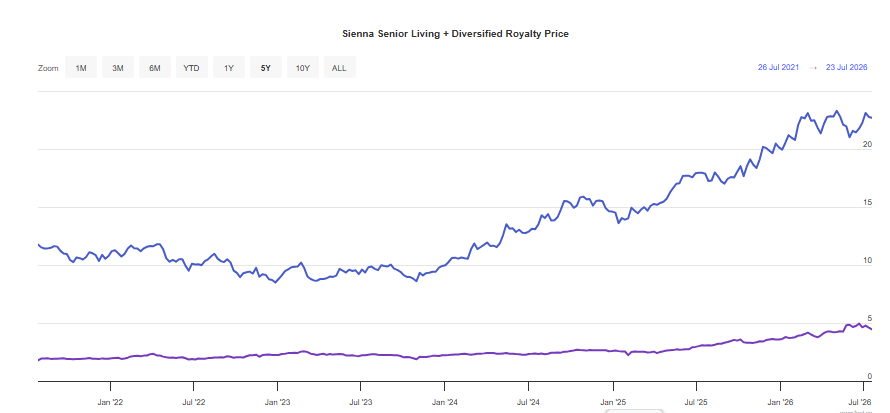
* Returns as of July 6th, 2026
The company’s retirement same-property occupancy reached 94.7% during the first quarter, while its adjusted funds-from-operations (AFFO) payout ratio improved to 68.5%. That coverage supports SIA stock’s monthly dividend of $0.078 per share, equal to $0.936 annually.
SIA stock therefore provides a relatively defensive starting point, but healthcare exposure alone won’t create a balanced income plan. The second holding adds royalties collected from a much broader group of consumer businesses.
DIV
Diversified Royalty earns cash by owning trademarks and other rights used by brands including Mr. Lube, BarBurrito, and AIR MILES. Those partners pay royalties based on sales or fixed agreements, allowing Diversified Royalty to collect cash without operating every restaurant, tutoring centre, or automotive shop itself.
First-quarter revenue rose 11.8% to $17.5 million, while distributable cash increased to $12 million. The first-quarter payout ratio reached 101.1%, partly due to seasonal weakness among certain partners. Investors should watch that figure closely, although management aims to pay a stable monthly dividend and grow it as cash flow allows.
The $14,000 income plan
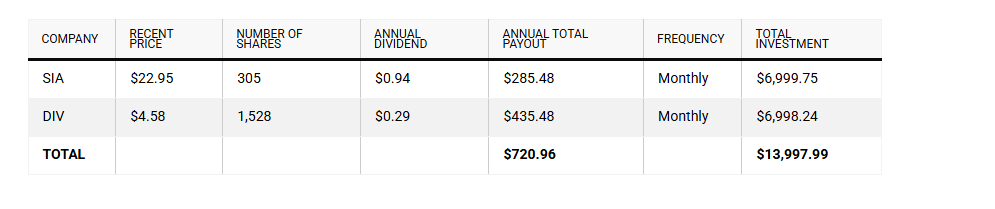
With that $14,000, I’d divide the money equally, giving SIA stock’s healthcare operations and Diversified Royalty’s consumer brands the same starting weight. Using recent prices, the portfolio could generate approximately $720.96 annually, or $60.08 per month.
Of course, SIA stock faces staffing expenses, government regulation, development costs, and substantial debt. Diversified Royalty depends on its partners remaining healthy enough to make their payments, while its first-quarter payout exceeded distributable cash.
Those risks make both holdings better suited to one portion of a broader collection of monthly dividend stocks. Reinvesting the income can also reduce the temptation to treat each deposit as guaranteed spending money.
Bottom line
SIA stock brings senior-housing demand and strong distribution coverage, while Diversified Royalty supplies a higher yield backed by several consumer brands. Holding both could keep monthly cash moving into a TFSA today, then let reinvestment turn that modest paycheque into a much larger source of retirement income.
Leave a Reply