Investment Trust Dividends

Category: Uncategorized (Page 341 of 462)

A second income from dividend shares


How I’m targeting a £10,000 second income from dividend shares

by Stephen Wright
The Motley Fool
For me, the point of investing is to earn extra income in retirement. And both growth stocks and dividend shares can be part of that project.

I own a number of stocks that don’t pay dividends, including Amazon and JD Wetherspoon. But they’re a key part of my plan to earn £10,000 a year in passive income.


If I were getting ready to retire today, I’d want to be in a position to earn as much income as possible. And sometimes, investing in growth stocks can be the best way to get to that position.

If I’d invested £1,000 in Unilever shares five years ago, I’d have an investment worth £882, plus £138 in dividends. Investing the same amount in Bunzl would have returned £1,491 in market value alone.

If I’d bought Bunzl shares five years ago, I could sell them and buy more Unilever shares today than I’d have if I’d invested in the company half a decade ago. Crucially, I’d receive more income as a result.
Of course, I could have reinvested my dividends to compound my returns. But while that narrows the gap, it doesn’t change the fact I’d be in a better position if I’d bought the growth stock five years ago.

An alternative
My long-term aim is passive income, but I’m not ruling out growth stocks as a means for getting there. But I’m also open to buying dividend shares that I think can perform well.

Take British American Tobacco, for example. The stock currently has a 9.43% dividend yield, but the company’s share price has been falling fairly sharply since 2017.
To some extent, this might not matter. If – and it might be a big ‘if’ – the dividend is secure for the long term, a 9.43% yield’s a golden opportunity.

A £1,000 investment compounded at 9.43% a year returns £135 after five years, £212 after 10 years, and £522 after 20 years. With that kind of dividend income, I probably won’t care what the stock does.

A stock I’m buying
Please note that tax treatment depends on the individual circumstances of each client and may be subject to change in future. The content in this article is provided for information purposes only. It is not intended to be, neither does it constitute, any form of tax advice.

One stock I’ve been buying is Primary Health Properties (LSE:PHP). The company’s a FTSE 250 real estate investment trust (REIT) that leases a portfolio of GP surgeries – mostly to the NHS.

The steady trend of increasing life expectancy in the UK should mean strong demand for its buildings in future. However, as is always the case with investing, there are risks for investors to think about.

Primary Health Properties has a record of increasing its dividend each year for over 25 years. But the amount of debt on its balance sheet might make maintaining this impossible in the future.

From an income perspective, any disruption to the dividend (which currently amounts to a 6% yield) would be unwelcome. But the company’s improving its financial position and could be a good long-term pick.


Aiming for £10,000
At an average dividend yield of 4%, I’ll need around £250,000 invested to earn £10,000 a year in passive income. I think that’s achievable, over time.

In terms of where to invest, my plan for the time being is simple. I’m aiming to buy whatever will generate the best return over time – whether that’s growth stocks or dividend share

Kepler SEQI

SEQI offers a high yield from a diversified portfolio of infrastructure loans…

Overview

Infrastructure is essential to an economy and society, and from an investment point of view has many stable qualities. Sequoia Economic Infrastructure Income Fund (SEQI) offers investors a way to generate an exceptionally high yield by lending against infrastructure projects and assets. Unlike some more specialised peers, the trust owns a highly diversified portfolio of loans invested across multiple sectors, from new economy areas like digitalisation and the energy transition to the more long-standing asset types such as railways and ports.

SEQI invests in private debt, which means it typically acts on its own or with a small group of other specialised lenders to supply funding to projects which for a variety of reasons don’t easily fit within a public bond structure. This requires a high degree of expertise when it comes to origination and risk assessment, and this along with the illiquidity of the loans means that highly attractive yields can be earned. SEQI yields 8.8% on an annualised basis at the time of writing, which partly reflects the Discount. However, the portfolio itself yields around 10% in cash terms (i.e. the yield earned on the current market value).

This high yield is generated from a portfolio with a high degree of defensiveness. Gearing  not a part of the model, while investments are generally held to maturity. The extra yield comes from a portfolio typically invested in BB/B credit quality investments, at the top end of the high-yield market. Head of portfolio management Steve Cook and team are defensive in sector and security selection, with very little exposure to construction risk, and highly flexible in their ability to allocate across a broad variety of industries. The publication of monthly external NAV valuations brings a high degree of transparency.

The shares trade on a discount of 15.7% at the time of writing (at the tighter end of the discount range for listed infrastructure and credit trusts, reflecting the largest buyback programme in the alternatives space since July 2022, which continues .

Analyst’s View

Many of the themes supporting the cash flows to SEQI are some of the most well-established secular growth themes in the world economy: digitalisation, the expansion and “greening” of the power grid, and building out renewable energy, for example. Additionally, there is widespread recognition across the US and Europe that its core infrastructure is in desperate need of renewal. There has been a huge wave of investment in the equity of infrastructure as a result, with global assets at over $1trn. This is creating an attractive opportunity for debt investors: currently the yield-to-maturity of SEQI’s portfolio, which can be thought of as the portfolio’s internal rate of return (IRR) is around 10%, unlevered. This means that the trust offers a way to generate an equity-like return by investing in debt in some highly attractive growth themes, but with much more stability and defensiveness than is available in equities.

This is an asset class that has historically been the preserve of banks and institutional investors, but SEQI makes it available to the mass market. The team is highly experienced, bringing with them a wealth of knowledge from their time originating and managing these investments for investment banks before launching the fund in 2015. We think that the trust could be a good ‘one-stop shop’ for investors seeking to get the diversifying and defensive qualities of infrastructure into their portfolios.

Bull

  • A high dividend yield from a portfolio with relatively low credit risk
  • Highly diversified exposure to a specialist asset class via an experienced team
  • Significant buyback programme offers source of return and demonstrates conviction in portfolio

Bear

  • Complex asset class
  • Yield on proportion of portfolio may fall with interest rates
  • Currency hedging may be expensive in future

Change to the Snowball

I’ve bought for the Snowball 4981 shares in SEQI

Sequoia Economic Infrastructure Income (SEQI)

27/06/2024

Results analysis from Kepler Trust Intelligence

Sequoia Economic Infrastructure Income (SEQI) has released its financial results for the year ending 31/03/2024. Over the year, the trust saw its NAV increase by 8.1% on a total return basis, in excess of its target return of 7-8%.

SEQI paid a total dividend of 6.875p per ordinary share which represents a yield of 8.7% on the share price at the time of writing. The trust delivered a total share price return of 9.6%, helped by a modest narrowing in its discount from 13.8% to 13.5%. The discount has since widened to 16.2%.

The managers have been active in portfolio management, increasing the proportion of fixed rate investments from 42% to 58% over the financial year to position the portfolio to take advantage of the expected fall in interest rates.

The managers and board also continue to take a proactive approach to capital allocation, repaying the revolving credit facility to reduce net debt to zero and returning £88 million to shareholders via a share buyback programme.

Chair James Stewart commented: “I am pleased to announce another resilient year of performance, despite ongoing challenges in the macroeconomic backdrop.”

Kepler View

Sequoia Economic Infrastructure Income (SEQI) generates a high yield for investors by lending against infrastructure projects backed by the security of tangible physical assets. The infrastructure sector is forecast to enjoy strong growth from mega-trends such as digitalisation and decarbonisation, which require trillions of pounds of investment.

This has led to a significant growth in private sector financing as a means of plugging the gap from government spending. We think SEQI is well-positioned to take advantage of this opportunity as the only listed economic infrastructure debt vehicle in the UK. One of SEQI’s strengths is the diversification of its portfolio, with around 55 investments across 30 sub-sectors.

Against a challenging backdrop for alternatives, SEQI has delivered a strong set of results with a NAV and share price total return of 8.1% and 9.6% respectively. This was primarily due to its focus on credit quality through the year.

In our view, SEQI could be an attractive proposition for investors seeking exposure to the infrastructure sector, which offers defensive qualities in addition to strong secular growth themes. While there would be some negative impact on income from falling interest rates, the managers’ decision to build up fixed rate exposure has counteracted some of this. We think the dividend looks sustainable over the coming year, thanks to the high amount of liquidity available and the current outlook for rates. Given the likely positive impact of falling rates on the valuation of the portfolio, we think there is the potential for strong total returns in such an environment from the 8.7% dividend yield plus capital upside from pull to par and a possible narrowing of the discount.

Top-quartile Trusts

Top-quartile trusts yielding more than government bonds

11 July 2024

Only a handful of equity income trusts have delivered sector-beating returns as well as yields over 4%.

By Emma Wallis

News editor, Trustnet

Now that UK government bonds offer a yield above 4%, equity income strategies have to work harder to justify their existence.

The argument for an equity income strategy is clear: dividend payouts plus the prospect of capital growth and higher total returns than those available from the bond markets. And with many investment trusts trading on a discount, investors can gain access to a portfolio of shares for less than they are intrinsically worth and potentially make additional gains if the discount narrows.

In practice, however, the holy grail of yields plus capital gains has been hard to achieve, with only a handful of investment trusts delivering top-quartile returns over three years with a yield payout in excess of 10-year gilts (4.2% as of 10 July 2024).

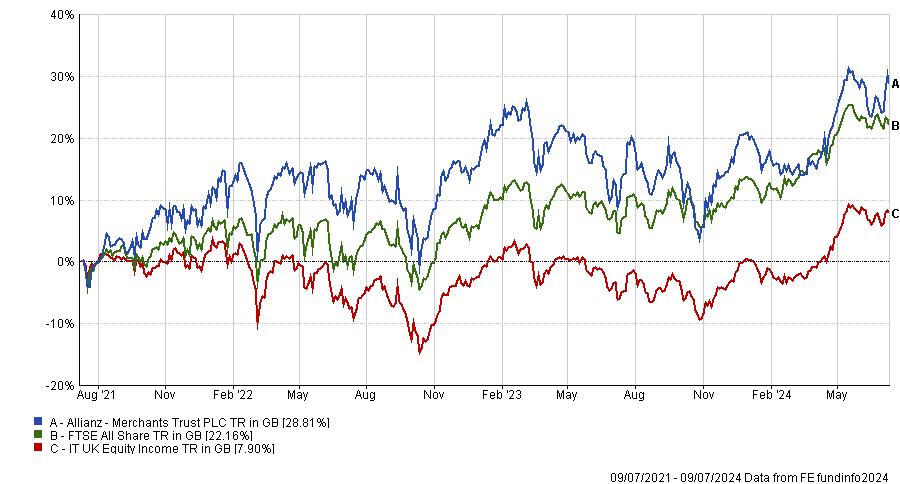
Within the Association of Investment Companies’ (AIC) UK Equity Income sector, Merchants Trust is the only one to make the mark with a yield of 4.9%. It is one of the AIC’s dividend heroes, having increased its dividend for 42 consecutive years.

Peter Hewitt, who manages the CT Global Managed Portfolio Trust and invests in Merchants Trust, said it can be relied upon to keep growing its dividend. “They will not drop the ball” he said.

The £859m trust is the third-best performer in its sector on a total return basis over three and five years. It is trading almost at par, with a very slight discount of 1.4% as of 31 May 2024.

Performance of trust vs sector and benchmark over 3yrs

Source: FE Analytics

Simon Gergel, chief investment officer for UK equities at Allianz Global Investors and head of the value and income team, helms the trust. RSMR analysts described its investment style as contrarian and value-orientated, with an income bias.

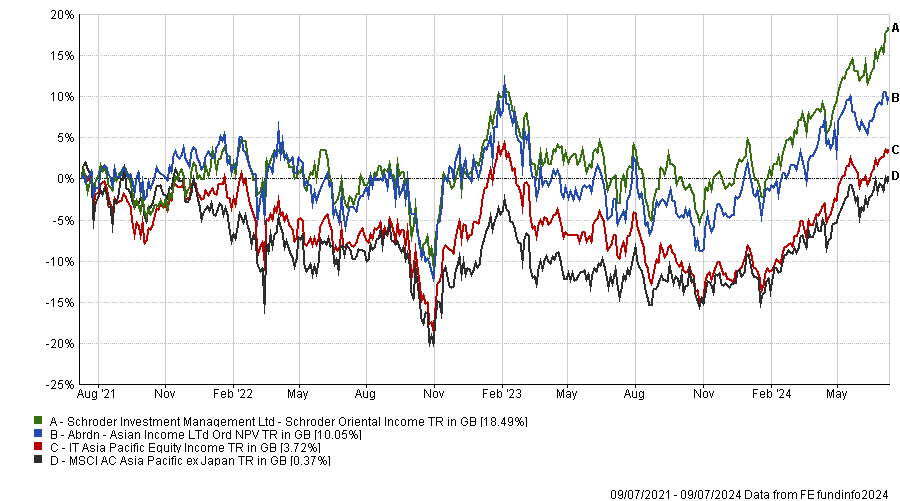
Two Asia Pacific equity income trusts achieved top-quartile returns over three years with a yield above gilts: abrdn Asian Income with a 5.7% yield and Schroder Oriental Income paying out 4.5%. The two trusts have grown their dividends for 15 and 17 consecutive years, respectively.

The abrdn Asian Income trust was trading on a 12.4% discount by 31 May and has a £348m market capitalisation. Richard Sennitt’s £690m Schroder Oriental Income trust sits at a 4.2% discount.

Performance of trusts vs sector and benchmark over 3yrs

Source: FE Analytics

Other equity trusts making the grade included BlackRock Latin America (a 6.4% net yield and a 12.9% discount), BlackRock Frontiers (a 4.4% yield and a 5.9% discount) and Schroders’ International Biotechnology Trust (a 4.5% yield and a 8.7% discount). The latter has committed to paying a 4% dividend from capital reserves.

Meanwhile, the Henderson High Income Trust is a top-quartile performer in the UK Equity & Bond Income sector and has a 6.4% yield. It is trading at a 9.7% discount.

For investors who prioritise income payouts, Henderson Far East Income has a 10.5% yield while the British & American Investment Trust boasts an 9% yield.

Two UK equity trusts paid an income over 7%: Chelverton UK Dividend Trust (7.8%) and abrdn Equity Income Trust (7.4%).

However, all four trusts underperformed their peer groups from a total return perspective over three years, which illustrates the difficulty of achieving both income and growth.

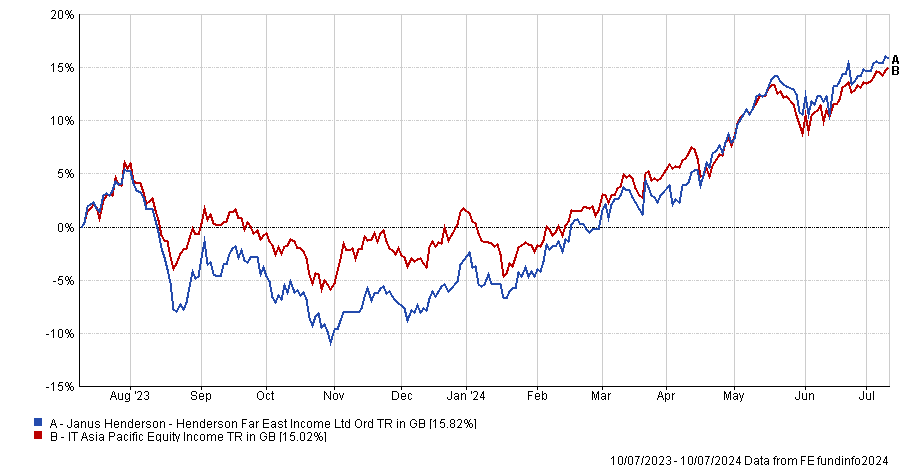
Henderson Far East Income’s performance has struggled, lagging its sector average over three and five years, but it changed hands last autumn when Mike Kerley retired and his colleague Sat Duhra stepped up to become lead manager. Since then, “it’s really picked up”, Hewitt said. “He’s sorted things out and I’m very impressed.”

Performance of trust vs sector over 1yr

Source: FE Analytics

The £376m trust has been consistently boosting its income by writing call options for a decade or more, Hewitt added.

The Dividend Deluge

Dividend investing has gained prominence, and it’s essential to navigate this golden period effectively.

Mark Peden, Investment Manager, Aegon Asset Management

04 July 2024

Partner Insight: The Dividend Deluge

Back in 2020, I penned an article titled ‘The Dividend Dilemma’. It was the depths of the Covid-induced market selloff; companies were cutting or suspending dividends left, right and centre; and analysts were predicting big cuts to global dividends from which they would take years to recover. I anticipated a fall of around 30%.

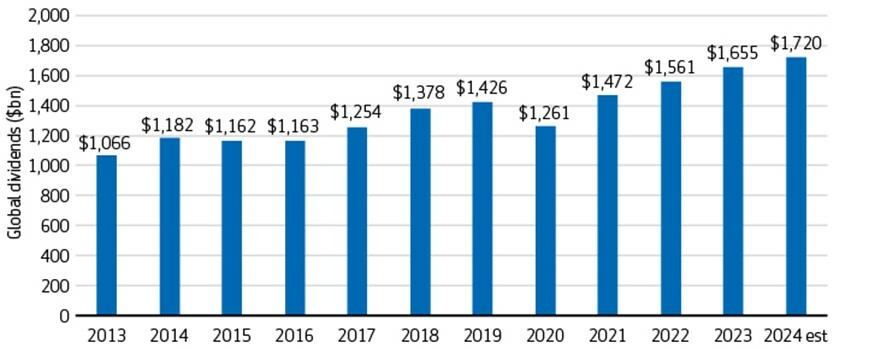
Yet for all the cataclysmic predictions, payouts took just one year to bounce back. 2021 was a record-setting year for global dividends at $1.47 trillion, a mark that was subsequently bettered in 2022 and again in 2023. We have now gone from the dividend dilemma to the dividend deluge and, with 2024 predicted to set yet another record at $1.72 trillion, there are no signs of the momentum fading. In addition, share buyback authorizations are also at all-time highs, meaning the picture is clear – companies are returning record amounts of capital to shareholders.

Exhibit 1: Global total annual dividends are climbing (USD, billions)

Source: Janus Henderson Global Dividend Index Report, as of February 29, 2024

The past few years have seen financial markets affected by bouts of volatility caused by factors such as Covid lockdowns, spiking inflation, historically steep interest rate rises and geopolitical tensions. Through all of this, dividends have reinforced that they are typically much less variable than earnings and can provide an important source of total return, regardless of the market environment. They also have a solid track record of keeping pace with inflation, meaning there was less erosion in real terms than we saw in payouts from most other asset classes during the inflationary spike in 2022 and 2023. All in all, the importance of dividends should not be overlooked.

A focus on quality dividend-paying companies

So where does this leave us now? Deep value areas of the market, characterized by companies with lower-quality earnings and high debt levels had their day in the sun in 2022. Such rallies tend to be sharp but also short-lived, as was illustrated by the strong comeback in growth stocks through 2023. That said, the growth rally has been very narrowly driven by a handful of US-listed, mega-cap, tech-related names known as the ‘Magnificent 7′. We do not see another sharp value rally on the horizon and would question whether the narrow market leadership seen recently can continue over the longer term.  

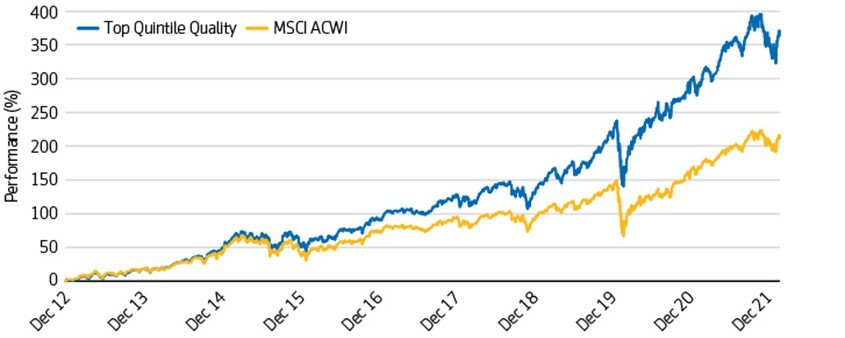
Instead, we believe a focus on ‘quality’ dividend paying companies with strong balance sheets and high returns on equity can be a powerful factor over time. As shown in Exhibit 2, the top quintile of companies, based on quality within the MSCI All Country World Index, has significantly outperformed the wider market over time.

Exhibit 2: Higher-quality companies have historically outperformed

 Source: Bloomberg, Aegon AM as of March 31, 2022. Quality is defined by low net debt to EBITDA and high return on equity.

This quality approach will, we believe, be as important as ever in the coming months. Economic growth remains healthy in the US but is more sluggish elsewhere. Inflation has fallen back from recent peaks but the final leg of the journey back to target is proving difficult. Consequently, investors have scaled back their expectations for both the timing and scale of interest rate cuts this year. Add in geopolitical tensions and the looming US presidential election and clearly there is uncertainty out there. We believe well established companies with strong balance sheets, good returns on equity and well covered dividends have the potential to fare well, whichever path the market takes.

Indeed, despite the uncertainty in the market right now, more than 10 companies in a representative global equity income portfolio have increased their dividends by double digit percentages so far this year – well above the rate of inflation. These increases suggest companies are generating plentiful free cash flow and returning it to shareholders, signalling what we believe is a healthy confidence in their financial situation.

A golden period for dividend investing

All of this suggests we may be in a golden period for dividend investing. Companies are returning record amounts of capital to shareholders and are doing so while recording payout ratios that are below long-term averages, meaning these dividends should remain even in the face of slowing growth. In the past several months, we have even seen some members of the Magnificent 7 initiate their first-ever dividends, suggesting dividends are in fashion, even for high-growth companies. While the yields on these companies remain relatively low compared to the wider market, we will monitor developments very closely to see how they progress over time.

Dividend strategies themselves tend to come into their own in more uncertain market environments, where income streams become an even more crucial part of total returns and a lower beta approach may offer some protection from volatility. With equity markets close to all-time highs in many countries and valuations looking fairly full, investors may look to incorporate these characteristics in their portfolios through a dividend focused approach. If nothing else, the shape of global dividends today should provide investors with opportunities going forward.

« Older posts Newer posts »

© 2026 Passive Income Live

Theme by Anders Noren — Up ↑