
Investment Trust Dividends

Category: Uncategorized (Page 6 of 412)

S&P 500 and beyond

S&P 500 and beyond: how popular US trackers and ETFs compare

Friday, May 22, 2026

Eve Maddock-Jones

Funds and Investment Trust Writer

Statue of bull on Wall Street

Related news

The US is the second most popular equity market to track, bested only by global options, with the most popular passive options housing billions in investors’ money.

Having previously gone under the bonnet of the global passive funds AJ Bell customers favour most, we’re turning our attention to the US.

As our research shows, the top 10 most popular products all have their own set of characteristics which feed into better or worse performance and higher or lower fees depending on which one you choose.

Why is the US so popular among passive investors?

Passive investing overall has become increasingly popular and the US in particular has become a favourite destination for this style of investing simply because it’s delivered consistently high returns for the best part of 20 years.

This has been underpinned by tech firms delivering significant growth and by low levels of inflation and interest rates making the growth stocks which populated the US market more attractive.

Since 2006 the S&P 500 has made almost double the total return from the MSCI All-Country World Index – of which the US market is now 63%. 

This made it tough for active managers to outperform, as AJ Bell’s ‘Manager versus Machine’ report found last year, and as a result, many investors have opted to take cheaper exposure via trackers instead.

Recent data found that UK retail investors put £28 billion into trackers in 2024, smashing the previous record set four years prior by almost £10 billion. This was a “stark contrast” to the £29 billion outflows from active funds, flagged by the Investment Association.

US funds took in a healthy chunk of these flows and monthly data shows that the trend hasn’t stopped since, bar events like Liberation Day and the US-Israel-Iran war stirring bouts of negative US sentiment.

A scan of the top holdings among AJ Bell customers and US passive funds are among some of the most widely held options.

But as we discovered in our global fund analysis, the most commonly owned funds may all appear to be the same on the surface, but can vary widely in terms of what they’re actually made up of and/or how much they cost.

Defining passive investing

‘Passive’ investing involves using a tracker fund or exchange-traded fund (ETF for short) to replicate the underlying index. This is unlike an active fund which has a manager picking just a few names they think will do better than the whole index combined.

This makes passive investment products cheaper because you just buy and hold a bit of everything in that index and aren’t paying the higher active management fees to get a more bespoke portfolio.

Because the US has been so popular the market is highly saturated and experts often say it’s a ‘race to the bottom’ with regards to fees. From our review of the most popular funds, fees ranged from 0.07% to 0.3%.

How tracker funds and ETFs are different

ETF and tracker funds are structurally different as well. An ETF is listed on the stock exchange (S&P, Nasdaq, FTSE for example) which means you buy and sell it just like you would shares in a company. You can buy them at any time, but the price will change depending on the intra-day moves.

Index funds are different as the price is based on the total value of all securities held within the fund, also known as the net asset value, and you’re only able to trade them once a day.

The US isn’t just one index

When discussing the US equity market, most investors focus on two indices: the aforementioned S&P 500 or the Nasdaq 100. Most of the popular ETFs and tracker funds tend to follow one of these indices.

And while often conflated, each have their own set of characteristics, which matters when it comes to picking the benchmark you’re tracking.

Straight off the bat you can see a big disparity in the amount of stocks they include, 500 versus just 100 (although there is also a Nasdaq Composite index which includes more than 3,000 stocks).

This makes the S&P the more diverse of the two and it’s why it is used as an overall gauge on the state of the US market. Meanwhile, the narrower Nasdaq is more volatile, because the fortunes of an individual company or handful of companies can have a greater impact on the basket’s average returns.

This has created some disparity in the indices’ respective performance, and therefore the portfolios tracking them.

Over 10 years, the Nasdaq has bested the S&P’s total returns over most time frames, delivering almost double the level of returns over 10 years.

This plays out in the performance data of the trackers as well, although not all of them track these two indices.

Comparing all 10 of them over five years, the total return ranged from 105.4% from the iShares NASDAQ 100 UCITS ETF to 75.92% in the Vanguard US Equity Index.

Digging a bit deeper, the S&P 500 and Nasdaq 100 indices themselves have very distinct characteristics.

The S&P 500 only allows US domiciled stocks in its universe, meanwhile the Nasdaq 100 allows some international names.

This’ partly because this Nasdaq index doesn’t include any financial companies, such as banks or life insurance firms, prioritising tech and growth sector stocks.

One example is Shopify. A Canadian firm which has a dual listing in the US allowing it to qualify for the index. Cambridge headquartered Arm Holdings is a UK example of this, having floated on the Nasdaq in 2023.

The S&P also has strict thresholds for market value ($14.5 billion minimum), liquidity (or how easy shares are to buy and sell), and profitability.

While they have some differences both indices’ performance is driven by a very narrow set of stocks. Largely the Magnificent 7: MetaAlphabetAmazonAppleMicrosoftNvidia and Tesla.

This is because they’re weighted by market value, meaning larger companies have a much higher representation and thereby greater impact on the performance of the index, meanwhile smaller companies have less of an influence.

The Mag 7 boast market values in the hundreds of billions and even trillions and means that they account for 30-40% of these indices alone, even the ‘broader’ S&P.

Working out what is being tracked

Looking at the most popular ETFs and it’s typically clear from the names which indices they track it’s harder to discern for the majority of the tracker funds. And it’s a crucial factor given the performance varies by some margin depending on what they tracked.

The most popular one – UBS S&P 500 Index – is obvious but the HSBC UK American Index Fund also tracks it even though it is not referenced in the name of the product.

The Vanguard US Equity follows the S&P Total Market Index (TMI) and the ‘total market’ element means it will also cover mid, small and microcap stocks, as well as large cap.

The Legal & General US Index Trust and Fidelity Index US Fund are outliers, following the FTSE USA Index and S&P 500 (NUK) Index, respectively.

FTSE is the UK’s version of the S&P and this benchmark is designed for use in the creation of index tracking funds, derivatives and as a performance benchmark.

The S&P 500 (NUK) Index prioritises limiting volatility over returns, designed to keep the index’s ups and downs to around 15% per year. It’s specifically designed for use by risk-controlled funds.

While not affiliated with any of the 10 funds here, it’s worth mentioning the Dow Jones Industrial Average index.

It’s often mentioned alongside the S&P 500 and Nasdaq in terms of coverage and attention.

Comprising of just 30 stocks, the Dow Jones is price-weighted rather than equal weighted like the others and covers all industries except transportation and utilities. It tends to have a more modest representation for the tech sector than the Nasdaq or S&P 500.

In a price-weighted index, stocks with a higher share price have more impact on the index movement, regardless of how big the company actually is.

Anyone joining this market train at a late stage in a major bull market are likely to lose money. One course of action would be to have funds ready to invest when the market turns down. The market may continue up for a while but be wary of a black swan event. Until then keep re-investing those dividends in your Snowball in line with the number of years you have to start spending those dividends and therefore your risk tolerance.

Dividend income

How I could live off dividend income alone!

Dr James Fox explores whether it would could be possible to generate enough dividend income to live comfortably and stop working.

Posted by Dr. James Fox

Published 30 May, 2023 11:28 am BST

Like many investors, I receive dividend income from the stocks I own. In my case, dividend-paying stocks represent the core part of my portfolio. But just how much would I need to earn from dividends to live off this income alone? And would it be possible?

Let’s take a close look.

How could it work?

Well, I’d want to build a portfolio of dividend stocks that collectively pay me enough money to live from. Let’s say this is £30,000, but I appreciate this might not be possible in London.

And I’d want to be doing this within an ISA wrapper. That’s because any capital gains, dividends, or interest earned within the ISA portfolio is tax-free.

So, if I was earning £30,000 from dividends, I’d actually be taking home more money than someone on a £45,000 salary — including student loan repayments.

Of course, unless I picked specific stocks, I wouldn’t expect this income to be spread evenly across the year. At this moment, the majority of my portfolio’s income comes around April and May, shortly after the end of the financial year. So that’s something to bear in mind.

Please note that tax treatment depends on the individual circumstances of each client and may be subject to change in future. The content in this article is provided for information purposes only. It is not intended to be, neither does it constitute, any form of tax advice. Readers are responsible for carrying out their own due diligence and for obtaining professional advice before making any investment decisions.

What would it take?

Well, to earn £30,000, I’d need to have at least £375,000 invested in stocks. That’s because I believe the best dividend I can achieve is around 8%. This would involve investing in companies, like Legal & General, that don’t offer much in the way of share price gains.

But what if we don’t have £375,000? And let’s face it, the majority of us don’t.

Well, I’d need to build a portfolio over time. And I could do that using a compound returns strategy. This involves reinvesting my dividends and earning interest on my interest. It’s very much like a snowball effect. 

Naturally, there are several key variables here. The starting figure, the yield I can achieve, and the amount of money I contribute from my salary every month.

If I started with £10,000 and stocks yielding 8%, in theory I could reach £375,000 in 19 years. But this would require me to contribute £400 a month and increased this contribution by 5% annually throughout those 19 years.

And by contributing £400 a month, I’d fall way under the maximum annual ISA contribution of £20,000.

Compound returns isn’t a perfect science, and as with any investment, I could lose money. But it’s certainly safer than investing in growth stocks.

About the stocks

Of course, the above is great in theory, but I’d need to pick the right stocks. I’m looking for stocks with strong dividend yields, but I also need to be wary. Big dividend yields can be a warning sign, and the dividend coverage ratio is a good place to start.

Let’s do a one eighty turn and look at the opportunity from the opposite angle, concentrate on the tail and not the body.

You may only have 10k of seed capital but it’s still the Snowball effect where your income roughly doubles every ten years.

So10k would earn income of £1,286, after twenty years £2,572 and after 30 years £5,144. A yield of 51% on seed capital. You have to allow for inflation but you could also add capital to your Snowball.

XD Dates this week

Thursday 28 May


Aberdeen Equity Income Trust PLC ex-dividend date
Alliance Witan PLC ex-dividend date
BlackRock Greater Europe Investment Trust PLC ex-dividend date
Greencoat Renewables PLC ex-dividend date
HICL Infrastructure PLC ex-dividend date
Regional Reit Ltd ex-dividend date
Temple Bar Investment Trust PLC ex-dividend date

Across the pond

This 10.5% Dividend Shines as Americans Get Richer (and Are Less Happy About It)

Michael Foster, Investment Strategist
Updated: May 25, 2026

There’s a clear “disconnect” happening in the US economy right now. And most investors are on the wrong side of it.

Funny thing about it is, it’s pretty obvious. We hear about both sides of it in the news daily, but few people truly see it for what it is. And the 10.5% dividend we’re going to discuss today is the perfect play on this misconception.

The first part of our opportunity? Consumer sentiment, which I’m sure you’ve heard is in the tank:

Here’s the University of Michigan consumer-sentiment survey over the last 50 years. At the right side of this chart we see that the current level is the lowest it’s been in all of that time.

In other words, Americans today feel worse about the economy than they’ve felt in a couple of generations, more or less. Which is where the other side of our disconnect comes in: In the last year alone, the S&P 500 has returned 25%.

That, of course, is good news for those of us who own stocks, but keep in mind that stocks do return around 10% per year including dividends, on average, so this strong gain clearly shows the value of buying for the long term and being patient.

But the disconnect between stocks’ brilliant performance and lousy sentiment raises another question: Are we headed for a correction? 

That’s not what we see in the data. Not even close.

As you can see above, S&P 500 firms booked year-over-year gains north of 11% in Q1. That’s the highest since 2022, and it’s historically very high indeed.

Note also that sales growth has been accelerating for years. That’s in part due to businesses benefitting from the AI boom.

Whatever feelings we may each have about AI, there’s no denying the fact that the AI buildout is benefitting utilities, energy, infrastructure, construction, transport, retail and other industries. That’s showing up in US companies’ bottom lines—even those of some of the riskiest firms out there.

In the speculative credit market, we’re seeing default rates fall significantly. Most crucially, they’re falling fastest in the loan market, which was behind the private-credit panic late last year and earlier this year.

The bottom line is that US companies are, on the whole, doing well. But where does that leave everyday Americans?

Despite their dour mood, American families have largely been financially healthy throughout this decade. As we can see above, they’re less likely to default on their debts than they were in the 2010s.

There was a trend of rising defaults earlier this decade, as pandemic-relief efforts from the Fed and US Treasury faded. But there’s been a sharp drop in defaults since early 2025. This shows that Americans’ financial health is improving. Part of that may be due to increased opportunities due to the aforementioned AI buildout.

Finally, the chart above shows inflation-adjusted earnings for workers. Note how from 1980 to 2015, wages didn’t really grow at all. Then they began to gain ground in the late 2010s and have continued to rise since.

Funny thing is, Americans generally started making more money in the late 2010s, just when sentiment began to slide. That trend continues to this day, setting up an odd dynamic: People are generally getting richer—and they’re not happy about it!

It’s an odd situation, to be sure, and it sets the stage for euphoric jumps and steep drops in stocks as rising earnings and lousy sentiment battle it out. We saw the dips around a year ago, when the Liberation Day tariffs were announced, and again this year, due to the Iran conflict (and if you go further back, the deep selloff in 2022, on inflation concerns).

All of those moments were buying opportunities, and I firmly believe that will be true of any future pullbacks, too.

This 10.5% Dividend Is a Smart Play on the Earnings/Sentiment Mash-Up

This is where a closed-end fund (CEF) called the Liberty All-Star Equity Fund (USA) comes in. It’s a 10.5%-yielder that holds large cap S&P 500 stocks.

Its top holdings are NVIDIA (NVDA)Microsoft (MSFT)Alphabet (GOOGL)Amazon.com (AMZN)Capital One Financial (COF)Meta Platforms (META)Visa (V) and Wells Fargo & Co. (WFC).

And because USA is a CEF, we can get access to its holdings at a discount to net asset value (NAV, or the value of the fund’s underlying portfolio). That’s a deal that just doesn’t exist with ETFs.

It’s particularly timely in USA’s case because the fund’s already-steep discount means we don’t have to wait to buy the dip here: USA already trades at an 11.3% discount, well below the 7.5% it’s averaged in the last year and far below the 0.7% it’s averaged over the last five years.

Deals like this are difficult to track down in a rising market like this one.

But the most exciting part is that 10.5% dividend, which USA generates by taking the returns on its holdings and “converting” them into an income stream for us. It manages that by linking the dividend to its NAV and committing to paying out roughly 10% of NAV as dividends every year.

That does mean the quarterly payout floats a bit, but we’re okay with that, since the result has been a pretty consistent dividend over the last three years:


Source: Income Calendar

And then there is the fund’s overall performance, which has been strong:

USA Delivers a Steady Long-Term Return

USA has delivered a 12.3% annualized total return over the last decade, and it’s done so consistently, thanks to that strong portfolio.

And since the fund gives out most of its price gains as dividends, you can reinvest in USA and grow your income (and portfolio value) further. Or you could withdraw your dividends and use them to finance your lifestyle, as many retirees do.

The choice is yours, and strong CEFs with proven track records, like USA, make that flexibility possible

Is the market about to crash? Maybe, so I’m hunting defensive stocks to buy

Story by Mark Hartley

Low angle close up color image depicting a man holding a shopping trolley filled with essential fresh groceries in the supermarket.

Global markets are wobbling again, so UK investors looking for stocks to buy need to pay close attention to their options.

Rather than showing signs of resolution, the ongoing conflicts in Ukraine and the Middle East seem to be more uncertain than ever.

Oil prices are swinging wildly as tensions around the Strait of Hormuz increase, leading to growing uncertainty among market analysts.

As these issues drag on, more and more investors are asking: is the stock market heading for a crash?

How to prepare for a stock market downturn

This year, the Dow Jones has flip-flopped between 45,000 and 50,000, while the S&P 500 dipped to 6,340 before surging past 7,500. Meanwhile, the FTSE 100 nearly cracked 11,000 points before briefly falling back below 10,000.

When I see sharp index moves like that, I think less about predicting the next crash and more about making my portfolio resistant to risk.

A few simple actions can help:

  • Keep some money in cash.
  • Trim higher-risk positions.
  • Tilt a little more towards defensive shares.

That does not mean hiding from the market. It means being ready if sentiment turns and investors start moving into bonds and other lower-risk assets, which can feed a broader correction.

What, then, counts as a defensive share?

The advantage of defensive shares

Defensive shares are businesses that tend to hold up better when the economy slows. They often have resilient earnings, dependable dividends, and exposure to sectors with steady demand, like utilities and healthcare.

Many also sell globally, which can smooth out weakness in any single market.

RECI

what is skills
whatisskills.comx
qowgvw@yahoo.com
112.51.42.159
I’ve been exploring passive income streams for a while, and this post gave me a fresh perspective on how RECI could fit into a balanced portfolio. The live tracking aspect seems especially useful for staying realistic about returns instead of just chasing hype. Do you have any thoughts on how it compares to traditional dividend-focused REITs in terms of risk?

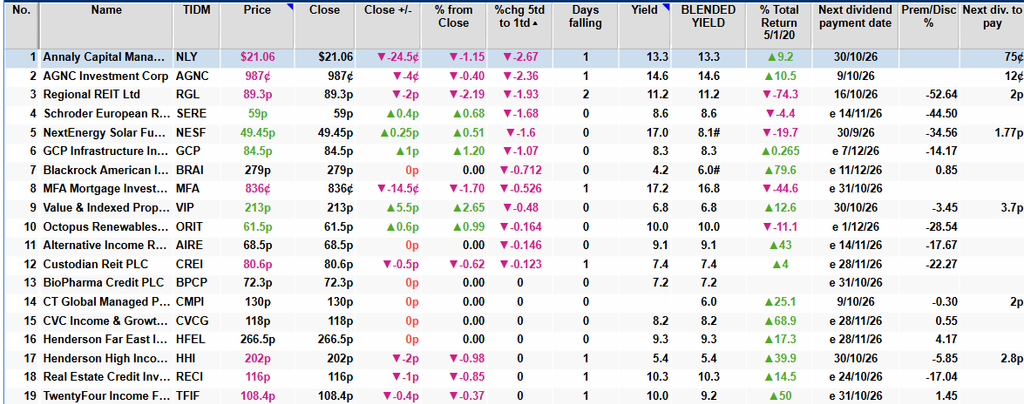
All the companies are loan arrangers, currently all paying a high yield, which tells you all you need to know about the market. The SNOWBALL would like to own NCYF but at a higher yield and at a discount to NAV, which means waiting for a market crash.

Now that’s a scary chart, when the market thought that due to covid companies wouldn’t be able to make loan repayments. Using good ole hindsight it was a great opportunity because as the price fell the yield rose and around the low the dividend was trimmed but the yield was still around 30% (subject to when you bought), where you would still be receiving a similar buying yield.

Back to RECI their loans are secured against property, so they should be a lower risk.

It never stopped the share from falling but it recovered fairly smartly but still not back to its previous price.

Everything crossed for the next market crash.

CMPI

A lower risk core share for your Snowball.

Price 129p dividend 7.6p yield 5.9%

If the price rises and the yield falls, you could book your profits and re-invest in a higher yielder/risk IT. If not keep re-investing the dividends either back into CMPI or your Snowball.

The SNOWBALL currently doesn’t invest in CMPI as the earned and re-invested dividend stream means that the SNOWBALL can take more risks when re-investing. When the SNOWBALL nears its drawdown period, it could become a key component of it’s income stream.

4 ETFs Yielding Over 7%

4 ETFs Yielding Over 7% That Income Investors Are Quietly Buying

These ETFs are compelling as investors still struggle to capture meaningful yields from equities.

By David Dierking – Mar 22, 2026

Key Points

  • Income seekers are looking beyond traditional equities for high yields.
  • Option income strategies remain popular, but investors have been committing money to alternative strategies as well.
  • These ETFs yielding 7% or more have proved to be good high-income diversifiers, but be aware of the risks.

If you’re a dividend stock investor, things are finally looking better for you in 2026.

After three straight years of underperformance in a market dominated by large-cap tech, dividend stocks have finally swung back into favor. One exchange-traded fund (ETF), the WisdomTree U.S. Total Dividend ETF, is outperforming the S&P 500 by about 5% year to date on the heels of leadership from value and defensive stocks.

But dividend yields are still pretty thin. The Vanguard S&P 500 ETF is only yielding about 1.1%. If you focus more on high yield stocks, you can capture something in the 3% to 4% range. To find something higher than that, you have to consider more niche and unique strategies.

Income investors have been looking into various strategies for high yields. Here are four ETFs that have drawn positive net inflows over the past three months and the past year, but have yet to really capture the market’s attention.

A couple looking at financial statements on a tablet.

Image source: Getty Images.

1. JPMorgan Equity Premium Income ETF

The JPMorgan Equity Premium Income ETF (JEPI) was one of the biggest success stories of the 2022 bear market. As yields began soaring and fixed income was delivering double-digit losses, covered-call strategies emerged as an alternative to bonds. With yields pushing 10% or higher, they soon drew billions of dollars of investor money.

This fund’s returns have cooled off over the past couple of years during the AI boom, but investor interest hasn’t waned. It’s up to more than $43 billion in assets and has taken in net new money of $2.3 billion in 2026 alone. It has a current yield of 7.6%.

JEPI

NYSEMKT: JEPI

JPMorgan Equity Premium Income ETF

The JPMorgan Equity Premium Income ETF is built on a portfolio of low-volatility stocks, so it’s made for an environment like the one we’re seeing now. It worked well in 2022, and it could work again in 2026.

2. JPMorgan Nasdaq Equity Premium Income ETF

The JPMorgan Nasdaq Equity Premium Income ETF (JEPQ+0.17%) is essentially the Nasdaq 100 version of the fund above. It was just launched in 2022, but it caught the popularity wave of its sister fund and then captured further buying interest due to the bull market in tech stocks. It offers a current yield of 11.4%.Collapse

JEPQ

NASDAQ: JEPQ

JPMorgan Nasdaq Equity Premium Income ETF

That higher yield is a product of the higher volatility that comes from the Nasdaq 100 stocks compared to a portfolio of low-volatility stocks. If the major U.S. indexes continue meandering sideways, as they have in 2026, it could be the kind of environment where we see the JPMorgan Nasdaq Equity Premium Income ETF actually outperform the Invesco QQQ ETF.

3. Global X SuperDividend ETF

The Global X SuperDividend ETF (SDIV) is about as pure of a high-yield equity play as you’ll find. Its strategy is simple: Include the 100 highest-yielding equity securities in the world (subject to minimum liquidity and tradable potential). Outside of that, it places almost no restrictions on what can make the cut.

What you end up with is a portfolio that’s heavy in financials (32%), real estate investment trusts (20%), and energy (18%). It’s also very diversified globally. The U.S., developed markets, and emerging markets all have nearly equal allocations of one-third each. It has a current yield of 7.3%.Collapse

SDIV

NYSEMKT: SDIV

Global X Funds – Global X SuperDividend ETF

Over the past year, investors have loved this fund. It has experienced 14 consecutive months of net inflows, including $60 million so far in March 2026. If that number holds, it would be the biggest monthly net inflow in 12 years.

4. VanEck BDC Income ETF

The VanEck BDC Income ETF (BIZD) is a fund that investors keep dipping their toes into, but it should come with a big warning. This fund invests in business development companies (BDCs), and that means heavy exposure to private credit.

BIZD

NYSEMKT: BIZD

VanEck ETF Trust – VanEck Bdc Income ETF

Its three biggest holdings are Ares CapitalBlue Owl Capital, and the Blackstone Secured Lending Fund. Blue Owl, in particular, has been in the news a lot lately for freezing investor capital and halting redemption requests. There can be plenty of potential with this segment of the market, but private credit can be illiquid and risky, as many investors are finding out right now.

The VanEck BDC Income ETF has an attractive yield of 9.6%, but be careful about getting too aggressive with the yield hunting here.

Compound Interest Case Study

Charcol; and Nick Sutton, sales director, Retirement Solutions

Ms Lowe’s concerns around equity release are completely valid, particularly when it comes to the potential for interest to compound over time. If Ms Lowe were to borrow £250,000 against her £800,000 home, the current best rate available as of today is a 6.4pc monthly equivalent rate (MER), or 6.59pc annual equivalent rate (AER).

If she chose not to make any repayments, the balance after 15 years would grow to approximately £651,261. This gives her the cash now without the need for monthly payments but does of course mean a significant reduction in the value of the estate left behind.

« Older posts Newer posts »

© 2026 Passive Income Live

Theme by Anders NorenUp ↑