The Telegraph thinks Merchants is well placed to capitalise over the long term, while The Mail on Sunday’s Midas believes Custodian Property Income has shown that it can deliver through thick and thin.
ByFrank Buhagiar•12 Aug, 2024•
Questor: Now is the time to add this long time favourite to your portfolio
The Telegraph’s Questor is upbeat about the FTSE 100’s future prospects. Bargain-basement valuations; globally focused companies (over 80% of sales made by FTSE100 constituents are generated outside the UK); and an improving outlook for the world economy – just three reasons cited for the tipster’s positivity. And Questor is putting its money where its mouth is by increasing its wealth preserver portfolio’s exposure to UK large-cap stocks. It’s doing this by adding a holding in long time favourite Merchants (MRCH). Easy to see why – the UK equity income fund was originally tipped by Questor back in February 2020 and has since generated an 18% capital return. The five-year record is even more impressive – up +50% compared to the FTSE All-Share’s +31%.
MRCH isn’t just a play on the world economy though, but the UK too. In addition to having 54% of its funds invested in FTSE 100 stocks, a further 39% of its holdings herald from the more domestically oriented FTSE 250. A more stable political outlook and the prospect of further interest rate cuts all bode well for UK mid-caps then. A positive global and domestic outlook allows Questor to be comfortable with MRCH’s11% gearing which could prove to be a useful ally in a rising stock market. And then there’s the income side of the equation. For as well as targeting long-term capital returns, the c. £900m fund looks to deliver above-average dividend growth, a neat fit with the wealth preserver portfolio’s aim to generate above-inflation total returns.
So too is MRCH’s strategy which is to buy stocks with sound fundamentals when they trade at attractive valuations. As Questor concludes “With Merchants having an excellent track record of outperformance, a sound strategy and generous gearing, it is well placed to capitalise over the long term.”
Midas: The property investment trust going cheap and packing a 7.5% dividend
The above-titled article opens with an interesting fact: the UK produces over 25 billion pints of milk a year. What that has to do with Custodian Property Income (CREI), the property investment trust that has caught the attention of The Mail on Sunday’s tipster, to be revealed later. But first, Midas highlights how CREI came to market in 2014 with £100 million worth of property and a £1 share price. Fast forward to today and the property fund’s assets are valued at £590 million. The share price has moved in the opposite direction however – the shares trade below the 80p level. Midas believes “The decline seems overdone and should reverse, as sentiment towards the property industry improves and interest rates continue to fall.”
In the meantime, shareholders are being paid to wait. Last year, CREI paid out 5.8p per share in dividends. This year, 6p per share is being targeted. At the current share price that equates to a 7.5%+ yield. Those high payouts are no one-offs. That’s because management “firmly believes that the main purpose of property firms is to generate reliable income for investors.” And because of those high dividend payments, investors who bought shares at the time of the 2014 listing would have made a 36p return on every 100p invested. That easily beats the 20% return generated by other listed property stocks over the same period.
What’s more CREI has achieved this sector-beating return without taking on excessive risk. At the heart of this is the portfolio’s diversification: properties – at the last count there were 155 spread across the country; tenants – the properties are let to more than 300 tenants, meaning no single tenant accounts for more than 1.5% of the rent roll; and sectors – the portfolio is exposed to a wide range of sectors including out-of-town retail parks and small industrial sites. Because of that diversification, “Custodian has shown that it can deliver through thick and thin, dividends are a big draw. At 79p, the stock is a buy.” As for what connects CREIto the 25 billion pints of milk the UK produces each year – Silgan Closures is a leading producer of lids for plastic milk bottles and produces these at an industrial unit owned by CREI.
££££££££££££
MRCH currently yields just under 5%, so if u wanted to buy and maintain a portfolio yield of 7%, u would need to pair trade it with another yielder.
JLEN Environmental Assets – Vote against discontinuation
18 July 2024
QuotedData
Vote against discontinuation
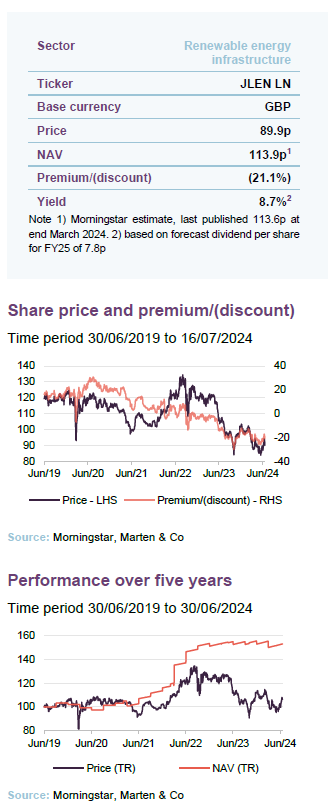
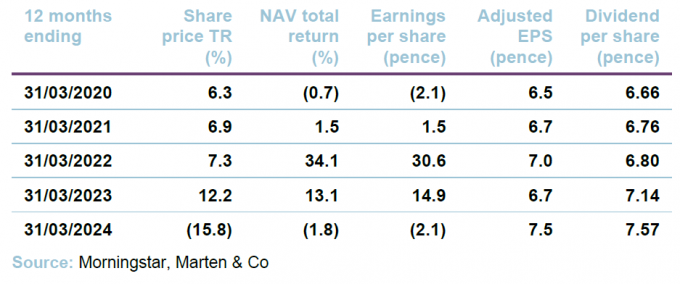
JLEN Environmental Assets (JLEN) and the wider renewable energy infrastructure sector have traded at a persistently wide discount with investor sentiment continuing to wane. This has triggered the activation of a discontinuation vote at JLEN’s AGM in September. We strongly believe shareholders should vote against discontinuation, taking into account the strong long-term track record of the company, which has produced NAV total returns of 119.5% since its launch just over 10 years ago to the end of June and delivered dividend growth every year.
The fundamental growth story for the sector remains as strong as ever, with investment in the energy sector continuing to swell – the majority of which is going to clean energy technology such as renewables, low carbon fuels, nuclear, grids and battery storage.
Progressive dividend from investment in environmental infrastructure assets
JLEN aims to provide its shareholders with a sustainable, progressive dividend, paid quarterly, and to preserve the capital value of its portfolio. It invests in a diversified portfolio of environmental infrastructure projects generating predictable wholly or partially index-linked cash flows. Investment in these assets is underpinned by a global commitment to support the transition to a low-carbon economy and mitigate the effects of climate change.
Fund profile
JLEN invests in infrastructure projects that use natural or waste resources or support more environmentally-friendly approaches to economic activity, support the transition to a low carbon economy, or mitigate the effects of climate change.
JLEN’s assets are broadly categorised as intermittent renewable energy generation, baseload renewable energy generation and non-energy-generating assets that have environmental benefits. Intermittent energy generation investments include wind, solar and hydropower. Baseload renewable energy generation investments include biomass technologies, anaerobic digestion and bioenergy generated from waste. Non-energy-generating projects include wastewater, waste processing, low carbon transport, battery storage, hydrogen and sustainable solutions for food production such as agri- and aquaculture projects.
JLEN aims to build a portfolio that is diversified both geographically and by type of asset. This emphasis on diversification reduces the dependency on a single market or set of climatic conditions and helps differentiate JLEN from the majority of its peers, which tend to specialise in solar or wind.
Reflecting its objective of delivering sustainable, progressive dividends and preserving its capital, JLEN does not invest in new or experimental technology. A substantial proportion of its revenues is derived from long-term government subsidies.
JLEN’s AIFM is Foresight Group LLP (Foresight). Foresight is one of the best-resourced investors in renewable infrastructure assets, with £12.1bn of AUM as at 31 March 2024. This includes Foresight Solar Fund, which sits in JLEN’s listed peer group. Foresight has a highly experienced and well-resourced global infrastructure team with 175 infrastructure professionals managing around 4.7GW of energy infrastructure. It is a global business, with offices in eight countries. The co-lead managers to JLEN are Chris Tanner and Edward Mountney.
Annual results
In annual results announced last month, JLEN reported a total NAV of £751.2m or 113.6p per share at 31 March 2024 – a 7.7% fall over the year. This equated to a NAV total return of -1.6% including dividends of 7.57p (which were 6% up on the prior year). JLEN’s NAV total return since IPO is 115.9% (8.0% annualised).
Cash from projects at record high underpinning the dividend
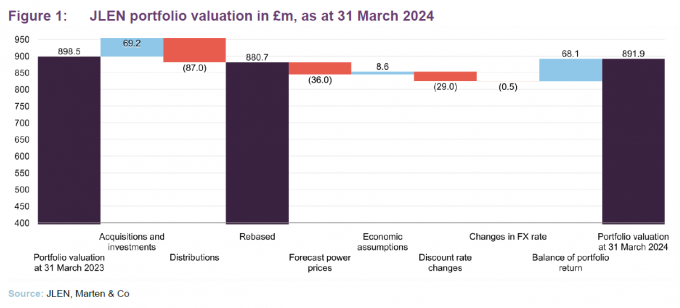
Distributions received from projects were at a record high of £87.0m (2023: £83.6m) and underpinned the dividend with a coverage of 1.3 times. The value of the portfolio fell £6.6m over the period, as shown in Figure 1, due mainly to changes in power price and discount rate assumptions, offset by underlying growth in the portfolio.
Discontinuation vote
As with many of its renewable energy and infrastructure peers, JLEN’s shares have been trading at a wide discount since interest rates ballooned in 2022. With the discount having averaged more than 10% in the financial year, a discontinuation vote has been triggered, which will take place at the company’s AGM in September.
Somewhat counterintuitively, shareholders should vote against the resolution if they want the company to continue. We believe this is the course investors should take, given the strong long-term track record of the company (see page 15), including delivering dividend growth every year since its launch 10 years ago (see page 19 for the dividend section).
Change in name and cut in management fee proposed
A reduction in the investment management fee will come into effect from 1 October (see page 21 of this note for details), while the board has proposed to shareholders a change in name of the company to Foresight Environmental Infrastructure – to reflect the fact that it has been five years since Foresight acquired the management team of John Laing (which informs the current name). The board states that it has assessed the benefits available through a closer association with the investment manager – including the scale afforded by its broader marketing initiatives and strong market reputation – and believes that there are clear commercial benefits to renaming the company. Should shareholders approve the proposed change of name, the board is recommending the company’s ticker change to FGEN and its website address switch to FGEN.com.
Market backdrop
The timing and pace of the impending interest rate cutting cycle is unknown, but the general consensus seems to be that the first rate cut in the UK will come in August – despite inflation falling back to the Bank of England’s target 2% in May. The first downward move in the base rate will be an important moment for many sectors, not least renewable energy infrastructure, where the higher interest rate landscape has put a substantial downward pressure on NAVs and, even more so, investor sentiment.
A general acceptance that the eventual pace of cuts is likely to be slower than first thought, plus the impact of falling inflation on cash flows from energy-generating assets and continued geopolitical instability, has seen discounts across all infrastructure companies remain persistently wide.
Estimated $2.8trn invested in energy sector in 2023, the majority of which aimed at clean energy technology
However, the fundamental growth story for the renewable energy infrastructure sector and JLEN remains as strong as ever, with the green agenda an urgent priority of most global governments. The International Energy Agency (IEA) has estimated that investment in the energy sector amounted to $2.8trn in 2023, of which more than 60% was invested in clean energy technology such as renewables, low carbon fuels, nuclear, grids and battery storage.
There seems to be political support across the benches for boosting clean energy capabilities in the UK and in Europe (key markets for JLEN), despite the recent European Union elections. The new Labour government in the UK has pledged to ‘make Britain a clean energy superpower’ and has vowed to work with the private sector to double onshore wind, triple solar power, and quadruple offshore wind by 2030, while also investing in carbon capture and storage, hydrogen and marine energy to ensure the country has the long-term energy storage it needs. This is in contrast to the US, where a Trump administration seems likely to scrap the Inflation Reduction Act (IRA, which has worked well in incentivising investment in green technology).
JLEN’s diversified portfolio and the manager’s strong track record and expertise in the sector seems completely at odds with its current discount of 21.1%. JLEN’s board has set out its approach to capital allocation, which includes prudent management of debt and consideration of share buybacks if they are NAV accretive. We explore the factors impacting JLEN’s NAV in detail below, beginning with power prices.
Power prices
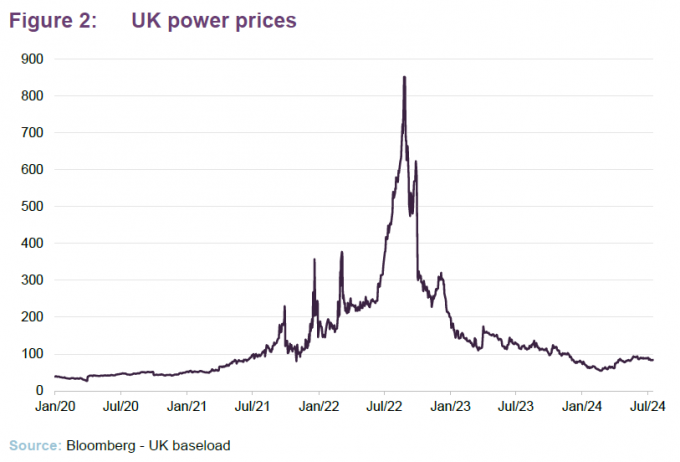
Despite having already fallen steeply from highs seen in 2022, electricity prices continued to fall further and faster than anticipated over the last year, as shown in Figure 2.
The overall change in forecasts for future electricity and gas prices compared to forecasts at 31 March 2023 negatively impacted JLEN’s NAV by £36.0m or 5.4p in the year to the end of March 2024.
Fixed prices secured on the majority of portfolio
JLEN looks to de-risk its exposure to volatile market prices and has fixed prices for the majority of its output. At 31 March 2024, the portfolio had price fixes secured over 61% for the Summer 2024 season and 58% for Winter 2024/25 season. Short-term market forward prices for the next two years are used to value the portfolio where contractual fixed price arrangements do not exist. After the initial two-year period, the project cash flows assume future electricity and gas prices in line with a blended curve informed by the central forecasts from three established market consultants.
Based on the portfolio at end March 2024, a 10% fall in power prices over the remaining life of JLEN’s assets would take off £37.4m or 5.7p from the NAV and a 10% increase would add £37.0m or 5.6p to the NAV. Even though the last months of the previous year had already seen electricity prices fall sharply from the highs seen during the energy crisis in 2022, electricity prices continued to fall further and faster than anticipated. In the year to March 2024, power prices reduced by a further £40/MWh – equivalent to approximately 40%.
JLEN’s manager states that in the extreme event that electricity prices fall to only £40/MWh, the company would maintain a resilient dividend cover for the next three financial years.
Discount rates
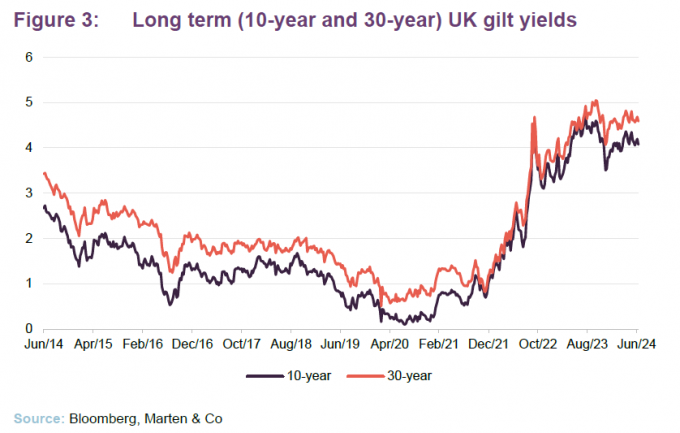
Gilt yields have remained at an elevated level for almost two years, as shown in Figure 3. Government borrowing costs rose sharply from the beginning of 2021 and accelerated in the fallout from the ‘mini budget’ of September 2022 and have remained elevated since.
The weighted average discount rate now sits at 9.4%
JLEN’s weighted average discount rate has remained unchanged over the six months to 31 March 2024 at 9.4%. This is 100bps higher than a year prior due to an upward movement in the discount rate applied in June and September 2023, reflecting the sustained increase in UK gilt yields as well as continued investment into JLEN’s ongoing development and construction projects (which are valued using higher discount rates to reflect the development risk). However, the discount rate was reduced on some construction projects that achieved key milestones during the year.
The overall uplift in discount rate over the year took £29.0m off the NAV.
The discount rates that are used in the discounted cash flow calculations that inform the NAVs of many alternative assets funds, including those in the renewable energy sector, can be broken down into the risk-free rate – derived from the yield on a government bond with equivalent duration – plus a risk premium. The risk premium element of the discount rates calculation is influenced by various factors including the composition of the portfolio and investors’ risk appetite for these sectors and projects, based on recent comparable market transactions.
An independent verification exercise of the methodology and assumptions applied in JLEN’s NAV calculation is performed by a leading accountancy firm and an opinion provided to the directors on a semi-annual basis.
Inflation
Inflation assumptions upgraded slightly
62% of JLEN’s forecasted revenues are contractually linked to inflation (as measured by the RPI) through government-backed subsidies and long-term contracts. An uplift in inflation assumptions used to value JLEN’s portfolio (based on actual data and independent forecasts) to 3.5% RPI inflation for 2024 (from an assumption of 3.0% at 31 March 2023) – reverting to 3% until 2030, and then falling to 2.25% thereafter – resulted in an overall increase in value of £8.6m.
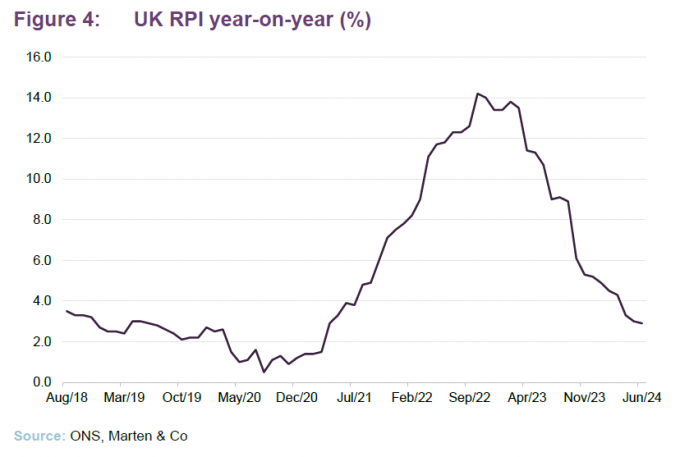
Figure 4 shows that RPI inflation fell to 2.9% in June 2024. JLEN’s sensitivity to changes in the inflation rate is about +£19.3m or 2.9p on the NAV for every 0.5% increase in the forecast inflation rate and a decrease of £18.9m or 2.9p on the NAV if rates were reduced by the same amount.
Useful economic lives
The assumption JLEN uses for the useful economic life of investments is the lower of lease duration and 35 years for solar assets, 30 years for wind farms and 20 years for anaerobic digestion (AD) facilities – being the life of the RHI subsidy. JLEN applies a conservative valuation in regard to its AD assets, with the assumption that the facilities will simply cease to operate beyond the life of their RHI tariff. The manager says that it has seen a growing case of evidence, including several transactional datapoints, pointing towards a positive change in market sentiment for valuing these assets – including the potential to run anaerobic digestion facilities on an unsubsidised basis.
In light of this change, the manager has provided a sensitivity extending the useful economic lives of its AD portfolio by up to five years – capped at the duration of land rights already in place. Such an extension would result in an uplift in the portfolio valuation of £21.9m or 3.3p.
Taxation
As we discussed in more detail in previous notes (links to which can be found on page 24), the UK government introduced a temporary windfall tax on electricity generators – the Electricity Generator Levy (EGL) – in response to higher energy prices. JLEN’s wind, solar and biomass assets are affected by the levy, which saw the government take 45% of revenues above a price of £75/MWh from 2023 to April 2024, and thereafter adjusted each year in line with inflation (as measured by CPI) on a calendar-year basis until the levy comes to an end on 31 March 2028. JLEN paid £5.5m on the EGL tax in the financial year, with the annual liability for the 2025 financial year estimated to be lower, reflecting the drop in power price forecasts year-on-year.
Around 42% of JLEN’s assets at the end of September 2023 fell completely outside of the levy. The managers say that this is a strength of having a diversified portfolio that has a combination of assets that generate electricity (and fall in the scope of the levy), assets that generate gas (the anaerobic digestion plants), and assets that do not generate energy at all (batteries, CNG refuelling stations, and the controlled environment assets).
Alternative Income REIT PLC ex-dividend payment date Aquila European Renewables PLC ex-dividend payment date Baillie Gifford UK Growth Trust PLC ex-dividend payment date Balanced Commercial Property Trust Ltd ex-dividend payment date BlackRock Sustainable American Income Trust PLC ex-dividend payment date Fair Oaks Income Ltd ex-dividend payment date Greencoat UK Wind PLC ex-dividend payment date Henderson Opportunities Trust PLC ex-dividend payment date ICG Enterprise Trust PLC ex-dividend payment date Impax Environmental Markets PLC ex-dividend payment date Majedie Investments PLC ex-dividend payment date Montanaro European Smaller Cos Trust PLC ex-dividend payment date Murray Income Trust PLC ex-dividend payment date NextEnergy Solar Fund Ltd ex-dividend payment date Octopus Renewables Infrastructure Trust PLC ex-dividend payment date Pershing Square Holdings Ltd ex-dividend payment date Reach PLC ex-dividend payment date Renewables Infrastructure Group Ltd ex-dividend payment date Target Healthcare REIT PLC ex-dividend payment date Tritax EuroBox PLC GBP ex-dividend payment date VH Global Sustainable Energy Opportunities PLC ex-dividend payment date
Hi, i think that I saw you visited my web site thus I came to go back the desire? I am attempting in finding things to enhance my web site! I assume its good enough to use some of your concepts!!
It already feels a long time ago that Labour won a landslide election at the start of July, but this seems to have had a calming influence on the market. The long-awaited interest rate cut occurred at the start of August, but even before this, the average share price move amongst the listed property sector was +3.1%. Corporate activity was again the driver behind many of the largest share price gains, with European logistics landlord Tritax EuroBox revealing that it was in discussions with more potential suitors following initial interest from Brookfield. A conclusion to Balanced Commercial Property Trust’s strategic review seems to be close, with a bid still on the cards. European property securities trust TR Property posted a double-digit uplift in its share price, mirroring the performance of its portfolio companies during the month. Values were back trending upwards for many of the diversified REITs, with AEW UK REIT (which also reported progress on dividend cover), Schroder REIT and Picton Property all seeing impressive share price gains. Capital & Regional continues to be the subject of takeover discussions, with a second party entering the fray. Meanwhile, student specialist Unite Group raised £450m in a placing.
Worst performing funds
Office landlord Regional REIT saw another sizable drop in its share price following a dilutive £110.5m rights issue in June. The company now languishes on a monstrous discount to NAV of almost 80%. Real Estate Investors is in wind down mode and reduced its dividend to reflect lower earnings from its diminishing portfolio. Three other companies at various stages of winding up – Macau Property Opportunities, Palace Capital and Ground Rents Income Fund – also feature. The residual value of the latter’s portfolio continues to be negatively impacted by leasehold reforms, but in a much more buoyant environment, a flat NAV was enough to earn its and Cuban property investor Ceiba Investments’ places in the table. Many other thinly traded real estate companies also made the worst performing funds table in July, reflecting the volatile nature of their share prices. This was the case for UK investor/developer Conygar Investment Company, and pan-African real estate investor and developer Grit Real Estate Income Group. Having staged a mini share price revival in the wake of its strategic review, in which it vowed to continue in its pursuit of development returns, London office developer Helical gave up those gains and now trades on a circa 35% discount to NAV.
Valuation moves
Company
Sector
NAV move (%)
Period
Comments
AEW UK REIT
Diversified
3.1
Quarter to 30 June 24
2.4% like-for-like valuation increase for the quarter to £215.8m
Schroder REIT
Diversified
0.5
Quarter to 30 June 24
Portfolio value increased 0.3% to £461.6m
Picton Property
Diversified
(0.1)
Quarter to 30 June 24
Like-for-like portfolio valuation increase of 0.4% to £700.2m
Balanced Commercial Property Trust
Diversified
(2.1)
Quarter to 30 June 24
Value of portfolio fell 1.5% to £943.3m
Unite Group
Student accom.
5.3
Half-year to 30 June 24
Portfolio valued at £5.7bn, up 2.7% on a like-for-like basis
Shaftesbury Capital
Retail
1.6
Half-year to 30 June 24
Portfolio valuation increased by 1.4% on a like-for-like basis to £4.8bn
SEGRO
Logistics
(1.8)
Half-year to 30 June 24
Values were flat; however, NAV fall was largely due to the impact of an equity placing
Primary Health Properties
Healthcare
(2.8)
Half-year to 30 June 24
Value of portfolio declined 1.4% to £2.75bn
Hammerson
Retail
(25.5)
Half-year to 30 June 24
NAV hit by sale of Value Retail stake at 24% discount to book value (see page 4 for details)
Markets have suddenly turned very volatile. One explanation is that everyone seems to have forgotten that it’s not nominal but real rates that matter.
ByDavid Stevenson•08 Aug, 2024•
As I write, markets are in a volatile mood. None of this should come as any great surprise as markets have been in an unbearably bullish mood for far too long, with everyone and their aunt assuming that the U.S. economy might have escaped even a slowdown, let alone a recession. The source of this jittery market sentiment? Friday’s non-farm payrolls figure came in at 114 vs. a 175k expectation with U.S. unemployment rising to 4.3% from 4.1%. Markets reacted very negatively to the miss and while the case for a rate cut builds rapidly, the concerns around a hard landing and deeper recession for the US economy are also escalating. Add in concerns about the geopolitical environment and growing uncertainty about the US election, and you have the makings of a classic sell-off. Oh, and there’s the obvious issue that U.S. tech stocks were over-bought and over-owned.
But I would argue that investors have also indirectly acknowledged the importance of a little discussed term called the real interest rate. The mass media tends to focus on the nominal interest rate, which was reduced last week to 5%. But the real interest rate is far more important. This was first popularised by the economist, Irving Fisher, who argued that we need to consider the importance of inflation in understanding the return on cash rates. He suggested an equation which states that the real interest rate is the nominal interest minus the expected rate of inflation. That last variable, the expected rate of inflation, can be deduced from market measures of the breakeven rate (for anything from 1 to 30 years) for government bonds. That, in turn, can be sourced from the Bank of England’s website, which publishes data on the forward implied inflation rates based on UK bonds. These suggest, currently, that in the UK, the market has pencilled in a 3-year implied inflation rate of 3.84%, a 5-year rate of 3.62% and a 10-year rate of 3.47%. Plug this into the simple equation – let’s go with a blended medium-term rate of 3.7% – and we get a real rate of 1.25% in the UK. By contrast, the U.S. Federal Bank formally publicises its real rate based on forward numbers, with the current 10-year real interest rate running at 2.05%. It also publicises its 10-year breakeven rate, which is, coincidentally, running at 2.04%, with the US nominal interest rate running at 5.33% (which is the Federal Funds Effective rate). The US 1-year (forward) real interest rate is running at 2.5%.
This all sounds terrifically interesting to a dismal economist but the average reader is probably left wondering why it matters. The first point is that long term real interest rates have been heading down steadily for hundreds of years. We tend to think that the last decade of negative real rates (close to zero interest rates and inflation above 1 or 2%) was an unprecedented era, but a paper by Bank of England economists, available freely online, shows clearly and clinically that real rates have been trending to close to zero for decades now, across the world. They call it a supra-secular decline. What’s the driver? Put simply, in our more egalitarian world, its surplus of capital was always going to drive real rates lower. The author concludes, “my new data showed that long-term real rates – be it in the form of private debt, non-marketable loans, or the global sovereign “safe asset” – should always have been expected to hit “zero bounds” around the time of the late 20th and early 21st century, if put into long-term historical context.” As for causes, it’s better to look at the massive accumulation of capital and savings across many developed economies and the declining volatility of both real rates and inflation. The paper also argues that as the capital stock grows relative to labour and other factors of production, the marginal return on capital decreases, leading to lower interest rates. I would also add the idea of secular stagnation as one possible explanation—this once popular idea looks at declining productivity growth rates and lower GDP growth rates and argues that the UK, in particular, but Europe more generally, has struggled to grow at an above-average rate, forcing down real rates. Regardless of the causes, one fact stands out. UK and U.S. real rates are now strikingly positive, even after the recent small cut in the UK. This is fine and dandy for some months and maybe even a year, but eventually, high positive real rates start to have an impact, and I would suggest that the U.S. payroll numbers are the canary in the coal mine – and U.S. equity investors have reacted. They have twigged that there is a possibility that the U.S. Federal Reserve is too hawkish and that their central bankers will now be forced to reconsider and cut rates even quicker than expected. In contrast, in the UK, markets are already betting on more rate cuts in the next six months. Real positive interest rates matter because they throttle investment and act as a disincentive to borrow. That impact isn’t felt immediately, but over a sufficient period – say 1 to 2 years – the pain becomes real, and even governments struggle to find the money to fund their own huge fiscal deficits. Given these widely acknowledged facts, I would argue that a reasonable scenario goes as follows. Both the U.S. and the UK will find themselves in a difficult spot as central banks try and tamp down inflation without completely throttling investment growth. The natural middle ground is that you push the real interest rate closer to +1% in the U.S. – the U.S. economy has probably been overheating in the last year, helped by a massive government deficit, so could probably sustain a positive real rate for a little longer That might suggest a landing place of around 3.5 to 4% for U.S. interest rates by some point in the first half of next year.
Given the UK’s more anaemic growth rate, one might be tempted to bring the real interest rate back to neutral, i.e. close to 0% or possibly as high as +0.5%. Given our longer-term inflation expectations, which are higher than those of the U.S., that might imply interest rates around the 4% level by early 2025.
What does this mean for investment trusts? I would argue strongly that prospects for the myriad of alternative investment trusts, ranging from lending funds to renewable funds, yielding more than 6.5% and some as high as 10%, will now start to look up. Cautiously, I think it reasonable to pencil in some decline in net yields for these funds (especially if they have floating rate debts), but if UK nominal rates stabilise around 4%, then any fund yielding a robust and well-covered yield of above 7% starts to look very compelling. And that list is long and getting longer by the week.
Two JPMorgan Japan funds unveil tie-up, TRIG triggers buyback programme, Triple Point Social Housing keeps credit rating, while Henderson Smaller Companies makes it 21 years in a row of dividend increases.
ByFrank Buhagiar
Two more JPMorgan funds to tie up
JPMorgan Japan Small Cap Growth & Income (JSGI) and JPMorgan Japanese (JFJ), the latest two JPMorgan investment companies to propose joining forces. As per JSGI’s press release, “JSGI’s assets will be rolled into JFJ in exchange for the issue of new JFJ shares to the continuing JSGI shareholders.” JSGI shareholders will be entitled to realise up to 25% of their JSGI holding for cash. Lots of reasons cited for the merger – broad all-cap strategy; increased scale; and reduced fees and costs.
JSGI Chair, Alexa Henderson, and the board believe “the proposed combination will provide continuity of investment process and philosophy within a broader market opportunity. The proposed combination will provide a much larger investment trust with significantly lower costs for shareholders.”
Winterflood: “With JFJ trading at an 8.8% discount, and JSGI at a 13.5% discount, JSGI shareholders should expect to receive an uplift following completion. Finally, the scale benefits of the combination cannot be overlooked, especially given reduced management fees and ongoing costs, at a time when costs are at the forefront of many investors’ minds, and greater liquidity, when there exist too many sub-scale funds within the sector.”
The Renewables Infrastructure Group joins the buyback pack
The Renewables Infrastructure Group (TRIG) announced a £50million share buyback programme following progress made with the fund’s capital allocation strategy. This includes reducing TRIG’s Revolving Credit Facility (‘RCF’) to c. £150m during 2024. “Based on current cash flow projections, divestments agreed to date, and assuming that c. £25m of the buyback programme is completed in 2024, RCF drawings would reduce from £364m at 31 December 2023 to c.£220m at 31 December 2024.” That’s not all. Additional disposals are in the pipeline as well as portfolio-level financing opportunities that will further reduce RCF drawings as well as “create greater capacity for future investment activities.”
Liberum: “TRIG has increasingly appeared as an outlier in the sector for not having an active repurchase programme so this is a welcome development. Given its size, and the very strong capital allocation argument for repurchasing shares at the discounts it has traded at, we think the market has been disappointed with the lack of a programme to-date.” Appears the market can cast aside its disappointment now!
Triple Point Social Housing maintains credit rating
Triple Point Social Housing (SOHO) put out a press release announcing that Fitch Ratings has reaffirmed the existing Investment Grade, long-term Issuer Default Rating of ‘A-‘ and a senior secured rating of ‘A’ for the Group’s existing loan notes. That’s the same as the ratings given by Fitch first time round in August 2021.
There has been a change in outlook from stable to negative though “to reflect prolonged rent arrears from two Registered Providers, and the risk that the independent review of the investment management arrangements could result in a change of investment manager.” Thanks for the heads up, Fitch!
Dividend Watch
Henderson Smaller Companies (HSL) is on course to raise its annual dividend for 21 consecutive years. This follows the board’s proposal to increase the final dividend to 19.5p per share. Add that to the 7.5p interim dividend and the total payout for the year comes to 27.0p per share. That’s a 3.8% increase on 2023’s 26.0p per share. “This dividend will be fully funded from current year revenues. As an ‘AIC Dividend Hero’, this will be our 21st consecutive year of growth in the annual dividend.”
The Times thinks Alliance Witan will be a tried-and-tested machine once the merger completes, while The Telegraph believes the outlook for Edinburgh Worldwide has brightened.
By Frank Buhagiar 06 Aug, 2024
Tempus: Alliance Witan will be a tried-and-tested machine The Times’ Tempus Column is minded to give the proposed combination of Alliance (ATST) and Witan (WTAN) the thumbs up. After all, the new fund, which will be known as Alliance Witan, has a fair bit going for it. There’s the combined fund’s size – at £5 billion, the global investor will match F&C Investment Trust (FCIT) for size and will only be behind Scottish Mortgage (SMT). Qualification for FTSE 100 membership therefore likely which “will increase demand among institutions that are mandated to hold shares in the entire index and will match the Alliance management’s desire to put more pension funds, insurance companies and other investment groups on the share register.”
Then there’s the substantial overlap between the two trusts. The two portfolios share capital and income growth strategies that will enable costs to be spread more widely. Both also deploy a multi-manager approach, whereby several fund managers covering different specialisations, regions or industries are mandated to manage a portion of the funds’ assets. It’s an approach that has a track record of delivery: Alliance has generated a +105% shareholder total return over the last seven years; Witan, +65%.
The two funds also have a long track record of dividend growth: Alliance boasts 56 successive years of dividend increases; Witan 48 years. All of which leads Tempus to write “Alliance Witan is a tried-and-tested machine that will appeal primarily to institutions and investors content with a middling income level today on the assurance that it will rise steadily in future.”
Questor: Back this SpaceX investor before its shares rocket When The Telegraph’s Questor Column first published the above article on global small-cap investor Edinburgh Worldwide (EWI) on 17 July 2024, the message in the title could not have been clearer: buy before the shares go higher. At the time, EWI shares were trading at 154.4p. Two weeks on and the share price still trades at around the same level. Investors, it seems, haven’t missed the boat (or should that be rocket) yet then. Worth a revisit of the tip.
The trigger for the piece, reports that the valuation of Elon Musk’s SpaceX had reached $210bn (£161bn). That’s good news for the £587m fund – at 11.8% of total assets, SpaceX is EWI’s largest position. For the trust invests in both public and private companies that it believes “have exceptional long-term growth prospects, even if they are not necessarily currently profitable. It is more skewed towards younger, smaller businesses valued at under $5bn at the point of first investment and has a pronounced technology theme.”
Certainly, the shares could do with a boost. For over the past three years, EWI’s share price has halved. And in the latest half-year results, the trust posted a relatively pedestrian-looking +4.6% underlying return compared to the +15% gain clocked by the index. But at least that was an improvement on the -23% and -40% losses reported for the previous two financial years. What’s more, Questor believes that with, albeit limited, interest rate cuts on the horizon, the outlook for the growth fund has brightened. The article concludes “investors should be wary of committing too much money to Baillie Gifford if they already hold Scottish Mortgage for example. Nevertheless, viewed on its own merits, we have no hesitation in repeating our recommendation for this trust.”