Short answer: DX (Dynex Capital) is a high‑yield, high‑risk mortgage REIT with a 15.4% dividend yield, extreme leverage, and improving earnings spreads, but still exposed to rate‑cycle volatility. It is not a traditional property REIT — it is a leveraged bond‑carry vehicle. For income investors, DX is attractive only if you accept the volatility and the risk of dividend cuts.
📌 DX — Full Investment Analysis (Grounded in latest data)
🧭 1. What DXis
DX is an internally managed mortgage REIT (mREIT) investing in:
Agency RMBS (Fannie/Freddie)
Ginnie Mae MBS
CMBS
Interest‑only strips
It earns money from net interest spread, not rents. This makes DX behave more like a leveraged bond fund than a property REIT.
Source:
💰 2. Dividend & Income Profile
Dividend yield:15.41%
Dividend: $2.04 annually, paid monthly
Payout ratio: 211% of GAAP operating cash flow (very high)
Dividend risk score: F
Years of dividend growth: 2
Source:
Interpretation: DX’s dividend is not safe. Mortgage REIT dividends move with interest spreads and leverage. DX has cut dividends in past rate cycles.
📈 3. Earnings & Spread Trends
DX’s Q2 2026 results show meaningful improvement:
EAD per share: $0.36 (+63.6% YoY)
Net interest spread:1.17%, up 21 bps YoY
Portfolio growth: +40% YoY
Coupons locked: 5–6% RMBS
Source:
Interpretation: DX is benefiting from stabilising rates and higher‑coupon MBS. This is the strongest operational improvement in several years.
⚖️ 4. Leverage & Balance Sheet
Leverage:8.1× equity
Debt/book capital: 88.55%
Net debt/EBITDA: 26.35×
Source:
Interpretation: DX is extremely leveraged — typical for mREITs, but still dangerous. Small spread changes = large earnings swings.
📊 5. Valuation & Returns
Price: ~$13
PE: 5.31
ROE: 13.74%
12‑month return: +20.6%
10‑year CAGR: 6.97% (below S&P 500’s 13.49%)
Source:
Interpretation: DX is cheap on earnings but historically underperforms broad equities. Returns come mostly from dividends, not price appreciation.
🧨 6. Key Risks
Rate cycle risk (dominant)
DX is highly sensitive to:
Yield curve inversion
Rapid rate hikes
Spread compression
This is the single biggest determinant of dividend safety.
Dividend cut risk
Payout ratio >200% of GAAP OCF is unsustainable long‑term.
Leverage risk
8× leverage magnifies both gains and losses.
MBS market volatility
Agency MBS are safe from credit risk, but not from duration/hedging risk.
🧠 7. Is DX a Buy?
UK‑based, income‑focused, analytical, and comfortable with REITs — here’s the tailored view:
DX is a buyonly ifyou want:
Very high monthly income
Exposure to stabilising US rate spreads
A contrarian, high‑yield mREIT with improving fundamentals
How to make yourself £5,000 in passive income from stocks and shares
The Independent
Story by Alex Sebastian
28 Aug
Key takeaways
Dividend Basics: Dividends are periodic payments companies make to shareholders. The dividend yield is calculated as annual dividend ÷ share price × 100. Consistency over years is key for reliable income.
High-Yield Stocks & Funds: Best options include asset managers, insurers, and REITs. For hands-off investing, consider equity income funds or ETFs, which provide managed portfolios of dividend-paying stocks with varying fees.
Growing Your Income: Start with spare money or lump sums, reinvest dividends (compounding) to increase holdings, and aim for long-term growth. Example: investing £8,000/year at 5% yield could reach £100,000 in under 10 years.
Passive income is the financial holy grail for many people.
The idea of making money in your sleep, while on the beach or engaging in your favourite hobby is highly appealing.
It is, of course, easier said than done. There is no shortage of people online claiming they can let you in on the secret to passive income, but the vast majority of these are scams, or active side hustles – entirely reputable, but where you need to do the legwork.
The stock market, however, offers arguably the most accessible, attainable and reliable route towards generating a passive income.
UK companies pay semi-annually in most cases, with the money split into an interim dividend and final dividend each year. Some companies pay once year, while in the US and other places, quarterly dividends are the norm.
The dividend yield of a stock is the percentage of its price that gets paid out in the dividend. To calculate it, you divided the company’s annual dividend per share by its share price and multiply that by 100.
So, for a stock with £5 per share dividend and £100 price, the yield it pays is 5per cent.
The numbers will vary year to year, but if they are reasonably steady over time, or even increasing, that is what investors should be looking for.
It is crucial that the dividend has been consistently strong over several years. One good payout followed by a sharp fall is not going to get you far.
Which stocks pay the highest dividends?
Dividends yields vary significantly from company to company. They can be as high as a double-digit percentage on occasions, or as low as zero. Many companies use all the money they bring in to fund their operations and growth plans, rather than paying a dividend.
But there are also types of companies that tend to pay high, consistent dividends, which should form the basis of any effort to generate an income through picking stocks.
First and foremost are asset managers and insurers, particularly in the UK. These are often mature companies, with most of their growth behind them and relatively stable costs of doing business.
This means much of the money they make can be given to their shareholders. Legal & General has been the highest yielding FTSE 100 stock in recent years at around 7.6 per cent, while Aberdeen Group has yielded around 7.1 per cent, M&G in the 7 per cent range and Admiral at 6.4 per cent.
Investment trusts, particularly real estate investment trusts (REITs) are another good option. These are companies which have a sole focus on investing money in assets on behalf their shareholders.
What are equity income funds?
If you do not feel sufficiently knowledgeable or comfortable picking a portfolio of dividend yielding stocks yourself, then investing in an equity income fund, or exchanged-traded fund (ETF), is perhaps the way to go.
Equity income funds have fund managers and analysts identifying the best stocks to meet a target level of income. They will do all the work in finding the stocks most likely to provide a reliable income at the minimal level of risk needed to achieve this. This will of course come with a fee attached. These vary, but broadly land between 0.6 per cent and 1 per cent per year in most cases.
Top-performing equity income funds over the past three years include JOHCM UK Equity Income, TM Redwheel UK Equity Income and Man Income Fund. As always, past performance does not mean future performance will be the same.
The advantage over actively managed funds is a lower fee, typically in the region of 0.15 per cent to 0.4 per cent. Examples include iShares UK Dividend and Vanguard FTSE All-World High Dividend Yield.
How to generate a £5k income from stocks
Clearly some spare money is required to start with, so generating an income from shares is not going to be for everyone, but it might be more achievable than many people think – and you certainly don’t need thousands of pounds going spare to get started.
But being consistent could see you save several thousand pounds a year, and doing so over five to ten years would get you to a point where a meaningful amount of dividend income could then be generated.
Year after year, shares can compound to grow far bigger (Getty Images)
If you are fortunate enough to receive a lump sum from selling something, perhaps a work bonus or inheritance, that offers a great starting point and puts reaching passive income on fast forward.
Best of all, everyone can let compounding go to work to do the heavy lifting over time. Compounding sees you reinvest the dividends you receive back in the same shares (rather than receiving the cash) to increase how many shares you own. In turn, that means next time there’s a dividend payout you get a larger amount – and so on, repeated year after year.
This requires deferred gratification, as you are sacrificing any income you could draw now to benefit from a much bigger passive income later down the line.
By way of a broad example, putting £8,000 a year into a dividend fund yielding around 5 per cent which reinvests the dividends – known as the accumulation units of the fund – could get you reach a total of £100,000 in under ten years, without considering any price gain to the shares. Share prices can also fall of course, particularly in the short term – but if your goal is accumulating shares that’s actually not a problem when it comes to dividend payment time, as the same amount of money can compound into more shares than if the price was higher at that time.
Once you reach £100,000 you could switch to what is called the income units of the funds you are using, instead of accumulation.
An alternative method would be to target higher growth funds at the start, which could reach your target several years earlier if they rose at an annual 7-8 per cent rate, for example, then switch to the dividend fund once you are either at your £100,000 target or ready to start taking income.
With a yield of 5 per cent you would have £5,000 a year paid out to you in passive income, plus still have the value of any continued rise in the prices of shares held by the fund – and if doing so inside an ISA, there would be no tax to pay on any of the gains.
When investing, your capital is at risk and you may get back less than invested. Past performance doesn’t guarantee future results.
The SNOWBALL re-invests with a targeted yield of around 7%
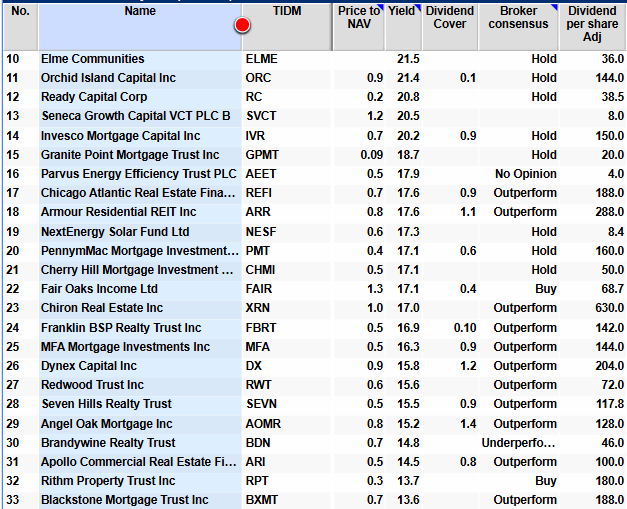
Pair trading is where you split your capital either 50/50 or 60/40, depending on your risk profile, into a higher yielding thus risky share and a lower yielding share which should be less risky. As always expect the unexpected and it’s your duty to check any dividend annoucements.
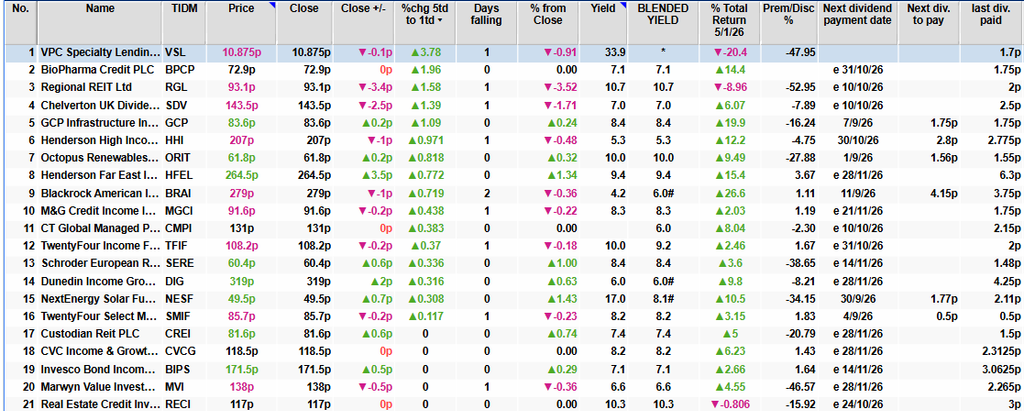
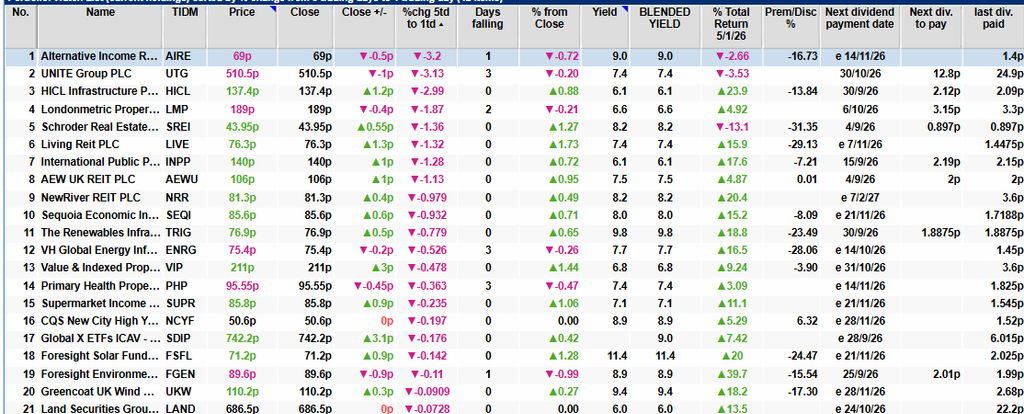
Let’s pick a high yielding share from the list below to research, we will use brokers comments as a starting place.
AI
Short answer: REFI is not an obvious buy, but it is an unusually high‑yield, high‑risk niche REIT whose valuation now looks cheap only if you believe credit losses will stay contained and cannabis‑sector regulation will improve.
Below is the decision‑ready breakdown, grounded in the latest filings and market data you saw above. (Not financial advice — just analysis.)
🧩 What REFI actually is
Chicago Atlantic Real Estate Finance (REFI) is a commercial mortgage REIT that lends almost exclusively to cannabis operators who cannot access traditional bank financing. This niche gives REFI:
Very high loan yields (often 12–18%)
Very high credit risk
Regulatory uncertainty
Limited competition
📉 Current valuation & yield
Share price: $10.67
Dividend yield:17.6% (extremely high)
P/E:7.8× (cheap vs mortgage REIT peers)
High yield + low P/E usually means the market expects credit losses or dividend cuts.
📊 Latest financials (Q2 2026)
REFI’s Q2 numbers show stable but pressured performance:
Net income: $7.47m
EPS: $0.34 (down from prior quarters)
Dividend: $0.47 (again exceeding EPS)
Portfolio yield: still strong (fixed/floored loans)
Credit loss provision: small but rising
Key issue: REFI is not covering its dividend with earnings. That is the biggest red flag.
⚠️ Risks you must weigh
1. Dividend sustainability risk (HIGH)
They are paying out more than they earn. This is the classic precursor to:
dividend cut
share price drop
re‑rating of the stock
2. Sector credit risk (HIGH)
Cannabis operators are:
capital‑starved
often unprofitable
exposed to regulatory swings
prone to defaults
REFI’s filings show rising credit‑loss provisions.
3. Regulatory overhang (MEDIUM)
Federal reform could:
massively help borrowers (good)
compress loan yields (bad)
REFI itself says 2026 could be “one of the more important periods in the history of the company.” Translation: big regulatory uncertainty.
4. Leverage rising
Long‑term debt has climbed from ~$98m to ~$140m in 2026. Higher leverage + stressed borrowers = more risk.
⭐ Reasons someonemightbuy it
You want very high income and accept the risk of a dividend cut.
You believe cannabis regulation will improve.
You think credit losses will stay modest.
You like niche lenders with strong collateral discipline.
❌ Reasons someone would avoid it
Dividend not covered by earnings.
Borrower quality is fragile.
Rising credit provisions.
High leverage.
Sector is volatile and politically unpredictable.
Reliable dividends to date
Cannot be held in a UK ISA, so not a consideration for the SNOWBALL, especially as you may see your cash go up in smoke.
The above only for research not buy or sell advice. I have deleted the top ten yielding shares on a risk basis.
After due diligence, one or two could be bought as part of a pair trading strategy, where you split your capital between a high risk high yielder and a lower yield less risky Trust.
With high yielding shares you are most probably going to make a capital loss if you exclude the earned dividends.
Global income funds (whose top holdings we recently analysed) are one option, but so are portfolios with a more granular approach.
Here, we set out some of those names focused on a specific market that have made big recent payouts – and how the options available differ.
To give a rough sense of the dividends delivered, we have screened for the funds in a given region that would have paid out the most so far this year, had you invested a £10,000 lump sum in late December 2025.
This is just a snapshot of how different funds have fared, but does give us a sense of what’s on offer.
Asia and the emerging markets
The UK market is known for its impressive dividend yields, and it’s Asia and the emerging markets that have competed best on this front.
Plenty of funds offer chunky yields – and have also generated some stellar returns in the last year thanks to an artificial intelligence (AI)-led market rally.
If we look at those funds with higher payouts in 2026 we are immediately met with a familiar name.
stands out with a payout of almost £780 – and certainly has a fanbase thanks to its almost 10% share price dividend yield.
The trust’s shares tend to trade on a small premium to net asset value (NAV) and it’s consistently among the most popular investment trusts among ii customers (as judged by real-time buys).
Note: Dividend payout is YTD in 2026, based on £10,000 lump sum invested in late December 2025. Source: FE Analytics, 18/08/26. Past performance is not a guide to future performance.
As we’ve written before, the trust is not without its failings.
It tends to lag its rivals in the Association of Investment Companies (AIC) Asia Pacific Equity Income sector pretty notably by total returns, meaning investors are sacrificing a good chunk of overall performance in the name of bigger dividends.
That figure came to around 34% for Aberdeen Asian Income, and to 34% for JPMorgan Asia Growth & Income (if at the end of July for the latter).
Note that different forms of income investing are on display here.
The JPMorgan trust uses an enhanced dividend policy, paying out a set proportion of NAV over a year and being less reliant on companies paying it dividends.
Meanwhile, both Schroder Asian Income Maximiser Z Inc (B52QVQ3) and Henderson Far East Income write covered call options, giving other investors the right to the gains on a stock above a certain price, for a fee.
That means they generate extra income but do sacrifice some capital gains in rising markets.
Note: Dividend payout is YTD in 2026, based on £10,000 lump sum invested in late December 2025. Source: FE Analytics, 18/08/26. Past performance is not a guide to future performance.
Some AI momentum can be seen in the composition of this fund, with semiconductor stock ASML Holding NV
Note: Dividend payout is YTD in 2026, based on £10,000 lump sum invested in late December 2025. Source: FE Analytics, 18/08/26. Past performance is not a guide to future performance.
It also uses BlackRock’s “Systematic Active Equity” investment process, which in its own words “combines human insight with the power of big data, machine learning and AI”.
This process involves analysing vast amounts of data and seeking to exploit market inefficiencies and create a diversified portfolio.
In practice, the fund doesn’t stray too far from its value-oriented benchmark and also has plenty of Magnificent Seven exposure.
Note, again, that the likes of income ETFs and “maximiser” funds do generate some income, if much less.
Japan
The Japanese market has continued to generate great returns this year but dividend generation still remains relatively modest, at least from the funds available to UK investors.
Note: Dividend payout is YTD in 2026, based on £10,000 lump sum invested in late December 2025. Source: FE Analytics, 18/08/26. Past performance is not a guide to future performance.
Dividend income is on offer from some troubled names, writes Dave Baxter.
27th August 2026
by Dave Baxter from interactive investor
Once a fashionable part of the investment universe, so-called alternative assets have run into all manner of problems in recent years.
Higher interest rates, combined with issues specific to the investment trust space, have dealt a bad hand to funds focused on areas such as renewable energy infrastructure, property and (to some extent) private equity.
And with plenty of disruption and consolidation still occurring here, bargain hunting for alternatives trusts has become a risky business.
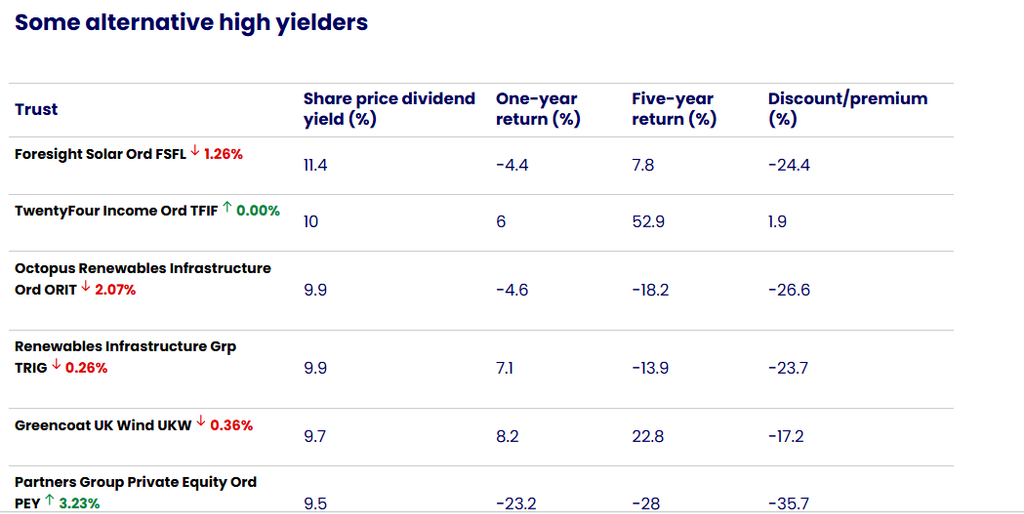
And yet these assets stand out most notably on the income front.
At a time when gains in equity markets have pushed down the dividend yields available, alternatives still offer some juicy numbers.
Many come with yields in either the double digits or the high single digits.
Even if overall performance is poor, some investors would argue that they are getting “paid to wait” through such chunky payouts.
There’s plenty going on with those names that do yield a lot, and many such funds are already in the process of winding up. Here, we look at some of the high yielders that are still active and assess their prospects.
Be wary of wind-downs
Investors can very easily look at investment trust share price dividend yields, for example using the Association of Investment Companies (AIC) website.
But it’s good to remember that high yields can be a sign of trouble, and that some of the funds standing out here are either in some sort of trouble, or looking to wind down.
A glance at some of the names with the highest yields confirms this.
which comes with a 14.5% yield but has struggled on the performance front and is now facing calls to wind down from the US activist Saba Capital, as one example.
The fund has not dodged the issues blighting its sector, with a recent trading statement pointing to a 4.4% drop in portfolio net asset value (NAV) for the first half of 2026, thanks to the effect of rising bond yields and falling near-term power prices.
Iain Scouller, an analyst at Canaccord Genuity, described the update as “disappointing”.
“There is no update on any portfolio sales, and we suspect shareholders would like to see a Bluefield Solar style take-private transaction,” he said.
“However, we think that is easier said than done and if an offer materialised for Foresight Solar, it would probably be at a much higher discount than the 9% for Bluefield Solar Income Fund BSIF given Foresight’s poorly performing non-UK assets.”
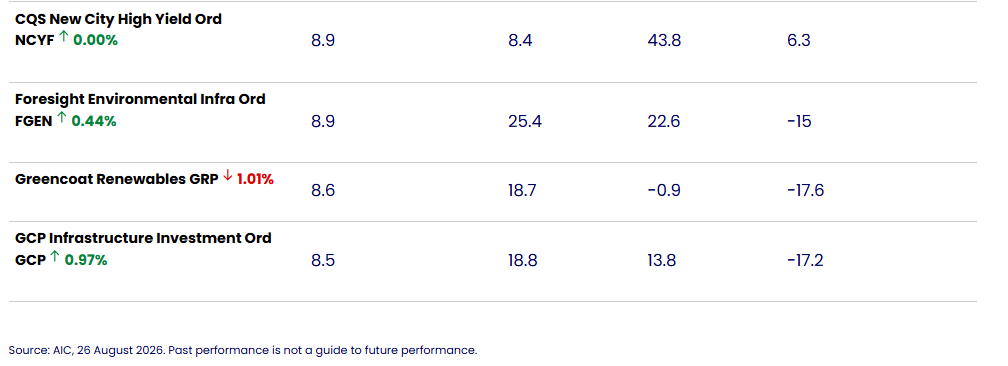
Source: AIC, 26 August 2026. Past performance is not a guide to future performance.
The trust has had some good fortune in recent times: its NAV was slightly up over the first half of this year and its level of dividend cover has improved. That’s good news after a 2025 in which low wind speeds hurt performance.
Given their reliance on one technology or energy source, the specialist renewables funds can be pretty volatile.
But the more diversified names also offer good yields even if they face a similar challenge, to sell assets at a decent price and reduce debt levels.
which launched something of a turnaround plan in late 2025 aimed at selling assets, buying back shares and reducing debt, as well as investing in higher-returning assets.
The fund, which has around half its portfolio in solar assets and most of the balance in onshore and offshore wind, has seen its NAV fall in the second quarter of 2026 and has continued to see its shares struggle.
and even Renewables Infrastructure Grp TRIG shares in the last year, in part thanks to investors paying more attention to the sector amid conflict in the Middle East.
But investors should pay close attention to how the funds are invested and how, for example, their plans to offload assets are progressing. TRIG has argued that it is doing well on that front, as it seeks to win over investors in the wake of last year’s botched attempt to merge with HICL Infrastructure PLC Ord HICL
On the portfolio composition note, Foresight Environmental Infrastructure stands out for being especially well diversified.
While some of the generalist funds tend to mainly invest in solar and wind, this fund has quite a mixed portfolio. Wind accounts for 23% and solar makes up 11%, but the fund also focuses on anaerobic digestion, biomass, energy from waste and hydro power.
Beyond renewables
Those tired of the renewables sector can bag some big yields elsewhere, from sectors with very different prospects.
First, it’s worth noting that debt funds continue to offer some big yields, with the popular TwentyFour Income Ord TFIF
both in the table. These funds have, unusually enough, managed to combine a high yield with strong total returns in recent years.
But investors are certainly paying a price for this, with shares in both trading at a premium to NAV.
The TwentyFour Income portfolio offers exposure to various forms of debt, from collateralised loan obligations to asset-backed securities and residential mortgage-backed securities. The fund also diversifies by the maturity, credit quality, and geography of the debt it holds.
There is an appeal to such a sector, and it should offer diversification to equities and other assets. But investors may well worry about the idiosyncratic risks that could come with such esoteric assets.
Like some of its rivals, it does pay out a dividend, although this can be a fraught model because this can sometimes involve paying from capital, and from an illiquid asset class.
The fund has also had a tough few years, and an update published today showed that its NAV had fallen by 8.6% on a total return basis in the first half of this year. However, the board argued that realisation activity, or the level of asset sales, “remained robust”, accounting for some 14% of net assets during this period.
As is often the case with seeking out the highest yields, investors will encounter some troubled names. But these might present a buying opportunity for the brave, and patient, individual.
The SNOWBALL has a comparator share VWRP, where 100k was nominally invested on the same day as the SNOWBALL started. The comparison being what you would receive if instead of having your own Snowball, you decided to retire using the 4% rule or to buy an annuity.
Current value of VWRP £171,792, not too shabby.
An annuity is a huge gamble with your retirement plans as there is no way of knowing what interest rates will be when you retire.
Canada Life figures show the 65-year-old with a £100,000 pension pot could buy an annuity linked to the retail price index (RPI) that would generate a starting annual income of £3,896. That’s up from £2,195 in the New Year following a 77% spike in rates this year. Oct 22.
Current annuity on £171,792 > £12,025 but you have to surrender all your capital, so not an option for the blog.
Using the 4% rule a ‘pension’ of £6,871.00.
The SNOWBALL will earn income of 12% this year on seed capital > 12k.
If we now jump forward ten years, the SNOWBALL will have income of 24% on seed capital, hopefully in less than ten years.
VWRP would need an equivalent value of £600k. GL with that, if that’s your plan.



 The Independent