Retail investors have endured a lot of pain in the last few years and share prices have taken a beating. But instead of complaining, I want to make the most of it. That’s why I’m buying cheap UK shares.
It’s a rare opportunity I believe investors should consider pouncing on. Today, the FTSE 100 trades on an average price-to-earnings (P/E) ratio of just 11, which is below its historic average of around 14. Yet yesterday (22 April), the index closed at an all-time high. That’s a mismatch I plan to capitalise on.
Better times ahead
The FTSE 100 has risen 4.4% year to date while the FTSE 250 has climbed 0.8%. With that in mind, it seems like things could be on the up going forward.
Both indexes have been ticking upwards as investor sentiment has steadily been rising. Market spectators are gearing up for interest rate cuts as early as June as inflation slowly drops closer to the government’s 2% target. Looking ahead, as cuts continue over the months and years to come, this should provide markets with a boost.
We’ve also had some positive retail figures in the first few months of the year, which further signal that we’re heading in the right direction.
Of course, threats do persist. Rate cut talk is speculative. And while inflation is falling, it still lingers.
Yet regardless of any potential near-term setbacks, I think UK-listed companies are well-positioned for growth in the years to come. With that, I’m going shopping.
A share I allowed the market to chase me out because of FTSE weakness. As the discount to NAV has closed I would sell today, if I hadn’t but I can’t because I have already sold. Always easier in the rear wing mirror.
abrdn Asian Income Fund Ltd ex-dividend payment date AVI Japan Opportunity Trust PLC ex-dividend payment date Bankers Investment Trust PLC ex-dividend payment date City of London Investment Trust PLC ex-dividend payment date CQS Natural Resources Growth & Income PLC ex-dividend payment date Foresight Solar Fund Ltd ex-dividend payment date Henderson Far East Income Ltd ex-dividend payment date Invesco Select Trust PLC Global Equity Income ex-dividend payment date Invesco Select Trust PLC UK Equity ex-dividend payment date JPMorgan Claverhouse IT PLC ex-dividend payment date Murray International Trust PLC ex-dividend payment date Schroder Oriental Income Fund Ltd ex-dividend payment date Seed Innovations Ltd ex-dividend payment date Shaftesbury Capital PLC ex-dividend payment date
Why buying dividend stocks could be a no-brainer for passive income We all have our own ideas on how to invest to generate some long-term income. Here, I explain why I go for dividend stocks every time.
Alan Oscroft
Motley Fool
The content of this article was relevant at the time of publishing. Circumstances change continuously and caution should therefore be exercised when relying upon any content contained within this article.
When investing, your capital is at risk. The value of your investments can go down as well as up and you may get back less than you put in.
There are countless ways to try to earn some extra income. Everyone will have their own approach, but buying dividend stocks looks like the no-brainer way for me. Here’s why.
What do I look for when I want to top up my income? I want three key things.
What I want I don’t want to have to do too much work. If I can put in an hour or so when I feel like it, and not leave the comfort of home, that would be great.
Then I need to be able to invest as much or as little as I like, when I like. I just don’t have big lump sums to plonk down. And I can’t commit to any fixed monthly outgoings.
And I want a method that has a long track record of success. I don’t need to take the income now. No, my aim is to build a good pot over the long term. And then I’ll start to draw down the cash when I retire.
Long-term success Over the past 10 years, Stocks and Shares ISAs have earned an average of 9.6% a year. That even beats inflation right now, and not many savings schemes can do that.
But in the 2019-20 year, we would have lost 13.6% on average. So cash in shares for a year can mean pain. But for 10 years, it looks a lot better.
Years like 2020 do come along. But already, UK shares are back to where they were before the pandemic.
And research by Barclays has shown that the longer we leave our cash in the stock market, the more chance we have to beat other forms of investment.
Why dividend stocks? For the long term, any stocks that generate good total returns can do just as well. But I prefer ones with good dividend yields.
When I see cash, I know it’s the real test of a company performance. That is, if it’s covered by earnings. Even if I buy more shares with the cash, I think I get more safety from mature dividend payers.
And if I should need a bit of cash one year, maybe for a bit of holiday spend, I can keep it back from my dividends.
Easy and cheap? I do have to put in a bit of effort to work out my strategy. But since I’ve gone for top quality dividend stocks, I don’t have to do much work to make my choices. So it’s easy enough for me.
To make sense of trading costs, I buy with at least £500 a time, and £1,000 or more is better. But I can put small sums of cash into my Stocks and Shares ISA and save it there until I have enough to buy.
Do you like the idea of dividend income?
The prospect of investing in a company just once, then sitting back and watching as it potentially pays a dividend out over and over?
If you’re excited by the thought of regular passive income payments, as well as the potential for significant growth on your initial investment…
Individual choice Stocks and shares won’t be for everyone, and each of us has to work out our own approach to risk. But for me, to build a long-term passive income pot, I don’t see anything better.
Christopher Ruane A lot of people reach a point in life where their savings fall short of what they would like to have. However, even at 30, 40, or 50 it is still possible to start building wealth by getting into good investment habits.
I would draw inspiration from hugely successful investors like Warren Buffett in doing that. Get rich slow One key lesson from Buffett’s long career is that time can be the friend of the patient investor.
Some people think of the stock market as a get-rich-quick scheme. But long-term investment in high-quality companies is not a sudden fix for personal finances.
Buffett has bought shares in major businesses like American Express, then held onto them for decades hoping that over time their business quality will lead to share price growth.
Dividend income Share price growth is not the only way an investor can make money from the stock market however. Dividends are also an important source of regular income for many investors.
Buffett receives billions of dollars a year in dividends. Rather than withdraw them from his business (for example by paying his own shareholders a dividend), he leaves them inside to fund more growth.
Compounding is reinvesting dividends, so that in turn they also start to earn dividends. Over time, compounding can be a significant source of income.
Focus on quality Another hallmark of Buffett’s approach to investing is his relentless focus on quality. He sticks to proven companies with business models he understands. He also looks for some sort of competitive advantage that can help a company make profits.
Interestingly, many such shares are well-known and have been around for decades. The ‘Sage of Omaha’ is not trying to uncover a business few investors have yet discovered, hoping to beat them to it. Rather, he is happy to invest in large, well-known businesses hiding in plain sight.
But one thing he does focus on is cost. Even a great business can make a poor investment at the wrong price. So Buffett tries to buy great businesses – at a fair price.
Getting started Having no savings and not knowing where to start, it can be a bit daunting knowing how to begin.
Buffett started his investment portfolio as a schoolboy, saving some money from a paper round and buying a few shares.
As an adult, I think a similar approach can work well. I would start small, while I learnt about the stock market and share valuation. I would also save money regularly that I could put into my investment portfolio to help me grow it over time.
£££££££££££££
I realised a long time ago I would never be the next Warren Buffett, that’s why I only invest in Investment Trusts and let someone more qualified invest my hard earned.
How London’s investment companies fared in Q1 2024
With Q1 coming to a close we take a look at which Investment Trusts, stocks and sectors have caught the eye.
ByFrank Buhagiar•17 Apr, 2024
Phew, that was quick – anyone else think Q1 2024 flew by in the blink of an eye? With the first quarter of the year done and dusted, that can mean only one thing – it’s time for our Q1 round-up of the movers and shakers in London’s investment trust space. Which funds had a good quarter? And which trusts had one to forget?
Q1 – An Overview
JPMorgan provides an overview for the year thus far: “2Q24 was generally a good one for stock markets, with the US a key driver, with the S&P500 up 11.8% (all figures in £), also driving the MSCI World Index, which was up 10.2%. Growth outperformed value, with the MSCI World Growth up 11.5% and MSCI Value up 8.7%. Japan was also a notably strong performer, with TOPIX up 11.1%, and Europe outperformed EM and Asia ex Japan with a 6.8% return from the FTSE Europe ex UK. The UK, as measured by the FTSE All Share, was up 3.6%, with large caps outperforming mid and small (FTSE 100 +4.0% vs FTSE 250 +1.6% and Numis SC ex ICs +0.2%).”
A positive quarter for markets then, but was it a positive quarter for investment companies?
Back to JPMorgan: “The overall sector, as measured by the FTSE Closed End Investments sector (which does not include 3i), was up 2.3% over the quarter.” So, positive performance for the sector, although not enough to match the All Share, let alone the double-digit returns seen in the US or the MSCI World Index.
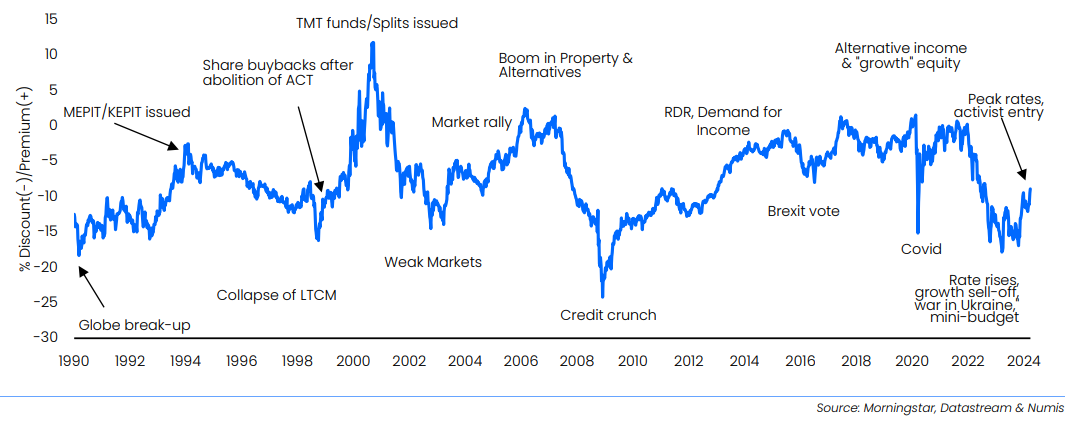
As for the discounts at which share prices traded at compared to underlying net assets, Numis reports a marginal widening of discounts during Q1: “Our figures, show that the average discount of the universe, excluding 3i Group, widened slightly in Q1 from 13.9% at December to 16.0% at 31 March. This included discounts on Equity ICs widening marginally from 10.1% at December 2023 to 11.5% at 31 March, whilst Alternative Asset ICs, excluding 3i, widened from 19.6% to 23.1%.”
Where does an average discount of 16% fit historically? Numis provides the graphic below:
Investment Companies Universe – Long-term discount history
A 16% discount, nothing like the depths seen during the Credit Crunch, but equally some way off the premia that prevailed in the early 2000s.
Winners and losers at the sector level
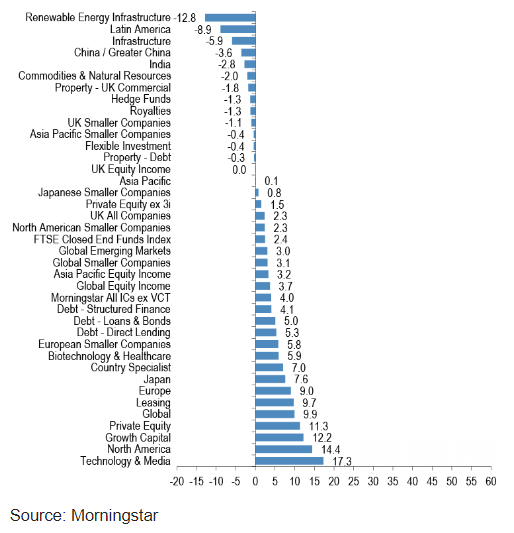
The 2.3% generated by the closed-end index over the quarter is just a headline, one that masks a wide dispersion of returns at the sub-sector level – as Numis writes, “we caution that the universe is so diverse that aggregated figures are of limited use.” To see what the broker means, look no further than the winners and losers at the sector level.
Winners first, funds with tech exposure stand out – no surprise given the continued strong showing by the US tech mega caps. Numis notes: “Technology ICs continued to lead the pack, with the technology exposure also benefiting North American ICs and Global ICs in absolute terms, albeit most ICs lagged benchmarks, which remain concentrated on a few mega-cap stocks.”
At the other end of the scale, Numis writes: “The expectation of higher for longer rates impacted sentiment towards Infrastructure ICs, including Renewable Energy ICs, where investors were also wary of lower power prices. Battery Storage funds were notable laggards as the challenging revenue environment led to dividend suspensions.”
The graphic below from JPMorgan adds some colour in the form of the relevant numbers for all subsectors:
AIC Sector price TR (%) 1Q24Renewable Energy Infrastructure off 12.8% during the quarter, Technology & Media up 17.3% – the two bookends. In between, a wide range of returns.
Winners and losers at the stock level
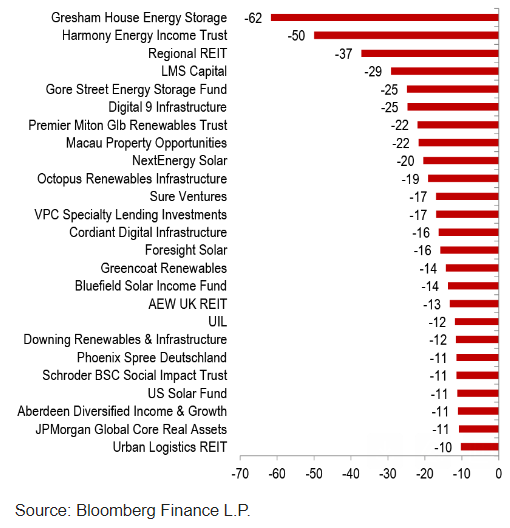
The same is true at the stock level. The worst performing fund in Q1 declined -62.4%, the best performer rose 43%. Among Q1’s worst performers, unsurprisingly, renewables, specifically battery storage investment companies, feature heavily in the below list from JPMorgan:
Q1 24 Worst performance (% price TR)
Similarly, tech-focused names such as Manchester & London, Polar Cap Technology and Allianz Technology feature in JPMorgan’s below graphic for Q1’s top-performing trusts:
Q1 24 Best performance (% price TR)
Interestingly, last year’s top-performer 3i Group (III) follows up this year with a 16% Q1 gain, enough to place the private equity giant in joint ninth.
Eagle-eyed readers will have no doubt noticed the clumsy crossing out of the name of Q1’s top-performing investment company. No accidental spilling of ink here. Instead, a clumsy attempt to build up a little suspense. The big reveal though cannot be put off any longer. The top-performing investment company in Q1 2024 is none other than space investor, Seraphim Space (SSIT) courtesy of an eye-catching 43% gain.
Question is, after such a stellar opening three months of the year, can SSIT kick on
from here and consolidate top spot? It’s a question that’s been on broker Winterflood’s mind too if the title of their recent note is anything to go by.
Seraphim Space (SSIT): Stick or Twist?
Firstly, hats off to Winterflood for including SSIT in its 2024 Recommendations List. SSIT’s inclusion was “based on the structural tailwinds benefiting the SpaceTech sector, tangible progress at the portfolio company level and a share price which roughly implied that all but the fund’s top two holdings were worthless.” Following the strong share price performance, Winterflood used the release of SSIT’s interim results in March to ask, “is it time to take profit, or does substantial runway remain (either from a ratings or underlying performance perspective)?”
In terms of numbers, SSIT reported a 1.8% increase in NAV per share. In terms of words, Chair Will Whitehorn sounded cautiously optimistic in his statement, “Indications of inflation being tamed and interest rates having peaked has resulted in some evidence of improved sentiment in both the private and public markets. We continue to believe that SSIT’s current cash reserves are sufficient to meet the near-term capital needs of the portfolio”.
Winterflood found the results encouraging: “There are certainly encouraging signs in these results, with portfolio company fundraising clearly illustrating investor demand. Sector tailwinds remain intact, with satellite imagery in high demand across applications such as national defence and sanctions compliance. This is reflected in the market, with VC investment in SpaceTech flat YoY in 2023 vs -35% for VC investment overall. In particular, the guidance on c.40% of the portfolio (by value) showing positive EBITDA by year-end is constructive, and with 60% of the portfolio funded to profitability, concerns around cash constraints should be eased.”
So, even though Winterflood “can see how locking in profits on SSIT may be tempting at this stage, particularly if the position was initiated recently”, the brokers “point out that the SSIT discount remains relatively wide at 36%”. What’s more, “we see room for further tightening as the year progresses, alongside the potential for valuation uplifts as portfolio companies raise funds and execute on their targets and partnerships. We therefore reiterate the fund’s inclusion in our 2024 Recommendations.”
All to play for
Winterflood thinks SSIT can kick on from here then. But will it be enough to hold onto top spot? Or will III manage to chip away at the lead? Perhaps another fund will come from nowhere to finish top of the tree? After all, the race to be the year’s best is only just beginning.





 Renewable Energy Infrastructure off 12.8% during the quarter, Technology & Media up 17.3% – the two bookends. In between, a wide range of returns.
 Interestingly, last year’s top-performer 3i Group (III) follows up this year with a 16% Q1 gain, enough to place the private equity giant in joint ninth.