Cash, Stash, Slash, Bash – how I see the current SEIT Enterprise Value to FY29
Sep 03, 2026

Dear reader
Detractors in the chattersphere are debating what percentage discount SEIT might have to accept when selling its assets from the starting point of a 77.8p NAV.
Some slyly seek to draw parallels to DGI9. Let’s consider their slime later on.
First, the serious point is what discount to NAV. It’s my contention considering a discount to NAV starts the debate in the wrong place. Because what exactly is that 77.8p per share?
#1 How many times should you discount the same SEIT cash flow?
The £1.078bn portfolio valuation underlying that NAV is already based on discounted cash-flow valuations using a 9.5% weighted-average levered discount rate. SEIT itself says that this discount rate is a reasonable proxy for the return that could be generated by the portfolio over time, all else being equal.
In other words, these assets are not being marked at some theoretical future value. Their forecast future cash flows have already been dragged back to today’s money at a required return of roughly 9.5% a year. It is not an optimistic appraisal of what SEIT’s assets might someday be worth.
Then there is another layer.
During FY26 management materially reduced the cash flow assumptions embedded in those valuations:
- Growth and development assumptions were cut. Those assumptions apply to SEIT and SEIT’s investment policy change of asset realisation. Those cuts were not based on a change in the market. More on that later.
- Onyx lost around £45m of value after future development assumptions were reduced or removed.
- RED-Rochester was marked down after the probability and timing of future customer demand were reduced.
- Primary Energy took a hit from lower REC assumptions for Ohio, despite new RECs being applied for and an assumption that RECs cannot be sold outside Ohio.
- Oliva was reduced by around £25m following more conservative regulatory assumptions.
- Kyotherm had already been rebased to the agreed disposal economics. The sale was struck at c.9% below its September 2025 carrying value and was expected to reduce NAV by around 1.2p/share. The FY26 report says the valuation decline was consistent with that disposal discount.
So this wasn’t an optimistic cash-flow forecast then being discounted at 9.5%.
That 77.8p is based on an already a heavily stress-tested NAV. Management has historically revised assumptions both upwards and downwards when evidence justified it; by March 2026, however, several of the largest uncertain growth assumptions had been materially reduced, delayed or removed.
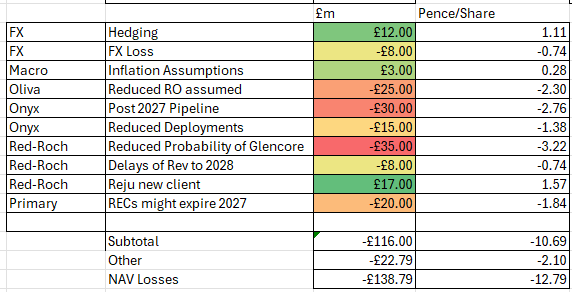
It has already been haircut, probability-weighted and is a capital-constrained forecast and then ADDITIONALLY is being discounted at 9.5%.
FY26 wasn’t the first time SEIT had had a haircut.
- In FY23, Primary Energy’s medium/long-term demand assumptions were materially reduced, costing about £16m of valuation. RED-Rochester also had £24m of adverse operating-cost assumption changes, although partly offset by commodity-price and growth effects.
- In 1H24, higher discount rates alone cut NAV by about £129m, while RED-Rochester forecasts were revised down and Onyx projects were delayed.
- In FY24, RED-Rochester underwent another detailed model review: revenue, load, business-development, labour, operating-cost and project-timing assumptions were revised, with adverse valuation impacts of roughly £26m, including about £17m from the September 2023 update.
- In FY25, SEIT again made asset-specific cash-flow adjustments at Oliva, Onyx, RED-Rochester and Primary Energy, and explicitly described its Onyx valuation as taking a “measured view” amid tariff/regulatory uncertainty.
So the FY26 reductions — Onyx development removed/reduced, Glencore probability slashed, Primary REC assumptions heavily cut, etc. — came on top of several years of prior rebasing.
Then, after arriving at the portfolio valuation, SEIT deducts the company’s own balance-sheet liabilities.
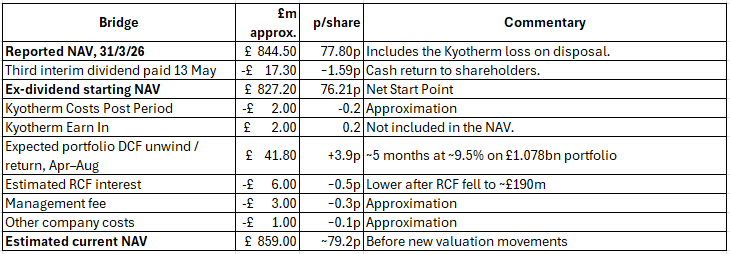
At 31 March 2026 the bridge was approximately:
£1.078bn portfolio valuation
− £233m RCF
− £2m working capital
+ £2m cash
= £845m NAV
or:
77.8p per share
Or:
79.2p NAV ESTIMATE per share today
Based on:
And even that may not be the end of the conservatism.
Because 9.5% is the levered portfolio discount rate.
SEIT also reports an 8.5% unlevered WADR, comprising approximately a 4.4% risk-free rate plus a 4.1% risk premium.
That distinction matters enormously now. SEIT is now deleveraging as quickly as possible.
The RCF has already fallen materially since 31st March, and the wind-down explicitly prioritises further debt reduction. As leverage disappears, why should a future buyer value an increasingly unlevered portfolio indefinitely using today’s 9.5% levered required return? Aggregate gearing has already fallen by about £70m since March 2026.
Using SEIT’s own 8.5% unlevered rate as a valuation anchor instead could increase the value of long-duration enterprise cash flows materially. Depending on their effective duration, our sensitivity analysis suggests something in the region of 7–12p per share could separate a 9.5% levered-style valuation from an 8.5% unlevered one.
That is not guaranteed upside. But it illustrates something important:
79.2p may already be a conservative valuation rather than an optimistic one.
And then we arrive at the market cap.
The shares trades at 36p.
So investors aren’t merely applying a discount to the future cash flows.
Those future cash flows have already been discounted at roughly 9.5%, after material operational and development assumptions have already been reduced, and after £233m of RCF debt has already been deducted.
Then the stock market cuts the resulting equity value by more than half again.
That is the second enormous layer of pessimism.
The debate therefore shouldn’t simply be:
“What discount to the 79.2p NAV estimate will buyers demand?”
It should also be:
“How much pessimism is already embedded in that estimated 79.2p NAV before the market applies another enormous discount on top?”
Or even:
“Should the pessimism discussion not be based on the equity value implied by an unlevered valuation framework? Perhaps ~86p-91p on an 8.5% unlevered valuation sensitivity?”
Or even:
“What if a buyer values SEIT’s increasingly unlevered enterprise cash flows closer to sector infrastructure hurdle rates?”
SEIT itself uses an 8.5% unlevered WADR. That does not look aggressive against peers: NESF uses an 8.0% weighted-average portfolio discount rate.
An 8.0% valuation sensitivity is not my base case, but nor is it an absurd one.
On my sensitivity analysis, something around 8.0% could imply an equity value in the region of ~95p per share — without reinstating all the development optionality SEIT has already removed.
Why is Arqiva, a TV/Radio infrastructure broadcaster and water meter provider a relevant read across for SEIT? Why are other energy infrastructure trusts not infinitely more relevant? To use DGI9 is a nonsense. Just amateur slime from Clowns.
#2 CASH
Let’s consider the FY26 results discussed in “Play it again Sam” and the potential upsides and downsides to cashflow.
Because assuming zero further disposals the portfolio continues to generate cash.
So my base case progression of EBITDA for FY26→FY29 is:
£72m → £80m → £89m → £96m
It could be higher or lower so there’s a Bear and Bull scenario too.

All three models are considered in run-off capacity scenarios. They are not realisation forecasts. If an asset is sold/disposed in the next three years, its operating cash disappears from the model and is replaced by disposal proceeds.
#2a: BASE CASE
Projects SEIT has already funded and built start doing what they were supposed to do, while cash extraction improves. The base case does not require the old blue-sky assumptions to come back. There are no great assumptions around inflation although SEIT would be a beneficiary to inflation given its inflation-linked revenues.
• Onyx: is the key swing factor. Existing operational projects totalled 209MW (at 31/12/25) under construction progressively enter operation and the operational MW base rises materially; no new development pipeline is assumed – just activation of existing projects +597 MW (the near tripling).
• RED-Rochester: underlying customer demand and efficiency projects support modest growth; Reju begins to contribute, but Glencore is still treated cautiously and no full recovery of previously removed upside is assumed.
• Primary Energy: core contracted operations continue to perform around budget; modest project/efficiency gains offset conservative REC assumptions.
• Oliva: second-half FY26 improvement proves durable; generation and electricity-market participation recover enough to lift EBITDA from depressed levels.
• Driva: remains a steady compounder; existing contracts and energy-as-a-service activity produce modest growth and good cash conversion.
• Portfolio-wide: lower capex/reinvestment requirements during wind-down allow more cash to be upstreamed rather than recycled.
• Holdco: RCF falls steadily, reducing finance costs and creating a positive feedback loop into net cash generation.
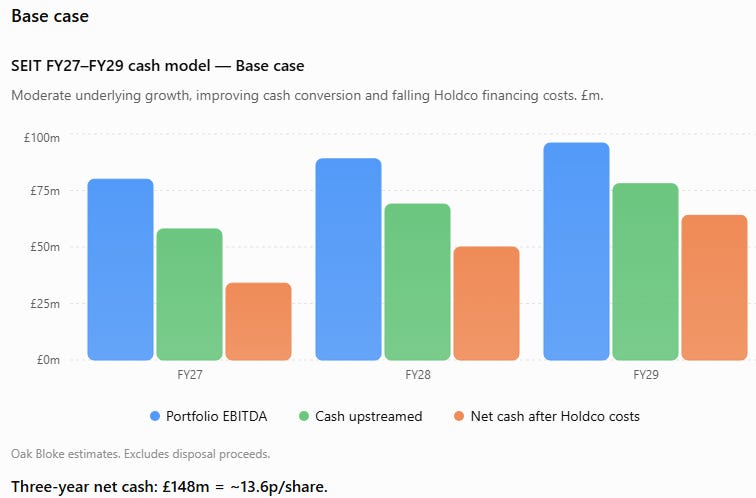
• Moderate EBITDA growth: £80m → £89m → £96m
• Cash conversion improves as reinvestment reduces: 72.5% → 77.5% → 81.3%
• Cash upstreamed: £58m → £69m → £78m
• Holdco costs fall with deleveraging: £24m → £19m → £14m
• Net cash: £34m → £50m → £64m
• Assumes Onyx commissioning, better Oliva contribution and normal operational progress, without restoring all written-down growth assumptions
#2b: The Bear Case:
Nothing really breaks, but very little improves.
• Onyx: commissioning slips again; only modest additional capacity becomes fully operational; EBITDA stays around current run-rate rather than stepping up materially.
• RED-Rochester: existing customers remain stable, but Glencore/Li-Cycle growth does not arrive and Reju contributes little or later than hoped.
• Primary Energy: core operations remain dependable, but REC economics stay weak and no meaningful upside is restored from the assumptions already cut from NAV.
• Oliva: generation/market economics remain subdued; no strong recovery in profitability and regulatory headwinds persist.
• Driva: continues to perform reasonably but does not repeat the strong outperformance seen against budget; growth contracts add little near-term cash.
• Portfolio-wide: cash remains trapped at project level for debt service, maintenance and working capital; cash conversion improves only slightly.
• Holdco: RCF repayment is slow, so interest remains a significant drag through FY29.
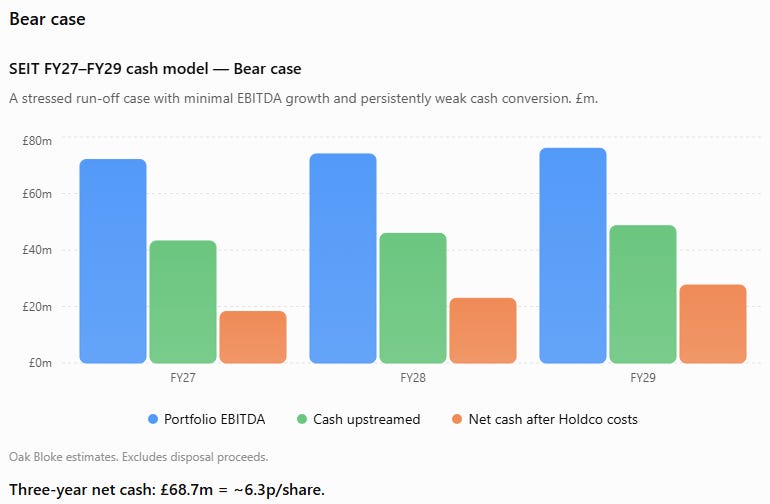
• EBITDA broadly flat: £72m → £74m → £76m
• Cash conversion stays weak: 60% → 62% → 64%
• Cash upstreamed: £43.2m → £45.9m → £48.6m
• Holdco interest/fees/costs fall only slowly: £25m → £23m → £21m
• Net cash: £18.2m → £22.9m → £27.6m
• Assumes little benefit from Onyx ramp-up or better asset-level cash extraction
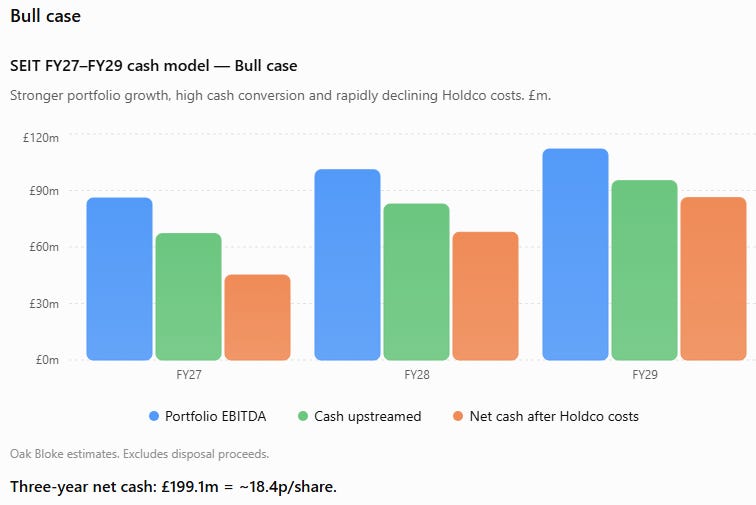
#2c. THE BULL CASE
The existing portfolio ramps strongly and some of the haircuts are reversed.
• Onyx: strong execution. A large portion of the existing construction portfolio reaches full operation on schedule, materially lifting EBITDA and upstream cash.
• RED-Rochester: Reju ramps well, efficiency projects deliver, and at least some customer-growth assumptions previously heavily probability-weighted begin to crystallise.
• Primary Energy: core operations beat budget and either REC pricing or incremental projects contribute more than currently embedded in the conservative case.
• Oliva: meaningful operational recovery; stronger generation, electricity prices and regulatory outcomes restore part of the earnings power lost in recent years.
• Driva: continues outperforming budget and wins additional profitable energy-service contracts without consuming excessive capital.
• Portfolio-wide: wind-down materially changes behaviour — maintenance capex only, very high cash extraction, limited cash trapped in subsidiaries.
• Holdco: asset cash and disposals crush the RCF quickly; interest expense falls sharply, allowing an increasing proportion of EBITDA to reach shareholders.
• Stronger EBITDA growth: £86m → £101m → £112m
• High cash conversion: 78% → 82% → 85%
• Cash upstreamed: £67.1m → £82.8m → £95.2m
• Rapid RCF reduction cuts Holdco costs sharply: £22m → £15m → £9m
• Net cash: £45.1m → £67.8m → £86.2m
• Assumes strong Onyx ramp-up, good execution across the remaining portfolio and increasingly efficient cash extraction during wind-down
#3 Double Counting
Eagle-eyed readers will say ah hah, a discounted future value includes the value of cash over the next three years.
Whether the start point is 79p – 95p per share we can’t just add 5.8p – 18.4p depending on whether the bear, base or bull scenario occurs.
But we can consider the EV. It was £1547.4m at 31/3/26 and is an estimated £1,415m as at 30/8/26

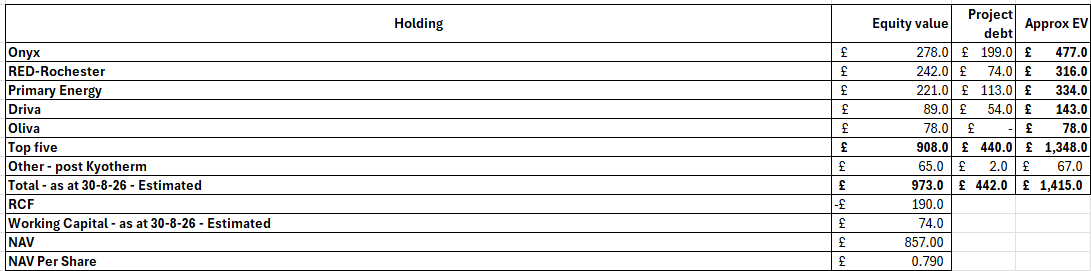
It is reasonable to think debt will be amortised at each project, or further debt incurred in a bear case reducing the value to SEIT. The assumptions made to the EV over the three years to FY29 are:

The base case is a run off would pay the RCF by FY29, although the bear case would reduce the RCF but not eliminate over three years. Even so even the bear case suggests the NAV nudges up by 1p over three years.
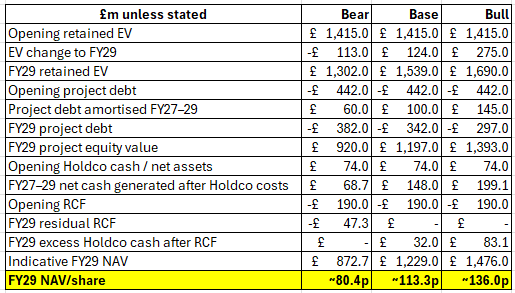
Under the base case the underlying portfolio EV only rises by £124m. But shareholder equity rises by around: £372m because shareholders benefit from both EV growth and deleveraging.
That difference is not financial alchemy: it is the combined effect of £124m of EV growth, project-level debt amortisation and cash generation used to eliminate Holdco leverage.
SEIT is a leveraged equity claim on roughly £1.4bn of retained enterprise value. Therefore relatively modest changes in enterprise value, combined with operating cash flow and debt amortisation, can create disproportionately large changes in equity NAV.
To illustrate this the Bull case assumes an average 7% per annum growth in EV and this is heavily weighted towards success at Onyx both due to its relative size but also due to upside.
I repeat once again these are run-off valuation scenarios assuming the retained portfolio remains owned for three years to FY29. Earlier disposals would replace the relevant future EV, debt amortisation and operating cash flows with the actual disposal proceeds received. The scenarios therefore illustrate value-generation capacity, not a forecast of the precise liquidation sequence.
#4 Disposals
SEIT has written down the development potential of Onyx to zero. It has likely curtailed its ambitions at other holdings such as Driva too. That doesn’t mean a buyer would value that expansion capability at zero. The market is valuing that at zero because SEIT is valuing it at zero.
SEIT proved the expansion model – but then changed its investment objective or rather its shareholders did – in the wind-down vote.
Will an asset be sold at X percent discount or Y percent? I’m not going to debate the specifics of what percent I think. I’ve given plenty of examples where assets are being sold at 16X – 18X EV/EBITDA
That valuation approach suggests my estimates of EV and EBITDA are broadly plausible.

I come back to the common sense view that cash-generating assets get valued on the basis of their ability to deliver a stream of returns. Even if SEIT-ies have to wait, the assets themselves can generate cash, amortise debt and potentially grow their ex-distribution enterprise value while they wait for realisations.
The model implies a buyer being willing to pay a near zero discount to NAV would be plausible under a Bear case based on a FY29 forecast. Or pay a 33p premium due to anticipating a rising valuation of some 33p under the base case, or even more under the Bull case is plausible.
So discount? What do you mean discount?

Conclusion
The market price of roughly 36p appears to assume that a great deal still has to go wrong. That assumption comes after SEIT has already:
- reduced growth assumptions;
- probability-weighted uncertain revenues;
- constrained development because of its own capital position;
- marked Kyotherm to actual disposal economics of -9%;
- applied a 9.5% levered discount rate;
- deducted substantial Holdco debt.
The assets do not simply sit there while shareholders wait. They generate cash. Project debt amortises. The RCF falls. Financing costs decline. And projects already funded can move from construction into operation.
That is why I think the question “what discount to NAV will SEIT sell at?” is far too simplistic. NAV itself is a moving target.
Under my Bear case, significant operating disappointment is largely offset by cash generation and deleveraging. The NAV broadly stands still even after three more years filled with never-ending disappointment.
Under the Base case, relatively modest enterprise-value growth combined with debt reduction could lift the equity value materially.
And under the Bull case, successful execution at Onyx and the other principal holdings creates substantial upside without requiring me to restore every development assumption SEIT has already removed.
Perhaps the slime have the right of it and SEIT will be just like DGI9 and today’s article picture of a burning effigy truly foreshadows SEIT’s coming future.
But before accepting that metaphor, I would ask one rather inconvenient question:
Are we looking at the same assets, the same cash flows and the same balance sheet?
I don’t think we are.
At 36p a share, I think the market is effectively discounting SEIT’s cash flows twice.
Regards
The Oak Bloke.

Leave a Reply