The SEIT mini series Part 6 – An Onyx Day’s Work
Part 6 of the SEIT Series – the final asset – best till last?
Oct 18, 2026
Dear reader,
In prior articles we’ve examined Primary Energy, Oliva, RED Rochester, SEIT’s Odds’n’Sods and Driva.
Onyx is SEIT’s largest and arguably most important holding – and it presents a different problem to the others. Maturing Onyx vs the more mature infrastructure of the other Top Five assets. With Onyx (and to a lesser extent RED and Driva) the challenge is to wait.
Because what if waiting for the business to mature actually creates substantially more value?
At March 2026, Onyx was valued at $367m (£278m). Yet only $128m of that valuation belonged to its five fully operational portfolios. The remaining $239m represented partly constructed portfolios and the development platform. That sounds risky. And it is.
But it also means a substantial amount of previously invested capital has yet to reach its full earning potential. My analysis suggests Onyx could potentially realise £435m or more by September 2030.
Let’s see why.
1. What exactly is Onyx?
Onyx develops, finances, owns and operates commercial and industrial (C&I) solar installations across the United States. Not to be confused with large utility-scale solar farms, as some Detractors have mistakenly done.
Customers purchase electricity under long-term Power Purchase Agreements (PPAs), avoiding the upfront construction costs. Approximately 93% of operating-portfolio revenue is contracted through PPAs, with an average contract duration of around 18 years and more than 100 offtakers.
So operating revenues should be reasonably predictable. The difficult part is getting the installations built.
SEIT initially acquired Onyx assets and 50% of its development business from Blackstone in February 2021 for approximately $150m, purchasing the remaining developer interest in June 2023.
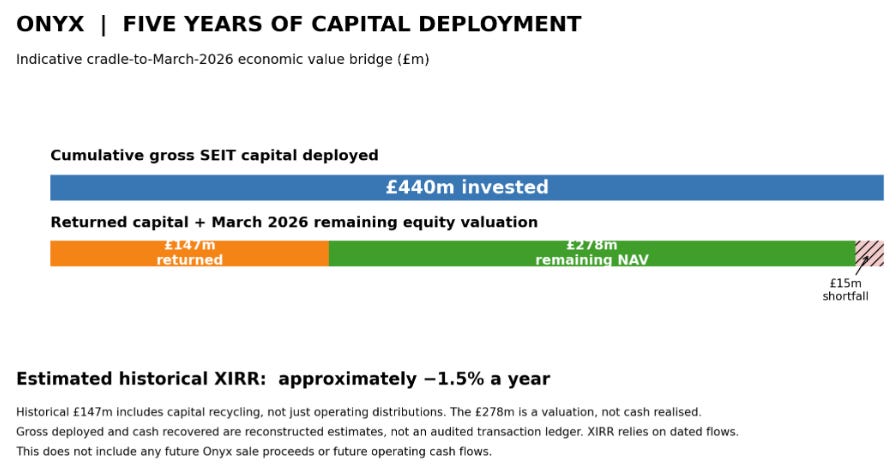
Since then, SEIT has invested heavily. My reconstructed ledger suggests approximately £440m of gross capital deployed, £147m returned and £278m of remaining equity value at March 2026.
That’s an estimated historical XIRR of −1.5% annually. Not exactly spectacular.
2. Why is only 35% of the valuation fully operational?
At March 2026, Onyx carried an equity valuation of $367m. Only $128m — about 35% — related to the five fully operational portfolios.
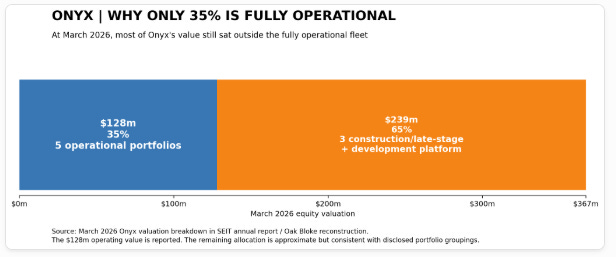
The remaining c.$239m sat in three construction-stage portfolios and the development platform. That sounds risky. It is.
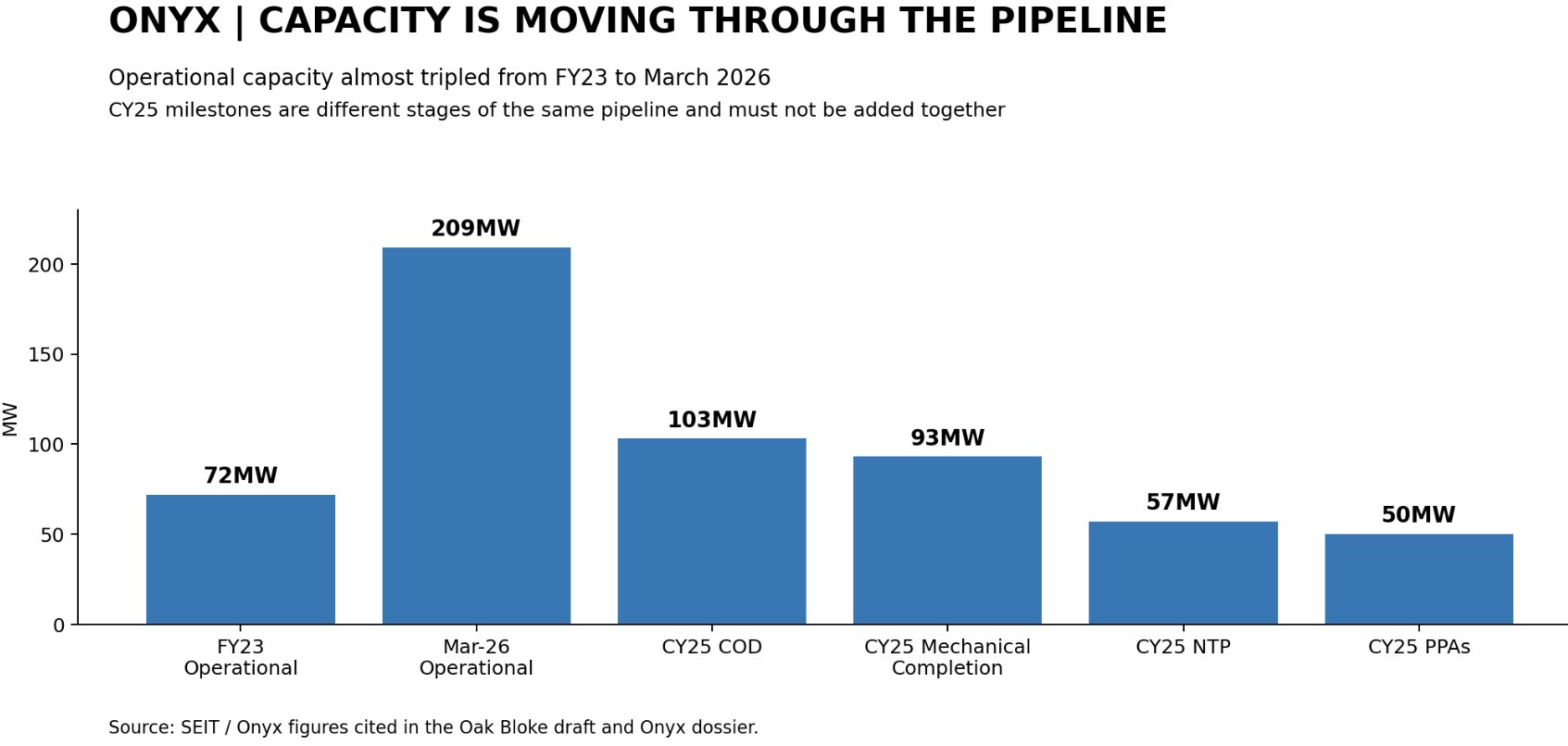
But “not fully operational” doesn’t mean “pure speculation”. Some of the construction-stage assets had already reached commercial operation, and progress accelerated sharply in 2025. Operational capacity increased from around 72MW in FY23 to 209MW by March 2026.
During calendar 2025, Onyx achieved 103MW reaching commercial operation, 93MW reaching mechanical completion, 57MW reaching notice to proceed and 50MW of new PPAs signed.
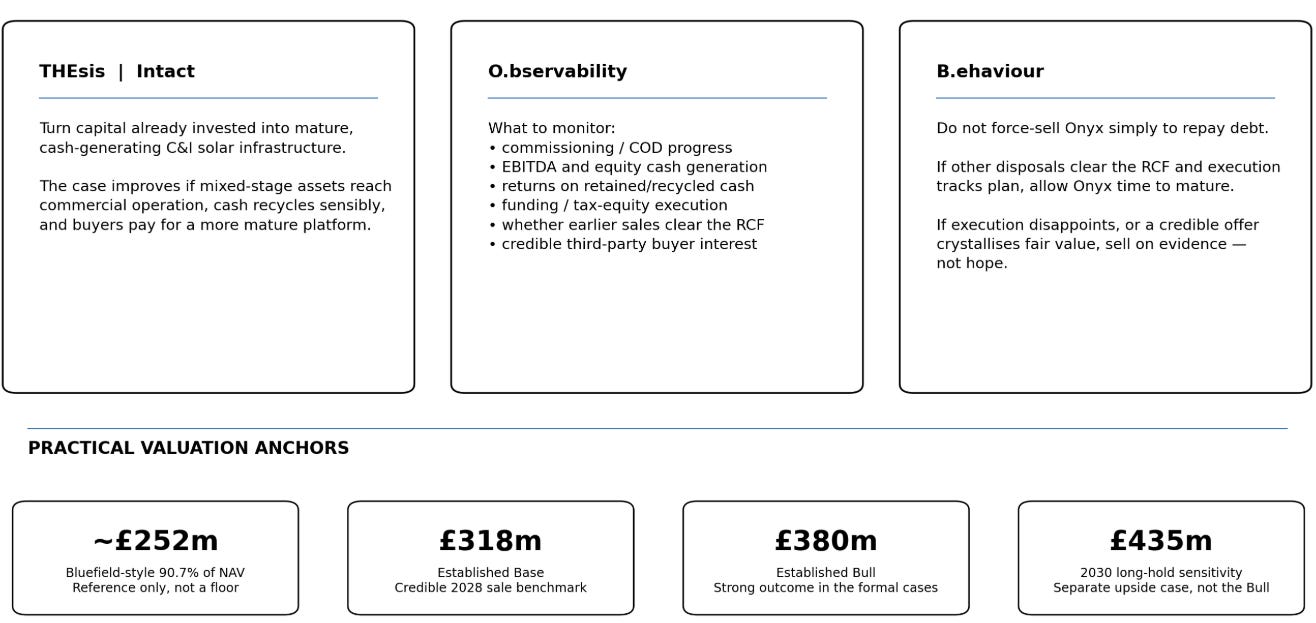
Turning capital already invested into profitable, cash-generating infrastructure is the Onyx thesis.
3. What about the $16.7m EBITDA?
Onyx’s five fully operational portfolios generated $16.7m EBITDA in calendar 2025, up 48.7% but 20% below budget.
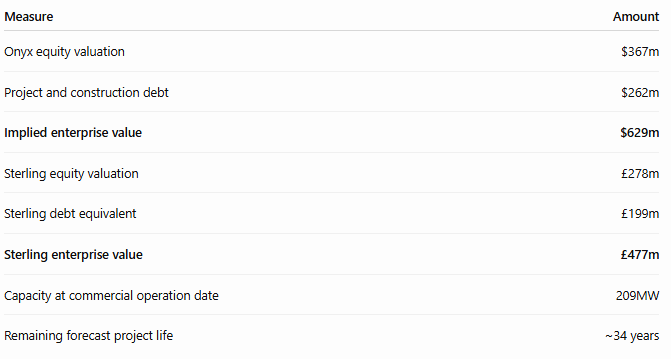
Comparing that with Onyx’s $629m enterprise value gives an alarming 37.7× EBITDA.
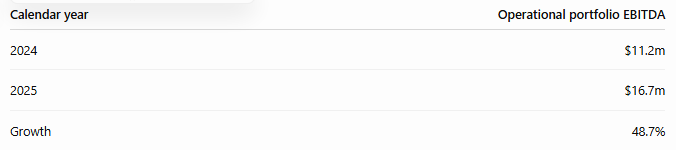
But it’s a highly misleading comparison. The enterprise value includes all eight portfolios and the development platform, while the EBITDA excludes earnings from the three partly constructed portfolio groups.
Much of Onyx’s newly commissioned capacity has yet to contribute a full year’s earnings. The model assumes only a modest 3–5% improvement in mature-fleet efficiency, but the principal driver of future growth is increasing productive capacity.
4. The cash-recycling machine
In FY26, SEIT received £40.2m of capital returned from Onyx. But this wasn’t recurring free cash flow.
American solar projects combine sponsor equity, construction debt and tax-equity financing. As projects reach completion, tax-equity funding can release previously committed capital.
In June 2025, Onyx secured a $260m financing facility, potentially expandable to $350m, helping reduce its dependence on additional SEIT funding.
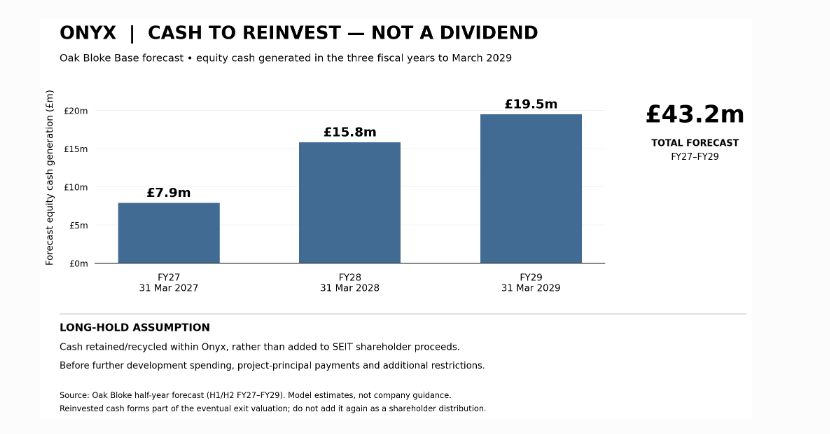
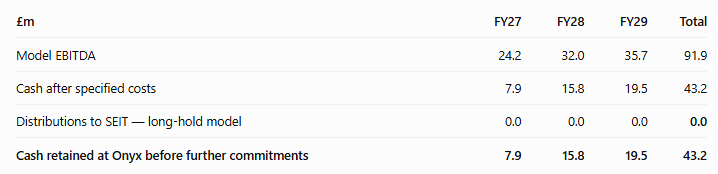
The FY27–FY29 model forecasts approximately £43m of equity cash generation, although this remains before further development expenditure, project-principal requirements and any additional restricted reserves.
Under my preferred long-hold strategy, Onyx retains that cash to complete projects, optimise financing and increase its eventual disposal value.
The crucial distinction: recycled capital isn’t profit, and cash already incorporated into Onyx’s eventual sale value cannot also be counted as a shareholder distribution.
That £43m must earn its keep before shareholders see the benefit.
The FY27–FY29 model illustrates the potential:
5. Three years of gestation — and potentially £435m
My model anticipates annualised EBITDA approaching £36–37m by March 2029, principally as recently commissioned projects mature and contribute full-year earnings.
But the real opportunity could lie in waiting longer.
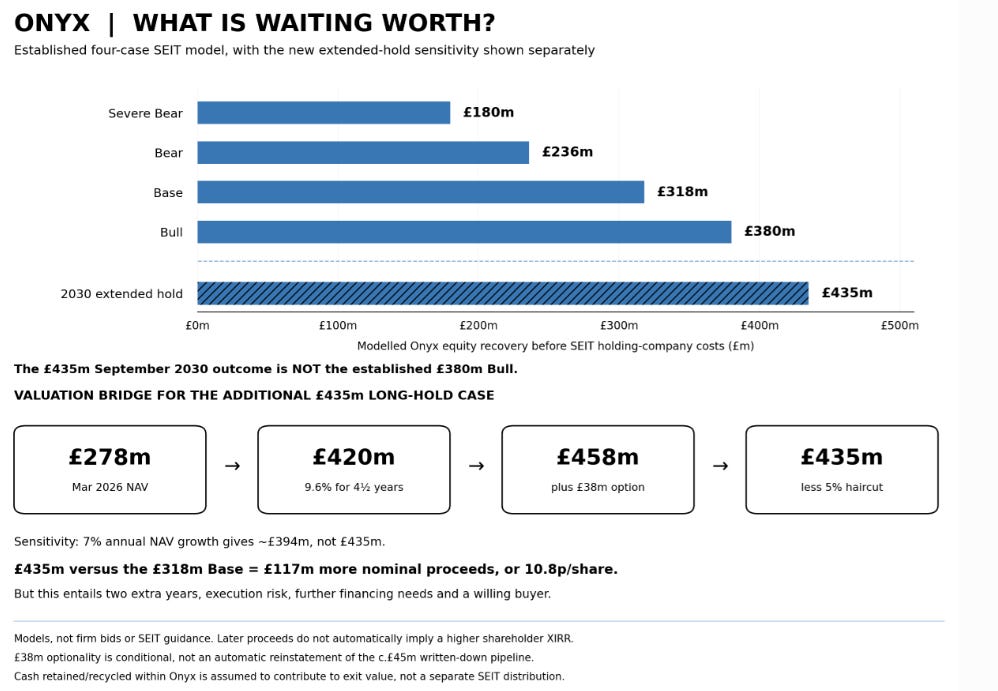
The established Base assumes £318m of recovery in September 2028. An additional long-hold sensitivity suggests £435m by September 2030.
That extended valuation assumes Onyx’s £278m March 2026 equity value compounds at 9.6% annually over 4½ years, reaching approximately £420m. Add £38m of potential development optionality and apply a 5% disposal haircut: £435m.
That’s conditional, not guaranteed. At 7% annual growth, the same calculation produces just £394m.
Importantly, SEIT already removed approximately £45m of previously anticipated development value from Onyx’s March 2026 valuation. Any additional optionality must be earned through genuine progress, not simply reinstated.
The difference between the September 2028 Base and September 2030 extended-hold case is £117m, or an additional 10.8p per SEIT share.
But two additional years introduce financing costs, execution risk and the opportunity cost of delayed shareholder distributions.
The question isn’t whether Onyx could be worth £435m. It’s whether waiting until 2030 offers a better risk-adjusted return than accepting a credible offer in 2028.
These sterling valuations are also exposed to GBP/USD movements, particularly as SEIT reduces its currency hedging.
6. Other earlier sales matter
SEIT had £188m outstanding on its corporate RCF at September 2026. But Onyx would be my last choice of asset to sell merely to repay it.
Primary Energy is the more logical early disposal candidate. Its £172.3m Base recovery would almost extinguish the borrowing. Adding Driva’s £92.3m brings combined proceeds to £264.6m, leaving £76.6m after RCF repayment, before other costs.
There are alternatives. As the graphic shows, several combinations of earlier asset disposals could eliminate SEIT’s corporate debt without selling Onyx.
Under the revised lending arrangements, disposal proceeds must first reduce the corporate RCF. Only once that obligation and appropriate liquidity requirements are satisfied can surplus proceeds become available for shareholder returns.
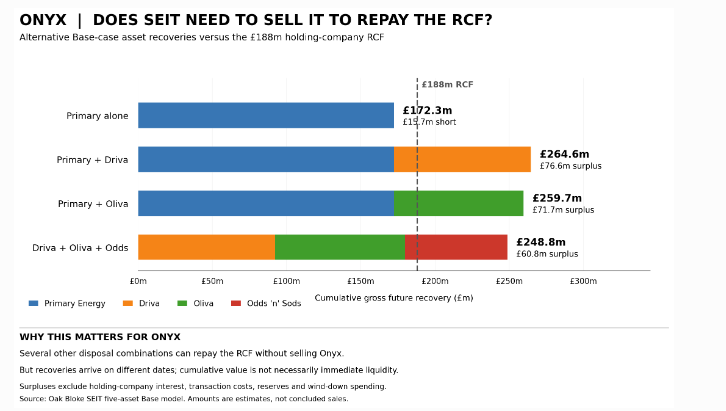
The catch is timing. Oliva and the Odds ‘n’ Sods include future recoveries extending into 2028. Cash expected eventually isn’t necessarily cash available tomorrow.
Once the RCF is cleared, SEIT could allow Onyx to retain and recycle its internally generated cash, completing existing projects and improving its eventual disposal value.
Of course, SEIT is in a managed wind-down. Reinvestment must be justified by attractive incremental returns and consistent with its investment policy.
But why sacrifice an immature investment at a discount when other assets might provide the necessary liquidity?
Sell the mature assets. Clear the debt. Give Onyx the opportunity to mature — provided it earns that privilege.
7. Why would somebody buy Onyx?
A buyer would be acquiring three distinct sources of value: operating assets, maturing assets and a development platform.
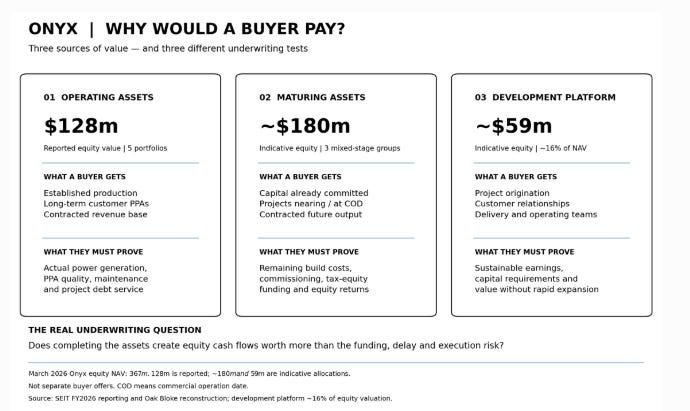
A buyer is not simply purchasing today’s cash generation. They are underwriting the possibility that construction-stage value becomes established operating value, and that the platform proves capable of turning capital into repeatable equity returns.
The separate long-hold sensitivity suggests that this £278m could potentially become £435m by September 2030 — a possible £157m uplift.
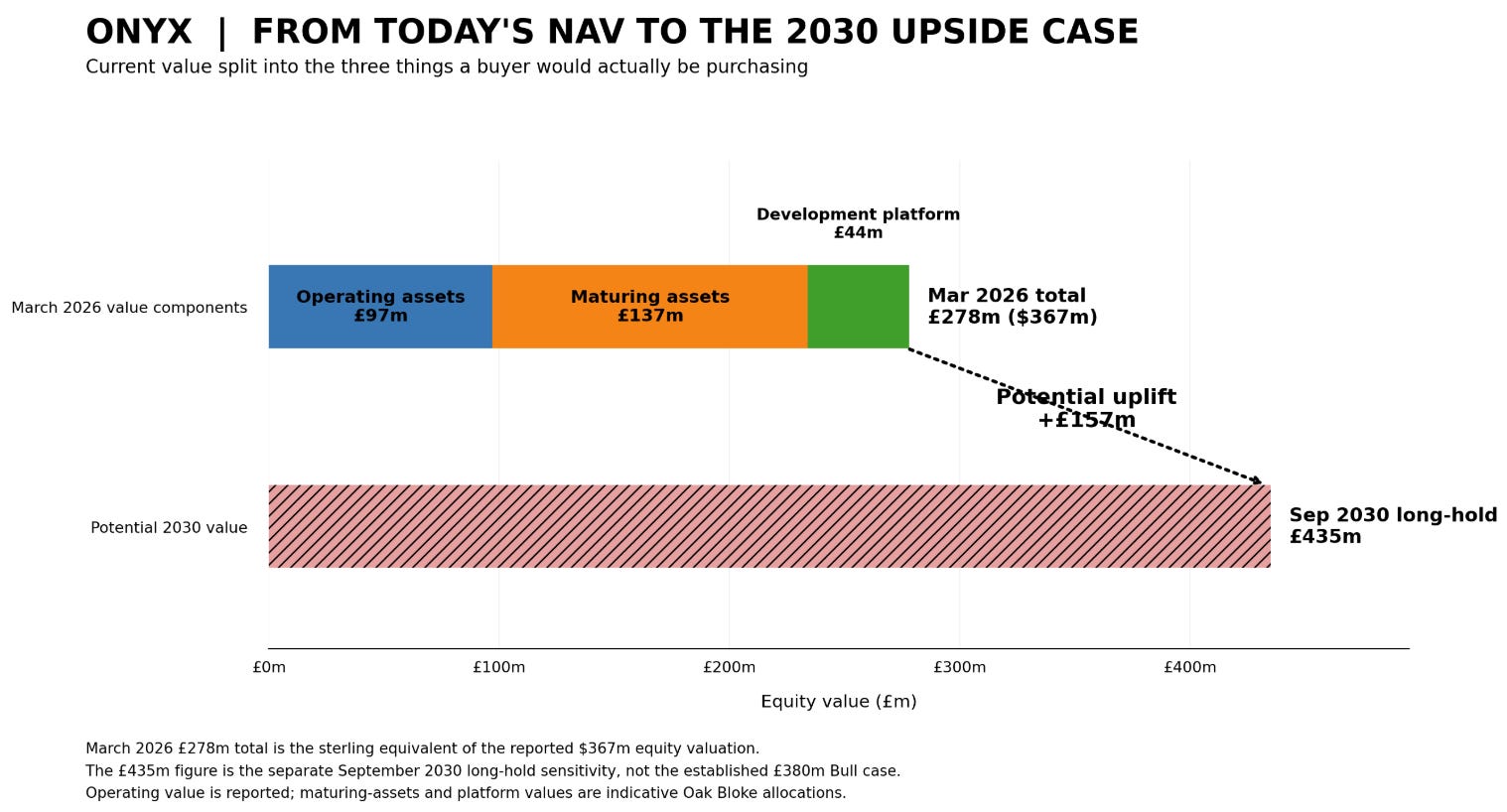
Success depends on successful commissioning, sensible financing, disciplined reinvestment and a purchaser willing to pay for the resulting maturity.
The real question isn’t whether Onyx has value today. It’s whether enough of that latent value can be turned into dependable cash flow before someone else buys it.
8. What does the market tell us?
In June 2025, SEIT abandoned Onyx’s formal disposal process after receiving offers that failed to meet acceptable terms.
We know buyers existed. But we don’t know their prices or conditions, so we cannot claim the market validated Onyx’s valuation of £278m NAV.
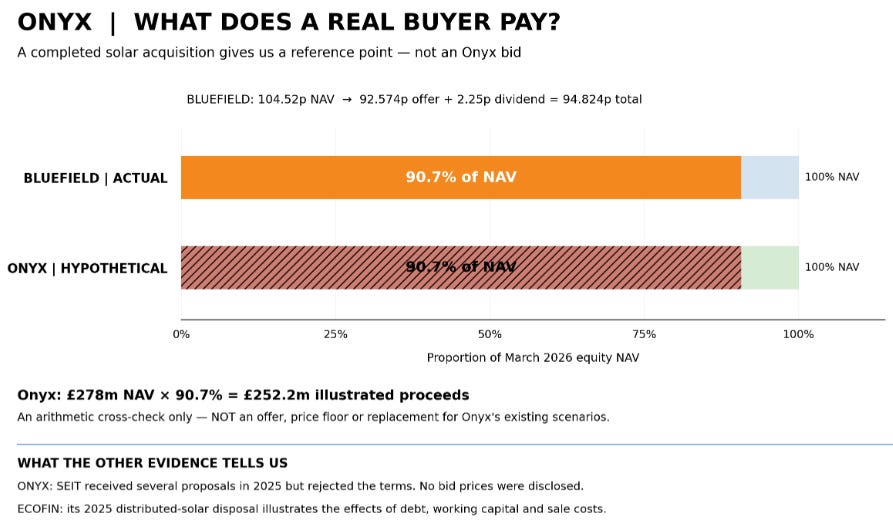
But a useful C&I comparison is Drax’s July 2026 acquisition of Bluefield Solar Income Fund for 94.82p per share, including a permitted dividend, against March 2026 NAV of 104.52p.
That’s approximately 90.7% of NAV. Apply that discount mechanically to Onyx and you get £252m.
8a. Bluefield Solar BSIF
Bluefield was predominantly UK solar C&I infrastructure albeit with a different portfolio composition, regulatory regime and capital structure. Nevertheless the transaction demonstrates that an institutional buyer was prepared to acquire a substantial renewable portfolio (with development rights) at something reasonably close to its reported NAV.
8b. The Ecofin Detractor “Proof”
Ecofin US Renewables Infrastructure Trust as invested in by certain foolish detractors who claimed they had lost lots of their money at Ecofin and that that “proved” Onyx would also lose money provides a less relevant comparison to Onyx.
That disposal of predominantly utility solar, not C&I solar, occurred during a distressed wind-down and 62 solar installations totalling 63.68MWdc and PPAs of only 16 years, illustrates how project debt, working-capital adjustments and transaction expenses certainly can affect the amount actually recovered. Onyx needs a buyer willing to value its particular combination of operating projects, construction assets and development capabilities.
9. The.O.B.
10. The detractor’s flagellation
Onyx has consumed approximately £440m of SEIT capital, delivered a reconstructed historical XIRR of −1.5%, and missed its 2025 EBITDA budget by 20%. Its previous sale process failed to produce acceptable offers.
And now the Oak Bloke wants shareholders to wait another four years?
The Detractor has three rather uncomfortable questions for the OB:
First, does commissioning actually create value? A completed solar installation isn’t necessarily a profitable one. Construction overruns, weak PPAs and expensive financing can consume the anticipated returns.
Second, where’s the money coming from? The £43m cash-generation forecast isn’t unrestricted spending money. Debt repayments, development commitments and financing covenants may absorb much of it.
Third, why believe the £435m valuation? It assumes 9.6% annual equity-value growth and additional development optionality. At 7% growth, the outcome falls to £394m. And SEIT has already written approximately £45m off its previous development expectations.
The Detractor’s strongest argument is that shareholders have already spent enough money waiting for Onyx to fulfil its potential.
The counter to that is that SEIT has already spent £440m. That’s sunk capital. The defence must be that waiting generates a better risk-adjusted shareholder return than selling today.
11. Conclusion — don’t sell the sunshine too cheaply
Onyx’s opportunity is to convert construction-stage investments into mature, cash-generating infrastructure.
My £318m Base and separate £435m September 2030 long-hold sensitivity demonstrate the potential value of waiting, provided execution and reinvestment returns justify it.
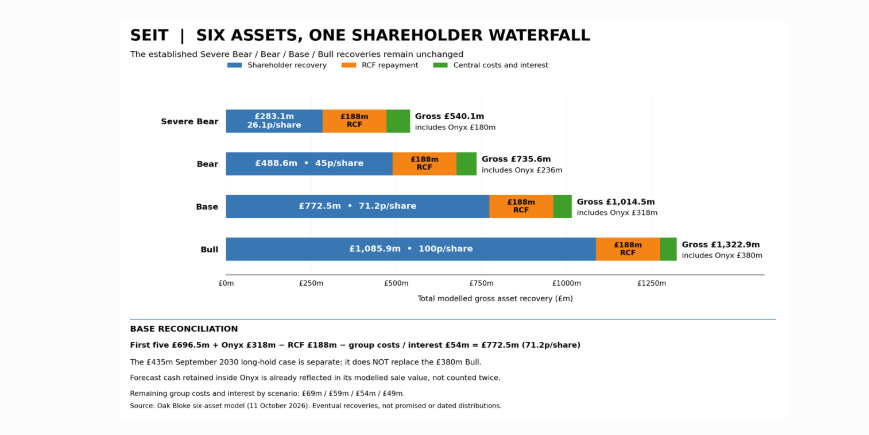
Across all six SEIT investments, my Base Case suggests £772.5m (71.2p/share) of eventual shareholder recovery, after the RCF and central costs.
Earlier disposals could give Onyx time to mature without a forced sale. But the £440m already invested is sunk capital. A credible offer in 2028 must be weighed against the additional risks and potential rewards of waiting.
Don’t sell the sunshine too cheaply. But don’t wait forever for the clouds to clear.
Regards
The Oak Bloke

Always DYOR
Leave a Reply